

CCNP and CCIE Security Core SCOR 350-701 Official Cert Guide (2020)
- Cisco Certified Network Professional
- 1635 pages
- Shared February 2025
- 67 downloads
CCNP and CCIE Security Core SCOR 350-701 Official Cert Guide (2020) is designed to make certification prep easy and effective.
Preview 31 of 1635 pages
See the first 31 pages exactly as they appear in the document.
Page 1 Page 2 Read page 2 as text
Downloaded from StudyXY.com [= Ww + StudyXY oi as . Za \ Rr ' BE \ Stu dy Anything This ContentHas been Posted On StudyXY.com as supplementary learning material. StudyXY does not endrose any university, college or publisher. Allmaterials posted are under the liability of the contributors. | 8) www.studyxy.com
Page 3 Page 4 Read page 4 as text
CCNP and CCIE Security Core SCOR 350-701 Official Cert Guide Omar Santos Hoboken, po oo USA
Page 5 Read page 5 as text
CCNP and CCIE Security Core SCOR 350-701 Official Cert Guide Omar Santos Copyright © 2020 Cisco Systems, Inc. Published by: Pearson 221 River St. Hoboken, NJ 07030 USA All rights reserved. This publication is protected by copyright, and permission must be obtained from the publisher prior to any prohibited reproduction, storage in a retrieval system, or transmission in any form or by any means, electronic, mechanical, photocopying, recording, or likewise. For information regarding permissions, request forms, and the appropriate contacts within the Pearson Education Global Rights & Permissions Department, please visit WWwWw.pearson.com/ permissions. No patent liability is assumed with respect to the use of the information contained herein. Although every precaution has been taken in the preparation of this book, the publisher and author assume no responsibility for errors or omissions. Nor is any liability assumed for
Page 6 Read page 6 as text
damages resulting from the use of the information contained herein. ScoutAutomatedPrintCode Library of Congress Control Number: 2020901233 ISBN-10: 0-13-597197-7 ISBN-13: 978-0-13-597197-0 Warning and Disclaimer This book is designed to provide information about the Implementing and Operating Cisco Security Core Technologies (SCOR 350-701) exam. Every effort has been made to make this book as complete and accurate as possible, but no warranty or fitness is implied. The information provided is on an “as is” basis. The author and the publisher shall have neither liability nor responsibility to any person or entity with respect to any loss or damages arising from the information contained in this book or from the use of the supplemental online content or programs accompanying it. Special Sales For information about buying this title in bulk quantities, or for special sales opportunities (which may include electronic versions; custom cover designs; and
Page 7 Read page 7 as text
content particular to your business, training goals, marketing focus, or branding interests), please contact our corporate sales department at corpsales@pearsoned.com or (800) 382-3419. For government sales inquiries, please contact governmentsales@pearsoned.com. For questions about sales outside the U.S., please contact international @pearsoned.com. Trademark Acknowledgments All terms mentioned in this book that are known to be trademarks or service marks have been appropriately capitalized. Pearson IT Certification cannot attest to the accuracy of this information. Use of a term in this book should not be regarded as affecting the validity of any trademark or service mark. Special Sales For information about buying this title in bulk quantities, or for special sales opportunities (which may include electronic versions; custom cover designs; and content particular to your business, training goals, marketing focus, or branding interests), please contact our corporate sales department at corpsales@pearsoned.com or (800) 382-3419.
Page 8 Read page 8 as text
For government sales inquiries, please contact governmentsales@pearsoned.com. For questions about sales outside the U.S., please contact intlcs@pearson.com. Feedback Information At Cisco Press, our goal is to create in-depth technical books of the highest quality and value. Each book is crafted with care and precision, undergoing rigorous development that involves the unique expertise of members from the professional technical community. Readers’ feedback is a natural continuation of this process. If you have any comments regarding how we could improve the quality of this book, or otherwise alter it to better suit your needs, you can contact us through email at feedback@ciscopress.com. Please make sure to include the book title and ISBN in your message. We greatly appreciate your assistance. Editor-in-Chief Mark Taub Alliances Manager, Cisco Press Arezou Gol
Page 9 Read page 9 as text
Director, Product Manager Brett Bartow Managing Editor Sandra Schroeder Development Editor Christopher A. Cleveland Project Editor Mandie Frank Copy Editor Bart Reed Technical Editor John Stuppi Editorial Assistant Cindy Teeters Designer Chuti Prasertsith Composition
Page 10 Read page 10 as text
codeMantra Indexer Proofreader
Page 11 Read page 11 as text
Credits This content is currently in development.
Page 12 Read page 12 as text
Contents at a Glance Introduction Chapter 1. Cybersecurity Fundamentals Chapter 2. Cryptography Chapter 3. Software-Defined Networking Security and Network Programmability Chapter 4. Authentication, Authorization, Accounting (AAA) and Identity Management Chapter 5. Network Visibility and Segmentation Chapter 6. Infrastructure Security Chapter 7. Cisco Next-Generation Firewalls and Cisco Next-Generation Intrusion Prevention Systems Chapter 8. Virtual Private Networks (VPNs) Chapter 9. Securing the Cloud Chapter 10. Content Security
Page 13 Read page 13 as text
Chapter 11. Endpoint Protection and Detection Chapter 12. Final Preparations Glossary of Key Terms Appendix A. Answers to the “Do I Know This Already?” Quizzes and Q&A Sections Appendix B. CCNP Security Core SCOR (350-701) Exam Updates Appendix C. (Website only) Study Planner
Page 14 Read page 14 as text
Contents Introduction The CCNP Security Certification The CCIE Security Certification The Exam Objectives (Domains) Steps to Pass the SCOR Exam Signing Up for the Exam Facts About the Exam About the CCNP and CCIE Security Core SCOR 350-701 Official Cert Guide The Companion Website for Online Content Review How to Access the Pearson Test Prep (PTP) App Customizing Your Exams Updating Your Exams Chapter 1. Cybersecurity Fundamentals “Do I Know This Already?” Quiz
Page 15 Read page 15 as text
Foundation Topics Introduction to Cybersecurity Cybersecurity vs. Information Security (InfoSec) The NIST Cybersecurity Framework Additional NIST Guidance and Documents The International Organization for Standardization (ISO) Defining What Are Threats, Vulnerabilities, and Exploits What Is a Threat? What Is a Vulnerability? What Is an Exploit? Risk, Assets, Threats, and Vulnerabilities Defining Threat Actors Understanding What Threat Intelligence Is Exploring Common Threats Viruses and Worms Trojans
Page 16 Read page 16 as text
Distributing Malware Ransomware Covert Communication Keyloggers Spyware Analyzing Malware Static Analysis Dynamic Analysis Common Software and Hardware Vulnerabilities Injection Vulnerabilities SQL Injection HTML Injection Command Injection Authentication-based Vulnerabilities Cross-site Scripting (XSS) Cross-site Request Forgery Cookie Manipulation Attacks Race Conditions Unprotected APIs
Page 17 Read page 17 as text
Return-to-LibC Attacks and Buffer Overflows OWASP Top 10 Security Vulnerabilities in Open Source Software Confidentiality, Integrity, and Availability What Is Confidentiality? What Is Integrity? What Is Availability? Talking About Availability, What Is a Denial-of-Service (DoS) Attack? Access Control Management Cloud Security Threats Cloud Computing Issues and Concerns Cloud Computing Attacks Cloud Computing Security IoT Security Threats IoT Protocols Hacking IoT Implementations An Introduction to Digital Forensics and Incident Response
Page 18 Read page 18 as text
ISO/IEC 27002:2013 and NIST Incident Response Guidance What Is an Incident? False Positives, False Negatives, True Positives, and True Negatives Incident Severity Levels How Are Incidents Reported? What Is an Incident Response Program? The Incident Response Plan The Incident Response Process Tabletop Exercises and Playbooks Information Sharing and Coordination Computer Security Incident Response Teams Product Security Incident Response Teams (PSIRTSs) The Common Vulnerability Scoring System (CVSS) National CSIRTs and Computer Emergency Response Teams (CERTS) Coordination Centers
Page 19 Read page 19 as text
Incident Response Providers and Managed Security Service Providers (MSSPs) Key Incident Management Personnel Summary Exam Preparation Tasks Review All Key Topics Define Key Terms Review Questions Chapter 2. Cryptography “Do I Know This Already?” Quiz Foundation Topics Introduction to Cryptography Ciphers Keys Block and Stream Ciphers Symmetric and Asymmetric Algorithms Hashes Hashed Message Authentication Code Digital Signatures
Page 20 Read page 20 as text
Key Management Next-Generation Encryption Protocols IPsec SSL and TLS Fundamentals of PKI Public and Private Key Pairs More About Keys and Digital Certificates Certificate Authorities Root Certificates Identity Certificates X.500 and X.509v3 Authenticating and Enrolling with the CA Public Key Cryptography Standards Simple Certificate Enrollment Protocol Revoking Digital Certificates Digital Certificates in Practice PKI Topologies Exam Preparation Tasks Review All Key Topics
Page 21 Read page 21 as text
Define Key Terms Review Questions Chapter 3. Software-Defined Networking Security and Network Programmability “Do I Know This Already?” Quiz Foundation Topics Introduction to Software-Defined Networking Traditional Networking Planes So What's Different with SDN? Introduction to the Cisco ACI Solution VXLAN and Network Overlays Micro-Segmentation Open Source Initiatives More About Network Function Virtualization NFV MANO Contiv Cisco Digital Network Architecture (DNA) Cisco DNA Policies
Page 22 Read page 22 as text
Cisco DNA Group-Based Access Control Policy Cisco DNA IP-Based Access Control Policy Cisco DNA Application Policies Cisco DNA Traffic Copy Policy Cisco DNA Center Assurance Solution Cisco DNA Center APIs Cisco DNA Security Solution Cisco DNA Multivendor Support Introduction to Network Programmability Modern Programming Languages and Tools DevNet Getting Started with APIs REST APIs Using Network Device APIs YANG Models NETCONF RESTCONF OpenConfig and gNMI
Page 23 Read page 23 as text
Exam Preparation Tasks Review All Key Topics Define Key Terms Review Questions Chapter 4. Authentication, Authorization, Accounting (AAA) and Identity Management “Do I Know This Already?” Quiz Foundation Topics Introduction to Authentication, Authorization, and Accounting The Principle of Least Privilege and Separation of Duties Authentication Authentication by Knowledge Authentication by Ownership or Possession Authentication by Characteristic Multifactor Authentication Duo Security Zero Trust and BeyondCorp Single Sign-On
Page 24 Read page 24 as text
Authorization Mandatory Access Control (MAC) Discretionary Access Control (DAC) Role-Based Access Control (RBAC) Rule-Based Access Control Attribute-Based Access Control Accounting Infrastructure Access Controls Access Control Mechanisms AAA Protocols RADIUS TACACS+ Diameter 802.1x Network Access Control List and Firewalling VLAN ACLs Security Group—Based ACL Downloadable ACL Cisco Identity Services Engine (ISE) Cisco Platform Exchange Grid (pxGrid)
Page 25 Read page 25 as text
Cisco ISE Context and Identity Services Cisco ISE Profiling Services Cisco ISE Identity Services Cisco ISE Authorization Rules Cisco TrustSec Posture Assessment Change of Authorization (CoA) Configuring TACACS+ Access Configuring RADIUS Authentication Configuring 802.1X Authentication Additional Cisco ISE Design Tips Advice on Sizing a Cisco ISE Distributed Deployment Exam Preparation Tasks Review All Key Topics Define Key Terms Review Questions Chapter 5. Network Visibility and Segmentation “Do I Know This Already?” Quiz Foundation Topics
Page 26 Read page 26 as text
Introduction to Network Visibility NetFlow The Network as a Sensor and as an Enforcer What Is a Flow? NetFlow for Network Security and Visibility NetFlow for Anomaly Detection and DDoS Attack Mitigation Data Leak Detection and Prevention Incident Response, Threat Hunting, and Network Security Forensics Traffic Engineering and Network Planning NetFlow Versions IP Flow Information Export (IPFIX) IPFIX Architecture Understanding IPFIX Mediators IPFIX Templates Option Templates Understanding the Stream Control Transmission Protocol (SCTP)
Page 27 Read page 27 as text
Exploring Application Visibility and Control and NetFlow Application Recognition Metrics Collection and Exporting NetFlow Deployment Scenarios NetFlow Deployment Scenario: User Access Layer NetFlow Deployment Scenario: Wireless LAN NetFlow Deployment Scenario: Internet Edge NetFlow Deployment Scenario: Data Center NetFlow Deployment Scenario: NetFlow in Site-to-Site and Remote VPNs Cisco Stealthwatch Stealthwatch Cloud On-Premises Monitoring with Cisco Stealthwatch Cloud Cisco Stealthwatch Cloud Integration with Meraki and Cisco Umbrella
Page 28 Read page 28 as text
Exploring the Cisco Stealthwatch On- Premises Appliances Threat Hunting with Cisco Stealthwatch Cisco Cognitive Threat Analytics (CTA) and Encrypted Traffic Analytics (ETA) What Is Cisco ETA? What Is Cisco Cognitive Threat Analytics? NetFlow Collection Considerations and Best Practices Determining the Flows per Second and Scalability Configuring NetFlow in Cisco IOS and Cisco I0S-XE Simultaneous Application Tracking Flexible NetFlow Records Flexible NetFlow Key Fields Flexible NetFlow Non-Key Fields NetFlow Predefined Records User-Defined Records Flow Monitors
Page 29 Read page 29 as text
Flow Exporters Flow Samplers Flexible NetFlow Configuration Configure a Flow Record Configure a Flow Monitor for IPv4 or IPv6 Configure a Flow Exporter for the Flow Monitor Apply a Flow Monitor to an Interface Flexible NetFlow IPFIX Export Format Configuring NetFlow in NX-OS Introduction to Network Segmentation Data-Driven Segmentation Application-Based Segmentation Micro-Segmentation with Cisco ACI Segmentation with Cisco ISE The Scalable Group Tag Exchange Protocol (SXP) SGT Assignment and Deployment Initially Deploying 802.1x and/or TrustSec in Monitor Mode
Page 30 Read page 30 as text
Active Policy Enforcement Cisco ISE TrustSec and Cisco ACI Integration Exam Preparation Tasks Review All Key Topics Define Key Terms Review Questions Chapter 6. Infrastructure Security “Do I Know This Already?” Quiz Foundation Topics Securing Layer 2 Technologies VLAN and Trunking Fundamentals What Is a VLAN? Trunking with 802.1Q Let’s Follow the Frame, Step by Step What Is the Native VLAN on a Trunk? So, What Do You Want to Be? (Asks the Port) Understanding Inter-VLAN Routing What Is the Challenge of Only Using Physical Interfaces?
Page 31 Read page 31 as text
Using Virtual “Sub” Interfaces Spanning Tree Fundamentals The Solution to the Layer 2 Loop STP Is Wary of New Ports Improving the Time Until Forwarding Common Layer 2 Threats and How to Mitigate Them Do Not Allow Negotiations Layer 2 Security Toolkit BPDU Guard Root Guard Port Security CDP and LLDP DHCP Snooping Dynamic ARP Inspection Network Foundation Protection The Importance of the Network Infrastructure The Network Foundation Protection Framework Interdependence
1604 more pages in the full document
Unlock it once and it stays in your library, ready to chat with or turn into flashcards.
Unlock the full documentMore Cisco Certified Network Professional study materials
See all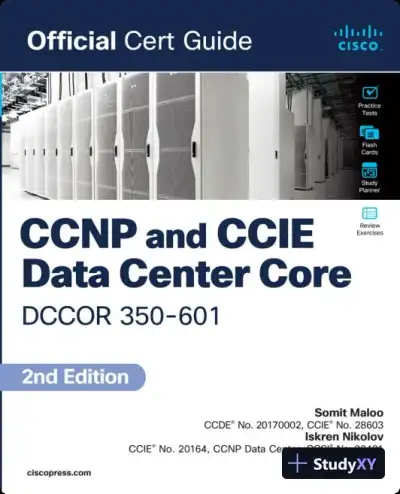 Certification Guides
CCNP and CCIE Data Center Core DCCOR 350-601 Official Cert Guide (2023)
Cisco Certified Network Professional
1111 pages161downloadsFeb 2025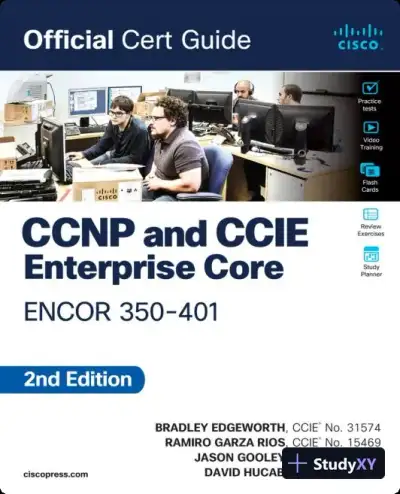 Certification Guides
CCNP and CCIE Enterprise Core ENCOR 350-401 Official Cert Guide (2023)
Cisco Certified Network Professional
1149 pages151downloadsFeb 2025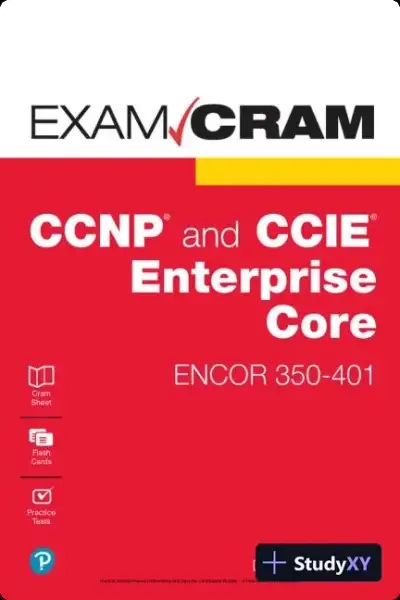 Certification Guides
CCNP and CCIE Enterprise Core ENCOR 350-401 Exam Cram (2022)
Cisco Certified Network Professional
798 pages130downloadsFeb 2025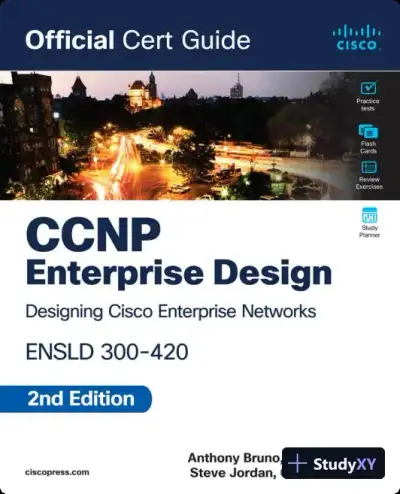 Certification Guides
CCNP Enterprise Design ENSLD 300-420 Official Cert Guide (2024)
Cisco Certified Network Professional
601 pages124downloadsFeb 2025 Certification Guides
CCNP and CCIE Enterprise Core ENCOR 350-401 Exam Cram (2022)
Cisco Certified Network Professional
827 pages110downloadsFeb 2025 Certification Guides
CCNP Enterprise Certification Study Guide (2020)
Cisco Certified Network Professional
679 pages108downloadsFeb 2025 Certification Guides
CCNP Enterprise Wireless Design ENWLSD 300-425 and Implementation ENWLSI 300-430 Official Cert Guide (2024)
Cisco Certified Network Professional
970 pages106downloadsFeb 2025 Certification Guides
CCNP and CCIE Data Center Core DCCOR 350-601 Official Cert Guide (2020)
Cisco Certified Network Professional
1260 pages102downloadsFeb 2025
Study this document with CramX
Once it is in your library, every tool can work from it.