
Solution Manual For Structural Wood Design: ASD/LRFD, 2nd Edition

Grasp textbook concepts quickly with Solution Manual For Structural Wood Design: ASD/LRFD, 2nd Edition, a well-organized learning guide.

Lily Green
Contributor
4.3
45
10 months ago
Preview (16 of 268 Pages)
100%
Log in to unlock

Page 1

Solution Manual For Structural Wood Design: ASD/LRFD, 2nd Edition - Page 1 preview image

Loading page ...

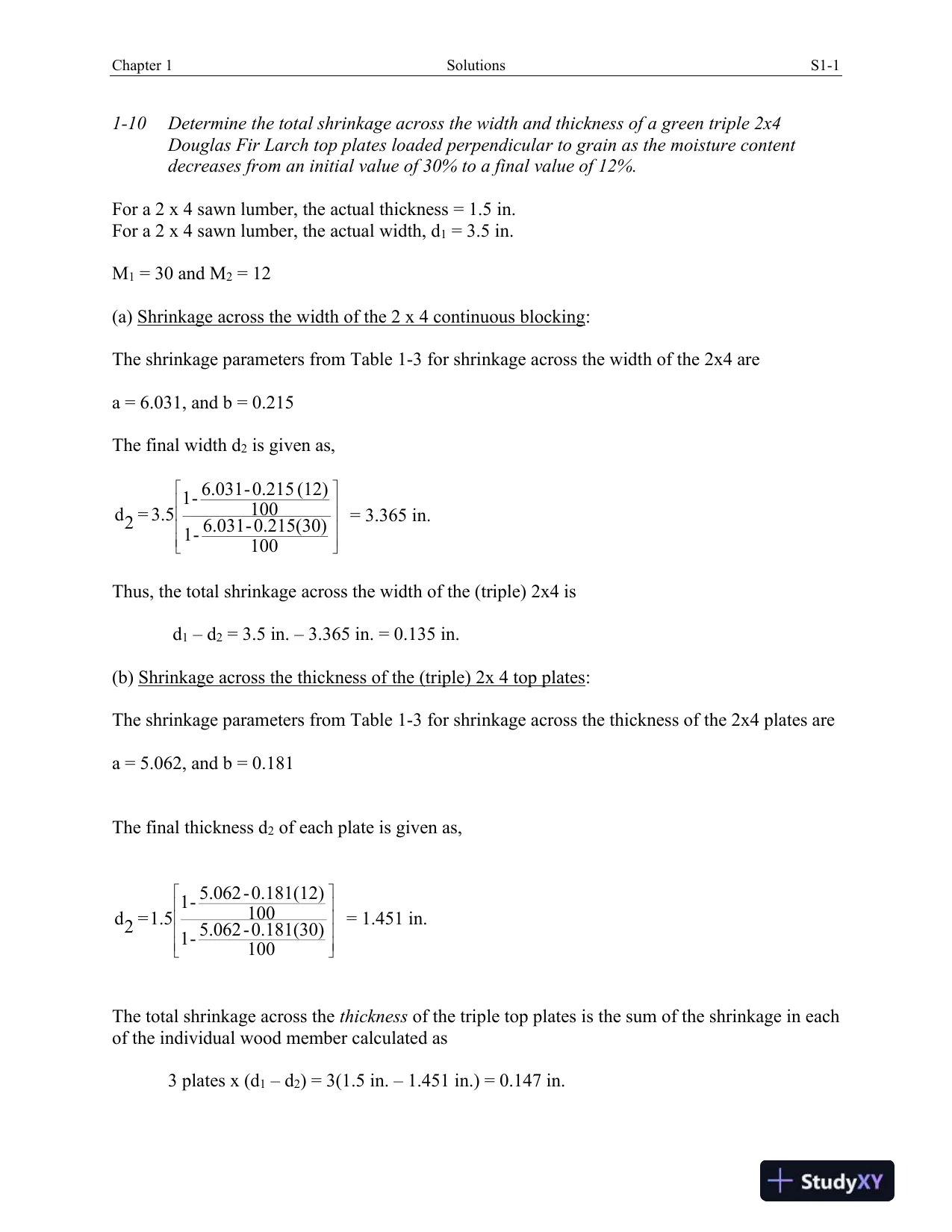
Chapter1SolutionsS1-11-10Determine the total shrinkage across the width and thickness of a green triple 2x4Douglas Fir Larch top plates loaded perpendicular to grain as themoisture contentdecreases from an initial value of 30% to a final value of 12%.For a 2 x 4 sawn lumber, the actual thickness = 1.5 in.For a 2 x 4 sawn lumber, the actual width, d1= 3.5 in.M1= 30 and M2= 12(a)Shrinkage across the width of the 2 x 4 continuous blocking:The shrinkage parameters from Table 1-3 for shrinkage across the width of the 2x4 area = 6.031, and b = 0.215The final width d2is given as,6.031- 0.215 (12)1-100d= 3.526.031- 0.215(30)1-100= 3.365 in.Thus, the total shrinkage across the width of the (triple) 2x4 isd1d2= 3.5 in.3.365 in. = 0.135 in.(b)Shrinkage across the thickness of the (triple) 2x 4 top plates:The shrinkage parameters from Table 1-3 for shrinkage across the thickness of the 2x4 plates area = 5.062, and b = 0.181The final thickness d2of each plate is given as,5.062 - 0.181(12)1-100d=1.525.062 - 0.181(30)1-100= 1.451 in.The total shrinkage across thethicknessof the triple top plates is the sum of the shrinkage in eachof the individual wood member calculated as3 plates x (d1d2) = 3(1.5 in.1.451 in.) = 0.147 in.

Page 2

Solution Manual For Structural Wood Design: ASD/LRFD, 2nd Edition - Page 2 preview image

Loading page ...

Page 3

Solution Manual For Structural Wood Design: ASD/LRFD, 2nd Edition - Page 3 preview image

Loading page ...

Chapter1SolutionsS1-21-11Determine the total shrinkage over the height of a 2-story building with the exterior wallcross-section shown below as the moisture content decreases from an initial value of25% to a final value of 12%.For a 2 x 6 sawn lumber, the actual thickness = 1.5 in.For a 2 x 12 sawn lumber, the actual width, d1= 11.25 in.M1= 25 and M2= 12(a)Shrinkage across the width of the 2 x 12header joist:The shrinkage parameters from Table 1-3 for shrinkage across the width of the 2x12 area = 6.031, and b = 0.215The final width d2is given as,6.031-0.215 (12)1-100d=11.2526.031-0.215(25)1-100= 10.93in.Thus, the total shrinkage across the width of the2-2x12header joistis2(d1d2)=2(11.25 in.10.93in.)= 0.64in.(b)Shrinkage across the thickness ofa2x 6 top plate:The shrinkage parameters from Table 1-3 for shrinkage across the thickness of the 2x6 plates area = 5.062, and b = 0.181The final thickness d2of each plate is given as,5.062 - 0.181(12)1-100d=1.525.062 - 0.181(25)1-100= 1.465in.In the section shown in Figure 1.24, there are a total of 7-2x6 top and sole or sill plates, and 22x12 header joists.The total shrinkageof the building cross-section will be the sum of theshrinkage across the thickness of the 2x6 top and sole/sill plates plus the shrinkage across thewidth of the 2x12 header joists. That is,

Page 4

Solution Manual For Structural Wood Design: ASD/LRFD, 2nd Edition - Page 4 preview image

Loading page ...

Chapter1SolutionsS1-37,2x6plates x (d1d2) =7(1.5 in.1.465in.) = 0.245in.The longitudinal shrinkage or shrinkage parallel to grain in the 2x6wallstuds is negligible.Therefore, the total shrinkageacross over the height of the two-story building, which is the sumof the shrinkage of all the wood members at the floor level, is0.245in. + 0.64in. =0.89in.1-12How many board feet (bf) are there in a 4 x 16 x 36 ft long wood member? How manyMbf are in this wood member? Determine how many pieces of this wood member wouldamount to 4.84 Mbf or 4840 bf?# of bf = 4x16x(36’x12)/144 = 192 bf= 192/1000 Mbf = 0.192 Mbf# of pieces = 4840 bf/192 bf = 25.2 or 25 pieces

Page 5

Solution Manual For Structural Wood Design: ASD/LRFD, 2nd Edition - Page 5 preview image

Loading page ...

Chapter 2SolutionsS2-12-1.Calculate the total uniformly distributed roof dead load in psf of horizontal plan area forasloped roof with the design parameters given below.2x8 rafters at 24” on centersAsphalt shingles on ½” plywood sheathing6” insulation (fiberglass)Suspended CeilingRoof slope: 6-in-12Mechanical & Electrical (i.e. ducts, plumbing etc) = 5 psfSolution:2x8 rafters at 24” on-centers= 1.2 psfAsphalt shingles(assume ¼” shingles)= 2.0 psf½” plywood sheathing = (4 x 0.4 psf/1/8” plywood) = 1.6 psf6” insulation(fiberglass) = 6 x 1.1 psf/in.=6.6 psfSuspended Ceiling= 2.0 psfMechanical & Electrical (i.e. ducts, plumbing etc)= 5.0psfTotal roof dead load, D (psf of slopedroofarea) = 18.4 psfThe total dead load in psf of horizontal plan area will be:DL226+12w= D12,psf of horizontal plan area()=18.4psf 1.118=20.6 psf of horizontal plan area2-2.Given the following design parameters for a sloped roof, calculate the uniform total loadand the maximum shear and moment on the rafter. Calculate the horizontal thrust on theexterior wall if rafters are used.Roof dead load, D= 20 psf (of sloped roof area)Roof snow load, S= 40 psf (of horizontal plan area)Horizontal projected length of rafter, L2=14 ftRoof slope: 4-in-12Rafter or Truss spacing = 4’ 0Solutions:Sloped length of rafter, L1=()224+121414.812=ftft

Page 6

Solution Manual For Structural Wood Design: ASD/LRFD, 2nd Edition - Page 6 preview image

Loading page ...

Chapter 2SolutionsS2-2Using the load combinations in section 2.1, the total load in psf of horizontal plan area will be:TLL1w= D L2+(Lror S or R),psf of horizontal plan area14.8'= 20 psf14'+40psf=61.1psfof horizontal plan areaThe total load in pounds per horizontal linear foot (Ib/ft) is given as,wTL(Ib/ft)=wTL(psf) xTributary width (TW) or Spacing of rafters=61.1psf (4 ft) =244.4lb/ft.h = (4/12) (14 ft) = 4.67 ftThe horizontal thrust H is,()2TL2LwL2H =h=()14'244.4 Ib/ft 14'24.67'=5129Ib.The collar or ceiling ties must be designed to resist this horizontal thrust.L2= 14The maximum shear force in the rafter is,2maxTLLV= w2=14'244.42=1711IbThe maximum moment in the rafter is,()2TL2maxwLM=8=()2244.4 14'8=5989ft-Ib =5.9ft-kip2-3.Determine the tributary widths and tributary areas of the joists, beams, girders andcolumns in the panelized roof framing plan shown below. Assuming a roof dead load of20 psf and an essentially flat roof with a roof slope of ¼” per foot for drainage,determine the following loads using the IBC load combinations. Neglect the rain load, Rand assume the snow load, S is zero:a.The uniform total load on the typical roof joist in Ib/ftb.The uniform total load on the typical roof girder in Ib/ftc.The total axial load on the typical interior column, in Ib.d.The total axial load on the typicalperimetercolumn, in Ib

Page 7

Solution Manual For Structural Wood Design: ASD/LRFD, 2nd Edition - Page 7 preview image

Loading page ...

Chapter 2SolutionsS2-3.Solution:The solution is presented in a tabular format as shown below:Tributary Widths and Tributary Areas of Joists, Beams and ColumnsStructural MemberTributary Width (TW)Tributary Area (TA)Purlin10'10'+=10'2210’ x20’ =200ft2Glulam girder20'20'+= 20'2220’ x60’ = 1200ft2Typical interiorColumn20'20'60'60'++=2222    1200ft2Typical perimeterColumn20'20'60'+=222    600 ft2Since the snow and rain load are both zero, the roof live load, Lrwill be critical.With a roof slope of ¼” per foot, the number of inches of rise per foot, F = ¼ = 0.25Purlin:The tributary width TW = 10 ft and the tributary area, TA = 200 ft2< 200 ft2From section 2.5.1, we obtain:R1= 1.0 and R2= 1.0,Using equation 2-4 gives the roof live load, Lr= 20 x 1 x 1 = 20 psfThe total loads are calculated as follows:wTL(psf) = (D + Lr) = 20 + 20 = 40 psfwTL(Ib/ft) = wTL(psf) x tributary width (TW) = 40 psf x 10 ft = 400 Ib/ftGlulam Girder:The tributary width, TW = 20 ft and the tributary Area, TA = 1200 ft2Thus,TA > 600, and from section 2.4, we obtain:R1= 0.6, andR2= 1.0Using equation 2-4 gives the roof live load, Lr= 20 x 0.6 x 1 = 12 psfThe total loads are calculated as follows:wTL(psf) = (D + Lr) = 20 + 12 = 32 psfwTL(Ib/ft) = wTL(psf) x tributary width (TW) = 32 psf x 20 ft = 640 Ib/ftTypical InteriorColumn:

Page 8

Solution Manual For Structural Wood Design: ASD/LRFD, 2nd Edition - Page 8 preview image

Loading page ...

Chapter 2SolutionsS2-4The tributary tributary area of the typical interior column, TA = 1200 ft2Thus,TA > 600, and from section 2.4, we obtain:R1= 0.6, andR2= 1.0Using equation 2-4 gives the roof live load, Lr= 20 x 0.6 x 1 = 12 psfThe total loads are calculated as follows:wTL(psf) = (D + Lr) = 20 + 12 = 32 psfThe Column Axial Load, P = 32 psf x1200 ft2=38,400 Ib =38.4kipsTypical Perimeter Column:The tributary tributary area of the typical perimeter column, TA = 600 ft2Thus, from section 2.5.1, we obtain:R1= 0.6, andR2= 1.0Using equation 2-4 gives the roof live load, Lr= 20 x 0.6 x 1 = 12 psfThe total loads are calculated as follows:wTL(psf) = (D + Lr) = 20 + 12 = 32 psfThe Column Axial Load, P = 32 psf x 600 ft2= 19, 200 Ib = 19.2 kips2-4.A building has sloped roof rafters (5:12 slope) spaced at 2’ 0” on centers and is locatedin Hartford, Connecticut. The roof dead load is 22 psf of sloped area. Assume a fullyexposed roof with terrain category “C”, and use the ground snow load from the IBC orASCE 7 snow map(a) Calculate the total uniform load in lb/ft on a horizontal plane using the IBC.(b) Calculate the maximum shear and moment in the roof rafter.Solution:The roof slope,for this building is 22.6,Roof Live Load, Lr:From Section 2.4, the roof slope factor is obtained as,F = 5R2= 1.20.05 (5) = 0.95Assume thetributary area (TA) of the rafter < 200 ft2,R1= 1.0The roof live load will be,Lr= 20R1R2= 20(1.0)(0.95) = 19psf

Page 9

Solution Manual For Structural Wood Design: ASD/LRFD, 2nd Edition - Page 9 preview image

Loading page ...

Chapter 2SolutionsS2-5Snow Load:Using IBC Figure 1608.2 or ASCE 7 Figure 7-1, the ground snow load, PgforHartford,Connecticut is 30psf.Assuming a building with a warm roof and fully exposed, and a building site with terraincategory “C”, we obtain the coefficients as follows:Exposure coefficient, Ce= 0.9 (ASCE 7 Table 7-2)The thermal factor, Ct= 1.0 (ASCE 7 Table 7-3)The Importance Factor, I = 1.0 ASCE Table 7-4The slope factor, Cs= 1.0 (ASCE Figure 7-2 with roof slope,= 22.6and a warm roof)The flat roof snow load,Pf= 0.7 CeCtI Pg= 0.7 x 0.9 x 1.0 x 1.0 x30=18.9psfMinimum flat roof snow load, Pm = 20Is= 20 (1.0) = 20 psf (governs)Thus, the design roof snow load,Ps= CsPf= 1.0 x20=20psfTherefore, thesnow load, S =20psfThe total load in psf of horizontal plan area is given as,TLL1w= D L2+(Lror S or R),psf of horizontal plan areaSince the roof live load, Lr(18 psf) issmallerthat the snow load, S (20psf), thesnowload ismore critical and will be used in calculating the total roof load.TLw225+12= 22 psf12+20psf=43.83psfof horizontal plan areaThe total load in pounds per horizontal linear foot (Ib/ft) is given as,wTL(Ib/ft)=wTL(psf) xTributary width (TW) or Spacing of rafters=43.83psf (2ft) =87.7lb/ft.AssumeL2= 14The maximum moment in the rafter is,()2TL2maxwLM=8=()287.7 14'8=2149ft-Ib =2.15ft-kip

Page 10

Solution Manual For Structural Wood Design: ASD/LRFD, 2nd Edition - Page 10 preview image

Loading page ...

Chapter 2SolutionsS2-62-5.A 3-story building has columns spaced at 18 ft in both orthogonal directions, and issubjected to the roof and floor loads shown below. Using a column load summation table,calculate the cumulative axial loads on a typical interior column with and without liveload reduction. Assume a roof slope of ¼” per foot for drainage.Roof Loads:Dead Load, Droof= 20 psfSnow Load, S= 40 psf2ndand 3rdFloor Loads:Dead Load, Dfloor= 40 psfFloor Live Load, L = 50 psfSolution:At each level, the tributary area (TA) supportedby a typical interior column is18’ x 18’ =324ft2Roof Live Load, Lr:From section 2.4, the roof slope factor is obtained as,F = ¼ = 0.25R2= 1.0Since the tributary area (TA) of the column =324ft2,R1= 1.20.001 (324) = 0.88The roof live load will be,Lr= 20R1R2= 20(0.88)(1.0) = 17.6 psf < Snow load, S = 40psfThe governing load combination from Section 2.1.1 for calculating the column axial loads is D +L + (Lror S or R). Since the snow load is greater than the roof live load, the critical loadcombination reduces to D + L + S.The reduced or design floor live load for the 2nd and 3rd floors are calculated using the tablebelow:Reduced or Design Floor Live Load Calculation TableMemberLevelssupportedAT(summationof floortributaryarea)KLLUnreducedFloor liveload, Lo(psf)Live LoadReductionFactor0.25 +15/(KLLAT)Designfloor liveload, L

Page 11

Solution Manual For Structural Wood Design: ASD/LRFD, 2nd Edition - Page 11 preview image

Loading page ...

Chapter 2SolutionsS2-73rdfloorColumn(i.e.columnbelow roof)Roof onlyFloor liveloadreductionNOTapplicable toroofs!!!---40psf(Snowload)2ndfloorcolumn(i.e.columnbelow 3rdfloor)1 floor +roof1 floor x324ft2=324ft24KLLAT=1296>400 ft2Live Loadreductionallowed50 psf0.25 +15/(4 x324) =0.670.67 x 50=33.5psf≥ 0.50 Lo= 25psfGround or1stfloorcolumn(i.e.columnbelow 2ndfloor)2 floors +roof2 floors x 324ft2=648ft24KLLAT=2592>400 ft2Live Loadreductionallowed50 psf0.25 +15/(4 x648) =0.540.54 x 50=27psf≥ 0.40 Lo=20psfThe column axial loads with and without floor live load reduction are calculated using thecolumn load summation tables below:

Page 12

Solution Manual For Structural Wood Design: ASD/LRFD, 2nd Edition - Page 12 preview image

Loading page ...

Chapter 2SolutionsS2-8Column Load SummationTableLevelTributary area,(TA)(ft2)DeadLoad,D(psf)LiveLoad,Lo(SorLrorRonthe roof)(psf)DesignLive LoadRoof:SorLrorRFloor:L(psf)Unfactoredtotal load ateach level,ws1Roof:DFloor:D+L(psf)Unfactoredtotal load ateachlevel,ws2Roof:D+0.75SFloor:D+0.75L(psf)Unfactored ColumnAxialLoad ateach level,P =(TA)(ws1)or(TA)(ws2)(kips)CumulativeUnfactoredAxial Load,PD+L(kips)CumulativeUnfactoredAxialLoad,PD+0.75L+0.75S(kips)MaximumCumulativeUnfactoredAxialLoad,P(kips)With Floor Live Load ReductionRoof32420404020506.5or16.26.516.216.23rdFlr324405033.573.565.123.8or21.130.337.337.32ndFlr3244050276760.321.7or19.55256.856.8Without Floor Live Load ReductionRoof32420404020506.5or16.26.516.216.2Thirdfloor3244050509077.529.2or25.135.741.341.3Second floor3244050509077.529.2 or25.164.966.466.4

Page 13

Solution Manual For Structural Wood Design: ASD/LRFD, 2nd Edition - Page 13 preview image

Loading page ...

Chapter 2SolutionsS2-92-6.A 2-story wood framed structure 36 ft x 75 ft in plan is shown below with the followinggiven information. The floor to floor height is 10 ft and the truss bearing (or roof datum)elevation is at 20 ft and the truss ridge is 28 ft 4” above the ground floor level. Thebuilding is “enclosed” and located in Rochester, New York on a site with a category “C”exposure. Assuming the following additional design parameters, calculate:Floor Dead Load =30 psfRoof Dead Load =20 psfExterior Walls =10 psfSnow Load (Pf) =40 psfSite Class =DImportance (Ie)=1.0SS=0.25%S1=0.07%R =6.5(a)The total horizontal wind force on the main wind force resisting system (MWFRS) inboth the transverse and longitudinal directions.(b)The gross vertical wind uplift pressures and the net vertical wind uplift pressures onthe roof (MWFRS) in both the transverse and longitudinal directions.(c)The seismic base shear, V, in kips(d)The lateral seismic load at each level in kipsSolution:(a) Lateral WindRoof Slope: Run = 18’, Rise = 8’-4”,= 25Assuming a Category II buildingV =115mph (ASCE 7 Table 26.5-1A)Wind Pressures (from ASCE 7, Figure28.6-1):Transverse(= 25):HorizontalVerticalZone A:26.3psfZone E:-11.7psfZone B:4.2psfZone F:-15.9psfZone C:19.1psfZone G:-8.5psfZone D:4.3psfZone H:-12.8 psf

Page 14

Solution Manual For Structural Wood Design: ASD/LRFD, 2nd Edition - Page 14 preview image

Loading page ...

Chapter 2SolutionsS2-10Longitudinal: (= 0):HorizontalVerticalZone A:21psfZone E:-25.2psfZone B: N/AZone F:-14.3psfZone C:13.9psfZone G:-17.5psfZone D: N/AZone H:-11.1psfEnd Zone width:a:0.1 x least horizontal dimension of building0.4 x mean roof height of the building and0.04 x least horizontal dimension of building3 feeta0.1 (36’) = 3.6’ (governs)+2'33.28'20)4.0(= 9.67’0.04 (36’) = 1.44’3 feetTherefore the Edge Zone = 2a = 2 (3.6’) = 7.2’Average horizontal pressures:Transverse:+=)widthbldg()pressurezoneerior)(intzoneendwidthbldg()pressurezoneend)(zoneend(qavg(7.2')(26.3)(75'7.2')(19.1)()(75')avgpsfpsfqwall+==19.8psf (Zones A, C)(7.2')(4.2)(75'7.2')(4.3)()(75')avgpsfpsfqroof+==4.3psf (Zones B, D)

Page 15

Solution Manual For Structural Wood Design: ASD/LRFD, 2nd Edition - Page 15 preview image

Loading page ...

Chapter 2SolutionsS2-11Longitudinal:(7.2')(21)(36'7.2')(13.9)()(36')avgpsfpsfqwall+==15.32psf (Zones A, C)Design wind pressures:Height and exposure coefficient:Mean roof height =+2'33.28'20= 24.2’= 1.35 (ASCE 7 Figure28.6-1, Exposure = C,h25’)Transverse wind:P = qavgPwall= (19.8psf)(1.35) =26.73psfProof= (4.3psf)(1.35) = 5.81psfLongitudinal wind:Pwall= (15.32psf)(1.35) =20.7psfTotal Wind Force:Transverse wind:(26.73)(10' 10')(5.81)(8.33') (75')TPpsfpsf=++=43.7 kips(base shear,transverse)Longitudinal wind:8.33'20 '(20.7)(36 ')2TPpsf=+=18.0 kips(base shear, longitudinal)

Page 16

Solution Manual For Structural Wood Design: ASD/LRFD, 2nd Edition - Page 16 preview image

Loading page ...

Chapter 2SolutionsS2-12(b) Wind UpliftAverage vertical pressures:P =qavgFrom Part (a), base uplift pressures:Transverse:Longitudinal:Zone E:-11.7 psfZone E:-25.2psfZone F:-15.9 psfZone F:-14.3psfZone G:-8.5 psfZone G:-17.5psfZone H:-12.8 psfZone H:-11.1psfTransverse:,36'36'( 11.715.9)(7.2')( 8.512.8)(75'7.2')(1.35)22u avgPpsfpsfpsfpsf=+ −=-39,922lb.,39,922(75')(36')u avglbq==-14.8psf(gross uplift, transverse)Longitudinal:,75'75'( 25.214.3)(7.2')( 17.511.1)(36'7.2')(1.35)22u avgPpsfpsfpsfpsf=+ −=-56,097lb.,56, 097(75')(36')u avglbq==-20.8psf(gross uplift, longitudinal)Netfactoreduplift (Longitudinal controls):qnet= 0.9D+W=(0.9)(20psf)+(-20.8psf) =-2.8psf(net uplift)
Preview Mode

This document has 268 pages. Sign in to access the full document!