

Solution Manual For Traffic And Highway Engineering, 5th Edition
- Civil Engineering
- 392 pages
- Shared May 2025
Master your textbook problems with Solution Manual For Traffic And Highway Engineering, 5th Edition, providing comprehensive solutions and explanations.
Preview 16 of 392 pages
See the first 16 pages exactly as they appear in the document.
Page 1 Read page 1 as text
Solutions Manual to Accompany TRAFFIC & HIGHWAY ENGINEERING, 5 TH EDITION NICHOLAS J. GARBER LESTER A. HOEL Prepared By Rod Turochy
Page 2 Page 3 Read page 3 as text
C ONTENTS Chapter Page 1. T HE P ROFESSION OF T RANSPORTATION ............................................................................................... 1 2. T RANSPORTATION S YSTEMS AND O RGANIZATIONS .............................................................................. 13 3. C HARACTERISTICS OF THE D RIVER , THE P EDESTRIAN , THE V EHICLE AND THE R OAD .................................. 29 4. T RAFFIC E NGINEERING S TUDIES ....................................................................................................... 45 5. H IGHWAY S AFETY .......................................................................................................................... 61 6. F UNDAMENTAL P RINCIPLES OF T RAFFIC F LOW .................................................................................... 77 7. I NTERSECTION D ESIGN ................................................................................................................ 103 8. I NTERSECTION C ONTROL .............................................................................................................. 117 9. C APACITY AND L EVEL OF S ERVICE FOR H IGHWAY S EGMENTS ............................................................. 143 10. C APACITY AND L EVEL OF S ERVICE AT S IGNALIZED I NTERSECTIONS .................................................... 169 11. T HE T RANSPORTATION P LANNING P ROCESS ................................................................................. 177 12. F ORECASTING T RAVEL D EMAND ................................................................................................. 191 13. E VALUATING T RANSPORTATION A LTERNATIVES .............................................................................. 241 14. H IGHWAY S URVEYS AND L OCATION ............................................................................................. 265 15. G EOMETRIC D ESIGN OF H IGHWAY F ACILITIES ................................................................................ 275 16. H IGHWAY D RAINAGE ................................................................................................................. 295 17. S OIL E NGINEERING FOR H IGHWAY D ESIGN ................................................................................... 311 18. B ITUMINOUS M ATERIALS ........................................................................................................... 329 19. D ESIGN OF F LEXIBLE P AVEMENTS ............................................................................................... 347 20. D ESIGN OF R IGID P AVEMENTS .................................................................................................... 365 21. P AVEMENT M ANAGEMENT ......................................................................................................... 383
Page 4 Read page 4 as text
1 Chapter 1 The Profession of Transportation 1-1 To illustrate the importance of transportation in our national life, identify a transportation-related article that appears in a local or national newspaper. Discuss the issue involved and explain why the article is newsworthy. In 2012, many areas in New York City were devastated by Hurricane Sandy. An article was published on December 2, 2012 in The New York Times to illustrate the importance of transportation on society, especially facing an emergency. Transit officials said that normal train services to the Rockaways were not going to resume for several months. People still needed to go to places, especially in a city like New York, where car ownership is relatively low and many people depend on transit. The article describes the solution found for the transit agency to reduce the impacts of Hurricane Sandy in daily activities of the population of the Rockaways; a special line, the shuttle line H, started running through a stretch of the devastated area, making stops at a limited number of stations. This is an example of an article in a major newspaper that mainly keeps the population informed of their options for transportation after an emergency. In this case, this article also was important to show population in general a sign of progress after a tragedy; the article shows the effort of the transit agency to keep society’s daily activities as normal as possible after the hurricane. 1-2 Arrange an interview with a transportation professional in your city or state (that is, someone working for a consulting firm, city, county or state transportation department, transit or rail agency). Inquire about the job he or she performs, why he or she entered the profession and what he or she sees as the future challenges in the field. Background: Bachelor of Science degree in Civil Engineering. During undergraduate study, worked part-time for the Traffic Engineering Division of the Department of Public Works. Earned a Master of Science in Civil Engineering degree with a major in transportation. Currently employed by a consulting firm, conducting research in multimodal and intermodal transportation systems. Envisions the transportation industry becoming cohesive in that modes will connect with one another at strategic points to allow for the seamless transfer of people and goods. Note: This is a brief transcript of an interview with a transportation professional.
Page 5 Read page 5 as text
Chapter 1: The Profession of Transportation 2 1-3 Keep a diary of all trips you make for a period of three to five days. Record the purpose of the trip, how you traveled, the approximate distance traveled and the trip time. What conclusions can you draw from the data? The table shown on the next page provides a list of all trips made by a student during a five-day period. The following conclusions can be reached about the student’s travel behavior. • 24 trips were made (an average a 5.4 trips per day) • 8 trips by bus • 9 trips by car • 7 trips by walking • 248 minutes were spent traveling (an average of 49.6 minutes per day) • 77 minutes of travel by bus (31% of total travel time) • 90 minutes of travel by car (36% of total travel time) • 81 minutes of travel by walking (33% of total travel time) • About an equal amount of time was spent riding buses, walking, and driving a car.
Page 6 Read page 6 as text
Chapter 1: The Profession of Transportation 3 Date Mode Purpose Time (minutes) Friday, Jan. 22 Bus Home to class 10 Walk Class to class 7 Bus Class to fraternity house 10 Walk Fraternity house to class 15 Bus Class to home 10 Car Home to store and back 10 Car Home to fraternity house and 10 Saturday, Jan 23 Car Home to store and back 10 Car To store, library, and home 20 Car To library and back 10 Sunday, Jan 24 Car To library and back 10 Car To sister's place and back 5 Monday, Jan 25 Bus Home to Class 10 Walk Class to Class 7 Walk Class halfway home 7 Bus Rest of way to fraternity house 7 Bus Fraternity house to class 10 Walk Class to home 15 Tuesday, Jan 26 Bus Home to class 10 Walk Class to fraternity house 15 Walk Fraternity house to class 15 Bus Class to home 10 Car Home to fraternity house and 10 Car Home to gym and back 5 TOTAL 248
Page 7 Read page 7 as text
Chapter 1: The Profession of Transportation 4 1-4 Identify one significant transportation event that occurred in your city or state. Discuss the significance of this event. An important event in transportation in Charlottesville, Virginia occurred in 1970, when the University of Virginia began its own bus service. The significance of this event is that the bus service, in a sense, enlarged the University. That is, students could reside off grounds and still be able to commute to classes. This opened the door to develop student housing projects off grounds. In addition, the University now could add new facilities further from central grounds and still have them accessible to students. 1-5 Describe how transportation influenced the initial settlement and subsequent development of your home city or state. Norfolk, Virginia was one of the early settlements in this state due to its proximity to water and near the Jamestown Settlement. Its transportation evolution began mainly as water transportation due to its accessibility to the Elizabeth River. Downtown Norfolk grew around the river, which became a harbor for the cities of Norfolk and Portsmouth, Virginia. As Norfolk's population grew, there became a need for more living area and people began to settle further away from the harbor area. As a result of this migration, horse drawn vehicles became the choice mode when people traveled to and from the river. Eventually the mode of transportation that originated Norfolk and Portsmouth, water, became its main industry for employment. The Norfolk Naval Shipyard, located in Portsmouth, is a major employer for the area which services and repairs ships used for the transportation of military goods and service personnel. 1-6 Describe your state’s transportation infrastructure. Include both passenger and freight transportation. Virginia's transportation infrastructure is vast. The highway system, as of 2011, according to data from the Federal Highway Administration, includes 74,461 miles of public roads. Of these 74,461 miles, 58,272 miles are state- maintained, with the remainder maintained by cities, towns, and counties. Virginia's rail network, excluding yards and sidings, totals 3,399 miles. In addition, two of the nation's largest railroads, the CSX Corporation and the Norfolk Southern Corporation, are headquartered within the state. Intercity rail passenger service is provided by AMTRAK, which operates eight trains with scheduled stops in Virginia. Rapid rail transit is provided by Metrorail to commuters in the Virginia suburbs of Washington, D.C.
Page 8 Read page 8 as text
Chapter 1: The Profession of Transportation 5 Commuter rail service is provided by the Virginia Rail Express (VRE), which operates from Fredericksburg and Manassas to Washington, D.C. Virginia is also served by 9 airports with commercial service to over 600 worldwide destinations. Another 66 airports are licensed for public use, and the majority of these can accommodate multi-engine aircraft. Virginia also has one of the finest natural ports in the world as well as three inland ports. The port of Hampton Roads is served by an ice-free 50-ft. deepwater channel capable of handling large volumes of cargo. Virginia also maintains the Virginia Inland Port, located in Front Royal, which serves the Ohio Valley and beyond. Note: These data are available from the Internet site of FHWA’s Office of Highway Policy Information at “http://www.fhwa.dot.gov”, The Virginia Department of Rail and Public Transportation at “http://www.drpt.virginia.gov”, and at Virginia Department of Aviation “http://www.doav.virginia.gov”. 1-7 What is the total number of miles of public roadways in your state? What percentage of the highway system mileage is maintained by the state government (as opposed to local and federal government)? What percentage of the total public highway system in your state is comprised of Interstate highways? Virginia’s total number of miles of public roadways was 74,461 miles in 2011. There were 58,272 state-maintained miles of highways in 2011, which represented 78.258% of the highway system. Also, there were 1,120 miles of Interstate highways in Virginia, which represented 1.504% of the total public highway system. Note: These data are available from the Internet site of FHWA’s Office of Highway Policy Information at “http://www.fhwa.dot.gov/policyinformation/statistics/2011/hm20.cfm ” 1-8 Estimate the number of personal motor vehicles in your city or state. What is the total number of miles driven each year? How much revenue is raised per vehicle per year for each 1 cent/gallon tax? Assume that the average vehicle achieves 25 miles per gallon in fuel economy. In Virginia, as of 2011, there were 6,998,385 registered motor vehicles. An estimated 80,974,000,000 vehicle-miles were traveled. Assume the average vehicle has a gasoline consumption rate of 25 miles per gallon (mpg). Thus the total amount of gasoline (T G ) consumed in one year is: T G = (miles driven/year)/(mpg) T G = (80,974,000,000)/25 T G = 3,238,960,000 gallons
Page 9 Read page 9 as text
Chapter 1: The Profession of Transportation 6 The total revenue (T R ) raised by the 1 cent/gallon tax would be: T R = ($0.01/gallon) × T G T R = 0.01 × 3,238,960,000 T R = $32,389,600 1-9 How many railroad trains pass through your city each week? What percentage of these are passenger trains? In Charlottesville, Virginia, an average of 63 freight trains pass through the city weekly (14 of these stop while 49 pass through). 20 Amtrak trains pass through weekly. Percentage passenger trains = (20/(20 + 63)) × 100 = 24% 1-10 Compare the extent of the U.S. railroad system of today with that of 100 years ago. What changes have occurred and what factors have led to these changes? Today, the U.S. active railroad track consists of approximately 140,000 rail miles operated by seven Class I railroads, 21 regional railroads, and 510 local railroads. 100 years ago, approximately 260,000 miles of railroad track were active. The "Golden Age" of the railroad system was from 1850s to 1920s, when it was the faster, cheaper, and more adaptable means of long-distance transportation. After World War II, a decline of passengers could be observed, as traffic dropped significantly. Automobile and airplane were emerging as competitive means of transportation for passengers while trucks were high speed, free vehicles available to move goods. In 1956, highway construction entered a new era with the authorization of a 42,500 mile National Interstate Highway System by President Eisenhower. This authorization changed the way people lived and traveled and further reduced the role of rail transportation. In addition to that, the railroad system faced a relevant adversity during the 1960s and 1970s when several companies were either purchased by stronger ones or went bankrupt. Also, a decline of passengers began in the 1950s until deregulation in 1980, as a result of severe sanctions and regulation by the Interstate Commerce Commission (ICC).
Page 10 Read page 10 as text
Chapter 1: The Profession of Transportation 7 1-11 What proportion of American household expenditures is associated with transportation, and what is the breakdown of these expenditures by category (such as ownership, fuel, maintenance, etc.)? Estimate the proportion of your monthly budget that is spent on transportation. The annual average American household expenditures are $49,705, which represents $4,142.03 per month; $8,294 are annual expenditures related to Transportation, which represents $691.17 per month. Therefore, Transportation represents approximately 16.7% of total expenditures for an average American household. The breakdown of Transportation expenditures by category is: CATEGORY ANNUAL AVERAGE SPENDING (dollars) PERCENTAGE OF TOTAL EXPENDITURES Vehicle purchases $2,669 5.4% Gasoline and motor oil $2,655 5.3% Other expenses (finance charges, maintenance and repairs, insurance, rental, leases) $2,454 4.9% Public transportation $516 1.1% TOTAL $8294 16.7% Note: These data are available from the Internet site of the United States Department of Labor “http://www.bls.gov/cex/#tables”. Data from 2011. A possible monthly budget of a college student is: CATEGORY AVERAGE SPENDING (dollars) PERCENTAGE Housing (rent and utilities) $525 47.5% Food $350 31.7% Clothing and miscellaneous $130 11.8% Transportation (gas, parking, bus, repairs, etc...) $100 9.0% TOTAL $1105 100% Approximately 9 percent of the monthly budget is dedicated to transportation.
Page 11 Read page 11 as text
Chapter 1: The Profession of Transportation 8 1-12 Identify an ITS project or application that is underway in your home state. Describe the project, its purpose, and the way it is operated. The Virginia Department of Transportation is implementing a traffic management system in the Richmond region. This system includes the installation on Interstates 64, 95, and 295, of permanent changeable message signs installed prior to major interchanges, video detection equipment at critical congestion locations, and highway advisory radio throughout the region. This system is intended to monitor traffic and ultimately ease congestion associated with major reconstruction projects on the region’s Interstate highways. The Richmond Smart Traffic Center is located adjacent to an interchange on Interstate 95 and houses the control and communications systems for the traffic management system. 1-13 Most Departments of Transportation incorporate at least five major transportation engineering subspecialties within their organization. List and briefly indicate at least three tasks falling under each specialty. Most state departments of transportation have at least five major transportation engineering sub-classes. Five of these subspecialties in the Virginia Department of Transportation are the planning division, location and design division, maintenance division, traffic engineering division, and a construction division. The planning division is primarily concerned developing long-range transportation plans. This is accomplished by first defining transportation needs, gathering and analyzing data, and then evaluating alternatives. The location and design division is primarily concerned with designing the transportation system. Usually with the design of highways, this division is responsible for the selection of dimensions for all geometric features, which include the longitudinal profiles, vertical curves and elevations, and right-of-way. The maintenance division is responsible for maintaining the transportation system to ensure it is in proper working order. This includes repairing damaged roadway sections and the scheduling of maintenance operations. The traffic engineering division is responsible for the integration of the vehicles, drivers, and pedestrians into the transportation system in a manner that improves the safety and capacity of streets and highways. This includes analyzing traffic accidents, design of parking areas, and the design of roadway traffic signing plans. The construction division is another subspecialty. This division is responsible for the building of the facilities designed by the location and design division. The primary tasks of this division include the development of contracts for highway construction, inspection of highway construction projects as performed by contractors, and publishing of manuals such as road and bridge specifications.
Page 12 Read page 12 as text
Chapter 1: The Profession of Transportation 9 1-14 List four major detrimental effects that are directly related to the construction and use of our highway transportation system. There are many benefits that have come from the highway system; however, these benefits have not come without significant costs. The most obvious cost is that of safety, highway accidents claim approximately 40,000 lives each year. The transportation system also creates air, water, and even noise pollution. It also spoils and changes forever the natural beauty of an area, and consumes vast quantities of precious energy resources. 1-15 Cite four statistics that demonstrate the importance of transportation in the United States. The following statistics illustrate the importance of the transportation sector in the U.S. • 8.7 % of the United States’ Gross Domestic Product (GDP) is accounted for expenses related to transportation. (2009 data) • Approximately 5% of the U.S. workforce is employed by transportation industries. (2010 data) • Of all the petroleum used in the U.S., 73.5% is for transportation. (2008 data) • Expenditures on transportation totaled $1.22 trillion. (2009 data) Note: These data are available from the Internet site of Census“http://www.census.gov”. 1-16 A state has a population of 17 million people and an average ownership of 1.1 cars per person, each driven an average of 12,000 mi/year, at an average fuel economy of 24 mi/gal of gasoline (mpg). Officials estimate that an additional $60 million per year in revenue will be required to improve the state’s highway system, and they have proposed an increase in the gasoline tax to meet this need. Determine the required tax in cents per gallon. First, determine the number of vehicles in the state. 17,000,000 people × 1.1 cars/person = 18,700,000 vehicles in this state. Next, determine the number of miles driven each year. 18,700,000 cars × 12,000 miles/year/car = 2.244 × 10 11 miles driven per year Now determine the number of gallons consumed each year. (2.244 × 10 11 miles/year)/24 mpg = 9,350,000,000 gallons/year
Page 13 Read page 13 as text
Chapter 1: The Profession of Transportation 10 Finally, determine the required tax increase. (9.35 × 10 9 gallons / year) × TAXINCREASE = $60,000,000 / year TAXINCREASE = $0.00642/gallon TAXINCREASE = 0.642 cents per gallon Therefore, impose a 0.7 cents per gallon tax to raise the required revenue. 1-17 Select a single event in Table 1-1 and explain why this is a significant achievement in the history of transportation. In my opinion, the completion of the first transcontinental railroad in 1869 was the most significant transportation event in U.S. history. This is because the completion of the railroad meant that goods and people could now be transported with relative ease to the western part of the country. This also meant that the development of the west would become more intense. The completion of the railroad spawned the development of the remainder of the U.S., which facilitated trade on both coasts. 1-18 Name and describe the first successful turnpike effort in the newly independent United States of America. The Philadelphia and Lancaster Turnpike Road Company was chartered by Pennsylvania in 1791 to build road between the two cities. This serves as an early example of a profitable toll road and a roadway with specified design standards. 1-19 What mode of transportation was the primary contributor to the demise of road construction in the U.S. in the early 19 th century, and what advantages did the new mode offer? Canals became popular in the early 19 th century through large projects such as the Erie Canal and several smaller efforts. Recent improvements in waterway transportation, such as the successful demonstration of the steamboat in 1807, generated interest in use waterways. Waterways provided advantages over the roadways in their level profiles and relative ease of effort in moving freight when compared with roadways.
Page 14 Read page 14 as text
Chapter 1: The Profession of Transportation 11 1-20 What mode of transportation succeeded the mode noted in Problem 1-19, and what advantages did it offer? Canals were succeeded by railways as the primary mode of long-distance travel. Railroads first appeared in the U.S. around 1830. By 1840, the mileage of railways was approximately equal that of canals. Railroads continued flourish while investment in canals declined. Locations for railroads were not confined to watercourses and therefore could be built almost anywhere. 1-21 What was the interest of the U.S government in supporting expansion of railroads in the mid-19 th century, and how did the government provide support? There was a growing demand for rail connections between towns, villages, lakes, and seaports. Railroads were indispensable to the development of a national market in the United States. To encourage railroad expansion westward, the federal government provided land grants to railroads totaling over 40 million acres. 1-22 The expectations the public has for the transportation system continue to increase. What is the principal challenge faced by the transportation engineer in meeting these expectations? What fields of knowledge beyond traditional transportation engineering are needed? The public increasingly expects an efficient, effective, long-lasting, and safe transportation system. This challenge requires a knowledge base beyond traditional transportation engineering, including an understanding of human factors, system performance, and technological advances.
Page 15 Page 16 Read page 16 as text
13 Chapter 2 Transportation Systems and Organizations 2-1 How would your typical day be changed without availability of your principal mode of transportation? Consider both personal transportation as well as goods and services that you rely on. A typical day in my life would be significantly different without the airplane. Although I do not use this mode daily, goods and services that I do purchase are transported via this mode. Other modes, such as trucking, trains, and the automobile, could serve as replacements to the airplane; however, the airplane significantly lowers the transit time for shipping goods. For example, I mail a letter to California. Typical transit time for this letter using the airplane is three days. By using another mode other than the airplane, the transit time for the same letter would probably exceed seven days. As for my personal transportation, long distance travel is accomplished by using the airplane. For example, I take a vacation to Europe. If I travel using a cruise ship, it would take me in excess of seven days to reach Europe. However, if I fly, I can arrive in Europe within nine hours. Having the ability to transport people and goods quickly allows the international trade market to prosper, which in turn provides me with goods in a timely and efficient manner. 2-2 What are the most central problems in your state concerning one of the following: (a) air transportation, (b) railroads, (c) water transportation, (d) highways, or (e) public transportation. (To answer this question, obtain a copy of the governor’s plan for transportation in your state or contact a key official in the transportation department.) (a) A problem in Virginia concerning air transportation is the high cost associated with short haul flights from airports such as Richmond and Norfolk to connection hubs for major airlines. Another problem is that our air transportation system is aging while the demand continues to increase; our air transportation system is approaching capacity and requiring substantial capital investment to provide modern terminals, increase the number of gates and available parking.
376 more pages in the full document
Unlock it once and it stays in your library, ready to chat with or turn into flashcards.
Unlock the full documentMore Civil Engineering study materials
See all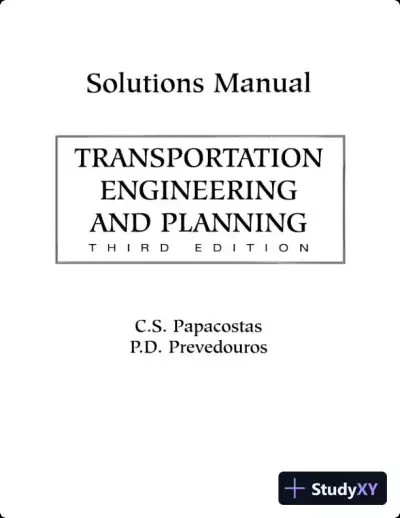 Textbook Guides
Solution Manual for Transportation Engineering and Planning, 3rd Edition
Civil Engineering
78 pages92downloadsFeb 2025 Textbook Guides
Reinforced Concrete Design, 9th Edition Solution Manual
Civil Engineering
198 pages65downloadsFeb 2025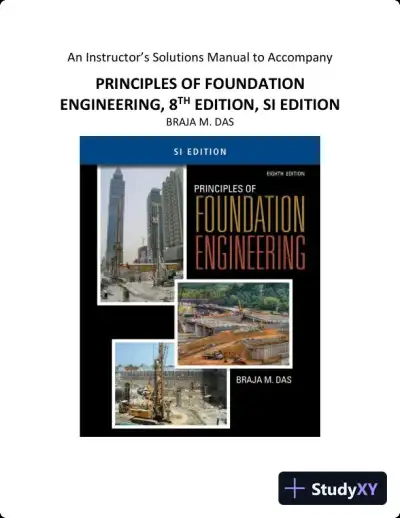 Exam Guides
Principles Of Foundation Engineering, 8th Edition Test Bank
Civil Engineering
166 pages49downloadsFeb 2025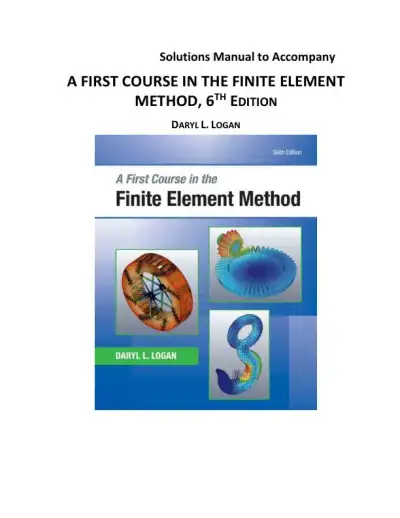 Textbook Guides
Solution Manual for A First Course in the Finite Element Method, 6th Edition
Civil Engineering
644 pagesMay 2025 Past Exams
The CE Shop Construction Final Exam With Answers (100 Solved Questions)
Civil Engineering
55 pagesMay 2025 Textbook Guides
Solution Manual for Structural Steel Design, 6th Edition
Civil Engineering
511 pagesMay 2025 Textbook Guides
Solution Manual For Structural Wood Design: ASD/LRFD, 2nd Edition
Civil Engineering
268 pagesMay 2025 Textbook Guides
Solution Manual For Structural Analysis, 8th Edition
Civil Engineering
558 pagesMay 2025
Study this document with CramX
Once it is in your library, every tool can work from it.