
4th, 5th, 6th, 8th, 14th Amendments American InterContinental University

An assignment analyzing key amendments and their impact on civil rights.

Aiden Campbell
Contributor
5.0
31
10 months ago
Preview (4 of 10 Pages)
100%
Log in to unlock

Page 1

4th, 5th, 6th, 8th, 14th Amendments American InterContinental University - Page 1 preview image

Loading page ...

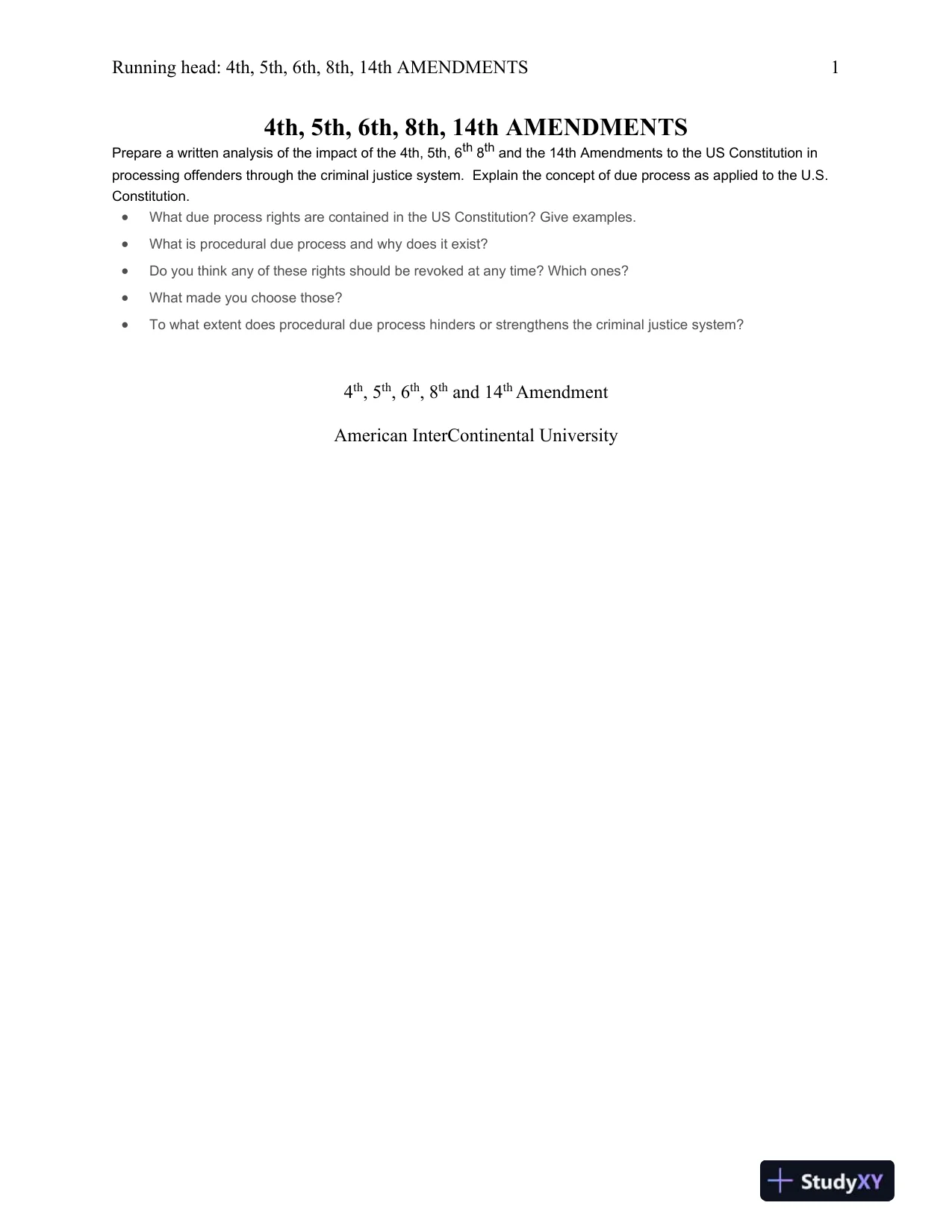
Running head: 4th, 5th, 6th, 8th, 14th AMENDMENTS14th, 5th, 6th, 8th, 14th AMENDMENTSPrepare a written analysis of the impact of the 4th, 5th, 6th8thand the 14th Amendments to the US Constitution inprocessing offenders through the criminal justice system.Explain the concept of due process asapplied to the U.S.Constitution.What due process rights are contained in the US Constitution? Give examples.What is procedural due process and why does it exist?Do you think any of theserights should be revoked at any time? Which ones?What madeyou choose those?To what extent does procedural due process hinders or strengthens the criminal justice system?4th, 5th, 6th,8thand 14thAmendmentAmerican InterContinental University

Page 2

4th, 5th, 6th, 8th, 14th Amendments American InterContinental University - Page 2 preview image

Loading page ...

Page 3

4th, 5th, 6th, 8th, 14th Amendments American InterContinental University - Page 3 preview image

Loading page ...

U. S. Amendments24th, 5th, 6th, 8th and 14th AmendmentIntroductionThe intent of this paper istoanalysisthe impact of 4th, 5th, 6th, 8th, and the 14thAmendments tothe United States Constitutionin processing offenders through the criminaljustice system” (AIU, 2015, para 1).The author Gasiawill be explaining and providing examplesof thedue process rights that are contained in the U.S. Constitution(AIU, 2015, para2).Gasiawill be addressing theprocedural due process” (AIU, 2015, para 3)and why they exist, and whythese rights should be revoked at any time” (AIU, 2015, para 4). Furthermore,Gasiawill beexplaining whyshemade those choices(AIU, 2015), andto what extent of procedural dueprocess that hinders or strengthens the criminal justice system” (AIU, 2015, para 6).Definitions of Due Process andAmendments of the United States ConstitutionDue Process-a fundamental principle of fairness in all licit is consequential, both civiland malefactor, especially in the courts. All licit procedures set by statute and courtpractice, including notice of rights, must be followed for each individual so that noprejudicial or unequal treatment will result. While marginally indefinite, the term can begauged by its aim to safeguard both private and public rights against inequitableness, ascited in Due Process. (2014),and Klotter & Kanovitz (2002).4th Amendment of the United States ConstitutionThe right of the people to be securein their persons, houses, papers and effects, against unreasonable searches and seizures,shall not be violated, and no Warrants shall issue, but upon probable cause, supported byOath or affirmation, and particularly describing the place to be searched, and the personsor things to be seized, as cited in Klotter & Kanovitz (2002).

Page 4

4th, 5th, 6th, 8th, 14th Amendments American InterContinental University - Page 4 preview image

Loading page ...

U. S. Amendments35th Amendment of the United States ConstitutionNo person shall be to answer for acapital, or otherwise infamous crime, unless on a presentment or indictment of a GrandJury, except in cases arising in the land or naval forces in the Militia, when in actualservice in time of War or public danger; nor shall any be subject for the same offence tobe twice put in jeopardy of life or limb; nor shall be compelled in any criminal case to bea witness against himself, nor be deprived of life, liberty, or property, without dueprocess of law; nor shall private property be taken for public use, without justcompensation, as cited in Klotter & Kanovitz (2002).6th Amendment of the United States ConstitutionIn all criminal prosecutions, theaccused shall enjoy the right to a speedy and public trial, by an impartial jury of the Stateand district wherein the crime shall have been committed, which district shall have beenpreviously ascertained by law, and to be informed of the nature and cause of the4accusation; to be confronted with the witnesses against him; to have compulsory processfor obtaining witnesses in his favor, and to have the Assistance of Counsel for hisdefense, as cited in Klotter & Kanovitz (2002).8th Amendment of the United States ConstitutionExcessive bail shall not be required,nor excessive fines imposed, nor cruel and unusual punishments inflicted, as cited inKlotter & Kanovitz (2002).14th Amendment of the United States Constitution-Section 1. All persons born ornaturalized in the United States, and subject to the jurisdiction thereof, are citizens of theUnited States and of the State wherein they reside. No State shall made or enforce anylaw which shall abridge the privileges or immunities of citizens of the United States; norshall any State deprive any person of life, liberty, or property, without due process of law;
Preview Mode

This document has 10 pages. Sign in to access the full document!