
CramX Logo
FTCE: ESE Law Practice Exam With Answers (297 Solved Questions) - Document preview page 1

FTCE: ESE Law Practice Exam With Answers (297 Solved Questions) - Page 1

Document preview content for FTCE: ESE Law Practice Exam With Answers (297 Solved Questions)

FTCE: ESE Law Practice Exam With Answers (297 Solved Questions)

FTCE: ESE Law Practice Exam With Answers enhances your preparation by familiarizing you with exam question styles.

Abigail Bennett
Contributor
4.4
0
12 months ago
Preview (10 of 32 Pages)
100%
Log in to unlock
Page 1 of 10
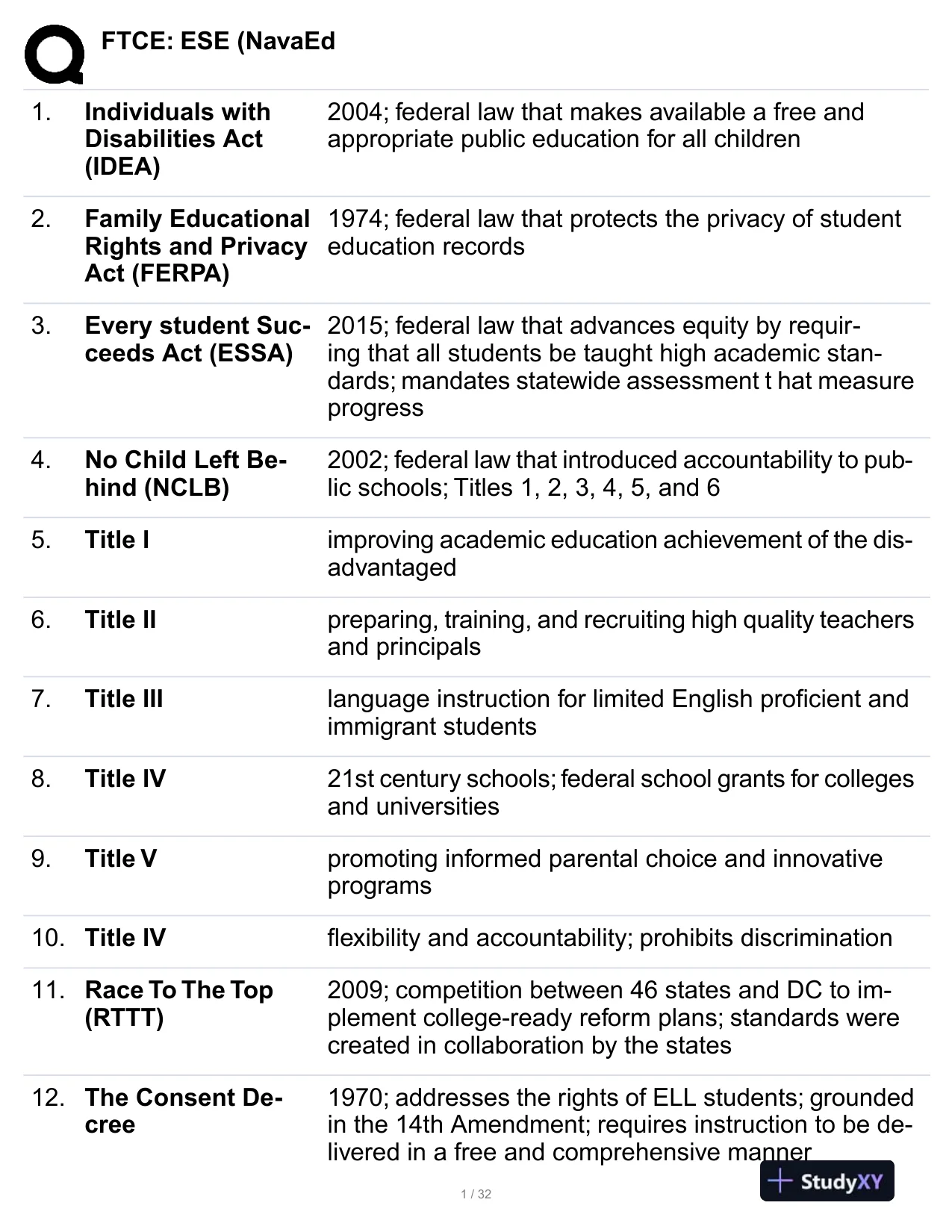
FTCE: ESE Law Practice Exam With Answers (297 Solved Questions) - Page 1 preview imageFTCE: ESE (NavaEd1.Individuals withDisabilities Act(IDEA)2004; federal law that makes available a free andappropriate public education for all children2.Family EducationalRights and PrivacyAct (FERPA)1974; federal law that protects the privacy of studenteducation records3.Every student Suc-ceeds Act (ESSA)2015; federal law that advances equity by requir-ing that all students be taught high academic stan-dards; mandates statewide assessment t hat measureprogress4.No Child Left Be-hind (NCLB)2002; federal law that introduced accountability to pub-lic schools; Titles 1, 2, 3, 4, 5, and 65.Title Iimproving academic education achievement of the dis-advantaged6.Title IIpreparing, training, and recruiting high quality teachersand principals7.Title IIIlanguage instruction for limited English proficient andimmigrant students8.Title IV21st century schools; federal school grants for collegesand universities9.Title Vpromoting informed parental choice and innovativeprograms10.Title IVflexibility and accountability; prohibits discrimination11.Race To The Top(RTTT)2009; competition between 46 states and DC to im-plement college-ready reform plans; standards werecreated in collaboration by the states12.The Consent De-cree1970; addresses the rights of ELL students; groundedin the 14th Amendment; requires instruction to be de-livered in a free and comprehensive manner1 / 32
Page 2 of 10
FTCE: ESE Law Practice Exam With Answers (297 Solved Questions) - Page 2 preview image
Page 3 of 10
FTCE: ESE Law Practice Exam With Answers (297 Solved Questions) - Page 3 preview image13.Section 504 of theRehabilitation Act1973; requires school districts to provide a free appro-priate education (FAPE) to each qualified student witha disability14.Americans with Dis-abilities Act1990; civil rights law that prohibits discriminationbased on disability; provides similar protections as theCivil Rights Act of 196415.autism SpectrumDisorder (ASD)developmental disability affecting verbal/nonverbalcommunication and social interaction which tends tohave an impact on educational performance; classifiedas OHI16.deaf orhard-of-hearingsevere impairment that impedes the processing oflinguistic information through hearing without amplifi-cation; may have adverse effects on a student's edu-cational performance17.developmentallydelayed (DD)student who is delayed in one or more of the followingareas:adaptive or self-help developmentcognitive developmentcommunication developmentsocial/emotional developmentphysical/motor development18.dual-sensory im-paired (DSI)simultaneous hearing and visual impairment thatcauses severe communication, acquisition of commu-nication, acquisition of information, and functionalitywithin the environment deficits19.emotion or be-havioral disabilities(EBD)one or more of the following characteristics over aperiod of time to the extent that it adversely affectseducational performanceunexplained inability to learninability to maintain interpersonal relationshipsinappropriate types of behaviors or feelingsprevalent unhappiness or depression2 / 32
Page 4 of 10
FTCE: ESE Law Practice Exam With Answers (297 Solved Questions) - Page 4 preview image20.homebound or hos-pitalized (HH)restriction of activities over a period of time basedupon medical diagnosis or psychiatric condition; con-fines student to home or hospital21.intellectual disabili-ties (InD)significant subaverage general intellectual functioningand deficits in adaptive behavior manifested duringbirth through age 1922.other health impair-ment (OHI)having limited strength, vitality or alertness during aheightened alertness to environmental stimuli; resultsin limited alertness to the educational environment anddue to chronic health problemsthese include:asthmaADDADHDdiabetesepilepsyheart conditionhemophilialead poisoningleukemiaASDrheumatic feverTourette syndromesickle cell anemia23.orthopedic impair-ment (OI)severe skeletal, muscular, or neuromuscular impair-ment resulting from congenital anomalies and impair-ments from other causes24.traumatic brain dis-order (TBI)injury to the brain caused by external force; causesimpairment in one or more of the followingcognitionlanguagememoryattentionreasoningabstract thinkingjudgement3 / 32
Page 5 of 10
FTCE: ESE Law Practice Exam With Answers (297 Solved Questions) - Page 5 preview imageproblem-solvingsensory deficitsperceptual deficitspsychosocial behaviordecreased physical functionslack of information processingspeech deficits25.specific learningdisabilities (SLD)disorder in one or more basic psychological processesbrain injuryperceptual disabilitiesminimal brain dysfunctiondyslexiadevelopmental aphasia26.speech impairment(SI)disorder of speech sounds, fluency, or voice that inter-fere with communication which may include stuttering,impaired articulation, or voice impairment27.language impair-ment (LI)dis orders of language that interfere with communica-tion and one or more of the basic learning processesinvolved in spoken languages28.visually impaired(VI)includes students who are blind, have low vision, no vi-sion, visual impairment after best correction; studentsdiagnosed with a progressive condition that will resultin visual impairment or no vision after best correction29.Piaget's stages ofcognitive develop-menttheory that states that cognitive development is a reor-ganization of mental processes resulting from biologi-cal maturation and natural eperience30.stages of Piaget'stheory of cognitivedevelopment1. sensorimotor (0-2) object permanence, separationanxiety2. pre-operational (2-6) identify use of symbols for ob-jects, do not have the ability to apply logical reasoning3. concrete operational (7-12) logical reasoning aboutconcrete objects, conservation, reversibility, serial or-dering, understanding cause and effect, thinking islimited to concrete4 / 32
Page 6 of 10
FTCE: ESE Law Practice Exam With Answers (297 Solved Questions) - Page 6 preview image4. formal operational (12-adult) abstract thinking, logic,deductive reasoning, comparison, classification31.atypical child devel-opmentabnormal development of a child; due to conditions ofa physical, neurological, learning, language, or behav-ior impairment; these conditionas impact day-to-dayfunctioning and usually last a lifetime32.principles of lawsgoverning ESEas determined byFDOEparent and student participationappropriate evaluationIEPFAPELREprocedural safeguards33.parent and studentparticipation2012; mandated by FDOE; a team of people conductan individual evaluation on a student's educationalstrengths and weaknesses34.individualized edu-cational plan (IEP)written agreement outlining services the school willprovide to help the ESE student meet educationalneeds35.free appropriatepublic education(FAPE)every student receiving ESE services has the right toa free and appropriate education; 3-21 years36.least restrictive en-vironment (LRE)children with disabilities have the right to receive theireducation in the school and classroom they wouldattend if they were not disabled; students that requireESE services should only leave the classroom for thatpurpose37.procedural safe-guardsschool and district staff must follow certain steps tomake sure ESE and related services meet the uniqueneeds of each public-school student with a disability38.IEP teamthe team that decides which special services andsupports that a student needs to make progress and5 / 32
Page 7 of 10
FTCE: ESE Law Practice Exam With Answers (297 Solved Questions) - Page 7 preview imageachieve annual goals; the individuals that make up theteam are called stakeholders; child study team39.IEP stakeholders(members of IEPteam)parentsgeneral education teacherspecial education teacherguidance counseloradministratorany other relevant partiesstudent (if possible)40.IEP goalsthe IEP team must work together to devise these forthe individual ESE student; must be long-term andshort-term; must be measurable41.SMART method forcreating goalsSpecificMeasurableAchievableRelevantTimely42.accommodationchanges how the student learns; material remains thesame as non-disabled peers in the classroom43.examples of accom-modationsfrequent breaksassistive technologypreferential seatingextra time for assignments and testsinstructional strategiespeer supportcurricular adaptationscollaborative teaching44.review and revisionof IEPmust occur every 12 months; method of measurementand progress must be measured; IEP must be revisedas needed; a new IEP may be created if necessary45.transition IEPused for students age 16 or older; the purpose is tohelp the student transition into life after high school6 / 32
Page 8 of 10
FTCE: ESE Law Practice Exam With Answers (297 Solved Questions) - Page 8 preview image46.reevaluation IEPthe school must reevaluate ESE students every threeyears; the determination will be made about whetherthe student should continue to receive services47.waivers for stu-dents with disabili-tiesallows disabled students to opt out of participating instatewide standardized assessments48.external supportaccommodations, supplementary aids, and servicesof support that are deemed to be required based oncollaboration between the general education and spe-cial education teachers; the IEP serves as the refer-ence for all necessary supports49.in-class supportco-teachersupport facilitatorpeers50.co-teacherformal commitment between a general educationteacher and an ESE teacher to jointly plan, deliver,and assess instructions for all students in a generaleducation classroom51.support facilitatoran individual who provides a variety of supports tostudents and/or to the general educationi teacher thatmeets the needs identified through collaborative plan-ning; this may include paraprofessionals, OT thera-pists, PT therapists, speech therapists52.peersstudents in the general education classroom that arematched with ESE students to assist with classroom,physical and social needs and may provide instruction-al tutoring53.specialized supportprovides focused support to students who require sup-port to address one or more objectives in a setting oth-er than the general education classroom for a periodof time during the school day; the support is the resultof individual analysis of the student7 / 32
Page 9 of 10
FTCE: ESE Law Practice Exam With Answers (297 Solved Questions) - Page 9 preview image54.least restrictive en-vironment (LRE)a legal requirement that children with special needsbe assigned to the most general educational contextin which they can be expected to learn55.LRE decisions can-not be based onthe student's exceptionalitylimited space in the programadministrative convenienceconfiguration of the school's delivery systemcost or funding issues56.parent communica-tionmust be notified 2 weeks prior to IEP meetingcommunication must occur frequentlymust emphasize positive behaviorsphone calls or emailindicate willingness to work with the parentcommunicate in student's native languageuse a translator if needed57.student communi-cationset clear rules and guidelinesprovide hardcopy of class outlineuse nonverbal cuesprovide rubric for assignmnets58.paraprofessionala person who works under the supervision of a morehighly educated professional; assists students59.National Associa-tion of SpecialEducation Teachers(NASSET)national membership organization dedicated to ren-dering support and assistance to those preparing foror teaching in the field of special education60.the Council for Ex-ceptional Children(CEC)advocates on behalf of children with exceptionali-ties; examines policy issues, develops appropriate re-sponses to those issues and influences legislation61.TheDivision of CareerDevelopment andTransition of thepromotes national and international efforts to improvethe quality of, and access to, career/vocational andtransition services, increase the participation of edu-cation in career development and transition goals, and8 / 32
Page 10 of 10
FTCE: ESE Law Practice Exam With Answers (297 Solved Questions) - Page 10 preview imageCouncil for Excep-tional Childrento influence policies affecting career development andtransition services for persons with disabilities62.disproportionalityin ESEstudents struggling with academic areas may be un-necessarily labeled as disabled and placed in ESEclassrooms; this happens more frequently with ELLs63.assessment typesdiagnosticformativesummativenormative-referencedcriterion-referenced64.diagnostic assess-mentpre-assessment; provides instructors with informationabout students' prior knowledge65.formative assess-mentassessment conducted before, during and afterlessons; drives instruction66.summative assess-mentassessment that focuses on the outcome of a lessonor unit; measures growth67.criterion-refer-enced assessmentassessment that measures student performanceagainst a specific set of standards68.norm-referencedassessmentassessment that measures a student's performanceagainst his or her peers69.informal assess-mentspontaneous forms of assessment that can easily beincorporated into day-to-day classroom activities70.alternative assess-mentmethod of testing through means other than traditionalassesssment71.authentic assess-mentassessment of students' knowledge and skills in a"real-life" context72.types of authenticassessmentsoral assessmentswritten assessmentsperformance-based assessments9 / 32
Preview Mode

This document has 32 pages. Sign in to access the full document!