
Inconsistencies in Cth and State Laws

Summary of key High Court cases on inconsistencies between Commonwealth and State laws under s109 of the Australian Constitution, including major tests like conflict of duties, modification of rights, and covering the field.

Daniel Miller
Contributor
4.8
43
10 months ago
Preview (4 of 12 Pages)
100%
Log in to unlock

Page 1

Inconsistencies in Cth and State Laws - Page 1 preview image

Loading page ...

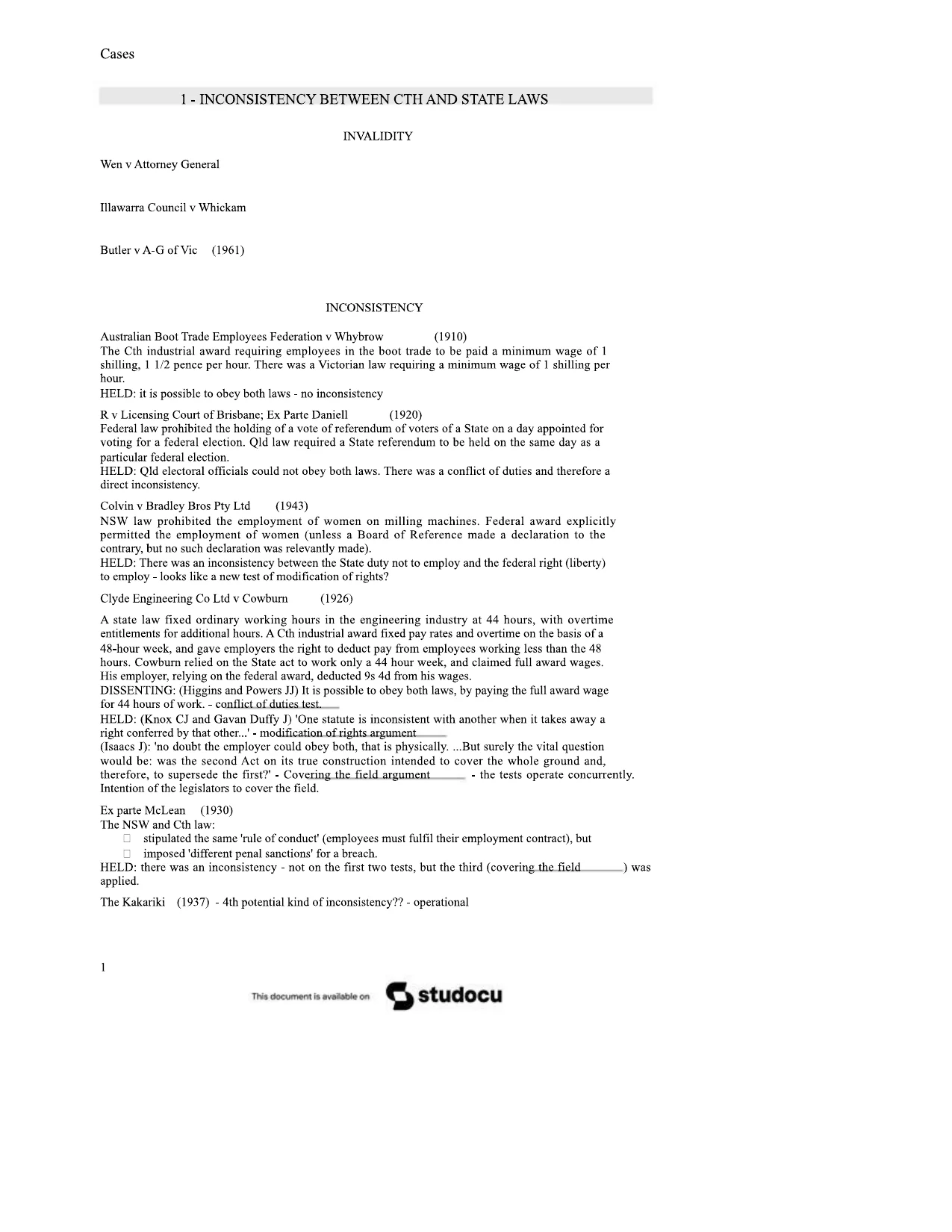
Cases1 - INCONSISTENCY BETWEEN CTH AND STATE LAWSINVALIDITYWen v Attorney GeneralIllawarra Council v WhickamButler vA-G of Vic(1961)INCONSISTENCYAustralian Boot Trade Employees Federation v Whybrow(1910)The Cth industrial award requiring employees in the boot trade to be paid a minimum wage of 1shilling, 1 1/2 pence per hour. There was a Victorian law requiring a minimum wage of 1 shilling perhour.HELD: it is possible to obey both laws - no inconsistencyR v Licensing Court of Brisbane; Ex Parte Daniell(1920)Federal law prohibited the holding of a vote of referendum of voters of a State on a day appointed forvoting for a federal election. Qld law required a State referendum to be held on the same day as aparticular federal election.HELD: Qld electoral officials could not obey both laws. There was a conflict of duties and therefore adirect inconsistency.Colvin v Bradley Bros Pty Ltd(1943)NSW law prohibited the employment of women on milling machines. Federal award explicitlypermitted the employment of women (unless a Board of Reference made a declaration to thecontrary, but no such declaration was relevantly made).HELD: There was an inconsistency between the State duty not to employ and the federal right (liberty)to employ - looks like a new test of modification of rights?Clyde Engineering Co Ltd v Cowbum(1926)A state law fixed ordinary working hours in the engineering industry at 44 hours, with overtimeentitlements for additional hours. A Cth industrial award fixed pay rates and overtime on the basis of a48-hour week, and gave employers the right to deduct pay from employees working less than the 48hours. Cowburn relied on the State act to work only a 44 hour week, and claimed full award wages.His employer, relying on the federal award, deducted 9s 4d from his wages.DISSENTING: (Higgins and Powers JJ) It is possible to obey both laws, by paying the full award wagefor 44 hours of work. - conflict of duties test.HELD: (Knox CJ and Gavan Duffy J) 'One statute is inconsistent with another when it takes away aright conferred by that other...' - modification of rights argument(Isaacs J): 'no doubt the employer could obey both, that is physically. ...But surely the vital questionwould be: was the second Act on its true construction intended to cover the whole ground and,therefore, to supersede the first?' - Covering the field argument- the tests operate concurrently.Intention of the legislators to cover the field.Ex parte McLean(1930)The NSW and Cth law:stipulated the same 'rule of conduct' (employees must fulfil their employment contract), butimposed 'different penal sanctions' for a breach.HELD: there was an inconsistency - not on the first two tests, but the third (covering the field) wasapplied.The Kakariki(1937) - 4th potential kind of inconsistency?? - operational1

Page 2

Inconsistencies in Cth and State Laws - Page 2 preview image

Loading page ...

CasesVic act which authorised removal by State authorities of any ship sunk in a port within Victoria whichhad not been removed by the owner. Cth Act which Authorised removal by Cth authorities of any shipsunk on or near the coast of Australia. - two powers/liberties.The Kakariki was a ship sunk in Port Phillip Bay, Vic. Neither the Cth nor the State authorities hadexercised their powers to remove the ship.HELD:Latham CJ: there was no inconsistency - no 'express' inconsistency as each law merely conferspower on an authority to do an act.no conflict of dutiesno modification of a right by a conflicting dutyno intention to cover the field (Cth law does not prohibit anyone other than the Cth authorityfrom revoking the wreck) An.inconsist.ency could ariseif Cth and State authorities bothattempted to exercise their powers.Dixon J:When a State law, if valid, would alter, impair or detract from the operation of theCommonwealth Parliament, then to that extent it is invalid. Moreover, if it appears from theterms, the nature or the subject matter of a Federal enactment that it was intended as acomplete statement of the law governing a particular matter or set of rights and duties, thenfor a State law to regulate or apply to the same matter or relation is regarded as a detractionfrom the full operation of the Commonwealth law and so as inconsistent.at 630Evatt J: Whether and to what extent a law of a State is inconsistent with a law of the Commonwealthcannot be determined by any rule of universal application... I have endeavoured to point outthe very great difficulties inherent in... regarding a State law as "inconsistent" with aCommonwealth law because the latter either "covers the field" or "expresses an intention tocover the field." Any analogy between legislation with its infinite complexities and varietiesand the picture of a two-dimensional field seems to me to be of little assistance... the newidea of "covering the field" was introduced at about the same time as the Engineers' Casecalled in aid a doctrine of Commonwealth "supremacy" expressly based upon s 109 of theConstitution.Wenn v Attorney-General (Vic)(1948)Dixon J's fine distinctionThe Cth:can legislate 'exhaustively to the intent that the areas of liberty designedly left should not beclosed up'cannot undertake a 'bare attempt to exclude State concurrent power from a subject theFederal legislature has not effectively dealt with by regulation, control or otherwise'Native Title Actcase (1995)Mason CJ, Brennan, Dean, Toohey, Gaudron and McHugh JJ:Where it is within the legislativecompetence of the Commonwealth Parliament to prescribe an exclusive statutory regime aCommonwealth law which merely expresses an exclusion of the operation of a State law is notconstrued as an attempt to invalidate the State law directly. It is construed as a declaration ofintention that the Commonwealth law should operate exclusively of State law on the topic, thatCommonwealth law is within power. Unless the Commonwealth law were expressed in terms whichprecluded that construction, the form of expression does not take the law outside the Commonwealthpower.COVERING THE FIELD TESTIMPLIED INTENTION*"Ansell v Wardley (1980)Under an agreement given force by federal law, employers were entitled to employ and dismiss airlinepilots, subject to conditions in the agreement. State law prohibited discrimination on the ground of sexin employment and dismissal decisions. Argument (Ansett): that the federal law conferred a right ingeneral terms to employ and dismiss pilots; the State law modified that right. Alternatively, the federallaw intended to cover the field.HELD:Stephen J: what is the subject matter of both laws?othe subject matter of the State law is discrimination on the basis of sex2

Page 3

Inconsistencies in Cth and State Laws - Page 3 preview image

Loading page ...

Casesothe subject matter of the agreement given force by federal law is the 'settlement of anentirelyorthodoxindustrialdispute'concerningrelationsbetweenparticularemployers and employeestherefore these are different fields, no inconsistency (based on subject matter)Mason J: what is the intention (of the Federal legislators)?oit is not a 'general industry award' which exhaustively determines the respective rightof employer and employeeoit assumes the right at general law of employers to dismiss employeesoit merely regulates the procedure and means by which such general law rights areexercisedothe federal law leaves room for State law to define the general law concerningemployment, such as imposing a prohibition of discrimination.Therefore there is no inconsistency based on the Cth's intention.O'Sullivan v Noarlunga Meat Ltd(1954)State law and federal law provided for separate licensing or registration regimes regarding theslaughtering of stock for export:federal law prohibited the export of meat unless it had been treated and stored in a'registered' establishmentstate law prohibited the use of premises for slaughtering stock for export without a licenceNoarlunga was registered under the Cth law, but did not have a State licenceand was prosecutedunder the State Act.Fullagar J: (4/7 majority) - what is the character of the law?the subject matter of both laws is the samethe federal law imposed an extremely elaborate and detailed set of requirementsthis showed an intention to express completely and exhaustively the requirements of law withrespect to the subject matterintention of the law is therefore to cover the fieldTaylor J (dissenting) - what is the subject matter?different- the state law was concerned with the establishment of abattoirs, the federal lawconcerned with licences for exporting meatthe federal law did not cover the fieldEXPRESS INTENTIONViskauskas v Niland(1983) - discrimination caseGeorge and Stella Viskauskas rana hotel in Kempscy. Three people of aboriginal descentcomplained they were refused service on the ground of race. The (Cth) Commissioner for CommunityRelations commenced an inquiry under the federalRacial Discrimination Act. The three complainantsmade a separate complaint under the NSWAnti-Discrimination Act 1977 .Cth Anti-Discrimination laws now generally have a clause which mean that State lawscontinue to operate (as in a not intending to cover the field clause)HELD: There was an inconsistency. The federal law covered the entire field of 'racial discrimination'. Itwas expressed 'with complete generality', and it had to operate 'equally and without discrimination inall States - with no exceptions under State laws. The State law dealt with the same subject matter in'substantially similar terms', but with different consequences for breach, thus prescribing differentrules of conduct.Legislative response: Enactment of s 6A(1), RDA:This Act is not intended, and shall be deemed never to have been intended, to exclude orlimit the operation of a law of a State or Territory that furthers the objects of the Conventionand is capable of operating concurrently with this Act.ONE YEAR LATER:University of Wollongong v Metwally(1984)Mr Metwally was an Egyptian postgrad student at Wollongong Uni. He lodged complaints under theNSWAnti-Discrimination Act.Thesecomplaints weremadewithintheperiodofpurportedretrospective operation of s 6A(1) RDA. He was awarded damages by the NSW Equal Opportunitytribunal, and the university challenged the finding on the basis that s 6A(1) was invalid so far as itpurported to have a retrospective operation.3

Page 4

Inconsistencies in Cth and State Laws - Page 4 preview image

Loading page ...

CasesHELD: All agree that s 109 means that the State laws are 'inoperative', not 'invalid'. They also allagree that the Commonwealth can validly pass retrospective laws (with the caveat of criminal laws).So, is there something unusual about the operation of the constitution?Gibbs CJ: Avoiding the operation of s 109 retrospectively would:'vary the effect which s 109 had produced at the relevant time''deprive s 109... of its operation'Cth laws cannot prevail over the operation and effect of the Constitution:US 109 is of 'great importance for the ordinary citizen, who is entitled to know which of twoinconsistent laws he is required to observe'Deane J: Australia is fundamentally a 'union of people'the const is 'ultimately concerned with the governance and protection of the people fromwhom the artificial entities called the commonwealth and states derive their authority's 109 serves the 'important function of protecting the individual from the injustice of beingsubjected totherequirements ofinconsistent lawsofthecommonwealth andstateparliaments on the same subject.'Therefore the Commonwealth cannot retrospectively avoid the operation of s 109----------DISSENTING:Mason J: si 09 operates on actual inconsistencythe Cth cannot enable a State law to operate when in fact there is an inconsistencyHowever, inconsistency in fact only exists by virtue of federal laws, and their effect dependson the terms and intention of those lawsHThus, federal laws can remove the fact of inconsistency - i.e. by expressing an intention not tocover the field.what Parliament can do prospectively, it can do retrospectivelyParliament cantherefore retrospectively remove theinconsistency uponwhichs 109operates, by expressing an intention not to have covered the field.
Preview Mode

This document has 12 pages. Sign in to access the full document!