

Lecture Notes for Introduction to Law, 7th Edition
- Civil Law
- 310 pages
- Shared February 2025
- 121 downloads
Lecture Notes for Introduction to Law, 7th Edition helps you review course material quickly and effectively.
Preview 31 of 310 pages
See the first 31 pages exactly as they appear in the document.
Page 1 Read page 1 as text
1 CHAPTER 1 THE HISTORICAL BASIS AND CURRENT STRUCTURE OF THE AMERICAN LEGAL SYSTEM CHAPTER OUTLINE The Historical Basis of American Law • Before the Government • The Results of the Revolution • The Influence of Political Theories • Balance as the Key to Success The Modern Legal System • The Sources of Law • The Hierarchy of Law • The Exception to the Rule of Hierarchy LECTURE KEYS 1. Early American settlers came to escape religious persecution and take advantage of economic opportunities. Settlers used many of the laws of their homelands and brought their prevailing attitudes toward religion. Under these laws and attitudes, people were charged and punished by the government for committing acts that were regarded as sinful and thus illegal. 2. As the population grew, foreign governments increased their efforts to establish a formal and permanent influence in the New World by establishing government offices and authorities and imposing taxes on the rich natural resources and products of America. 3. Many of the colonists did not want to be under the rule of a foreign government that they believed would not be responsive to the will of the people and would not allow them to maintain the personal freedoms they had gained by leaving those countries in the first place. 4. The need to establish a permanent government structure in order to manage issues on a local basis, raise a military for defense, and avoid rule by another country was realized. Despite some movement toward creating many small independent nations, representatives of the colonies agreed success was more likely if there was a unified front. 5. The concept of crime being equal to what was considered wrong or sinful as defined by those in authority was based on the naturalist theory—a belief that all persons were born with the ability to distinguish the difference between right and wrong and the knowledge of their responsibility to act in the proper manner. See Practical Application1.1 and the Point for Discussion.
Page 2 Page 3 Read page 3 as text
2 6. Increases in population from different cultures with different mores, values, and rules resulted in a more diverse group of legal representatives and different opinions of right and wrong. This in turn led to the need for a more detailed and developed legal system. 7. The first formal and international action by the colonies as a collective group was their issuance of the Declaration of Independence. Today most Americans consider it the bedrock of our nation, but originally it was more or less a formality. Essentially, independence was in name only, and at first was defended by a largely unsophisticated, poorly armed, and disorganized band of citizens against the potential threat of Great Britain and other governments. 8. The new central government was guided by the adoption of the Articles of Confederation. The Constitution was not passed until 11 years later in September 1787. 9. The Articles of Confederation bore little resemblance to the current Constitution. Under the Articles of Confederation, • each state sent delegates as members of Congress who then nominated and elected a president among themselves; • the delegates wrote and passed all laws; • the delegates acted as judges in disputes among the states; • the delegates negotiated treaties; and • the duties assigned the president were to preside over sessions of Congress and act as an ambassador to, and receive representatives of, other governments’ all legal disputes with respect to individuals continued to be dealt with by each state’s own system of justice. 10. The Articles of Confederation and Congress were largely ineffective on a local level. The national government had none of the following: • Enforcement power • Judges • Jails • Ways to force collection of the monies that each state was supposed to contribute • Money of its own and no way to get it other than by voluntary contribution • Organization to support a national army • Staff of government employees to operate the government when Congress was not in session 11. An early and real issue for the permanent government was whether to allow the states to continue in existence in any sort of individual fashion. Several delegates, including some from the South, believed individual states should be abolished and all people and legal issues should be governed by a central authority. In history, small states within a country often ended up in conflict with one another. In this instance, however, the idea failed to gain popular support. The citizens were fiercely independent and sought to preserve as much personal freedom from government as possible. 12. Separate state governments and a unified national government with specific functions were created. The states were left intact to respond effectively and quickly to the needs of citizens and individual state economies. The national
Page 4 Read page 4 as text
3 government was formed to protect the fundamental rights of all citizens and ensure that state governments would not interfere with individual rights. The national government would also handle national issues such as interstate commerce, Indian affairs, immigration, and international issues such as treaties for trade and nonaggression. 13. The members of the Constitutional Convention agreed on three distinct branches of government, each with separate duties and all with the obligation to cooperate with and monitor the other branches to ensure that no one branch obtained too much power. This separation of powers was a direct attempt to prevent the monarchy type of government that so many colonists sought to avoid by coming to America. 14. The first branch of government created was the legislative branch and was called Congress. • Congress would be elected by the people (members of the House of Representatives directly by the people, and members of the Senate indirectly—that is, by state legislatures until the Seventeenth Amendment was ratified in 1913). • Congress would retain the sole authority to make statutory law. In this way, the people as a whole would always have significant influence in making the laws that all persons were required to follow. 15. The second branch of government created was the executive branch. The president was given authority to head the executive branch at the national level. This structure is paralleled in the states where each state executive branch is headed by a governor. 16. Under the Constitution, the president (the head of the executive branch) • is elected indirectly by the people through the electoral college; • has power to approve or reject laws passed by Congress, although the power is not absolute and the president cannot deny the authority of Congress to enact law if it is, in fact, the will of the majority that such law be enacted (rejection by the president of a law enacted by Congress is known as the veto power and can be overridden by a significant majority of Congress); • has several important functions with respect to foreign affairs; and • has the ultimate duty to enforce the laws of the United States. 17. The third and final branch of government was the judiciary, which was needed to protect the Constitution and serve as mediator of disputes. This branch of government has the authority and responsibility to interpret laws and protect the Constitution from violation by Congress, the president, or the states. Although the Constitution vests the ultimate authority to enforce laws in the president, in practice, the judiciary also assists in enforcement when the courts apply law to specific cases. 18. Independent operation of the branches but with the power of the branches to influence one another better protects one branch from obtaining too much power or using its power unwisely. Each branch can use its specially designated powers to make sure the other branches act within their constitutionally prescribed limits—checks and balances.
Page 5 Read page 5 as text
4 19. Congress, with the approval of the people, subsequently passed the Bill of Rights, which protects essential fundamental human freedoms from government infringement on those matters presumed to be inherently personal and a matter of choice for all human beings. The following rights are specifically protected: • Freedom of speech, religion, and press; peaceable assembly; petitions for governmental change (First Amendment). • Right to bear arms (Second Amendment). • Freedom from unreasonable invasion of home by the government for purposes of search and seizure of persons or property, or occupation by military other than as prescribed (Third and Fourth Amendments). • Right to have an independent judicial magistrate determine if probable cause exists before a search or arrest warrant can be issued (Fourth Amendment). • Right not to be tried twice for the same crime (Fifth Amendment). • Right not to have persons or property seized without due process (Fifth Amendment). • Right to a speedy and public trial (Sixth Amendment). • Right to an impartial jury in the jurisdiction where the alleged crime occurred or the dispute is governed by common law (Sixth and Seventh Amendments). • Freedom from forced self-incrimination (Fifth Amendment). • Right to counsel in criminal prosecutions (Sixth Amendment). • Right of the accused to know of the crime alleged (Sixth Amendment). • Right of the accused to confront the witnesses for the prosecution (Sixth Amendment). • Right not to be subjected to excessive bail (Eighth Amendment). • Freedom from cruel or unusual punishment (Eighth Amendment). • Freedom from use of the Constitution to limit individual rights not mentioned (Ninth Amendment). • Right of the states to govern on matters not addressed in the Constitution or its amendments (Tenth Amendment). 20. The Supreme Court has been increasingly asked to resolve issues that determine the rights of persons to be free from governmental intrusion into their private lives. From time to time, additional language regarding these freedoms has been added through amendments to the Constitution as Congress and the people have deemed appropriate. 21. All law created in this country must be consistent with, and embody the spirit of, the rights guaranteed in the Constitution and its Bill of Rights. This includes legal standards issued by the executive branch to clarify and define statutory law, and those issued by the judiciary, which interprets and applies the law to individual situations. See the answers to Assignments 1.1 and 1.2. 22. The positivist theory proposes that a government should have a single entity to determine what is right and wrong as a matter of law and that it is not subject to question or challenge. This theory is evident in the court of last resort—the U.S. Supreme Court. Short of a constitutional amendment, the decisions of the Supreme Court are not subject to any other authority.
Page 6 Read page 6 as text
5 23. Sociological theory suggests that people as a group determine what is and is not acceptable, based on the needs of society at the time. It holds that the law is in a constant state of change and adjusts accordingly to the needs of society. 24. The U.S. Constitution is the product of three philosophies: naturalist theory, positivist theory, and sociological theory. If citizens believe a law is wrong, they can lobby to have it changed. If they believe their elected representatives are not enacting laws that embody the beliefs of the people, they can elect new legislators. If the legislature passes a law that appears to violate the Constitution, citizens can challenge the law in those courts that have the power to resolve the issue by upholding the statute or invalidating it as unconstitutional. 25. Courts continually face the task of balancing competing interests. The traditional balance is the challenge facing every judge to enforce the laws to the extent necessary to protect the rights of the public while permitting the greatest amount of personal freedom possible for the individual. Simply stated, the traditional balance equals the rights of the people versus the rights of the individual. 26. In essence, the modern balance is the need to enforce existing legal principles based on the Constitution versus the need to adopt legal principles more reflective of current society. This balance has been accomplished without ever disturbing the fundamental structure set forth in the Constitution. Indeed, the modern balance is the ability to enforce law consistently while retaining enough flexibility to adapt to changes in societal standards. See Practical Applications 1.2, 1.3, and 1.4 and the Points for Discussion. 27. The first government was a single Congress of senators and representatives from the 13 colonies (the Senate with two senators elected by each state legislature and the House of Representatives with members proportionate to the population of each state), a president whose role was still not well defined beyond basic duties listed in Article II of the Constitution, and a single court to serve as the judiciary for an entire nation. 28. Today, that same Congress includes more than 500 voting senators and representatives elected by the population of each of the 50 states. The presidency has developed into a complicated office that not only represents this country in foreign affairs but also oversees the administrative agencies of government and approves or rejects all acts of Congress. The federal judiciary has grown to include three separate levels: The Supreme Court, 13 U.S. circuit courts of appeals, and more than 90 U.S. district courts. 29. Law, which is also known as a legal standard or legal principle, comes in different forms and from different sources. It can apply to people in general, a particular group of citizens, or a specific person or entity such as a corporation. 30. Statutory law is enacted by a state legislature or by Congress. If a state legislature enacts a law, all persons and entities legally present in the state must obey it. If Congress enacts a federal law, all persons legally present in the nation are required to follow it. Once approved by the legislature, a statute will generally continue indefinitely as law until either the legislature repeals (deactivates) it or the high court of the state or federal government rules it unconstitutional.
Page 7 Read page 7 as text
6 31. Federal laws must be consistent with the U.S. Constitution, whereas state laws must be in accordance with both the state and the federal constitutions. Similarly, no state constitution can conflict with the U.S. Constitution. The provision of the U.S. Constitution declaring that federal laws take precedence over conflicting state laws is known as the supremacy clause. See Exhibit 1.1: Sample Legislative Language. 32. The language of statutes is broad enough to include as many potential situations as possible. However, if a court determines that a law is written so vaguely that citizens cannot determine exactly what is and is not acceptable conduct, the law will not be upheld as valid. The Constitution guarantees the right to fair notice of what is considered illegal conduct and what is required in a particular situation. 33. In judicial law , the judiciary interprets law from other sources and has power on occasion to create legal standards known as case law. Judges may consider a legal standard and determine whether it was meant to apply to the circumstances of a particular case. Persons in similar situations may then look to the judge’s decision to guide their own conduct. When no law exists, judges are responsible for making law or extending decisions of judges in previous similar cases. 34. The continuation of existing legal standards is commonly referred to as stare decisis (literally, “let the decision stand”). Following the same legal principles in similar cases gives consistency and stability. People can look to the past for guidance in what to expect from the courts in the future. 35. When a court applies stare decisis , it is following a precedent—that is, a previously established legal standard. See “Case Briefs: Instructor Notes”: In the Matter of the Estate of Marc R. Beauregard , 456 Mass. 161, 921 N.E.2d 954 (Mass., 2009). 36. In many sectors of our society and economy, large numbers of people or areas of commerce need specific guidelines. It would be unduly burdensome and increase the likelihood of inconsistent decisions from different judges in different areas if the judiciary had to handle all cases that arose. Yet the areas are so specific as to require attention from the government that would be too cumbersome of the Congress. The response to dilemmas of this sort has been the advent of administrative law . 37. The executive branch has the primary responsibility to determine when a law has been violated or whether the law is even applicable to a particular situation. Administrative agencies are overseen by the executive branch with direct influence by the Congress and the judiciary. At the federal level, the president is assisted by administrative agencies in carrying out the law enacted by Congress. 38. Administrative law primarily consists of two elements: administrative regulations (sometimes called rules) and administrative decisions. Administrative law is an extension of statutory law established by Congress. Failure to obey administrative law can result in penalties or even criminal prosecution. 39. Administrative agencies issue regulations or rules that more specifically define the broadly written statutes.
Page 8 Read page 8 as text
7 40. Administrative decisions issued for highly specific cases have the same effect of law as judicial or legislative law. These cases usually involve persons or entities that challenge the authority of the agency to issue or enforce a particular regulation. See Exhibit 1.2: Entitlement of Tenants to Occupy. 41. U.S. law is governed by a distinct hierarchy. First in the hierarchy is the U.S. Constitution. Although technically the Constitution and its amendments are statutory law, they are considered superior to all other laws because they established the governmental structure and the process for creating all other laws. 42. Next in the hierarchy of laws are the legislative (statutory) acts of Congress. Statutes have greater weight than judicial or administrative law because statutes are enacted by Congress and state legislatures, which are composed of people elected by the people. Thus, statutes are most likely to represent the laws intended for and desired by the majority. 43. The judiciary has the authority to interpret legislation and to fill in gray areas where the law is unclear or nonexistent. The judiciary is also obligated to ensure that the law is consistent with the Constitution. When the judiciary determines that the law does not meet the requirements of the Constitution, it has the authority to declare the law invalid and thereby supersede the ordinarily superior statutory law. 44. Constitutionality is the only basis for judicial rather than statutory law controlling an issue. 45. Last in the hierarchy is administrative law. Administrative agencies assist Congress by issuing regulations and decisions that clarify and aid in the enforcement of statutes. However, Congress has the right to eliminate an agency or regulations that are inconsistent with legislative objectives. The judiciary also has the authority to overrule actions of an agency when such actions are unconstitutional. See the answers to Assignment 1.3. CASE BRIEFS: INSTRUCTOR NOTES What follows is the case brief for the case included within the seventh edition text. They can be used to check case brief assignments or to quickly review the materials. In the Matter of the Estate of Marc R. Beauregard , 456 Mass. 161, 921 N.E.2d 954 (Mass., 2009) Facts: Decedent died unmarried and childless, leaving his parents as sole heirs. Plaintiff, who lived at the same address as decedent, produced a copy of decedent’s will in which significant assets were bequeathed to plaintiff. Plaintiff filed a petition for probate of a “copy of a will” because the original will could not be located. Decedent’s parents and siblings filed objections to the petition. The trial court applied the evidentiary presumption that when a will that was known to exist cannot be found, it is presumed the decedent destroyed the will with the intent to revoke it. The trial court found that decedent had indeed executed a will but that plaintiff failed to rebut
Page 9 Read page 9 as text
8 the presumption that decedent destroyed the will with the intent to revoke it. Plaintiff’s petition was dismissed. Plaintiff appealed. Issue: Whether the trial court erred in finding that plaintiff failed to rebut the presumption that the will that was known to exist and could not be found was destroyed by decedent with the intent to revoke the will. Law: Where a will once known to exist cannot be found after the death of the testator, there is a presumption that it was destroyed by the maker with an intent to revoke it. Miniter v. Irwin , 331 Mass. 8, 9 (1954) It must be demonstrated by a preponderance of the evidence that the testator did not destroy the will with the intent of revoking it. Matter of the Estate of Leggett , 584 So. 2d 400, 403 (Miss. 1991) Rule: The trial court found that decedent was young, healthy, and fully competent at the time of his death, so it is unlikely he lost the will. The trial court further noted that there was a brief time between the date the will was executed and the decedent’s death, which left little time to lose the will. The trial court made its decision to deny petition for probate based on its finding that plaintiff failed to rebut by a preponderance of the evidence the presumption that the will that could not be located was destroyed by the decedent with the intent to revoke it. Affirmed. ASSIGNMENT 1.1 Consider the following situations and identify which parts of the Bill of Rights would allegedly protect the behavior. 1. The right to have a parade to celebrate Gay Pride. Answer: First Amendment’s right to peaceable assembly. 2. The right to not be forced to pray, or participate in prayer, in a public school. Answer: First Amendment’s freedom to establish religion. 3. The right to refuse entry to one’s home by a government official who does not have a warrant. Answer: Fourth Amendment’s freedom from unreasonable search. 4. The right to refuse to answer questions by the police. Answer: Sixth Amendment’s right to counsel in criminal prosecutions. 5. The right to be released from jail before trial if the defendant deposits a sum with the court that is reasonably expected to deter the defendant from fleeing the jurisdiction or committing additional crimes. Answer: Eighth Amendment’s right to bail that is not excessive under the circumstances. 6. The right to set fire to an American flag in a public place as a political statement. Answer: First Amendment’s right to free speech. 7. The right of media to be present during the trial in a criminal prosecution. Answer: Sixth Amendment’s right to a public trial.
Page 10 Read page 10 as text
9 8. The right to carry or own multiple registered weapons. Answer: Second Amendment’s right to bear arms. 9. The right of a defendant to refuse to testify in a criminal trial against himself or herself. Answer: Fifth Amendment’s freedom from forced self-incrimination. 10. The right of a defendant charged with sexual assault to force the alleged victim to testify at trial and answer questions about the allegations. Answer: Sixth Amendment’s right of confrontation of witnesses for the prosecution. ASSIGNMENT 1.2 Identify five modern-day situations where the rights of an individual are at odds with the rights of the public as a whole. Answer: Responses will vary but should reflect the boundary between individual freedoms and the best interests of society. Example: The right of a motorcyclist to choose whether to wear a helmet versus the right of the public to protect themselves from the costs to the government in providing long-term care for individuals who sustain severe brain and other serious related injuries as a result of a motorcycle accident in which the injured individual did not wear a helmet. ASSIGNMENT 1.3 Examine the following situations and explain which source of law would most appropriately deal with each situation. 1. The criteria used to determine whether an individual is placed on the “No Fly List” for passengers traveling by air. Answer: Because ensuring the safety of air travelers is the responsibility of federal law enforcement agencies, these administrative agencies would create the criteria used to determine the No Fly List. However, because the list raises civil liberties and due process concerns, due in part to the potential for ethnic, religious, economic, political, or racial profiling and discrimination, the judiciary is likely to be asked to determine whether the criteria used to determine the No Fly List violate constitutional rights. 2. The definition of what constitutes driving under the influence. Answer: Operating a vehicle on public roads affects virtually all citizens. As a result, the legal standards would generally be statutory. However, the specific circumstances of an individual accused of having violated those laws would be most properly addressed by a judge who could consider all of the relevant facts of the particular situation.
Page 11 Read page 11 as text
10 3. An individual is arrested after purchasing eggs, then hatching and raising several baby chicks to use in a home school science project on the basis they violated a law prohibiting harboring livestock within city limits. At 4 months of age, and the end of the experiment, the chicks were given to a farmer. Answer: The legal standards with respect to what types of activities are allowed within city limits would be best addressed by an elected body (e.g., zoning committee) representing the residents of that city. This would ensure that the standards are consistent with the best interests of the majority of the residents. INTERNET ASSIGNMENT 1.1 Locate the official government Web site for each branch of state government where you live. Answers will vary. INTERNET ASSIGNMENT 1.2 Using the Internet, determine whether the constitution for your state has been amended, and if so, when. Answers will vary. PRACTICAL APPLICATION 1.1 Point for Discussion: Even today, cultural differences among even members of the same religion can be profound in terms of the definitions of acceptable conduct. Can you identify any similar differences that exist today, or that may have existed at the time of American colonization, that could have legal ramifications? Conflicting views toward abortion are a strong illustration of how cultural differences among members of the same religion have legal ramifications. As an example, throughout Christianity, there is a shared belief that life is valued and should be protected. However, within Christianity there are intensely conflicting views about whether a pregnant woman has a right to make decisions that affect her body or whether her rights are superseded by the right of her unborn child to survive. Christians within cultures that have a more liberal viewpoint are more likely to support a woman’s right to choose, and those within cultures that have a more conservative viewpoint staunchly support the right to life. Legislatures have grappled with the issue and passed laws that they believe reflect the values of the majority of the community. The U.S. Supreme Court has examined those laws closely, most famously through Roe v. Wade , and has nullified any laws that it finds violate the rights of individuals as guaranteed in the Constitution. Other examples of cultural differences include conflicting views toward gay marriage, physician-assisted suicide, and the death penalty.
Page 12 Read page 12 as text
11 PRACTICAL APPLICATION 1.2 Point for Discussion : What do you think of the reasoning of the Justice in explaining the balance that must be struck when competing values are in conflict? A well-structured argument will take into account on the one hand, the business owner’s right to be free to think, to believe any way they wish and to pray to the God of their choosing. On the other hand, we must realize that the law in New Mexico grants the customers the right to engage in the commercial market place free from discrimination. PRACTICAL APPLICATION 1.3 Point for Discussion : At what point should someone’s personal right to bear arms become limited? Although an individual’s right to bear arms is guaranteed by the Second Amendment, that individual right cannot infringe upon the right of people to live safely and without fear. If an individual is stockpiling large amounts of weapons, ammunition, and explosives, that poses a danger to the people around him or her if an accident occurs and sets off an explosion. More troubling is the possibility that the individual could intentionally use the weapons and explosives to fend off what he or she perceives are attacks on his or her freedom. In this case, it is the responsibility of the government— through legislative laws, judicial overview, and administrative law enforcement—to curtail the rights of the individual to protect rights of society as a whole. PRACTICAL APPLICATION 1.4 Point for Discussion : Was it prudent of the Court to act as it did, or should it have waited for the democratic processes at the state level to play out on this issue? A well-structured discussion will recognize the right of states to pass laws to protect the health and safety of its citizens. Marriage has been an area where states have traditionally enacted laws that regulate who can lawfully marry. However, the Supreme Court has the obligation to interpret the Constitution. In doing so, the Court must look to the nation’s values, history traditions, and changing societal norms to protect groups that have been disfavored under the current law. REVIEW QUESTIONS 1. What was the structure of the U.S. government under the Articles of Confederation? The United States operated in a singular government structure under the Articles of Confederation. Each state sent delegates as members of Congress, who then nominated and elected a president among themselves. The delegates passed laws, acted as judges in disputes among the states, negotiated treaties, and served as the government for the new nation. The president presided over the sessions of Congress as head of the delegates and acted as an ambassador for the nation.
Page 13 Read page 13 as text
12 2. What political theories influenced the structure of the U.S. government? The three theories that influenced the structure of the U.S. government are as follows: a. naturalist theory—based on the belief that all persons are born with the ability to distinguish between right and wrong and the knowledge that they are responsible for acting in the proper manner; b. positivist theory—proposes that a government should have a single entity to determine what is right and wrong as a matter of law; and c. sociological theory—holds that the law is in a constant state of change and adjusts according to the needs of society. 3. How does the U.S. Constitution guarantee that power will not fall into the hands of one person? The U.S. Constitution guarantees that power will not fall into the hands of one person by establishing three distinct branches of government: a. legislative branch—Congress is elected directly by the people and has the sole authority to make statutory law; b. executive branch—the president is indirectly elected by the people through the electoral college and has the power to (i) approve or reject acts of Congress, though the power is not absolute, (ii) represent the country in foreign affairs, and (iii) enforce the laws of the United States; c. judicial branch—the judiciary has the responsibility to interpret the laws and protect the Constitution from violation by Congress, the president, or the states. Through a system of checks and balances, these three branches operate independently but with the power to influence each other, ensuring that one branch does not gain too much power. 4. Explain how each political theory appears in modern-day government. The naturalist theory is reflected in the language of the U.S. Constitution and especially the Bill of Rights, which state what was and continues to be fundamentally fair. The positivist theory is also apparent in the U.S. Constitution and Bill of Rights, which contain statements indicating an ultimate authority that interprets the laws and decides how they should be enforced. The U.S. Supreme Court is an example of positivist theory. Short of a constitutional amendment, decisions by the U.S. Supreme Court are not subject to any other authority. The sociological theory is evident in government structure in the way society influences the government and laws by electing members of Congress, selecting the president, and even approving or rejecting constitutional amendments and certain other laws. As society’s needs change, the flexible system of government allows passage of laws and election of representatives who will enact laws suited to the changing times. 5. The flexibility and stability elements of the modern balance express what goals of the judiciary? Modern balance reflects the goal of the judiciary to balance the need for consistency and stability against the need for a flexible and adaptive government. In essence, it is the need to enforce existing legal principles based on the Constitution versus the need to adopt legal principles that are more reflective of current society.
Page 14 Read page 14 as text
13 6. The individual elements and the elements of the people as a whole of the traditional balance represent what goals of the judiciary? Traditional balance reflects the goal of the judiciary to allow maximum personal freedom without detracting from the welfare of the general public. Simply put, it is the Rights of the People versus the Rights of the Individual. 7. Explain the difference between stare decisis and precedent. Stare decisis , which literally means “let the decision stand,” holds that following the same legal principles in similar cases gives the legal system consistency. When a court applies stare decisis and follows the same type of ruling as issued in a previous, similar case, it is following a precedent, which is a previously established legal standard. 8. Give two characteristics of each type of legal standard: statute, case, and regulation. (An example of a characteristic would be the source of the legal standard.) Two characteristics of statutes, case law, and regulations: Statute: a. Statutes are enacted by federal and state legislatures. b. Statutes are broadly to apply to all persons. Case law: a. Opinions issued by the judiciary in legal disputes have the effect of law. b. In case law, members of the judiciary interpret the law and apply it to individual circumstances based on legal principles in previous, similar cases. Regulation: a. Regulations are issued by administrative agencies under the direction of the executive branch. b. Regulations more specifically define broadly written statutes. 9. What is the only situation in which judicial decision is more powerful than a statute? The only situation in which a judicial decision is more powerful than a statute is when the judiciary determines that the law does not meet the requirements of the Constitution. 10. Why does the executive branch have the power to create administrative law through administrative agencies? The executive branch has the power to create administrative law through administrative agencies because the Constitution gives it the duty to enforce the law. This involves determining whether a law has been violated or whether it is even applicable to a particular situation.
Page 15 Read page 15 as text
14 CHAPTER 2 THE COURTS CHAPTER OUTLINE The Purpose and Effect of Judicial Law • Characteristics of Judicial Law • Clarification of the Law • Protection of the Law The Structure of the Judicial System • Trial versus Appellate Courts • The Federal Court System • The U.S. District Courts • Special Federal Courts • The U.S. Courts of Appeals • The U.S. Supreme Court The State Court System The Process of Legal Analysis • Legal Analysis of Case Law (Judicial Opinions) • The Facts • The Legal Issue • The Law • The Rule • Statutory and Administrative Analysis • Application of Legal Analysis LECTURE KEYS 1. The judiciary • reviews the acts of Congress and the executive branch, • is expected to have the knowledge and objectivity to examine individual situations and determine appropriate legal standards and how they should apply—this is what is meant by “the letter and spirit of the law”, • provides access to the governmental system for the entire population, and • is designed to provide fairness and enforcement of rights of all persons. See Practical Application 2.1 and the Point for Discussion. See “Case Briefs: Instructor Notes”: People v. Kevorkian , 447 Mich. 436, 527 N.W.2d 714 (Mich. 1994).
Page 16 Read page 16 as text
15 2. Interpretations of statutory or administrative law occur anytime a statute or administrative regulation or decision is an issue. The statute and the facts of the case are reviewed, and applicable legal standards are employed to determine the result. 3. No two cases are exactly alike, but a judge may apply the same ruling used in previous cases that have striking similarities such as the facts of the case, legal issues involved, or both. See Practical Application 2.2 and the Point for Discussion. 4. In cases when no applicable statute or administrative law exists, a judge is required to establish the law. This may be done by looking to case law (the precedents of past similar cases) and applying the principle of stare decisis. 5. When no prior judicial precedent or applicable statutory or administrative law exists, a judge must create a legal standard. This is known as common law, a term that has carried over from medieval times when judges created law for the common man. Technically, common law is defined as a newly established legal principle, whereas case law is the application of stare decisis (perpetuate and continue application of a prior legal principle). In actual practice, the terms common law and case law have come to be used interchangeably. The basic concept is that the terms represent judicially created law. 6. Individuals can look at existing case law in relation to their own situations. By comparing established precedents, persons involved in lawsuits can often predict with some certainty the likely outcome of their case. In so doing, through a process known as legal analysis , they can make intelligent decisions about whether to pursue, settle, or dismiss a dispute. See the answers to Assignment 2.1. 7. A second function of the judiciary is to protect and uphold law that is consistent with the Constitution. See Practical Application 2.3 and the Point for Discussion. 8. Federal and state court systems consist of two basic types of courts: trial and appellate. The trial court is the court in which the case is presented to the judge or jury. In the trial court, each party follows certain required procedures to prepare the evidence for a fair and complete presentation. The judge and, in many cases, a jury hear the evidence to support the claims of both sides of the dispute. When this is completed, a verdict is then given that declares whether the defendant is at fault for violation of a legal standard. 9. A court that hears trials is known as a court of original jurisdiction . This is where the case is determined for the first time (originates). If a party believes the trial court verdict is the result of failure to properly follow legal requirements for the proceedings, then that party may choose to appeal the verdict. 10. When a case is brought on appeal, the judges of an appellate court will review part or all of the trial court’s proceedings. An appellate court has authority superior to that of a trial court and has the power to change the trial court’s verdict.
Page 17 Read page 17 as text
16 11. Appellate courts often consist of several judges who review cases as a panel. By utilizing multiple reviewers, there is less chance that mistakes will be made in the review of an application of law to a particular case. 12. The duty of the trial court is to determine the applicable law, hear the evidence, and render a verdict, whereas the duty of the appellate court is to only review what took place in the trial court and determine whether the law was correctly applied to the evidence presented. Appellate courts generally do not hear new evidence such as testimony of witnesses. Nor do appellate courts issue new verdicts. Rather, they affirm (approve) or reverse (reject) the trial (lower) court verdict. 13. The federal court system started with a single court, which is now known as the U.S. Supreme Court. Over time, Congress added several courts to the federal judicial branch. Currently, the federal court system comprises three levels (see Exhibit 2.1), each of which functions totally independent of state court systems, just as each state judicial branch functions independent of the other states. See Exhibit 2.1: The Three Tiers of the Federal Court System. 14. An easy way to distinguish a federal court from a state court is by the court’s name. All federal courts will have the words United States or U.S. in the title. 15. Of the three levels of federal courts, the trial courts—where the vast majority of federal cases originate—are known as the U.S. district courts. Generally, the U.S. district courts are used as trial courts. However, in limited circumstances, a federal case can be initially heard by an administrative hearing officer with the executive branch and appealed to a U.S. district court. In such an instance, the U.S. district court takes on appellate authority rather than its usual original jurisdiction. Also, there are highly specific types of cases that may be initially filed for trial at the appellate level and that bypass a U.S. district court altogether. 16. Typically, the appellate level is reserved for parties who wish to challenge the decision of a U.S. district court. Such an appeal is made to the next level, which is the U.S. court of appeals. Following such an appeal, a party who is still dissatisfied with the result of the case may seek appellate review by the U.S. Supreme Court. 17. Currently, there are more than 90 U.S. district courts. Congress has increased the number of these courts when warranted by the number of cases filed and tried in the federal system. When the burden becomes too heavy for one court, Congress creates an additional court to handle part of the load. 18. The various U.S. district courts are separated by geographical boundaries. Legal disputes over federal law that occur or have connections to the court within the court’s physical boundaries are subject to the authority of a U.S. district court. 19. For convenience and to facilitate understanding by the population, state lines have been used as district boundary lines. However, there is no connection between state court authority and federal court authority because of the setting of such boundaries.
Page 18 Read page 18 as text
17 20. States with substantial population and litigation have more than one U.S. district court divided by county lines (for convenience) within the state. A district that covers a wide geographical area may be subdivided into divisions; these operate as branches of a district court, with buildings in each division to make the court more accessible to citizens. 21. Some federal courts are set up expressly to handle specific types of cases. Specified types of claims made against the U.S. government must be filed with the U.S. Court of Federal Claims. Claims involving federal taxation are tried in the U.S. Tax Court. The Court of International Trade hears disputes involving international trade agreements. The U.S. Court of Appeals for the Armed Forces offers a final review of military tribunal actions. These claims involve specific and often complex series of legal standards. 22. A party to a lawsuit who is dissatisfied with a U.S. district court decision may appeal to a U.S. court of appeals designated to hear cases appealed from the particular U.S. district court where the case originated. This system of pairing specific trial courts with a particular appellate court allows the appellate courts to create legal standards to be consistently followed by the designated U.S. district courts subject to the appellate court’s authority. 23. U.S. courts of appeals were originally established to make appellate review faster, easier, and more accessible to parties in litigation. 24. Currently, there are 13 courts of appeal: Eleven courts are located across the country and identified by number (e.g., First U.S. Circuit Court of Appeals); the U.S. Circuit Court of Appeals for the District of Columbia, which hears cases originating in the U.S. District Court for the District of Columbia; and the U.S. Federal Court of Appeals, which hears cases from special federal courts such as the U.S. Court of Federal Claims and the U.S. Court of International Trade. 25. The U.S. courts of appeals are the courts most responsible for establishing legal standards. Although the U.S. Supreme Court opinions control in any situation, the limited number of cases heard and the opinions issued limit the number of legal standards established by the high court. Like U.S. district courts, the physical limits of authority of each U.S. court of appeals are defined by geographical boundaries. Each circuit court of appeals is responsible for handling the appeals coming from the federal courts within the geographical boundaries of the circuit. See Exhibit 2.2: Geographical Boundaries of U.S. Circuit Courts of Appeals and U.S. District Courts. 26. No U.S. court of appeals has authority over any other. Each court functions independently and is accountable only to the U.S. Supreme Court. When different courts issue conflicting legal standards, the Supreme Court may accept one or more of these cases and decide what exactly the legal standard shall be. This eliminates any inconsistency that may arise among the rulings of the various circuits. 27. The U.S. Supreme Court is the final authority on all matters of federal jurisdiction in the U.S. legal system. The Court cannot overrule Congress or the president unless the legislative or executive branch has in some way violated or exceeded
Page 19 Read page 19 as text
18 the authority granted to the branch by the Constitution and that action has been challenged in the courts. 28. The primary function of the Supreme Court is one of review. The Court reviews cases from the federal courts and, in some instances, from the highest state courts that have constitutional issues or that include the government as a party. The key element in the authority of the Supreme Court is that there must be a federal issue at stake either in the form of the parties involved or in the constitutionality of state or federal law. 29. The Supreme Court has limited original jurisdiction. Cases involving original jurisdiction are not appealed but rather are filed in court for the very first time at the level of the U.S. Supreme Court. Original jurisdiction is limited to only the types of situations listed in Article III of the Constitution. 30. The U.S. Supreme Court has two common methods of obtaining review. The first is by right. Certain types of cases are automatically entitled to review by the Supreme Court if the party so desires. The Court will review the case as long as the procedural rules for filing the appeal are met. 31. The second and more common method is known as certiorari (pronounced “sir- shore-are-ee”), which describes the authority of the Court to accept a number of cases for review where there is no right, but where it would serve the interests of justice to have the Court make a final and ultimate determination of a legal standard. 32. Another significant factor in the determination of whether to grant certiorari of cases is when the decision offered for review involves constitutional rights. An ultimate goal of the Court is to ensure that the Constitution will be applied fairly for all persons. When the Court declines to accept a petition for certiorari , the practical effect is that it accepts and indirectly affirms the decision of a U.S. court of appeals. 33. In rare cases, a U.S. court of appeals may “certify a question,” in which case the appeals court may specifically request that the Supreme Court resolve a pertinent issue on which the various U.S. courts of appeals are divided. 34. Totally independent of the federal courts are the state court systems for each of the 50 states. Each state government has legislative, executive, and judicial branches that in many ways parallel the federal government. Every state has a judicial system to provide a forum for the resolution of disputes among persons and entities within the state. Such disputes must involve acts or occurrences that are controlled by state rather than federal law. The law may be case law or state legislative law. No state court is bound by the authority of a court from a different state. Nor is a court obligated to follow the rulings of an equivalent court. 35. The states utilize two basic judicial structures: three-tiered and two-tiered systems. The three-tiered system is comparable to that of the federal system. The three tiers are a court of last resort (the highest court of the state), an intermediate appellate court level, and a trial court level. 36. The alternative is a two-tiered system consisting of only one appellate (supreme) court and the various trial courts. However, because of the increase in litigation, more states are considering the three-tiered system (see Exhibit 2.3). See Exhibit 2.3: Three-Tiered State Court System.
Page 20 Read page 20 as text
19 37. The terms district court and circuit court are used in some states in the same way as in the federal system. Other states reverse these titles. Some states use other names entirely to describe their courts. Persons not trained in the structure of the legal system can be misled as to the importance of a judicial opinion by attaching more weight to the decision than is warranted simply because of the name of the court that rendered the opinion. 38. Because the trial courts of the states handle more cases than any other level of state or federal court in the U.S. legal system, they must be organized to process the multitude of cases filed each year. Most often, state courts will divide the time of the various judges by the type of case filed. These various divisions operate together to create the trial court level. In addition, the trial courts within a particular state (usually at least one per county) are divided into geographical regions, usually bounded by county borders. By having a court within each county, the people are guaranteed reasonable access to the courts. 39. Analytical ability is the skill of applying past experiences to current or foreseen circumstances to determine the probable outcome. For attorneys, the skill lies in the ability to analyze past similar situations handled within the legal system and use them to predict the likely outcome of a current case. Because no two situations are exactly alike and legal issues are not simplistic, legal analysis is performed at a much more complex level. 40. It is necessary to identify all of the relevant similarities and differences of facts, the law of the jurisdiction, the parties, and the apparent attitudes of the judge and potential jury. Each factor must be evaluated in terms of their significance and impact on the likelihood of a similar result in the current case. Analytical skill also is directly supported by the training and skill required to locate and identify all relevant facts and law in a particular case. 41. It is rare that both legal research and the investigation and discovery of facts produce little or no result. On the contrary, it is more often the case that attorneys must sift through a great wealth of information and either retain the facts as significant or discard them as unimportant or inapplicable. This process in and of itself is legal analysis at the base level. 42. Next, the more complicated task of evaluation (analysis) of the applicability and significance of what remains becomes the focus. Finally comes the crucial point when the lawyer determines the likely outcome of the case by applying the existing legal principles now analyzed in terms of the current case. This determination guides the case in terms of settlement, trial tactics and strategies, and even whether to appeal unsatisfactory results. 43. Legal analysis allows the judge to resolve a dispute in a way that is consistent with the modern balance and allows the lawyer to advise the client as to the appropriate course of conduct based on past experiences of similarly situated persons. It enables the paralegal to know what information will be necessary to interview a client and prepare legal documents. 44. Legal analysis is performed with respect to statutes, administrative law, and cases. The process of analyzing different types of law varies somewhat because the format is different between law generated for the general public and legal
Page 21 Read page 21 as text
20 standards applied to specific parties. However, the desired effect is the same—to determine the applicability or nonapplicability of the legal standard to the case at hand. 45. Of the various methods of legal analysis, case analysis is the specific method of legal analysis of past judicial opinions and their impact on a current situation. The similarities and differences between the past cases and the current situation give insight with regard to whether the outcome should be similar in the current case. Because case analysis is used so extensively, an organized system for publishing and arranging the cases is necessary so that cases on specific topics or from particular courts can be easily accessed. See Practical Application 2.4 and the Point for Discussion. See the answers to Assignment 2.2. 46. Published cases are predominantly appellate for quite practical reasons. First, because trial courts are generally the lowest level of judicial authority, a trial court opinion need not be followed by a judge in a subsequent case. The decisions are applied to a specific case in a particular locale. However, when faced with a similar case, trial courts are under an obligation to either follow a legal standard or interpretation from a higher authority or make a clear distinction as to why the outcome of the case should be different. Appellate court opinions, on the other hand, must be followed by those trial courts that are subordinate to the authority of the appellate court that issued the opinion. 47. Appellate decisions also are usually rendered by a panel of several appellate judges, rather than a single trial judge, whose collective wisdom is respected by the legal community. 48. Judicial opinions are published chronologically—that is, as they are handed down by the courts—in a series of publications. That is to say that the published opinions of a jurisdiction, and sometimes more than one, are published in the same series as they are issued. Each new volume in the publication is numbered consecutively and contains the most recently issued opinions. Periodically, format changes are made and a new series of volumes is started to reflect the updates. With each new series, the numbering of volumes starts over. This series and volume renumbering signals a change in the format of the material within. It does not signal a change in the chronological publication of opinions as they come down from the court or courts for which the reporter is published. 49. In addition, once a particular group of appellate courts is collected for inclusion in a reporter, those courts will continue to have opinions published in that particular publication. In this way, if one is frequently conducting research in a specific jurisdiction, the opinions from the appellate courts for that jurisdiction will be housed together. 50. Regardless of the judge or jurisdiction from which an opinion is derived, nearly all complete judicial opinions contain the same essential elements. This consistency allows not only a thorough understanding of the opinion and reasoning behind it but also an easy comparison to other similar legal issues that arise. Because the process of legal analysis allows consistency in the application of legal standards in
Page 22 Read page 22 as text
21 similar cases, it is necessary that a regular pattern of information and reasoning be included. 51. The initial step in analyzing the meaning of a case is to know the elements of a judicial opinion. The analysis can be renamed or reorganized in any fashion but will still contain the same fundamental elements. 52. The term case brief describes a synopsis of a judicial opinion. A common purpose of a case brief is to facilitate a determination of the effects of a previously issued judicial opinion on a current situation. To accurately make such a determination, one must examine each aspect of the case and decide whether the case is sufficiently similar to the current situation to create a likelihood that the same legal standards would be applied in the same way today. 53. A case brief’s purpose is to identify only those points that were pivotal in the decision and consequently would be considered in a similar case. The first step is to identify the key facts. 54. A case brief contains two types of facts: occurrence facts and legal (sometimes called procedural ) facts . Occurrence facts are the details of the circumstances that initially gave rise to the lawsuit. Two questions can be asked about each fact when deciding whether to include that fact in a brief: (1) Will exclusion of the fact from the brief prevent the reader from understanding the general premise of the case? (2) Was the fact pivotal in the outcome of the case? 55. The legal facts consist of what took place once litigation began and then chronicle the progression of the lawsuit. The only real legal facts usually necessary in a case brief are those that tie directly into the basis for the appeal, which ultimately prompted the ruling and consequent judicial decision. 56. There are, of course, exceptions to the rule about when less than absolutely vital information should be included. Such cases occur when otherwise ordinary information has an impact because of the result of the particular circumstances of the case. Although much information is more often than not a backdrop for the case, if it might influence other facts or legal issues, then it should be included. See Practical Application 2.5 and the Point for Discussion. 57. The appellate courts that publish the vast majority of judicial opinions do not serve the same function as trial courts. Although the ultimate legal issue in a trial court is usually one of guilt or innocence, in the appellate court, and consequently in the published opinion, the issue is almost always whether something inappropriate occurred in the trial court that in turn prevented the proper finding on the issue of guilt or innocence. 58. Because no two cases are exactly alike, there must be some room for the court to consider and apply the law it interprets for a given situation. Likewise, no two juries are identical in makeup or in the way they interpret evidence. Because the U.S. legal system places such high value on the ability to have questions decided by one’s fellow citizens, a significant respect is also afforded the reasoning on a jury as to why a particular verdict is reached. Consequently, both judges and juries are given a certain degree of discretion in their roles.
Page 23 Read page 23 as text
22 59. The appellate court examines whether this grant of discretion has been abused in such a way that the result in the case is clearly and unequivocally contrary to the existing principles of law and whether any justification exists for the deviation. 60. One method that can be helpful to the less experienced in the identification of the legal issue is to read the opinion and then complete the following statements: • The appellant alleges the trial court erred (abused its discretion) when_______________ . Or • The question before the court is__________. 61. Without exception, the judicial opinion will make some reference to the legal issue either as part of the recitation of the legal facts or in a discussion of the task before the appellate court. 62. The decision in a case will be based on some existing statement of law or wisdom. The court uses such a statement as authority and applies it to the occurrence and legal facts of the case to determine the answer to the issue before the court. 63. Most often the court will use an established legal standard as authority. However, sometimes the judge applies an opinion of a scholar, but this is private opinion and not law. However, by incorporating such opinion into the judicial opinion, the private opinion becomes the legal standard in that court. 64. In a case brief, one should indicate the source of the “law” (legal principle) used to determine a case. Just as important, the actual principle should be stated. When analyzing the effects of a case, it is necessary to know not only the source but also the content of the legal standard. Seek out those principles that address the issue at hand. 65. The court will give some explanation regarding why or how the legal standard applies to the facts and issue of the case. It is impossible to predict the effects of a case without understanding the reasoning of the court in the judicial opinion. Unless this information is included in the case analysis (brief), one could not determine whether the same legal standards would apply in the current situation to the current facts and issue. 66. Once the facts, issue, law, and rule have been determined, the case brief can be used to compare the case with other situations of similar facts and issue. One should then determine whether the similarities are strong enough to create a likelihood that the same legal standards would be applied in the same way in the other situation. See “Case Briefs: Instructor Notes”: Iowa v. Leckington , 713 N.W.2d 208 (Iowa 2006). See the answers to Assignment 2.3. 67. Statutory analysis and administrative legal analysis are much more straightforward. Statutes and administrative regulations are more broadly written and do not generally provide detailed discussions of exact case scenarios. These types of law will only be applied when the various conditions or elements are satisfied. See Exhibit 2.4: Chapter 750. Families Act 5. Illinois Marriage and Dissolution of Marriage Act Part V—Property, Support, and Attorney Fees.
Page 24 Read page 24 as text
23 68. The specific elements of a statute are rarely given in the format of a laundry list. They are written most often in a narrative form. Often a single sentence includes multiple elements that must be satisfied for the statute to apply and to indicate a result. Consequently, great care must be taken in reading the statute and identifying the exact meaning of each statutory requirement based on the language used. The use of the words and , or , must , or may can totally change the meaning and application. See the answers to Assignments 2.4 and 2.5. 69. When considering applicable authorities, the key is to compare and distinguish. With respect to judicial opinions, the information contained within the case brief should be closely compared with the current facts and issues. Legal standards should also be compared in terms of their applicability to the current case and the degree of influence that the authority, the precedent, and its cited legal standards would have on the court in the current lawsuit if one is pending or anticipated. 70. Statutory analysis requires close examination of all the facts of the current case to determine whether they are addressed in the current statute. If they are not, then a determination must be made as to the overall applicability of the statute to the case. If it does apply, then what result does the analysis indicate? If it does not appear to apply because of the absence of facts that satisfy the elements, then be prepared to explain how the statute can be distinguished from the current case. CASE BRIEFS: INSTRUCTOR NOTES What follow are case briefs for each of the cases included within the seventh edition text. They can be used to check case brief assignments or as a quick review of the materials. People v. Kevorkian , 447 Mich. 436, 527 N.W.2d 714 (Mich. 1994) Facts: Before the enactment of Michigan’s ban on assisted suicide, defendant Kevorkian allegedly assisted in the deaths of Marjorie Wantz and Sherry Miller. According to testimony, the plan was to use the “suicide machine” invented by Kevorkian in both cases. In Wantz’s case, Kevorkian inserted the IV needle in Wantz’s arm, and she released the chemicals when she was ready to die. In Miller’s case, Kevorkian tried unsuccessfully several times to insert the IV needle into Miller’s arm. Kevorkian then rigged up a gas mask and instructed Miller to open the gas valve with a screwdriver when she was ready to die. Both women died, and Kevorkian was indicted on two counts of murder. In circuit court, Kevorkian moved to quash the information and dismiss the charges. The court granted the motion. The Court of Appeals reversed. Issue: Whether defendant Kevorkian can be prosecuted for murder for his role in the deaths of Marjorie Wantz and Sherry Miller. Law: Defendant who mixed poison with water and placed it within reach of his wife to enable her to put an end to her life was guilty of murder by means of poison within
Page 25 Read page 25 as text
24 the meaning of the statute, even though she requested him to do so. People v. Roberts , 211 Mich. 187, 178 N.W. 690 (1920) Rule: The court overruled Roberts, holding that only where there is probable cause to believe that death was the direct and natural result of a defendant’s act can the defendant be properly bound over on a charge of murder. Merely providing the means with which a person kills him- or herself is not enough. Remanded. Iowa v. Leckington , 713 N.W.2d 208 (Iowa 2006) Facts: A mother who assisted children in the purchase and provision of alcohol also accepted responsibility for care of her son’s friend who became severely intoxicated. When it became apparent the child’s friend required medical attention, the mother attempted to remove the child from her residence. Ultimately, the authorities were called, and the boy was transported to the hospital. The mother was charged and convicted in the matter. She appealed, alleging that the trial court erred on the basis of insufficient evidence to support the convictions and sentence. Issue: Did the trial court abuse its discretion when it found the evidence presented supported the convictions? Law: When reviewing a challenge to the sufficiency of the evidence, we view the evidence in the light most favorable to the state, including legitimate inferences and presumptions that may fairly and reasonably be deduced from the evidence in the record. State v. Casady , 597 N.W.2d 801, 804 (Iowa 1999) Rule: The presence of evidence that the defendant voluntarily picked up the injured child from his home and the care of his parents, that the defendant was aware the minors had consumed large quantities of alcohol, left them unattended, and then attempted to remove the injured child from her home before calling authorities supports the violation of statutes regarding the care, custody, and endangerment of the child. Affirmed. Edwards v. Edwards , 777 N.W.2d 606, 2010 N.D. 2 (2010) Facts: Katherine and Robert Edwards first married in 1989 or 1990. They divorced in September 1996. In December 1996, Katherine gave birth to K.A.E., whose biological father is not Robert. Katherine and Robert remarried in 1997 and divorced again in 2008. As part of the second divorce action, the district court gave Robert visitation rights and certain “custodial-like” decision-making rights to K.A.E. Katherine appealed, arguing that the district court did not have jurisdiction over visitation and custodial rights because Robert is not K.A.E.’s biological father. Katherine also argued that the district court erred by awarding Robert visitation and custodial rights to K.A.E. without first finding that Robert was a psychological parent and without finding that such an order was necessary to prevent serious detriment to the welfare of K.A.E. Issue: Did the court have jurisdiction to decide legal custody and visitation, and did the court err in determining visitation and custody?
Page 26 Read page 26 as text
25 Law: With regard to jurisdiction, in a divorce proceeding, an award of custody may be made to a third party if exceptional circumstances exist. Worden v. Worden , 434 N.W.2d 341, 342 (N.D. 1989); Hamers v. Guttormson , 2000 ND 93, 610 N.W.2d 758 A court’s determinations on visitation and custody are findings of fact and will not be reversed unless clearly erroneous. Berg v. Berg , 2000 ND 36, ¶ 18, 606 N.W.2d 895; Hogan v. Hogan , 2003 ND 105, ¶ 6, 665 N.W.2d 672 Rule: Although the district court did not use the words “exceptional circumstances” in its decision, the effect is that completely cutting K.A.E. off from “the only ‘father’ [she] has ever known” would likely cause her serious harm and detriment. In light of these exceptional circumstances, it was not clearly erroneous for the district court to award Robert Edwards visitation with K.A.E. Moreover, although some of the rights and duties the district court awarded to Robert Edwards concerning K.A.E. are reasonable and relate to visitation, others relate to decision-making authority and are not supported. District court’s award to Robert Edwards of visitation with K.A.E. affirmed. District court’s award of decision-making authority to Robert Edwards reversed. ASSIGNMENT 2.1 Examine the following situations. Evaluate and determine whether each situation represents a court’s application of a statute, application of stare decisis , or creation of common law. Explain your answers. 1. A young woman under treatment for a chronic medical condition is prescribed a new medication. No tests have ever shown the drug to produce any side effects of impairment. As a result, there are no restrictions with the use of the medication. On the first day she has taken the drug, she is driving home from work when she suddenly and without warning loses consciousness and causes a massive accident. She is sued by several individuals involved in the accident, claiming she was driving under the influence and thereby caused the accident. As it turns out, her loss of consciousness was caused by the effects of the drug on a previously undiscovered brain lesion. In a normal individual, the drug would not have affected consciousness in the way it did in this young woman. Even though the patient’s conduct did not meet the intentional element of the statues regarding driving under the influence statute, the court finds that anyone taking a medication for has a responsibility to monitor the effects of the medication for a reasonable period before operating any motorized equipment. Answer: On finding that the woman has a responsibility to monitor the effects of the medication for a reasonable period before driving a car, the court is applying common law. The court is stating that based on legal principle, this woman has a responsibility to act in a way that prevents harm to the general public. That includes monitoring the effects of medication for a reasonable period before getting behind the wheel of a car.
Page 27 Read page 27 as text
26 2. The owner of a sporting goods store has a large display of live fish. Although some of the fish are carnivorous, the owner has not placed a cover over the tank. A customer’s child reaches into the tank and is severely bitten. The customer sues the store owner. The judge holds that failure to take appropriate precautions with known dangers on one’s property, with regard to invited customers, has long been held by the judiciary as a basis for liability and that this principle has been applied in other cases when injuries arose from the danger. Answer: This could have two applicable areas of law. First, handling of animals on a commercial basis is something not common to the majority of the population. As a result, there well may be administrative regulations that would apply. In addition, even if no specific regulation applied, the judge could extend the judicial ruling in other situations where commercial settings did not provide adequate safety precautions for an uneducated public. 3. As a prank, a high school senior writes on a bathroom wall: “I’ll be glad the last day of school when I blow this place sky high and out of existence in my life.” She is arrested and charged with terrorism. She pleads not guilty and claims, in her defense, that she meant no threat of bombing but merely referred to leaving the premises as a graduate. Nevertheless, the court found the language specific enough to be interpreted by others as a terroristic threat. Answer: The court is applying both statutory law and stare decisis . Statutory law prohibits threats of terrorist activity. The high school senior might argue she is acting within her First Amendment rights of free speech, but the court would look to previous court decisions and hold that there are certain types of speech, including terrorist threats, that are not protected by the First Amendment. ASSIGNMENT 2.2 For each of the following situations, explain how legal analysis could help. 1. A 17-year-old man away at college gets drunk and is involved in a traffic accident. He is taken to a local hospital where he signs a consent for medical care for nonlife-threatening injuries. He later develops medical complications and subsequently dies. His parents sue the hospital, claiming that their son was a minor and did not have legal capacity to consent to care. The suit also claims that he was drunk and unable to give informed consent to the treatment. The hospital claims that the young man lied about his age, likely to avoid charges of underage drinking. They also claim that he passed their standards to determine capability to give consent to medical care. Answer: Examination of statutes regarding legal capacity to consent to care, as well as inspection of the hospital’s consent forms, should be considered. Also, it would be beneficial to research case law that deals with legal capacity to consent to care.
Page 28 Read page 28 as text
27 2. A 14-year-old who has suffered abuse at the hands of his drug-addicted parents reacts during a beating by his parents and kills them with a knife he had previously hidden under his bed. The young man, who is of average intelligence, is found to have suffered serious psychological problems as a result of years of abuse. His attorney claims he has the emotional maturity of a young child. The state argues that his actions demonstrate premeditation and he should be tried as an adult. Answer: Case law concerning severe physical and psychological abuse and how it affects emotional maturity should be researched. It would also be of value to study the boy’s doctors’ reports—both medical and psychological. ASSIGNMENT 2.3 Prepare a case brief for the following judicial opinion in Edwards v. Edwards . Answer: Edwards v. Edwards , 777 N.W.2d 606, 2010 N.D. 2 (2010) Facts: Katherine and Robert Edwards first married in 1989 or 1990. They divorced in September 1996. In Katherine and Robert Edwards first married in 1989 or 1990. They divorced in September 1996. In December 1996, Katherine gave birth to K.A.E., whose biological father is not Robert. Katherine and Robert remarried in 1997 and divorced again in 2008. As part of the second divorce action, the district court gave Robert visitation rights and certain “custodial-like” decision-making rights to K.A.E. Katherine appealed, arguing that the district court did not have jurisdiction over visitation and custodial rights because Robert is not K.A.E.’s biological father. Katherine also argued that the district court erred by awarding Robert visitation and custodial rights to K.A.E. without first finding that Robert was a psychological parent and without finding that such an order was necessary to prevent serious detriment to the welfare of K.A.E. Issue: Did the court have jurisdiction to decide legal custody and visitation, and did the court err in determining visitation and custody? Law: With regard to jurisdiction, in a divorce proceeding, an award of custody may be made to a third party if exceptional circumstances exist. Worden v. Worden , 434 N.W.2d 341, 342 (N.D. 1989); Hamers v. Guttormson , 2000 ND 93, 610 N.W.2d 758. A court’s determinations on visitation and custody are findings of fact and will not be reversed unless clearly erroneous. Berg v. Berg , 2000 ND 36, ¶ 18, 606 N.W.2d 895; Hogan v. Hogan , 2003 ND 105, ¶ 6, 665 N.W.2d 672 Rule: Although the district court did not use the words “exceptional circumstances” in its decision, the effect is that completely cutting K.A.E. off from “the only ‘father’ [she] has ever known” would likely cause her serious harm and detriment. In light of these exceptional circumstances, it was not clearly erroneous for the district court to award Robert Edwards visitation with K.A.E. Moreover, although some of the rights and duties the district court awarded to Robert Edwards concerning K.A.E. are reasonable and relate to visitation, others relate to decision-making authority and are not supported. District court’s award to Robert Edwards of visitation with K.A.E. affirmed. District court’s award of decision-making authority to Robert Edwards reversed.
Page 29 Read page 29 as text
28 ASSIGNMENT 2.4 Examine and evaluate the statute in Exhibit 2.4 and break into its applicable components. Answer: Awards from deceased parents’ estate for support of children are allowed: 1. When an adult child is mentally or physically disabled and not otherwise emancipated. 2. For the educational expenses upon proper application and regardless of the age of the child. 3. Educational expenses may include, but shall not be limited to, room, board, dues, tuition, transportation, books, fees, registration and application costs, medical expenses including medical insurance, dental expenses, and living expenses during the school year and periods of recess. 4. Awards may continue until the child receives a baccalaureate degree. 5. Awards from the estate may be paid to the child, to either surviving parent, to the educational institution, or directly or through a special account to a trust created for that purpose. 6. The child shall sign any consents necessary for the educational institution to provide the supporting parent with access to the child’s academic transcripts, records, and grade reports. 7. In making awards, modifications, and terminations to the amount, the court shall consider all relevant factors that appear reasonable and necessary, including the following: a. The financial resources of both parents b. The standard of living the child would have enjoyed had the marriage not been dissolved c. The financial resources of the child d. The child’s academic performance ASSIGNMENT 2.5 Refer to the section “The Process of Legal Analysis” in this chapter before answering. State the reasons why the chicken owners feel they should be able to keep their chicken. Explain the reasoning of the Court in finding that the chickens must go. Although the restrictive covenant at issue states that “... no livestock, animals or poultry of any kind…” shall be allowed on the premises, pets are allowed. The chicken owners feel that since the children treat the chickens as pets, then they are pets and they should be allowed to keep them. The Court used the “plain meaning rule” to resolve the issue. The Court stated that the covenant is clear that no livestock, animals or poultry of any kind shall be raised, bred or kept on any Existing Property except dogs ... and other household pets. The word “poultry” is understood to mean “all types of chickens ....” 3 Pa.C.S.A. § 1402. In addition, the words “poultry” and “chicken” are often interchangeable in everyday use and in case law. From its plain meaning, the Court found that the poultry prohibition contained in the restrictive covenant is quite clear, and was meant to prohibit Buck Hills Falls community members from maintaining chickens of any kind for any reason.
Page 30 Read page 30 as text
29 INTERNET ASSIGNMENT 2.1 Find the Internet address (URL) for the U.S. district court and state trial court that would have authority over matters happening where you live. Answers will vary. INTERNET ASSIGNMENT 2.2 What is the Internet address for the highest appellate court in the state where you live? Answers will vary. INTERNET ASSIGNMENT 2.3 Who are the judges currently sitting on the court identified in Internet Assignment 2.2? Answers will vary. PRACTICAL APPLICATION 2.1 Point for Discussion : The courts are often forced to balance competing interests in reaching a decision. Which side do you think has the better argument? Can you think of ways that the Act can be amended so that it furthers the interest of the Act, without infringing on freedom of speech? The prosecution can argue that there is no First Amendment value in false statements and the government has an interest in protecting the integrity of the Medal of Honor. The defense can argue that there is no harm in the false statements because there is no imminent harm to another person. The Act can be amended by Congress, creating a national data base on all the individuals who hold the Congressional Medal of Honor so that any false claims can be easily checked. This would act as a deterrent to false claims without restricting free speech. PRACTICAL APPLICATION 2.2 Point for Discussion : What should the court consider in this case with respect to the statute? The court should consider the purpose behind the statute: Why are schools required to disclose all allegations of sexual misconduct by staff to local law enforcement and immediately suspend the staff member without pay until the matter is resolved by law enforcement? Society has a strong need and desire to protect vulnerable citizens from sexual assault, particularly minors who are under the “control” of adults such as teachers and school administrators. In this case, the court will likely decide that the overarching need to protect minors from threats of sexual assault take precedence over the teacher’s right to be considered innocent until proven guilty.
Page 31 Read page 31 as text
30 PRACTICAL APPLICATION 2.3 Point for Discussion : Why should an accident such as this become the basis for a lawsuit? In this case, a soccer team member was injured playing soccer on a field that was used with the express purpose of hosting a soccer match. The teams used the field with the presumption that it would be safe for this purpose. However, the university allowed a tractor pull to take place on the field before the match, which left ruts and holes in the field and that made the field unsafe for the soccer match. The university had a responsibility to provide a safe venue for the soccer teams. This case has the basis for a lawsuit because a party was injured and the facts suggest the university may have been liable for the injuries. Because the university disputes these facts, it is up to a trial court to consider the facts, apply the law, and determine whether the university is indeed liable. PRACTICAL APPLICATION 2.4 Point for Discussion : How is a legal interview different from a newspaper interview? A legal interview is different from a newspaper interview because the purpose of a legal interview is to gather facts to support a legal case. In a newspaper interview, the purpose is to gather facts, but also to tell an interesting story. In a legal interview, although interesting facts may come to light, if they do not apply directly to the case, they are not explored further and are not presented in the case. Any facts gleaned from a legal interview can be admitted into a court of law and used as evidence when the case is tried. PRACTICAL APPLICATION 2.5 Point for Discussion : Why is it relevant that the insurance company claimed the policy did not apply? It is relevant that the insurance company claimed that the policy does not apply because if the policy does apply, the insurance company, which provided coverage to the fraternity, would be held liable for any damages awarded in the lawsuit. It is up to a court to decide whether the policy does apply. In the event that the court finds that the policy does not apply, the fraternity itself will be liable for any and all damages. REVIEW QUESTIONS 1. What is a key element in the Supreme Court’s authority? The key element in the authority of the Supreme Court is that there must be a federal issue at stake, in the form of either the parties involved or the constitutionality of state or federal law. 2. What happens when a court has no applicable statute to guide the outcome of a case? In a case in which no applicable statute exists, a judge is required to establish the law. This may be done by looking to case law and applying the principle of stare decisis .
279 more pages in the full document
Unlock it once and it stays in your library, ready to chat with or turn into flashcards.
Unlock the full documentMore Civil Law study materials
See all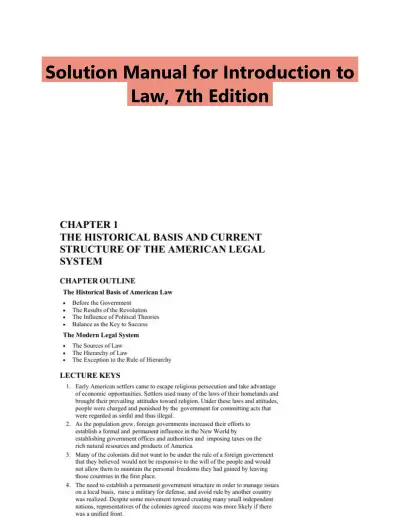 Textbook Guides
Solution Manual for Introduction to Law, 7th Edition
Civil Law
310 pagesMay 2025 Class Notes
Class Notes For Legal Terminology, 6th Edition
Civil Law
168 pages149downloadsFeb 2025 Past Exams
2024-2025 TCOLE Basic Jailer Course Practice Exam with Answers (1401 Solved Questions)
Civil Law
84 pages72downloadsFeb 2025 Class Notes
Lecture Notes For Legal Research, Analysis, and Writing, 14th Edition
Civil Law
618 pages57downloadsFeb 2025 Solved Assignments
Alcohol Regulation
Civil Law
3 pagesMay 2025 Solved Assignments
Assessment 1 Long Answer Question
Civil Law
9 pagesJun 2025 Practice Problems
Ensuring Fairness In Jury Selection: The Case Against Racial Discrimination
Civil Law
3 pagesMay 2025- Solved AssignmentsSolved Assignments
Ethical and Practical Challenges in Elder Law
Civil Law
1 pageJun 2025
Study this document with CramX
Once it is in your library, every tool can work from it.