

Lecture Notes For Legal Research, Analysis, and Writing, 14th Edition
- Civil Law
- 618 pages
- Shared February 2025
- 57 downloads
Master key topics with Lecture Notes For Legal Research, Analysis, and Writing, 14th Edition, your perfect class companion.
Preview 31 of 618 pages
See the first 31 pages exactly as they appear in the document.
Page 1 Read page 1 as text
CHAPTER 1 INTRODUCTION TO LEGAL PRINCIPLES AND AUTHORITIES Lecture Plan/Chapter Outline Instructor’s Note: The purpose of this chapter is to provide students a basic familiarity with the sources of law, hierarchy of the law, federal and state court systems, and fundamental concepts involved in legal analysis, such as precedent and authority. The material in this chapter may be covered in greater depth in other courses. It is presented here to ensure that basic information and concepts related to legal analysis and writing are covered and available to students in the text. Even if there is repetition of material presented in other courses, the information is important and bears repetition. The assignments are designed to allow students the opportunity to apply the concepts presented in this chapter. I. INTRODUCTION Define legal research, legal analysis, and law. Legal research is the process of finding the law that applies to a client’s problem. Legal analysis is the process of determining how the law applies to the problem. For the purposes of the text, law is defined as the body of enforceable rules that govern individual and group conduct in a society. II. SOURCES OF LAW Summarize the history of the U.S. legal system. A. Enacted Law Define the term enacted law and what makes up enacted law. Enacted law encompasses all law that has been adopted by a legislative body or the people. It includes: ▪ Constitutions—adopted by the people
Page 2 Page 3 Read page 3 as text
▪ Statutes, ordinances—laws passed by legislative bodies ▪ Regulations—actions of administrative bodies that have the force of law 1. Constitutions A constitution is a governing document adopted by the people. It establishes the framework for the operation of government, defines the powers of government, and guarantees the fundamental rights of the people. Both the federal and state governments have constitutions. U.S. Constitution 1. Establishes and defines the powers of the three branches of federal government: executive (president), legislative (Congress), and judicial (courts) 2. Establishes the broad powers of the federal and state governments and defines the relation between the federal and state governments 3. Defines in broad terms the rights of the members of society State Constitutions Each state has adopted a constitution that establishes the structure of the state government. In addition, each state constitution defines the powers and limits of the authority of the state government and the fundamental rights of the citizens of the state. 2. Statutes Laws passed by legislative bodies are called statutes. Statutes declare rights and duties or command or prohibit certain conduct. A statute is any law passed by any legislative body: federal, state, or local. Such laws are referred to by various terms, such as acts, codes, statutes, or ordinances. 3. Administrative Law Administrative law is the body of law created by administrative agencies. It is composed of the rules, regulations, orders, and decisions promulgated by the administrative agencies when carrying out their duties.
Page 4 Read page 4 as text
B. Common Law or Case Law Define the terms common law and case law and explain how courts create and interpret law. In a narrow sense, the term common law refers to the law created by courts in the absence of enacted law. Case law encompasses a broader range of law than common law. Case law includes not only the law created by courts in the absence of enacted law but also the law created when courts interpret or apply enacted law. 1. Role of the Courts Disputes in our society arise from specific fact situations. The courts are designed to resolve these disputes. The creation of new law and the interpretation and application of existing law by the courts become law itself. The result reached by a court is usually called a decision. The court’s written decision, which includes the reasons for the decision, is called an opinion. The case law is composed of the general legal rules, doctrines, and principles contained in court opinions. 2. Court Systems There are two parallel court systems: the federal court system and the state court system. Jurisdiction Jurisdiction is the extent of a court’s authority to hear and resolve specific disputes. A court’s jurisdiction is usually limited to two main areas: 1. Personal jurisdiction is the authority of a court over the parties to resolve a legal dispute involving the parties. 2. Subject matter jurisdiction is a court’s authority over the types and kinds of cases it may hear and decide. ▪ There are two types of courts in both the federal and state court systems:
Page 5 Read page 5 as text
1. Courts of general jurisdiction have the authority to hear and decide any matter brought before them. 2. Courts of limited jurisdiction are limited in the types of cases they can hear and decide. Concurrent Jurisdiction Concurrent jurisdiction exists when more than one court has the authority to deal with the same subject matter. Federal Court System The federal court system is composed of three basic levels of courts: 1. Trial Courts. The trial court is the court where the matter is heard and decided. If the trial is conducted by a judge and a jury, the judge decides questions of law such as what the law is or how it applies. The jury decides questions of fact such as whether a person performed a certain act. 2. Court of Appeals. The primary function of a court of appeals is to review the decision of a trial court to determine and correct any error that may have been made. 3. U.S. Supreme Court. The U.S. Supreme Court is the final court of appeals in the federal system. It is the highest court in the land. A party who disagrees with the decision of a court of appeals must ask (petition) the Supreme Court to review it. The request is called a petition for writ of certiorari. State Court System Every state has its own state court system. 1. Trial Courts. All states have trial courts where the evidence is presented, testimony taken, and a decision reached. The court of general jurisdiction is often called a district court. There are various courts of limited jurisdiction, such as probate courts, small claims courts, county courts, domestic relations courts, and magistrate courts. 2. Courts of Appeals. Many states have intermediary courts of appeals that function in the same manner and play the same role in the state court system as the federal courts of appeals does in the federal system.
Page 6 Read page 6 as text
3. State Supreme Court. Every state has a highest appellate court, usually called the supreme court. This court is the highest court in the state, and its decisions are final on all questions involving state law. 3. Precedent and Stare Decisis Precedent Precedent is an earlier court decision on an issue that applies to govern or guide a subsequent court in its determination of an identical or similar issue based on identical or similar facts. A case that is precedent is often called on point. Stare Decisis The doctrine of stare decisis is a basic principle of the case law system that requires a court to follow a previous decision of that court or a higher court when the current decision involves issues and facts similar to those involved in the previous decision. The doctrine does not apply if there is a good reason not to follow it. Some of these reasons include: 1. The earlier decision has become outdated because of changed conditions or policies. 2. The legislature has enacted legislation that has, in effect, overruled the decision of an earlier court. 3. The earlier decision was poorly reasoned or has produced undesirable results. III. HIERARCHY OF THE LAW Define what the terms federalism and the supremacy clause mean. In general, within each jurisdiction, the constitution is the highest authority, followed by the other enacted law (legislative and administrative law), then the case law. The U.S. Constitution separates the powers to govern between the federal and state governments. This separation of powers is called federalism. The supremacy clause of the Constitution (Article VI) provides that between federal and state law, federal law is supreme. IV. AUTHORITY Define the term authority.
Page 7 Read page 7 as text
Authority may be defined as anything a court may rely on when deciding an issue. It includes not only the law but also any other nonlaw source that a court may look to in reaching a decision. A. Types of Authority 1. Primary Authority Primary authority is the law itself. It is composed of the two main categories of law: enacted law and case law. 2. Secondary Authority Secondary authority is any source a court may rely on that is not the law, that is, not primary authority. Secondary authority consists of legal resources that summarize, compile, explain, comment on, interpret, or in some other way address the law. Secondary authority can be used in several ways: ▪ To obtain a background or overall understanding of a specific area of the law. Legal encyclopedias are useful for this purpose. ▪ To locate primary authority (the law) on a question being researched. American Law Reports (ALR), treatises, digests, and Shepard’s can be used for this purpose. ▪ To be relied on by the court when reaching a decision, which usually occurs only when there is no primary authority governing a legal question or it is unclear how the primary authority applies to the question. Treatises, law reviews, and Restatements of the Law are relied on for this purpose. Annotations Annotations are notes and comments on the law. One of the well-known annotations is the ALR. Law Dictionaries Legal dictionaries include definitions of legal terms (and usually a citation to the authority for the definition) and guides to pronunciation.
Page 8 Read page 8 as text
Law Reviews Law reviews are scholarly publications usually published by law schools. Legal Encyclopedias A legal encyclopedia is a multivolume set of books that provides a summary of the law. Restatements of the Law Restatements of the Law, published by the American Law Institute, presents a variety of topics and discusses what the law is on each topic or what it should be. Treatises A treatise is a single-volume or multivolume work written by an expert in an area that covers that entire area of law. B. Role of Authority 1. Mandatory Authority Mandatory authority is any source that a court must rely on or follow when reaching a decision (e.g., a decision of a higher court in the jurisdiction on the same or a similar issue). Secondary authority can never be mandatory authority. Enacted Law There is a three-step process for determining whether an enacted law applies to govern a legal question: STEP 1: Identify all the laws that may govern the question. STEP 2: Identify the elements of the law or statute. STEP 3: Apply the facts of the case to the elements. Case Law For a court opinion to be mandatory authority, binding another court to follow the rule or principle of law established in the opinion, two conditions must be met: 1. The court opinion must be on point. 2. The court opinion must be written by a higher court in that jurisdiction.
Page 9 Read page 9 as text
2. Persuasive Authority Persuasive authority is any authority a court is not bound to consider or follow but may consider or follow when reaching a decision. Primary Authority as Persuasive Authority On occasion, courts look to enacted law as persuasive authority. Secondary Authority as Persuasive Authority Secondary authority should not be relied upon when there is mandatory authority. If there is no mandatory authority and there is persuasive primary authority, the secondary authority may be used in support of the primary authority. Secondary authority is most valuable in situations where there is no primary authority, either mandatory or persuasive. V. INTRODUCTION TO LEGAL CITATION There are two manuals that provide the rules and format of legal citation. A. The Bluebook: A Uniform System of Citation (The Bluebook) The Bluebook is organized into four main parts: Introduction, Bluepages, Rules, and Tables. 1. The Bluepages and Bluepage Tables Summarize the rules for citing legal resources in documents prepared for filing in court or for use in a law office. 2. Citation Rules There are rules of citation for each type of legal source. 3. Tables List necessary abbreviations for use in citations. B. The ALWD Guide to Legal Citation (ALWD Guide) The ALWD Guide is used in many colleges and law schools. It provides ease of use and in- depth explanations of the various citation rules. It is organized into seven parts, the following are essential to its effective use:
Page 10 Read page 10 as text
1. Part 1: Introductory Material 2. Text of Citation Rules 3. How to Use Citations 4. The Appendices There are eight appendices. VI. KEY POINTS CHECKLIST VII. APPLICATION Teaching Tips Focus first on the sources of law and the types of courts. Then discuss how the hierarchy of the law and types of authority are related. This is best accomplished through a review of the examples presented in the text. Emphasize the importance of knowing the definition of the terms used in the chapter. Suggested Assignments The following are additional assignments related to the subject matter presented in this chapter. 1. Direct students to identify the number and names of the justices on the state court of appeals and the state supreme court in your state. 2. If there is more than one court of limited jurisdiction in your state, have students identify the courts and show how the jurisdiction of each differs. For example, some states have county courts and municipal courts; each court has different limited jurisdiction. 3. Have students identify the sources of law in your state and discuss the hierarchy of authority of the sources of law in your state.
Page 11 Read page 11 as text
Text Assignments: Answers ASSIGNMENT 1 Instructor’s Note: Answers vary depending on location of student. This assignment requires students to research their own state’s statutes. Because most states have more than one court of limited jurisdiction, such as municipal, probate, and county courts, the assignment may be expanded to require students to name and describe the jurisdiction of more than one limited jurisdiction court. ASSIGNMENT 2 Instructor’s Note: This assignment may be expanded to require students to describe the jurisdictional differences between a state’s court of appeals and its supreme court. A trial court is where the evidence is presented, testimony is taken, and a decision is reached. It is where the matter is heard and decided. It differs from a court of appeals in that it is not the role of a trial court to review the decision of another court. The primary function of a court of appeals is to review the decision of a trial court to determine and correct any error that may have been made. A court of appeals differs from a trial court in that it does not hear the matter; that is, it does not hear testimony, try the case, or hear the evidence. ASSIGNMENT 3 A court opinion becomes a precedent when the facts and issues of an opinion are identical or similar to the facts and issues in the case before the court. ASSIGNMENT 4 Instructor’s Note: This assignment involves the following authority, which is listed here for quick reference: 1. State A’s Uniform Commercial Code Act 2. State A’s Consumer Credit Act 3. State B’s Uniform Commercial Code Act 4. Federal statute—Consumer Credit Act 5. Iron v. Supply Co. —a decision of the highest court in state A 6. Milk v. Best Buy Inc. —a decision of the highest court in state B 7. Control Co. v. Martin —a decision of an intermediary court of appeals in state A
Page 12 Read page 12 as text
8. Lesley v. Karl Co. —a decision of a trial court in state A 9. Irene v. City Co. —a federal case involving the federal Consumer Credit Act 10. Regulations adopted by state A’s Corporation Commission that apply to consumer credit and the sale of goods 11. Restatements of the Law defining sales, consumer credit, and other terms related to the problem 12. An ALR reference that directly addresses the issues in the case ASSIGNMENT 4A Primary authority is defined as the law itself. It is composed of enacted law (constitutional, legislative, regulatory, etc.) and common law or case law (court-made law). Secondary authority is any source a court may rely on that is not the law and that is not primary authority. With these definitions in mind, numbers 1 through 10 of the above-listed authorities are primary authority. a. Numbers 1 through 4 are laws passed by state or federal legislative bodies. b. Numbers 5 through 9 are court decisions that present common law or court-made law. c. Number 10 is administrative law. The regulations adopted by the state’s Corporation Commission have the force of law. d. Numbers 11 and 12 are secondary authority. They are reference sources that are not the law. Restatements of the Law includes formulations of what the law should be and comments and discussions on why the formulations are recommended. ALR references are notes and comments on the law, not actual law. ASSIGNMENT 4B PART 1 Mandatory authority is any primary authority a court must rely on when reaching a decision. In this assignment, since the problem involves the sale of goods in state A, the mandatory authority is the authority that the courts in state A must apply when reaching a decision. Of the 12 sources of authority listed in the assignment, the following may be mandatory authority for state A courts:
Page 13 Read page 13 as text
a. Number 4, the federal Consumer Credit Act. The federal Consumer Credit Act may be mandatory authority for a state A court if, by terms of the statute, it applies to govern the particular sale-of-goods question being addressed by a state A court. b. Numbers 1, 2, and 10, state A’s Uniform Commercial Code, Consumer Credit Act, and Corporation Commission regulations, respectively. These may be mandatory authority because they are enactments of state A’s legislature or an administrative agency, all of which are laws of state A. The state courts must follow the laws enacted by the state legislative body and administrative agencies unless the laws violate the U.S. Constitution or state A’s constitution. c. Numbers 5 and 7, Iron v. Supply Co. and Control Co. v. Martin . These court opinions are decisions of the highest court and intermediary court of appeals in state A, respectively. The decisions of these courts establish the law in state A and must be followed by the courts in state A. d. Number 9, Irene v. City Co. This federal court decision can be mandatory authority because if the federal Consumer Credit Act (number 4) applies, the federal court’s interpretation of that law must be followed by state A courts. e. Number 8, Lesley v. Karl Co. Trial court decisions in a state normally are not mandatory authority. Usually, only the opinions of a state’s highest court and intermediary courts of appeal are mandatory authority that other courts in the state must follow; however, this may vary from state to state. ASSIGNMENT 4B PART 2 Not all of the primary authority will be mandatory authority for state A courts. Certain conditions must be present for primary authority to be mandatory authority. a. Number 4, the federal Consumer Credit Act. For a federal statute to be mandatory authority, the provisions of the act must apply to govern the question being addressed by the court. In addition, a federal law will not apply if its application is deemed to violate the U.S. Constitution.
Page 14 Read page 14 as text
b. Numbers 1 and 2, state A’s Uniform Commercial Code and Consumer Credit Act, respectively. State statutes are mandatory authority when: 1. Their provisions apply to govern the facts of the case. (Use the three-step process discussed in Section IV.B.1.a of this chapter.) 2. Their application does not conflict with a federal law that governs the area. 3. Their application does not violate the U.S. Constitution or the state’s constitution. c. Number 10, Regulations adopted by state A’s Corporation Commission. Regulations adopted by a state A administrative body can be mandatory authority when: 1. Their provisions apply to govern the facts of the case. (Use the three-step process discussed in Section IV.B.1.a of this chapter.) 2. Their application does not conflict with a federal or state law that governs the area, and their application does not violate the U.S. Constitution or state A’s constitution. d. Number 9, Irene v. City Co . For the federal court decision to be mandatory authority: 1. The federal statute (number 4, the federal Consumer Credit Act, in this case) must apply to govern the question. 2. The case must be on point; that is, it is sufficiently similar to the facts of the case for the decision to apply as precedent (see Chapter 12). 3. The decision must not have been superseded by a higher federal court decision. e. Number 5, Iron v. Supply Co . Under the doctrine of stare decisis, the decision of the highest court in state A is mandatory authority and must be followed by the lower courts in state A. The prerequisites are that the decision is on point (see Chapter 12) and its application does not violate either the U.S. Constitution or state A’s constitution. f. Number 7, Control Co. v. Martin . Under the doctrine of stare decisis, the decision of the intermediary court of appeals is mandatory authority and must be followed by the lower courts in state A. The prerequisites are that the decision is on point, its application does not violate either the U.S. Constitution or state A’s constitution, and
Page 15 Read page 15 as text
its application does not conflict with a higher court decision in state A (the state supreme court). Also, under the doctrine of stare decisis, the intermediary court of appeals in state A will follow an earlier decision of a state A intermediary court of appeals if the earlier decision is on point. A later court of appeals, however, is not absolutely bound to follow an earlier court of appeals decision. It is free to amend or overrule the decision if it finds that the earlier decision was in error or no longer reflects current public policy or current legal thinking. ASSIGNMENT 4C Persuasive authority is authority that a court may rely on and follow but is not bound to rely on or follow. It can be either primary or secondary authority. In certain situations, all of the 12 listed sources of authority could be persuasive authority. a. Numbers 3 and 6, state B’s Uniform Commercial Code Act and Milk v. Best Buy Inc., respectively. The statutes and case law of state B cannot be mandatory authority in state A. A state is not required to follow the law of other states; however, in the absence of mandatory authority in state A, state A courts may consider, adopt, or follow state B law and court decisions. For a court decision to be considered persuasive authority, the decision must be on point. That is, the key facts and applicable law of the court opinion must be sufficiently similar to the key facts and applicable law of the case being heard by the court before the opinion may provide guidance to the court in deciding an issue (see Chapter 12). b. Numbers 11 and 12, Restatements of the Law defining sales, consumer credit, and other terms related to the problem and an ALR reference that directly addresses the issues in the case, respectively. Restatements of the Law and ALR references are secondary authority and therefore are not mandatory authority. In the absence of mandatory authority, a court may look to and adopt secondary authority if it so chooses. The usual prerequisite is that the secondary authority is on point; that is, it addresses legal questions and applies laws or legal principles that are sufficiently
Page 16 Read page 16 as text
c. similar to the questions and laws being applied in the case before the court. d. Number 8, Lesley v. Karl Co . A decision of a state trial court is not mandatory authority for other trial courts or higher courts in the state. The other courts, including the higher state courts, may consider, adopt, or follow a decision of a trial court. e. Numbers 5, 7, and 9, Iron v. Supply Co., Control Co. v. Martin, and Irene v. City Co., respectively. When the decision of a federal court or a higher state court is not mandatory authority (see the previous discussion in Assignment 4B), the reasoning or holding may still be persuasive precedent and considered, adopted, or followed in whole or in part. An opinion may not be mandatory authority, but a court may consider it persuasive authority when: ▪ It is not on point, but the court refers to the reasoning or analysis in the decision for general guidance in interpreting the statute (see Chapter 12). ▪ The decision has been superseded by a higher state court or later court of appeals decision in state A, yet the reasoning or analysis in the decision is persuasive to a subsequent court. The court may refer to the prior reasoning or analysis unless it was rejected by the subsequent ruling. ▪ The question is governed by a federal statute but there is no federal case law interpreting the statute, leaving the state case as guidance. ▪ The question is governed by a state statute but there is no state case law interpreting the statute; then, a federal case law may be referred to for guidance. f. Numbers 1, 2, 3, 4, and 10, state A’s Uniform Commercial Code Act, state A’s Consumer Credit Act, state B’s Uniform Commercial Code Act, the federal Consumer Credit Act, and Regulations adopted by state A’s Corporation Commission that apply to consumer credit and the sale of goods, respectively. A statute or regulation may not be mandatory authority because the elements of the law do not apply to govern the facts of the case. When a statute or regulation does not apply, a court may still look to the statute or regulation for guidance when interpreting another law that has similar provisions.
Page 17 Read page 17 as text
A term defined in Act A may not be defined in Act B, the act that governs the problem being addressed by the court. In this situation, the definition in Act A may be relied on by the court, guide it in its interpretation of the term in Act B, and be adopted in whole or in part. In such a situation, Act A can be persuasive authority. ASSIGNMENT 4D In general, the hierarchy of primary authority within each jurisdiction is the constitution (the highest authority), followed by the enacted law (legislative and administrative), then the common, or court-made, law. When state and federal law both apply, the federal law takes precedence over state law. When there is primary mandatory authority and primary persuasive authority, the primary mandatory authority takes precedence over the primary persuasive authority. With these guidelines in mind, the hierarchy of the primary authority listed in the assignment is as follows (the highest primary authority is listed first followed by the next highest, and so forth): 1. Number 4, Consumer Credit Act—the federal statute 2. Numbers 1 and 2, state A’s Uniform Commercial Code Act and state A’s Consumer Credit Act, respectively—the more specific statute generally has the greater authority value 3. Number 10, Regulations adopted by state A’s Corporation Commission that apply to consumer credit and the sale of goods 4. Number 9, Irene v. City Co. —a federal case involving the federal Consumer Credit Act 5. Number 5, Iron v. Supply Co. —a decision of the highest court in state A 6. Number 7, Control Co. v. Martin —a decision of intermediary court of appeals in state A 7. Number 8, Lesley v. Karl Co. —a decision of the trial court in state A (As mentioned in Assignment 4C, the decisions of state trial courts do not usually have authoritative value. If in state A, certain trial court decisions have authoritative value, then that value is mandatory authority only for any courts lower than the
Page 18 Read page 18 as text
trial court in that jurisdiction and takes precedence over persuasive authority, such as the persuasive authority listed below.) 8. Number 3, state B’s Uniform Commercial Code Act (State B’s legislative enactments cannot be mandatory authority in state A. This statute’s value as authority is subordinate to the authority listed above, all of which can be mandatory authority.) 9. Number 6, Milk v. Best Buy Inc. —a decision of the highest court in state B (Like Number 3 above, this is persuasive authority and is subordinate to the mandatory authority.) ASSIGNMENT 5 This assignment involves the following authority, which is listed here for quick reference. 1. Idle v. City Company —a 1980 decision by the highest court of state A in which the court created a cause of action in tort for the wrongful destruction of business records. The court ruled that a cause of action exists if the records were destroyed in anticipation of or while a worker’s compensation claim was pending. The court also held that a cause of action exists if the destruction was intentional or negligent. 2. A 1989 state A statute—a law passed by the legislature of state A that created a cause of action in tort for the intentional destruction of business records. The statute provides that a cause of action exists if the destruction occurs in anticipation of or while a worker’s compensation claim is pending. 3. Merrick v. Taylor —a 1990 decision of the court of appeals of state A. The court of appeals is a lower court than the state’s highest court. The court held that the term intentional within the meaning of the 1989 statute includes either the intentional destruction of records or the destruction of records as a result of gross negligence. 4. Davees v. Contractor —a decision of the highest court of state B interpreting a state B statute identical to the 1989 state A statute. The court held that intentional as used in the statute includes gross negligence only when the gross negligence is accompanied by a “reckless and wanton” disregard for the preservation of the business records.
Page 19 Read page 19 as text
5. A 1991 federal statute—the statute is identical to the 1989 state statute. It only applies to contractors with federal contracts. 6. ALR reference—an ALR reference that addresses specific questions similar to those raised in the client’s case. ASSIGNMENT 5A As discussed in Assignment 4A, primary authority is defined as the law itself. It is composed of the enacted law (constitutional, legislative, regulatory, etc.) and the common law or case law (court-made law). Secondary authority is any source a court may rely on that is not the law— and that is therefore not primary authority. Numbers 1 through 5 on this list are primary authority. Number 6, the ALR reference, is secondary authority; it is not the law. ASSIGNMENT 5B a. Numbers 2, 3, and 5 can be mandatory authority. Numbers 2 and 5 are statutory law (enactments of legislative bodies), both of which could apply to govern the question of whether the destruction of business records constitutes a tort. Number 2, the 1989 state A statute, is mandatory authority if the client pursues a tort claim against the employer for the destruction of the business records. The application of the statute is not preempted by the application of the federal statute, and the application of the statute does not conflict with the provisions of the U.S. Constitution or state A’s constitution. Number 3, Merrick v. Taylor, is a decision of the court of appeals of state A and can be mandatory authority for the lower courts in state A. Merrick v. Taylor can be mandatory authority if the case is on point, it has not been superseded by a higher state court decision, its application does not violate the U.S. Constitution or state A’s constitution, and the question involves the interpretation of the 1989 state A statute. Number 5, the 1991 federal statute, can be mandatory authority if the client’s employer is a contractor with a federal contract and the application of the statute does not violate the U.S. Constitution.
Page 20 Read page 20 as text
b. Number 1, Idle v. City Co., is probably not mandatory authority because it has been superseded by the 1989 state A statute (Number 2). See the discussion of this case in Assignment 5D. ASSIGNMENT 5C As discussed in Assignment 4C, persuasive authority is authority a court may rely on and follow but is not bound to rely on or follow. It can be either primary or secondary authority. In certain situations, all of the six listed sources of authority could be persuasive authority, with the possible exception of Number 1, Idle v. City Co . If Idle has been superseded by the 1989 state A statute, then it may not be authority at all. Refer to the discussion of this case in Assignment 5D. a. Number 2, a 1989 state A statute. The 1989 state A statute may be persuasive authority if the cause of action is based on another statute that has similar provisions to the 1989 statute and the court looks to the statute for guidance when interpreting the similar provisions. b. Number 3, Merrick v. Taylor . Merrick can be persuasive authority when: ▪ It is not on point; a court may refer to the reasoning or analysis in the decision for general guidance in interpreting the statute (see Chapter 12). ▪ The decision has been superseded by a higher state court or later court of appeals decision in state A, yet subsequent courts have found the reasoning or analysis in the decision to be persuasive. A court may refer to the prior reasoning or analysis unless it has been rejected by a subsequent ruling. ▪ The question is governed by a federal statute but there is no federal case law interpreting the statute, resulting in reliance on the state case for guidance. (This answer is similar to the answer in Assignment 4C[d].) c. Number 4, Davees v. Contractor . Decisions of other states may act as persuasive precedent. In the absence of mandatory authority in state A, state A courts may consider, adopt, or follow state B law and court decisions. For a court decision to be
Page 21 Read page 21 as text
d. considered persuasive authority, the decision must be on point. That is, the key facts and applicable law of the court opinion must be sufficiently similar to the key facts and applicable law of the case being heard by the court before the opinion may provide guidance to the court in deciding an issue (see Chapter 12). e. Number 5, a 1991 federal statute. The federal statute may not be mandatory authority because the elements of the law do not apply to govern the facts of the case. When a statute does not apply, a court may still look to the statute or regulation for guidance when interpreting another law that has similar provisions. (This answer is similar to the answer in Assignment 4C[e].) f. Number 6, an ALR reference. An ALR reference is not mandatory authority; it is secondary authority and therefore is persuasive authority by definition. In the absence of mandatory authority, a court may look to and adopt secondary authority if it so chooses. The usual prerequisite is that the secondary authority is on point; that is, it addresses legal questions and applies laws or legal principles that are sufficiently similar to the questions and laws being applied in the case before the court. (This answer is similar to the answer in Assignment 4C[b].) ASSIGNMENT 5D Idle v. City Co. is probably not mandatory authority because it has been superseded by the 1989 state A statute (Number 2). The 1989 state A statute was enacted subsequent to the Idle decision and creates a statutory cause of action in tort for the intentional destruction of business records. Legislative bodies have the authority to modify or replace court decisions. This authority is only limited by the requirement that the legislative act may not violate the U.S. Constitution or the state constitution. In this instance, the Idle decision created a cause of action in tort for the intentional or negligent destruction of business records while a worker’s compensation claim was pending. The subsequent state A legislative act replaces the court decision with a statute that limits the cause of action to the intentional destruction of business records.
Page 22 Read page 22 as text
By not including in the statute a cause of action for the negligent destruction of business records, that cause of action has been eliminated. The legislature is presumed to be aware of the law created by court decisions. By passing a statute that specifically addressed and narrowed a cause of action created by the court, the legislature appears to have intended to replace the decision of the court in Idle v. City Co . The statute, therefore, probably supersedes the court decision. ASSIGNMENT 5E If Idle v. City Co. can be considered authority at all, it would only be authority for guidance in interpreting that portion of the cause of action that was not eliminated by the 1989 state A statute. The statute provides a cause of action for intentional destruction of business records. The part of the Idle decision that addressed the intentional destruction of business records may be considered authority. Any reasoning, rules, principles, or guidelines presented in the case concerning the intentional destruction of records may be considered authority by subsequent courts addressing issues involving the intentional destruction of business records. ASSIGNMENT 5F Merrick v. Taylor is a state court of appeals decision that interprets the “intentional destruction of business records” as used in the statute to include the destruction of records as a result of gross negligence. In effect, the decision expands the scope of the statute to include the negligent destruction of business records if the type of negligence is gross negligence. Courts have the authority to interpret statutes, and through the use of this authority, courts have the power to expand or restrict the operation of a statute. ASSIGNMENT 5G Davees v. Contractor (Number 4), a state B court decision, cannot be mandatory authority in state A. State courts are never bound to follow the decisions of other states. The requirements for a court decision in another state to be persuasive authority are discussed in the answer to Assignment 5C. In Davees, the highest court of state B interpreted a state B statute identical to the 1989 state A statute. The court interpreted the terms “intentional destruction of business records”
Page 23 Read page 23 as text
to include grossly negligent acts only when the gross negligence was accompanied by a “reckless and wanton” disregard for the preservation of the records. If a state A court is addressing the question of what constitutes gross negligence as discussed in Merrick v. Taylor, it may look to the Davees decision for guidance if the question has not already been addressed by state A courts. In this situation, the Davees decision would be considered persuasive authority. ASSIGNMENT 5H Instructor’s Note: The introduction to this assignment is the same as the introduction to Assignment 4D; both assignments address the same question. In general, the hierarchy of primary authority within each jurisdiction is the constitution (the highest authority), followed by enacted law (legislative and administrative), and then common law or court-made law. When state and federal law both apply, federal law takes precedence over state law. When there is primary mandatory authority and primary persuasive authority, the primary mandatory authority takes precedence over the primary persuasive authority. With these guidelines in mind, the hierarchy of the primary authority listed in Assignment 5 is as follows (the highest primary authority is listed first followed by the next highest, and so forth): Number 5, a 1991 federal statute. If the federal law applies, it is higher authority than the state law. Number 2, a 1989 state A statute. The state law is subordinate to the federal law when the federal law applies. When the state law does apply, it is higher authority than case law. Number 3, Merrick v. Taylor. The decision of the state A court of appeals involving state A law is the next highest authority, unless there is a higher state A court decision on the subject. This assumes that the Idle v. City Co. decision is no longer authority because it has been replaced by the 1989 statute. If Idle is primary authority, it is higher authority than Merrick because it is a decision of a higher state A court than the court of appeals that decided the Merrick case.
Page 24 Read page 24 as text
Number 4, Davees v. Contractor. The case law of state B cannot be mandatory authority in state A. A state is not required to follow the law of other states. At most, the decisions of other states are persuasive authority. In the absence of mandatory authority in state A, state A courts may consider, adopt, or follow state B court decisions. The Davees decision has the least authoritative value of the primary authority presented in the assignment because numbers 1, 2, 3, and 5, in certain situations, can be mandatory authority in state A, and mandatory authority is higher authority than persuasive authority. MindTap Supplementary Exercises: Answers ASSIGNMENT 1 Instructor’s Note: Most state supreme courts have websites. Many, but not all, courts of general jurisdiction also have websites. A general search, using the name of the court as the topic, will usually help find the court. For example, the search topic “Texas Supreme Court” will locate the court’s website. One of the best sites for finding state court sites is http://www.findlaw.com. ASSIGNMENT 2 Mandatory authority is any source that a court must rely on or follow when reaching a decision. Persuasive authority is any authority a court is not bound to consider or follow but may consider or follow when reaching a decision. Examples will vary. ASSIGNMENT 3 This assignment involves the following authority, which is listed here for quick reference. 1. A 1998 state A statute that provides that a candidate for state supreme court judge must have resided in the state three years prior to the election. 2. A 2000 state B statute that states that individuals running for any county or municipal office must have resided in the county or municipality for six months. 3. Garcia v. Municipality of Weston . A 2001 state A court of appeals decision providing that a person running for state senate must reside within the senate district for a minimum of one year prior to the election.
Page 25 Read page 25 as text
4. Reisin v. City. A state B supreme court decision holding that a person running for any municipal position must reside in the municipality for three months. 5. American Jurisprudence Second section, which provides that most states have a three- month residency requirement for the purposes of eligibility to run for municipal positions. ASSIGNMENT 3A Primary authority is the law itself, such as constitutional, statutory, or case law. Numbers 1 and 2 are statutory laws and therefore primary authority. Numbers 3 and 4 are case laws and therefore primary authority. Number 5 is secondary authority. ASSIGNMENT 3B Mandatory authority is any source that a court must rely on when reaching a decision. Primary authority becomes mandatory authority only when it governs the legal question or issue being decided by the court. None of the authority is mandatory authority. 1. The 1998 state A statute does not apply to municipal elections; therefore, it is not mandatory authority. 2. The 2000 state B statute is not a state A statute and state B law does not apply to state A matters; therefore, it does not apply to state A elections. 3. Garcia v. Municipality of Weston does not apply to municipal elections; therefore, it does not govern the issue of the residency requirement for those elections. 4. Reisin v. City is a state B court decision, and state B court decisions do not have to be followed in state A. 5. American Jurisprudence Second is secondary authority, and secondary authority is not the law and can never be mandatory authority. ASSIGNMENT 3C Persuasive authority is any authority a court is not bound to consider or follow but may consider or follow when reaching a decision. All of the authority listed may be persuasive authority because all may act as guidance for a court when deciding the question of residency requirements for municipal elections. The state A statute and court decision are state A laws
Page 26 Read page 26 as text
that establish the residency requirements for certain state A elections and may be considered when addressing questions concerning municipal elections. The state B statute and court decision provide guidance as to how another state has addressed residency requirements for municipal elections. The American Jurisprudence Second section provides guidance as to how most states have addressed the question. ASSIGNMENT 4 Answers will vary by student. ASSIGNMENT 5 Answers will vary by student. ASSIGNMENT 6 Precedent is an earlier court decision on an issue that applies to govern or guide a subsequent court in its determination of an identical or similar issue based on identical or similar facts. Stare decisis is a basic principle of the case law system that requires a court to follow a previous decision of that court or a higher court when the current decision involves issues and facts similar to those involved in the previous decision. That is, similar cases are decided in similar ways. ASSIGNMENT 7 Answers will vary by student. ASSIGNMENT 8A Primary authority is the law itself—constitutional, statutory, or case law. The following are primary authority: 1. The 1982 state A embezzlement statute 2. State v. Pete 3. State v. Artee 4. State v. Stahl 5. United States v. Crimm 6. Federal Statute 18 U.S.C. §641 The Am. Jur. section and the law review article are secondary authority—they are not constitutional provisions, enacted law, or case law.
Page 27 Read page 27 as text
ASSIGNMENT 8B Mandatory authority is any primary authority a court must rely on when reaching a decision. The following can be mandatory authority: 1. Since the problem involves a charge of embezzlement in state A, the 1982 state A statute is mandatory authority. 2. Since State v. Pete is a decision of the highest court of state A, it will be mandatory authority if it is on point. 3. Since State v. Artee is also a decision of a state A court, it will be mandatory precedent for lower courts in the state if it is on point. ASSIGNMENT 8C Persuasive authority is authority a court may rely on and follow but is not bound to rely on or follow. It can be either primary or secondary authority. The following could be persuasive authority: 1. State v. Pete and State v. Artee could be persuasive authority if it is determined that they are not sufficiently on point to be mandatory authority. Even though they are not on point, the court still may be persuaded to follow guidance provided in the opinions. 2. Since State v. Stahl is not an opinion of a state A court, it cannot be mandatory authority; however, it could be persuasive authority if the state A court considers it sufficiently on point to provide guidance. 3. Since United States v. Crimm is not an opinion of a state A court, it cannot be mandatory authority. Like State v. Stahl , it could be persuasive authority if a state A court considers it sufficiently on point to provide guidance. 4. Both the Am. Jur. section and the law review article could be persuasive authority. Even though these secondary authority sources cannot be mandatory authority, they can be persuasive authority. A court may look to and follow the guidance of these sources if they are on point, that is, if they address legal questions and apply laws or
Page 28 Read page 28 as text
legal principles that are sufficiently similar to the questions and laws being applied in the case before the court. ASSIGNMENT 8D In general, the hierarchy of authority within each jurisdiction is the constitution (the highest authority), followed by the enacted law (legislative and administrative), then common law, or court-made law, and then secondary authority. When there is primary mandatory authority and primary persuasive authority, the primary mandatory authority takes precedence over the primary persuasive authority. With these guidelines in mind, the hierarchy of the primary authority listed in the assignment is as follows (the highest primary authority is listed first followed by the next highest, and so forth). 1. The 1982 state A statute is the highest authority. Applicable state law is higher authority than applicable case law. 2. State v. Pete is the highest court decision in a state A court. 3. State v. Artee is the second-highest decision of a state A court. 4. State v. Stahl is a decision by a nonstate A court (a state B court). 5. The law review article published in 2004 discusses what constitutes entrustment and conversion. The law review article probably is more specific and on point than the Am. Jur. section. 6. 26 Am. Jur. 2d Embezzlement §23 (2006). ASSIGNMENT 8E a. The federal statute and United States v. Crimm probably do not have authoritative value in this case because the charges are state, not federal. Although federal law usually takes precedence over state law when both apply to a fact situation, this is a state criminal charge, and federal law does not apply. A state court is not bound by federal law when dealing with state matters. There is probably not a situation in this case in which the federal statute will have authoritative value. The court may look to the federal statute for guidance, such as
Page 29 Read page 29 as text
when interpreting a term not defined by the statute being applied by the court. In this case, the federal statute is entirely different from the state statute and probably will not be looked to by the state court. United States v. Crimm could be persuasive authority if the state A court considers it sufficiently on point to provide guidance in making its decision. MindTap Study Questions: Answers 1. Law is defined as the enforceable rules that govern individual and group conduct in a society. 2. Legal analysis involves a determination of how the law applies to a client’s facts. It requires knowledge of what the law is and the general principles that govern its application. 3. Enacted law is the body of law adopted by the people or legislative bodies. It includes constitutions, statutes/ordinances, and regulations. 4. Case law encompasses a broader range of law than common law does. Case law includes not only the law created by courts in the absence of enacted law but also the law created when courts interpret or apply enacted law. 5. There are two parallel court systems, the federal court system and the state court system. The federal court comprises trial courts, court of appeals, and the U.S. Supreme Court. The state court system comprises trial courts, court of appeals, and the state supreme court. 6. Jurisdiction is the extent of a court’s authority to hear and resolve specific disputes. Jurisdiction is limited to personal jurisdiction and subject matter jurisdiction. Personal jurisdiction is the authority of the court over the parties to a legal dispute. Subject matter jurisdiction is the court’s authority over the types and kinds of cases it may hear and decide. 7. Personal jurisdiction is the authority of the court over the parties to resolve a legal dispute involving the parties. Example will vary.
Page 30 Read page 30 as text
8. Subject matter jurisdiction is the court’s authority over the types and kinds of cases it may hear and decide. Example will vary. 9. Concurrent jurisdiction exists when more than one court has the authority to deal with the same subject matter. Example will vary. 10. The trial court is the court where the matter is heard and decided. Evidence is presented, testimony taken, and a decision reached. There are trial courts of general jurisdiction and trial courts of limited jurisdiction. 11. A court of appeals is a court that reviews the decision of a trial court or other lower court to determine and correct any error that may have been made. It only reviews what took place in the trial court. It does not hear new testimony, retry the case, or reconsider the evidence. It reviews the record of the lower court and takes appropriate action to correct any errors. These courts are also called circuit courts. 12. Precedent is an earlier court decision on an issue that applies to govern or guide a subsequent court in its determination of an identical or similar issue based on identical or similar facts. 13. The doctrine of stare decisis is a basic principle of the common law system that requires a court to follow a previous decision of that court or a higher court when the current decision involves issues and facts similar to those involved in the previous decision. 14. The supremacy clause of the Constitution (Article VI) provides that between federal and state law, federal law is supreme. If an enacted law or court decision of a state conflicts with a federal law or court decision, the state law/decision is invalid to the extent it conflicts with the federal law/decision. Examples will vary. 15. Primary authority is the law itself. It is composed of the two main categories of law: enacted law and common law or case law. Courts refer to and rely on primary authority first when resolving legal problems.
Page 31 Read page 31 as text
16. Secondary authority is any source a court may rely on that is not the law, that is, not primary authority. Secondary authority consists of legal resources that summarize, compile, explain, comment on, interpret, or in some other way address the law. 17. Mandatory authority is any source that a court must rely on or follow when reaching a decision (e.g., a decision of a higher court in the same jurisdiction on the same or a similar issue). 18. Persuasive authority is any authority a court is not bound to consider or follow but may consider or follow when reaching a decision. 19. The four main parts of The Bluebook are the Introduction, Bluepages, Rules, and Tables.
587 more pages in the full document
Unlock it once and it stays in your library, ready to chat with or turn into flashcards.
Unlock the full documentMore Civil Law study materials
See all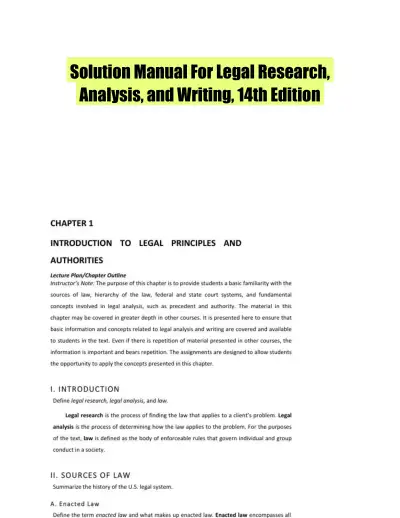 Textbook Guides
Solution Manual For Legal Research, Analysis, and Writing, 14th Edition
Civil Law
618 pagesMay 2025 Class Notes
Class Notes For Legal Terminology, 6th Edition
Civil Law
168 pages149downloadsFeb 2025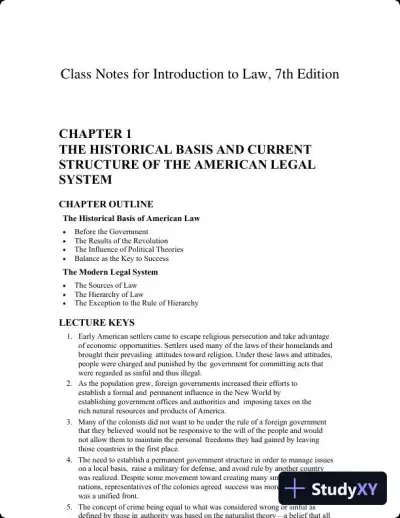 Class Notes
Lecture Notes for Introduction to Law, 7th Edition
Civil Law
310 pages121downloadsFeb 2025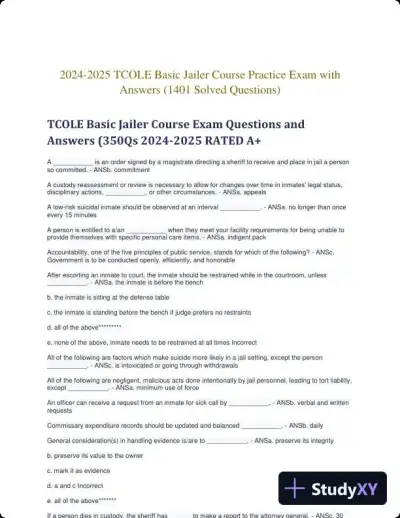 Past Exams
2024-2025 TCOLE Basic Jailer Course Practice Exam with Answers (1401 Solved Questions)
Civil Law
84 pages72downloadsFeb 2025 Solved Assignments
Alcohol Regulation
Civil Law
3 pagesMay 2025 Solved Assignments
Assessment 1 Long Answer Question
Civil Law
9 pagesJun 2025- Solved AssignmentsSolved Assignments
Ethical and Practical Challenges in Elder Law
Civil Law
1 pageJun 2025  Solved Assignments
The Case for Raising the Legal Driving Age to 18: Ensuring Safety and Responsibility on the Roads
Civil Law
4 pagesMay 2025
Study this document with CramX
Once it is in your library, every tool can work from it.