
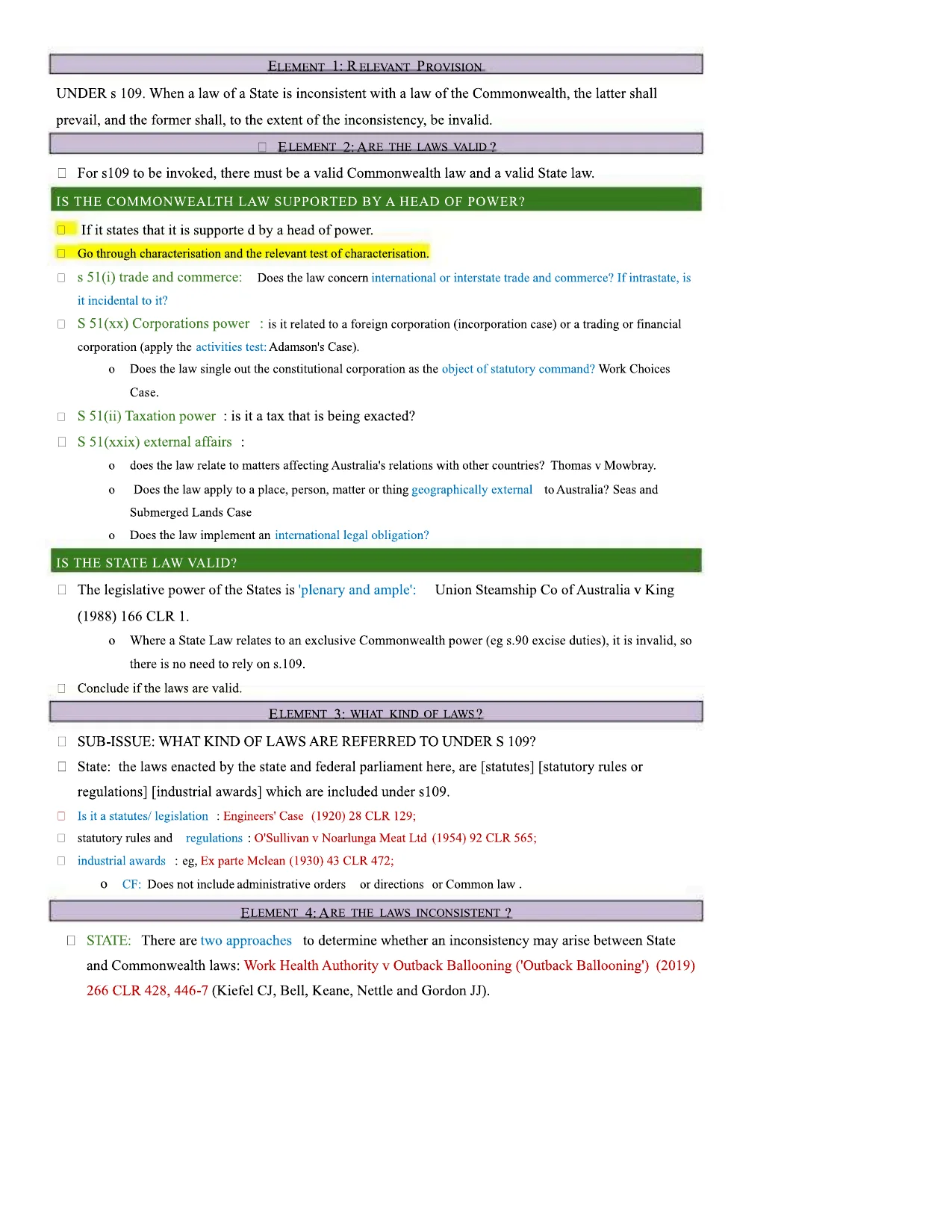
 |ET.EMF.NT1: RELEVANTPROVISION.UNDER s 109. When a law of a State is inconsistent with a law of the Commonwealth, the latter shallprevail, and the former shall, to the extent of the inconsistency, be invalid.L _______________□ELEMENT2: ARETHE LAWS VALID?______________________________For s109 to be invoked, there must be a valid Commonwealth law and a valid State law.IS THE C O M M O N W E A L T H LAW S U P P O R T E D BY A HEAD OF P O W E R ?If it states that it is supporte d by a head of power.Go through characterisation and the relevant test of characterisation.s 51(i) trade and commerce:Does the law concern international or interstate trade and commerce? If intrastate, isit incidental to it?ES 5 l(xx) Corporations power: is it related to a foreign corporation (incorporation case) or a trading or financialcorporation (apply the activities test: Adamson's Case).oDoes the law single out the constitutional corporation as the object of statutory command? Work ChoicesCase.S 51(ii) Taxation power : is it a tax that is being exacted?S 51(xxix) external affairs:odoes the law relate to matters affecting Australia's relations with other countries? Thomas v Mowbray.oDoes the law apply to a place, person, matter or thing geographically externalto Australia? Seas andSubmerged Lands CaseoDoes the law implement an international legal obligation?IS THE STATE LAW VALID?The legislative power of the States is 'plenary and ample':Union Steamship Co of Australia v King(1988) 166 CLR 1.oWhere a State Law relates to an exclusive Commonwealth power (eg s.90 excise duties), it is invalid, sothere is no need to rely on s.109.Conclude if the laws are valid.ELEMENT3:WHATKIND OF LAWS?SUB-ISSUE: WHAT KIND OF LAWS ARE REFERRED TO UNDER S 109?CState: the laws enacted by the state and federal parliament here, are [statutes] [statutory rales orregulations] [industrial awards] which are included under si 09.Is it a statutes/ legislation: Engineers' Case(1920) 28 CLR 129;Estatutory rules andregulations : O'Sullivan v Noarlunga Meat Ltd (1954) 92 CLR 565;Eindustrial awards: eg, Ex parte Mclean (1930) 43 CLR 472;oCF: Does not include administrative ordersor directionsor Common law .ELEMENT4: ARETHELAWS INCONSISTENT ?STATE: There are two approachesto determine whether an inconsistency may arise between Stateand Commonwealth laws: Work Health Authority v Outback Ballooning ('Outback Ballooning') (2019)266 CLR 428, 446-7 (Kiefel CJ, Bell, Keane, Nettle and Gordon JJ).
Preview Mode
This document has 7 pages. Sign in to access the full document!