

Solution Manual for Introduction to Law, 6th Edition
- Civil Law
- 58 pages
- Shared May 2025
Solution Manual for Introduction to Law, 6th Edition is the perfect textbook guide, offering thorough solutions to all your textbook exercises.
Preview 16 of 58 pages
See the first 16 pages exactly as they appear in the document.
Page 1 Read page 1 as text
Solution Manual for Introduction to Law Sixth Edition Joanne Banker Hames DeAnza Community College Yvonne Ekern Santa Clara University, School of Law Instructor’s Manual and Testbank prepared by Mark Morrison
Page 2 Page 3 Read page 3 as text
iii CONTENTS Contents iii TestBank Word Exports iv To the Instructor v Syllabi vi Chapter 1: Introduction to Law 1 Chapter 2: The U.S. Legal System 4 Chapter 3: The Courts and Legal Personnel 9 Chapter 4: Finding the Law: Legal Research 12 Chapter 5: Using the Law: Legal Analysis and Writing 14 Chapter 6: Constitutional Law 17 Chapter 7: Tort Law 19 Chapter 8: Family Law 22 Chapter 9: Estate Planning: Wills, Trusts, and Probate 27 Chapter 10: Contract and Property Law 29 Chapter 11: The Business Environment 33 Chapter 12: Civil Procedure Before Trial 37 Chapter 13: Alternative Dispute Resolution 41 Chapter 14: Criminal Practice: Criminal Law and Juvenile Law 45 Chapter 15: Criminal Procedure before Trial 47 Chapter 16: Rules of Evidence 50 Chapter 17: The Trial 53 Chapter 18: Alternative Dispute Resolution 55
Page 4 Read page 4 as text
1 Chapter 1 Introduction to Law CHAPTER OVERVIEW Chapter 1 provides an overview of the nature of law and its historical origins and philosophical theories. This chapter also explains some of the more common categories of law, including the sources of law, the distinction between substantive and procedural law and the differences between criminal and civil law. CHAPTER OBJECTIVES 1. Define the term law. 2. List some of the historical origins of law. 3. Explain the basic concepts of a civil law legal system. 4. Explain the basic concepts of a common law legal system. 5. List and describe three major philosophical theories of law. 6. List three important categories of law. 7. Explain the purpose of substantive laws. 8. Explain the purpose of procedural laws. 9. Provide examples of substantive criminal laws and substantive civil laws. 10. Compare and contrast procedures in a criminal case with procedures in a civil case. LECTURE OUTLINE 1. Case File – Centerville News: March 10 2. Introduction 3. What Law Is 4. Categories of Law 5. Chapter Cases 6. Case Summaries LIST OF CHANGES/TRANSITION GUIDE Feedback from instructors and students who use this text confirmed that the basic organization and features of this textbook are successful. Students especially appreciate the extensive key term definitions in the margin, the interesting cases, and the wide use of common hypothetical cases to explain the application of legal principles. These features remain in the text. However, the law is not, nor will it ever be, a static entity. Any useful textbook dealing with the law must reflect these changes. As a result, our goal in this edition is to also provide students with the following. • Updates to the law and exhibits containing current legal forms and court documents • A broader view of some of the substantive and procedural areas of law • Updated information on the use of technology in law practice • Discussion of new court cases illustrating current trends in the development of our laws • More practice in building critical thinking skills with additional case questions and end-of-chapter exercises. All chapters have been reviewed, edited, and updated so as to contain current law and legal forms.
Page 5 Read page 5 as text
2 QUESTIONS FOR REVIEW Suggested answers: 1. A set of rules and procedures usually intended to regulate some aspect of society. 2. Code of Hammurabi and the Napoleonic Code. 3. Stare decisis / Medieval England 4. A civil law legal system is based on written laws or codes. A common law legal system is developed through the courts. 5. Study of philosophy of law. 6. Natural theory of law is a philosophical theory holding that law reflects the moral and unchangeable laws of nature. Legal positivism is a philosophical theory holding that the validity of law is not related to morality. Legal realism is a philosophical theory that laws are created by judges and therefore subject to individual beliefs and prejudices. 7. U.S. laws generally stem from one of three sources: a constitution, a statute, or a case decision; they are known accordingly as constitutional law, statutory law, or case law. 8. Substantive laws are laws that define our rights and obligations. Procedural laws are laws that dictate how we enforce our rights and obligations. 9. Due process of law. 10. Procedural laws or rules tell us how we enforce substantive rights. Often, these rules deal with the court process. Where a lawsuit should be filed, what the time limit is for filing the action, and what type of papers must be filed in court are all questions of procedural law. The answers to these types of procedural questions are generally found in statutory law or rules of court. Rules of court are laws that are adopted by various courts with power given to the courts by the legislature. However, in both criminal and civil cases both constitutional and case law are sometimes important in determining the procedures that must be followed. In the area of criminal law, the U.S. Constitution specifies several procedures that must be followed by police, by prosecutors, and by the court. For example, in criminal cases, a defendant has the right to have an attorney. The defendant also has a right to due process of law. In the area of civil law, the selection of the proper court in which to initiate the lawsuit is sometimes a problem. Civil lawsuits must be filed in a court that has jurisdiction. Jurisdiction is a complicated legal subject, but refers to the fact that the court must have the power or authority to hear a case. The U.S. Constitution limits the types of cases that can be brought in federal courts. The concept of due process of law also applies to jurisdiction and limits the rights of courts to hear cases against defendants who do not reside within the state in which the court is located. This is an increasingly important issue with the amount of business done over the Internet. When constitutional procedural issues arise, courts are often required to determine how the Constitution applies to the specific facts of the case. APPLICATION AND ANALYSIS PROBLEMS Suggested Answers: 1. The landlord in Smith was not allowed to refuse to rent. The court stated that the landlord’s religious beliefs “may not permit her to rent to unmarried cohabitants, but the right of free exercise does not relieve an individual of the obligation to comply with a valid and neutral law of general applicability on the ground that the law proscribes conduct that his religion prescribes.” (p. 1161)
Page 6 Read page 6 as text
3 2. In ‘North Coast Woman’s Care Medical Group’ the court stated that California has a civil rights law that prevents a business from discriminating based on sexual orientation. Because this is a valid and neutral law, the doctors had no First Amendment right to discriminate. 3. The action against the officers was civil and not involving the state or any criminal law. 4. This is a criminal case. It resulted from the commission of a crime and was brought by the state, not the victim. 5. Answers will vary. ASSIGNMENTS AND PROJECTS Suggested answers: 1. Answers will vary. 2. Answers will vary. 3. Answers will vary. SKILLS ASSESSMENT Suggested answers: 1. This is a civil case resulting from a civil lawsuit filed by a rape victim under 42 U.S.C. § 13981. 2. (a.) Criminal. (b.) Civil. 3. (a.) Criminal. (b.) Eighth and Fourteenth Amendments. (c.) The Court looked at recent history and examined how state legislatures and the international community had been eliminating the death penalty for juveniles. (d.) The Court considered the humanity of the death penalty, the national and international consensus against the use of the death penalty on juveniles and weighed the nature of the penalty against the immaturity and lack of judgment of juveniles.
Page 7 Read page 7 as text
4 Chapter 2 The U.S. Legal System CHAPTER OVERVIEW Chapter 2 provides an overview of the U.S. legal system. Included is a discussion of the concept of federalism. The different branches of federal and state governments are discussed. The three major sources of laws, constitutions, case law and statutory law, are defined and explained. OBJECTIVES 1. Explain the concept of federalism. 2. Describe the power of the federal government to make laws and identify the source of that power. 3. Discuss the limits on the right of the states to make laws. 4. Explain the difference between exclusive and concurrent jurisdiction as related to the law-making process. 5. Explain how the Supremacy Clause relates to the law-making power of the states. 6. Identify and describe the function of each branch of the federal government. 7. Describe role of the U.S. Constitution and state constitutions. 8. Explain how the concept of precedent or stare decisis operates today. 9. Compare and contrast case law and statutory law. 10. Outline the legislative process for the enactment of laws. LECTURE OUTLINE 1. Case File – The Richfield Matters 2. Introduction 3. Federalism – the Relationship Between Federal and State Government 4. The Federal Government and the Legal System 5. State Governments and the Legal System 6. Sources of U.S. Law 7. Chapter Cases 8. Case Summaries LIST OF CHANGES/TRANSITION GUIDE Feedback from instructors and students who use this text confirmed that the basic organization and features of this textbook are successful. Students especially appreciate the extensive key term definitions in the margin, the interesting cases, and the wide use of common hypothetical cases to explain the application of legal principles. These features remain in the text. However, the law is not, nor will it ever be, a static entity. Any useful textbook dealing with the law must reflect these changes. As a result, our goal in this edition is to also provide students with the following. • Updates to the law and exhibits containing current legal forms and court documents • A broader view of some of the substantive and procedural areas of law • Updated information on the use of technology in law practice • Discussion of new court cases illustrating current trends in the development of our laws • More practice in building critical thinking skills with additional case questions and end-of-chapter exercises.
Page 8 Read page 8 as text
5 All chapters have been reviewed, edited, and updated so as to contain current law and legal forms. QUESTIONS FOR REVIEW Suggested answers: 1. Federalism is a system of government in which the people are regulated by both federal and state governments. 2. The power of the federal government to regulate and make laws is limited by the U.S. Constitution, which grants express and implied powers to regulate. Express powers are granted to the U.S. Congress in Article I, Section 8 of the Constitution, which gives Congress the right to regulate such matters as the coining of money, the post office, and the military. (See Figure 2–1 entitled “Powers Granted to the U.S. Congress” for a more complete list of these powers.) Along with the express powers, the federal government also has the power to make all laws that are necessary and proper for executing any of the stated powers. When Congress makes laws under this provision, it is using its implied powers. Implied powers must be related to one of the express powers. Matters that are not within the express or implied powers of the federal government are generally left to the states to regulate. The Tenth Amendment to the U.S. Constitution provides, “The powers not delegated to the United States by the Constitution, nor prohibited by it to the States, are reserved to the States, respectively, or to the people.” As a practical matter, however, the power of the federal government to pass laws and to regulate is extensive. One reason for this is that the Supreme Court has given a broad interpretation to the Commerce Clause. This clause gives the federal government the right to regulate interstate commerce. In the past, the Court has liberally interpreted this power. For example, Congress used this section to justify numerous laws, including civil rights legislation. 3. Because there are areas of concurrent jurisdiction, conflicts sometimes exist between laws made by the federal government and laws made by states. Where a conflict exists, federal law controls. This is because of the Supremacy Clause of the Constitution (Article VI): “This Constitution, and the Laws of the United States which shall be made in Pursuance thereof… shall be the supreme Law of the Land; and the Judges in every State shall be bound thereby, any Thing in the Constitution or Laws of any State to the Contrary notwithstanding.” When a state passes a law that conflicts with the Constitution, the U.S. Supreme Court has the power to declare that state law unconstitutional and unenforceable. 4. Concurrent jurisdiction is where more than one entity has the power to regulate or act. Exclusive jurisdiction is t he sole power or authority to act in a certain situation. 5. Because there are areas of concurrent jurisdiction, conflicts sometimes exist between laws made by the federal government and laws made by states. Where a conflict exists, federal law controls. This is because of the Supremacy Clause of the Constitution (Article VI): “This Constitution, and the Laws of the United States which shall be made in Pursuance thereof… shall be the supreme Law of the Land; and the Judges in every State shall be bound thereby, any Thing in the Constitution or Laws of any State to the Contrary notwithstanding.” When a state passes a law that conflicts with the Constitution, the U.S. Supreme Court has the power to declare that state law unconstitutional and unenforceable. 6. Executive, legislative and judicial.
Page 9 Read page 9 as text
6 7. The primary purpose and function of the U.S. Constitution and the state constitutions is to establish a government and define its powers. 8. All case law originates with a controversy between two or more parties. The parties bring the controversy before a court, asking the court to resolve the dispute. The controversy must be a real, legitimate dispute, not something fabricated for bringing it to court. It is not the function of the court, nor does the court have authority, to render advisory opinions to individuals. Once a court is presented with a real, factual dispute, it then has the power to resolve that dispute by applying appropriate legal principles. The power of the court is, however, limited by the facts actually presented. Because the law in each case is limited by the facts, the development of a thorough body of law through the case method is a slow process. Nevertheless, many important areas of law, both criminal and civil, have developed, and are continuing to develop in this manner. To see exactly how legal principles develop, a review of the history of the right to an attorney in state criminal cases provides a good example. The basic law involved is the Fourteenth Amendment, which provides that no state may deny an individual due process of law. The question for court interpretation involves the obligation of the state to provide lawyers, free of charge, for indigent defendants. 9. Although the concept of stare decisis helps to bring consistency to court decisions, it does not apply to every case decided by courts. In the U.S. legal system, the concept is limited in the following ways: (1) Stare decisis applies only when a lower court is faced with a factual situation that was decided by a higher court. Assume that a court system consists of a supreme court, an intermediate appellate court, and a trial court. Cases from the Supreme Court are stare decisis for cases heard in the appellate court and the trial courts. Cases from the appellate courts are stare decisis for cases heard in the trial courts, but not other appellate courts or the Supreme Court. Cases from the trial court are not stare decisis because there is no lower court. (2) Decisions of state courts are stare decisis only within the state where they are decided. (3) Stare decisis applies only when the court orders that the opinion be published. All cases decided by the U.S. Supreme Court are published. However, the various courts of appeals in all jurisdictions decide many cases that never become binding case law (case law that must be followed by lower courts). Appellate court cases are generally published only if they contain a new interpretation or clarification of law. 10. The enactment of statutory law is usually a lengthy process consisting of the following steps: (1) legislation proposed (2) bill introduced (3) bill referred to committee (4) bill voted on by legislators (5) action passed by other house (6) executive options APPLICATION AND ANALYSIS PROBLEMS Suggested answers: 1. In Riegel, the Supreme Court held that the MDA’s (federal law regulating medical devices) pre-emption clause bars common-law claims challenging the safety or effectiveness of a medical device marketed in a form that received premarket approval from the FDA. Therefore, petitioner’s common-law claims were pre- empted because they were based upon New York “requirement[s]” with respect to Medtronic’s catheter that were “different from, or in addition to” the federal ones, and that relate to safety and effectiveness. 2. Answers will vary. 3. The Supreme Court held it was a violation of the Eighth Amendment.
Page 10 Read page 10 as text
7 4. Answers will vary. 5. The case illustrates the power of judicial review. The Telecommunications Act of 1996 was challenged by respondents. The Supreme Court agreed with the lower court that the act was unconstitutional and in violation of the First Amendment. ASSIGNMENTS AND PROJECTS Suggested answers: 1. (a.) Fourth Amendment. The shooting was part of the arrest, and the Fourth Amendment states that arrests must be reasonable. Fourth, Fifth, Sixth, Eighth, and Fourteenth Amendments of the United States Constitution also apply here. (b.) Tenn. Code Ann. § 40 7 108 (1982). (c.) The Court did not strike down the Tennessee statute in its entirety, only as applied in this type of situation. “It is not, however, unconstitutional on its face. Where the officer has probable cause to believe that the suspect poses a threat of serious physical harm, either to the officer or to others, it is not constitutionally unreasonable to prevent escape by using deadly force. Thus, if the suspect threatens the officer with a weapon or there is probable cause to believe that he has committed a crime involving the infliction or threatened infliction of serious physical harm, deadly force may be used if necessary to prevent escape and if, where feasible, some warning has been given. As applied in such circumstances, the Tennessee statute would pass constitutional muster.” (d.) The Court discusses the common-law rule that one can use deadly force against a fleeing felon. (e) The common-law rule applied to a time when the killing of a resisting or fleeing felon resulted in no greater consequences than those authorized for punishment of the felony of which the individual was charged or suspected. Courts have also justified the common law rule by emphasizing the relative dangerousness of felons. Neither of these justifications makes sense today. Almost all crimes formerly punishable by death no longer can be. And while in earlier times the gulf between the felonies and the minor offenses was broad and deep, today the distinction is minor and often arbitrary. Many crimes classified as misdemeanors, or nonexistent, at common law are now felonies. These changes have undermined the concept, which was questionable to begin with, that use of deadly force against a fleeing felon is merely a speedier execution of someone who has already forfeited his life. They have also made untenable the assumption that a “felon” is more dangerous than a misdemeanant. There is an additional reason why the common law rule cannot be directly translated to the present day. The common law rule developed at a time when weapons were rudimentary. Deadly force could be inflicted almost solely in a hand to hand struggle during which, necessarily, the safety of the arresting officer was at risk. Handguns were not carried by police officers until the latter half of the last century. Only then did it become possible to use deadly force from a distance as a means of apprehension. As a practical matter, the use of deadly force under the standard articulation of the common law rule has an altogether different meaning— and harsher consequences – now than in past centuries. (f.) Yes, this case would apply to Rambeaux. “A police officer may arrest a person if he has probable cause to believe that person committed a crime. United States v. Watson, 423 U.S. 411 (1976). Petitioners and appellant argue that if this requirement is satisfied the Fourth Amendment has nothing to say about how that seizure is made. This submission ignores the many cases in which this Court, by balancing the extent of the intrusion against the need for it, has examined the reasonableness of the manner in which a
Page 11 Read page 11 as text
8 search or seizure is conducted. It is plain that reasonableness depends on not only when a seizure is made, but also how it is carried out.” Rambeaux is accused of using excessive force in making an arrest. How he made the arrest is an issue. This case would apply. 2. They would have to try to get local authorities to pass a law. Since there is no existing controversy, there can be no court case. 3. They could try to get the city legislative body to repeal the law. Alternatively, they could file a lawsuit, but they would probably have to violate the curfew and be cited for it. 4. Statutory and case law. SKILLS ASSESSMENT Suggested answers: 1. Answers will vary.
Page 12 Read page 12 as text
9 Chapter 3 The Courts and Legal Personnel CHAPTER OVERVIEW Chapter 3 explores the federal and state court systems and the various personnel found in the U.S. legal system. OBJECTIVES 1. Describe the structure of the federal court system. 2. Explain the role of the U.S. district courts. 3. Explain the role of the U.S. courts of appeals. 4. Explain the role of the U.S. Supreme Court. 5. Describe the basic structure of state court systems. 6. Explain the circumstances in which the federal courts have jurisdiction. 7. Describe the selection process for federal judges. 8. List and describe the various personnel working in the U.S. legal system. 9. Summarize general standards of ethical conduct for judges and judicial employees. 10. Summarize general standards of ethical conduct for lawyers, paralegals, and criminal justice professionals. LECTURE OUTLINE 1. The Courts And Their Roles 2. The Judiciary 3. The Legal Community 4. Ethics and Professional Conduct 5. Chapter Cases 6. Case Summaries LIST OF CHANGES/TRANSITION GUIDE Chapter 3 contains new discussion of administrative hearing representatives and business ethics. QUESTIONS FOR REVIEW Suggested answers: 1. The U.S. Constitution provides for the establishment of a Supreme Court and such inferior courts as Congress may establish. As a result of laws enacted by Congress, the federal court structure now consists of trial courts (primarily the U.S. district courts, but also various specialized courts), appellate courts (U.S. courts of appeals), and one Supreme Court. The courts are arranged much like a pyramid, with the Supreme Court at the top, the courts of appeals in the middle, and the district courts at the bottom. 2. District courts are courts of original jurisdiction, or more simply, trial courts. 3. As the name suggests, a U.S. court of appeals is primarily a court of appellate jurisdiction; that is, a court of review. In our legal system, parties in most cases have the right to have an appellate court review of what happened at the trial court. 4. The Supreme Court is primarily a court of review (i.e., it exercises appellate jurisdiction). It hears cases from the lower federal courts. It can also hear cases that originated in the state courts if the case involves a constitutional issue or a question of
Page 13 Read page 13 as text
10 federal law. If the issues in the case relate only to state law, then the Supreme Court has no authority to hear the case. In most instances, the Supreme Court has discretionary power to review cases. It often exercises that power in cases of major importance or in cases where the lower courts are in disagreement regarding the law to be applied. 5. State court systems are established and organized according to state law. The various state systems resemble the federal system. All states have trial courts and courts of review. Some states, like the federal system, have three tiers of courts: trial courts, intermediate appellate courts, and a court of last review. The function of trial courts and appellate courts is similar to that of their federal counterparts, although the names of the various courts are often different. 6. Federal district courts have jurisdiction over all cases involving federal law. 7. Federal judges are nominated by the President and confirmed by the Senate. 8. Court clerk: assists the court and the judge by filing documents, marking and safeguarding evidence, reviewing documents that are submitted to the judge, and performing other similar tasks. Court reporter: records the testimony that takes place during the open court proceedings; the court reporter will produce a transcript. Bailiff: responsible for the safety of the judge and for order within the courtroom; sometimes known as a court deputy or court attendant. 9. For judges: (1) A Judge Should Uphold the Integrity and Independence of the Judiciary (2) A Judge Should Avoid Impropriety and the Appearance of Impropriety in All Activities (3) A Judge Should Perform the Duties of the Office Impartially and Diligently (4) A Judge May Engage in Extra-Judicial Activities to Improve the Law, the Legal System, and the Administration of Justice (5) A Judge Should Regulate Extra-Judicial Activities to Minimize the Risk of Conflict with Judicial Duties (6) A Judge Should Regularly File Reports of Compensation Received for Law-Related and Extra-Judicial Activities (7) A Judge Should Refrain from Political Activity – For judicial employees: (1) a judicial employee should uphold the integrity and independence of the judiciary and of the judicial employee’s office (2) a judicial employee should avoid impropriety and the appearance of impropriety in all activities (3) a judicial employee should adhere to appropriate standards in performing the duties of the office 10. Lawyers: All members of the legal profession, including attorneys, paralegals, and support staff, are bound by ethical standards. When a lawyer agrees to represent a client, a special relationship is created between the lawyer and the client. This fiduciary relationship means that the attorney must exercise the highest degree of trust and care with that client. The relationship carries with it various duties or obligations for the attorney in handling the case. Attorneys also have obligations to the court, especially with respect to honesty and candor – Paralegals: A paralegal working under the supervision of a lawyer must also follow the ethical rules that govern attorneys. Because paralegals are not licensed, they are not subject to any disciplinary action by a state bar. If a paralegal violates any of the standards, however, other penalties might result. APPLICATION AND ANALYSIS PROBLEMS Suggested answers: 1. Answers will vary. 2. Answers will vary.
Page 14 Read page 14 as text
11 3. (a) In this case the appellate court found no ethical violation because the judges “rudeness” did not interfere with effective administration of the courts. (b) The court found no ethical violation here saying that any error here was one related to a legal question and had nothing to do with proper judicial conduct. (c) The court found no ethical violation because the parties eventually received what they asked for and therefore there was no interference in the expeditious administration of the courts. (d) The judge did nothing to interfere with the defendant’s rights in this case and his slight involvement with the defendant years earlier caused no harm. The court found no ethical violation. (e) Answers will vary. 4. Conflict of interest. 5. Answers will vary. 6. Answers will vary, but the prosecution has an obligation to provide exculpatory evidence to the defense. 7. Answers will vary, but the defense has no obligation to provide this information to the prosecution. 8. Answers will vary. ASSIGNMENTS AND PROJECTS Suggested answers: 1. Answers will vary. 2. Answers will vary. 3. Answers will vary. SKILLS ASSESSMENT Suggested answers: 1. Answers will vary.
Page 15 Read page 15 as text
12 Chapter 4 Finding the Law: Legal Research CHAPTER OVERVIEW Chapter 4 explores basic legal research and common research methods. CHAPTER OBJECTIVES 1. Describe the differences between primary legal research sources and secondary legal research sources. 2. Identify the categories of primary and secondary legal research sources. 3. Analyze the facts of a client’s case. 4. Compare the facts of a client’s case with the facts of a published (reported) case. 5. Identify basic legal issues. 6. Identify relevant facts. 7. List and describe the factual categories into which facts often fall. 8. Explain the differences between dictionaries, legal encyclopedias, form books, legal periodicals, treatises, and digests. 9. Explain where case law is located. 10. Explain the similarities and differences between federal case law and state case law publications. 11. List and define the components of case law. 12. Identify the elements of simple statutes. LECTURE OUTLINE 1. Case File – The Welch Family Law Matter 2. Introduction to Legal Research Using Print Resources 3. Before You Begin 4. Where to Begin Research 5. Case Law 6. Statutory Law 7. Introduction to Computer-Assisted Legal Research (CALR) 8. Chapter Case LIST OF CHANGES/TRANSITION GUIDE Chapter 4 contains a complete revision and update of the section on computer-assisted research. QUESTIONS FOR REVIEW Suggested answers: 1. Primary sources include constitutions, statutes, and case law. Secondary sources include dictionaries, digests and citators. 2. Relevant facts are key or significant facts. Explanatory facts are facts that help the researcher understand what happened. Unnecessary facts are irrelevant to the legal issue. 3. A legal encyclopedia is a collection of legal information; a secondary source of the law. 4. A collection of reported cases.
Page 16 Read page 16 as text
13 5. The example set by the decision of an earlier court for similar cases or similar legal questions that arise in later cases. 6. The pocket part is a removable supplement to a volume of statutory law. The pocket part is located in a slip pocket in the back of the volume. This is how the codes (and many other legal materials) are kept current. 7. Lexis Advance, Westlaw, and Bloomberg Law. 8. (1) http://www.gpo.gov/fdsys (2) http://www.uscourts.gov (3) http://www.law.cornell.edu 9. (1) Although computer search capabilities are continually improving, at times you may have problems with misspelled words, typographical errors, or use of synonyms (2) a tendency to overuse hyperlinks can result in unorganized (and lost) research (3) the use of Lexis and Westlaw can be costly 10. Boolean is a special logic used in computerized legal research; uses connective words. APPLICATION AND ANALYSIS PROBLEMS Suggested answers: 1. (a) Bobby met all of the elements of the statute (1) he committed an assault (2) he used a firearm (3) the assault was upon a law enforcement officer (4) the officer was in the performance of his duties. (b) Bobby did not violate the statute because it requires that the assault be on a law enforcement officer. Security guards are not considered law enforcement. 2. Answers will vary. 3. Section 1139 in Figure 4-2 is taken from an encyclopedia (California Jurisprudence.) In Welsh this section provides the researcher with background information concerning the law regarding support modification and leads the reader to primary sources. The researcher should use this section to obtain an overview of the law and to identify primary sources to be consulted. ASSIGNMENTS AND PROJECTS Suggested answers: 1. Answers will vary. 2. 491 U.S. 274: Missouri v. Jenkins, 491 U.S. 274 (1989) 372 U.S. 335: Gideon v. Wainwright, 372 U.S. 335 (963) 367 U.S. 643: Mapp v. Ohio, 367 U.S. 643 (1961) 384 U.S. 436: Miranda v. Ariz., 384 U.S. 436 (1966) 474 U.S. 82: Heath v. Ala., 474 U.S. 82 (1985) SKILLS ASSESSMENT Suggested answers: 1. Answers will vary.
42 more pages in the full document
Unlock it once and it stays in your library, ready to chat with or turn into flashcards.
Unlock the full documentMore Civil Law study materials
See all Exam Guides
Test Bank for Introduction To Law , 6th Edition
Civil Law
264 pagesMay 2025 Class Notes
Class Notes For Legal Terminology, 6th Edition
Civil Law
168 pages149downloadsFeb 2025 Class Notes
Lecture Notes for Introduction to Law, 7th Edition
Civil Law
310 pages121downloadsFeb 2025 Past Exams
2024-2025 TCOLE Basic Jailer Course Practice Exam with Answers (1401 Solved Questions)
Civil Law
84 pages72downloadsFeb 2025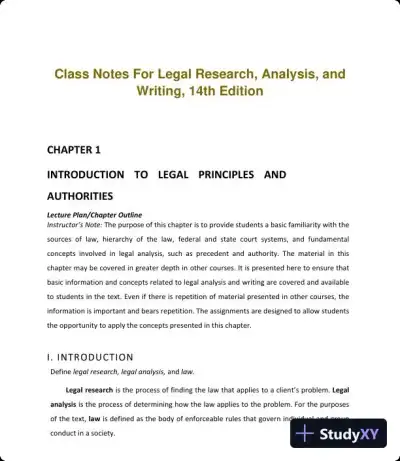 Class Notes
Lecture Notes For Legal Research, Analysis, and Writing, 14th Edition
Civil Law
618 pages57downloadsFeb 2025 Solved Assignments
Assessment 1 Long Answer Question
Civil Law
9 pagesJun 2025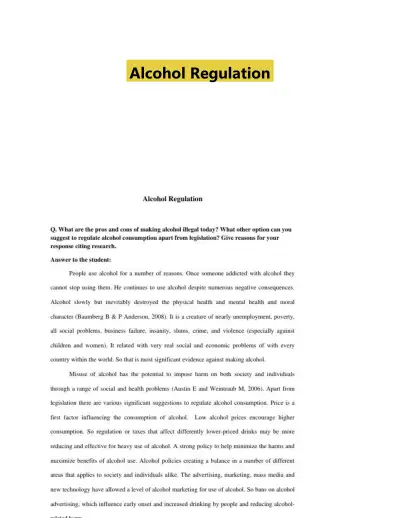 Solved Assignments
Alcohol Regulation
Civil Law
3 pagesMay 2025- Solved AssignmentsSolved Assignments
Ethical and Practical Challenges in Elder Law
Civil Law
1 pageJun 2025
Study this document with CramX
Once it is in your library, every tool can work from it.