
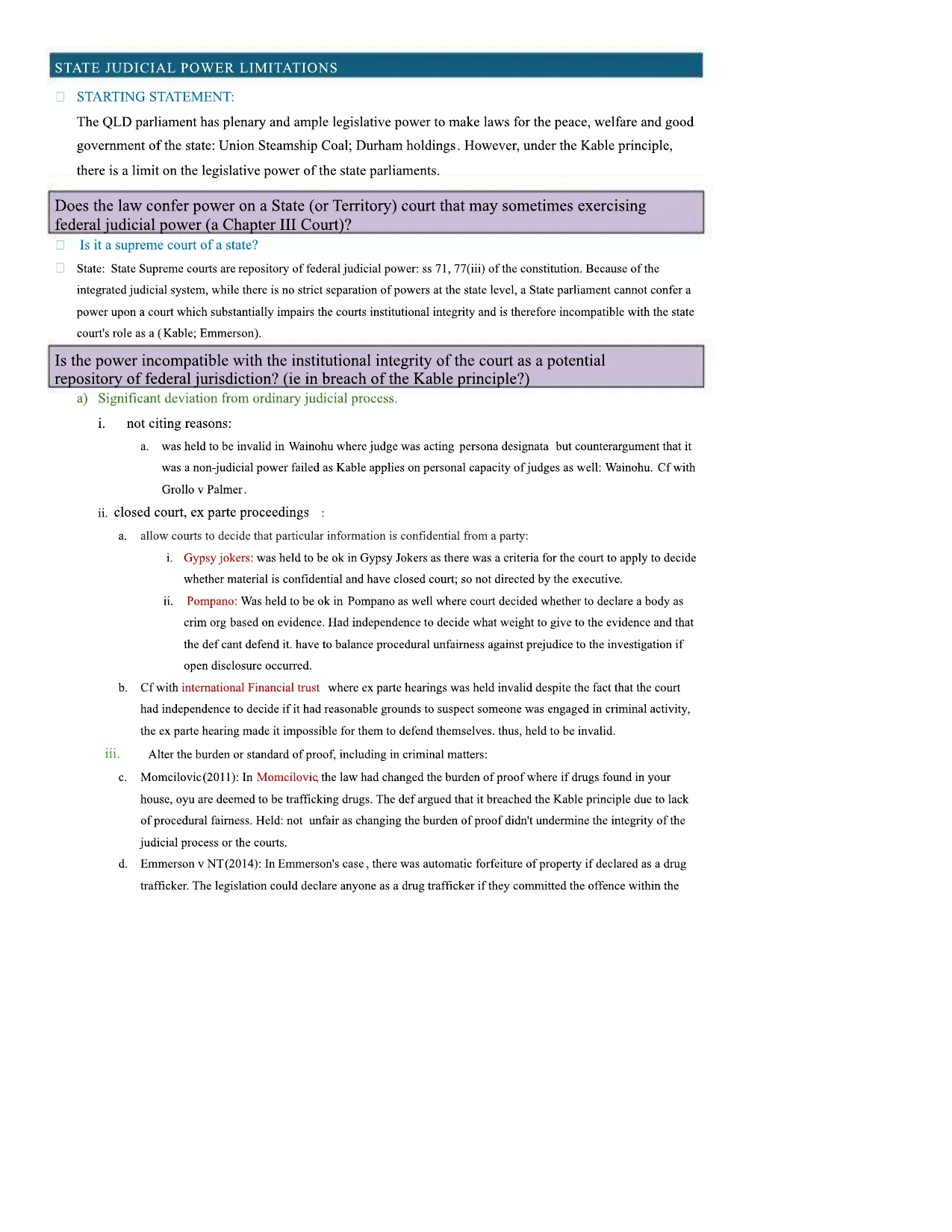
 STATE JUDICIAL POWER LIMITATIONS□STARTING STATEMENT:The QLD parliament has plenary and ample legislative power to make laws for the peace, welfare and goodgovernment of the state: Union Steamship Coal; Durham holdings. However, under the Kable principle,there is a limit on the legislative power of the state parliaments.Does the law confer power on a State (or Territory) court that may sometimes exercisingfederal judicial power (a Chapter III Court)? ____________________________________________TTIs it a supreme court of a state?State: State Supreme courts are repository of federal judicial power: ss 71, 77(iii) of the constitution. Because of theintegrated judicial system, while there is no strict separation of powers at the state level, a State parliament cannot confer apower upon a court which substantially impairs the courts institutional integrity and is therefore incompatible with the statecourt's role as a (Kable; Emmerson).Is the power incompatible with the institutional integrity of the court as a potentialrepository of federal jurisdiction? (ie in breach of the Kable principle?) _____________________a)Significant deviation from ordinary judicial process.i.not citing reasons:a.was held to be invalid in Wainohu where judge was acting persona designata but counterargument that itwas a non-judicial power failed as Kable applies on personal capacity of judges as well: Wainohu. Cf withGrollo v Palmer .ii.closed court, ex parte proceedings:a.allow courts to decide that particular information is confidential from a party:i.Gypsy jokers: was held to be ok in Gypsy Jokers as there was a criteria for the court to apply to decidewhether material is confidential and have closed court; so not directed by the executive.ii.Pompano: Was held to be ok in Pompano as well where court decided whether to declare a body ascrim org based on evidence. Had independence to decide what weight to give to the evidence and thatthe def cant defend it. have to balance procedural unfairness against prejudice to the investigation ifopen disclosure occurred.b.Cf with international Financial trustwhere ex parte hearings was held invalid despite the fact that the courthad independence to decide if it had reasonable grounds to suspect someone was engaged in criminal activity,the ex parte hearing made it impossible for them to defend themselves, thus, held to be invalid.iii.Alter the burden or standard of proof, including in criminal matters:c.Momcilovic(2011): In Momcilovic; the law had changed the burden of proof where if drugs found in yourhouse, oyu arc deemed to be trafficking drugs. The def argued that it breached the Kable principle due to lackof procedural fairness. Held: not unfair as changing the burden of proof didn't undermine the integrity of thejudicial process or the courts.d.Emmerson v NT(2014): In Emmerson's case , there was automatic forfeiture of property if declared as a drugtrafficker. The legislation could declare anyone as a drug trafficker if they committed the offence within the
Preview Mode
This document has 7 pages. Sign in to access the full document!