

Test Bank for The Litigation Paralegal: A Systems Approach , 6th Edition
- Civil Law
- 176 pages
- Shared May 2025
Test Bank for The Litigation Paralegal: A Systems Approach , 6th Edition is a must-have resource, providing clarity on tough topics and plenty of practice questions.
Preview 16 of 176 pages
See the first 16 pages exactly as they appear in the document.
Page 1 Read page 1 as text
Test Bank to Accompany The Litigation Paralegal: A Systems Approach Sixth Edition J AMES W. H. M C C ORD P AMELA R. T EPPER
Page 2 Page 3 Read page 3 as text
266 TEST BANK C HAPTER 1: W ELCOME TO THE L AW O FFICE : F OUNDATIONS FOR LITIGATION Multiple Choice 1. An active founding owner of a law firm is often called a(n) a. senior associate. b. associate. c. senior partner. d. counsel. 2. A lawyer who works for a firm, but is not yet a partner in the firm is a(n) a. associate. b. paralegal. c. law clerk. d. legal aide. 3. A multijurisdictional practice is one that a. is illegal. b. provides legal services beyond one state. c. provides legal services in both state and federal courts. d. includes both paralegals and lawyers. 4. An example of an intellectual property case is a _____. a. negligence b. civil rights c. products liability d. copyright 5. An incidence of food poisoning might lead to a _____. a. contract b. civil rights c. corporation d. products liability 6. A paralegal is valuable to a law firm because a a. paralegal will make a good partner. b. paralegal’s time is billed at the same rate as an attorney’s. c. paralegal is not bound by ethical standards. d. paralegal can help the law firm efficiently deliver legal services to more people. 7. Keeping track of how you spend your time in the law office a. is called docket control. b. is called disbursement entry. c. may be done online. d. is the responsibility of your supervising attorney.
Page 4 Read page 4 as text
Chapter 1: Welcome to the Law Office: Foundations for Litigation 267 8. Under task-based billing, clients are charged a. for the number of hours required by a task. b. a set fee for a particular task. c. only if the case is won. d. for the attorney’s work, but not the paralegal’s work. 9. A fee paid upfront to secure legal services is called a. a contingency fee. b. value billing. c. flat-fee billing. d. a retainer fee. 10. Electronic billing a. provides instant client access to billing information. b. is the cost of a firm’s Internet access. c. helps the firm cut costs. d. only involves attaching a bill to e-mail. 11. The limitation of legal representation to one step in a multiple-step process is a. multijurisdictional practice. b. always unethical. c. unbundling legal services. d. task-based billing. 12. Professional telephone use includes a. a chatty conversation. b. repetition of facts. c. lengthy discussions of sensitive matters. d. anonymous calls. 13. The litigation system is least helpful to the paralegal in a. saving time. b. assisting with unique and irregular tasks. c. preparing for the job. d. saving effort. 14. Paralegals may a. give legal advice to a friend. b. accept cases for the firm. c. represent clients at federal administrative hearings. d. split fees with an attorney. 15. Ethical responsibility in a law firm rests with a. attorneys only. b. the senior partner only. c. paralegals only. d. all employees. 16. To avoid the unauthorized practice of law, the paralegal’s work a. must be delegated by an attorney. b. must not include drafting documents. c. must not involve the client. d. must be kept separate from the attorney’s work.
Page 5 Read page 5 as text
268 Chapter 1: Welcome to the Law Office: Foundations for Litigation 17. A conflict of interest occurs when a paralegal assists a. on a case for a bank where the paralegal has an account. b. an attorney representing his or her family. c. on a case against a store in which the paralegal occasionally shops. d. on a case against a good friend. 18. Conflicts of interest are unethical because they a. diminish the professional’s allegiance to the client. b. cause clients to put too much trust in professionals. c. are the main cause of double billing. d. pit stronger corporate clients against weaker private ones. 19. Confidentiality would be at risk in the a. office reception area with the paralegal, client, and the client’s mother-in-law present. b. paralegal’s office with the paralegal and the client alone. c. paralegal’s office with the paralegal, client, and supervising attorney present. d. client’s home with the client and paralegal alone. 20. Disclosure of confidential information is always unethical when the a. client consents in writing. b. disclosure is necessary to prevent death. c. disclosure is to an attorney not involved in the case. d. disclosure is necessary to prevent financial injury by fraud. 21. An intermediate appellate court a. exists in all state systems. b. has original jurisdiction. c. considers only questions of law. d. considers only questions of fact. 22. Most court cases are disposed of by the a. trial court. b. intermediate appellate court. c. highest appellate court. d. U.S. Supreme Court. 23. A court of general jurisdiction a. hears military cases only. b. usually has appellate jurisdiction only. c. is common to the federal court system. d. is common to the state court system. 24. When a judge or jury attempts to answer the question “what happened?” it is trying to answer a question of a. law. b. fact. c. venue. d. jurisdiction.
Page 6 Read page 6 as text
Chapter 1: Welcome to the Law Office: Foundations for Litigation 269 25. A U.S. district court can have _____ jurisdiction. a. general b. diversity c. appellate d. unlimited subject matter 26. A court has personal jurisdiction a. when a summons and complaint are served. b. when a warrant is served. c. over everyone in its district. d. over everyone named in an action brought in its district. 27. The jurisdictional amount a. can determine in which court a case can be tried. b. is the attorney’s fee. c. is the same in all courts. d. can be waived for indigents. 28. Sovereign immunity a. protects foreign leaders from prosecution when they visit the United States. b. protects government employees from being sued for exercising their constitutional duties. c. is an out-of-date concept that American courts have abandoned. d. is the power of one state to protect property from lawsuits arising in another state. 29. Legislative courts do not include the U.S. a. Claims Court. b. District Court. c. Tax Court. d. Court of Veterans Appeals. 30. The jurisdictional amount in federal diversity cases a. is the combined claim for multiple plaintiffs. b. is the value of all claims made by one plaintiff against one defendant. c. can never include attorney’s fees. d. does not apply to class-action suits. 31. The U.S. Supreme Court a. is the highest authority on the federal law. b. is an intermediate appellate court. c. has seven associate justices. d. has no original jurisdiction. 32. Venue includes a. each county where multiple plaintiffs reside. b. the same area as jurisdiction. c. the county most convenient for all parties. d. the county where the incident occurred.
Page 7 Read page 7 as text
270 Chapter 1: Welcome to the Law Office: Foundations for Litigation True/False 33. It is unethical for law firms to market services on Web pages and blogs. 34. Sexual harassment is likely to lead to a contract suit. 35. Pro bono cases deal with corporation law. 36. Paralegals are responsible for clerical and word-processing services for the law firm. 37. A law firm may bill clients for the time spent by paralegals on their cases. 38. Timekeeping is important for analyzing productivity. 39. A tickler system is a calendaring process. 40. Computer software can automatically calculate and calendar deadlines. 41. Disbursements are expenses incurred on behalf of the client. 42. Office work on a laptop or home computer is adequately secured by a password. 43. When speaking to a witness on the phone, it is best not to identify your firm. 44. One of the most common problems in using the telephone is failing to record phone numbers and addresses accurately. 45. Use your clients’ first names to help them feel comfortable. 46. Paralegals may represent clients in court if the amount in controversy is less than five thousand dollars. 47. Generally, paralegals may have business cards with the name of the firm on them. 48. Poor research is the most frequent reason for malpractice suits. 49. Professional development requires that you join the ABA. 50. Ethical standards are set in each jurisdiction by the local judge. 51. There would be a conflict of interest if you assisted in representing a client in a suit against your cousin. 52. Only attorneys need concern themselves with professional ethics. 53. Paralegals must be licensed in thirteen states. 54. Venue is determined in the same way as jurisdiction. 55. The Supreme Court has original jurisdiction over controversies between two states. 56. A court can have personal jurisdiction based on Internet contacts.
Page 8 Read page 8 as text
Chapter 1: Welcome to the Law Office: Foundations for Litigation 271 57. The jurisdictional amount for federal diversity cases is $25,000. 58. Federal question cases go directly to the Supreme Court. 59. Domicile is established for the purposes of appeal. 60. Trial courts decide questions of law and questions of fact. 61. The U.S. Court of Appeals for the Federal Circuit hears appeals from the U.S. Commissioner of Patents. Short Answer 62. What is the role of the paralegal in the law firm? 63. What is the role of the paralegal manager? 64. Pricing for legal services to a corporation based on cost estimates and specific services is called what? 65. Define double billing and describe the ABA Formal Opinion on it. 66. Define professional ethics as applied to attorneys and discuss its significance to the paralegal. 67. List three sources of guidelines for ethical paralegal conduct. 68. List three recommended ways to screen for conflict of interest when personnel are hired from an opposing firm. 69. How can a paralegal continue professional development? 70. List the courts in your state system and their primary jurisdictions. 71. What is the domicile of a corporation? An insurance company? 72. CAFA extends diversity jurisdiction in class actions when what two requirements are met? 73. Explain the differences between venue and subject matter jurisdiction. 74. How is forum non conveniens used? 75. One of the following steps in the flow of a case is out of chronological order. Which is it? a. accident or event b. informal investigation c. motion for summary judgment d. file complaint e. file answer f. discovery g. trial h. appeal
Page 9 Read page 9 as text
272 C HAPTER 2: T HE I NITIAL I NTERVIEW Multiple Choice 1. A good interview form a. gives you all the questions you will need. b. requires specific information on damages. c. meets ABA standards. d. is available from the clerk of court. 2. A paralegal should not rely entirely on model interview forms because they a. are usually too long. b. are usually too short. c. do not always allow for the uniqueness of the individual case. d. often waste time. 3. A good source for researching the elements of a cause of action or defense thereto is a a. legal practice manual. b. state or federal jury instruction book. c. law office procedures manual. d. court clerk. 4. That aspect of law that defines the rights of individuals and the duties owed one person by another is the definition of a. substantive law. b. procedural law. c. ethics. d. negligence. 5. If A has a miscarriage and sues her doctor for malpractice for giving her x-rays before realizing she was pregnant, and A reveals on the witness stand that she fell down the stairs at home just before the miscarriage, the element of the plaintiff’s proof that is in jeopardy is a. duty. b. breach of duty. c. proximate cause. d. injury. 6. A orders a large pitcher of beer, as does B. A proceeds to drink his pitcher and half of B’s. A dies of asphyxiation (drowning). In an action by A’s estate against the bar that sold the beer, the defense most applicable to the action is a. contributory negligence. b. comparative negligence. c. assumption of risk. d. last clear chance. 7. A boat strays into the swimming area of a lake. A swimmer sees the boat, but swims directly in front of it to retrieve a beachball and is injured when the boat hits him. The boat operator has the defense of a. breach of duty. b. comparative negligence. c. assumption of risk. d. procedural law.
Page 10 Read page 10 as text
Chapter 2: The Initial Interview 273 8. In regard to scheduling the initial interview, it is best to a. schedule about an hour and to end at a specified time so the interview will not be unduly prolonged. b. leave it open ended to provide flexibility and an unhurried environment. c. leave time to allow clients to chat as long as they want. d. schedule twenty minutes and let the client know at the end of that time that you have more important things to do. 9. The best way to record a client interview is to a. take notes. b. tape record it. c. have the client sign a written statement. d. videotape it. 10. The body language of a person may best be assessed to determine a. whether the person is lying. b. whether the firm should take the person’s case. c. how a jury will perceive the person. d. a person’s intelligence. 11. Fee agreements a. are never discussed by paralegals. b. are set by paralegals. c. are always based on billable hours. d. require the client’s signature. 12. Doctors or others holding confidential information are authorized to give that information to a lawyer or paralegal through a. docket control forms. b. release forms. c. summons. d. writ of certiorari. 13. Permission to access medical records must be a. HIPAA compliant. b. HIPPO compliant. c. compliant with federal regulations only in federal cases. d. filed with the clerk of court. 14. Which of the following is an example of a good interview question? a. You stopped to look before you crossed the road, didn’t you? b. Why didn’t you pay more attention to traffic? c. Do you know what Statute CS § 127 requires? d. How long did it take you to cross the road? 15. Professional ethics require the paralegal a. to give reliable legal advice to the client. b. to question the truth of what the client says. c. to keep client information confidential. d. not to ask questions that would embarrass the client.
Page 11 Read page 11 as text
274 Chapter 2: The Initial Interview 16. The client should be told not to make statements to others about his or her case or injuries, because such statements a. might cause gossip. b. can be used against the client in court. c. might damage the attorney’s reputation. d. are against the law. 17. In concluding the interview, be sure to a. have the client sign necessary documents. b. have the client sign a statement. c. avoid any conversation that is not pertinent to the case. d. encourage the client to promote his or her side of the case among friends. 18. Typically, at the initial interview the client should sign a a. motion to dismiss. b. medical information release. c. sworn statement about the accident. d. malpractice release for the attorney. 19. One of the most frequent client complaints is addressed by paralegals providing a. more relaxed interviews. b. better legal forms. c. better billing procedures for clients. d. increased communication with the client. 20. In preparing the interview site the paralegal should a. keep other client files on the desk to show how much business the firm has. b. have all paper, pencils, diagrams, and forms ready. c. arrange the office seating to keep distance between client and interviewer. d. arrange for all calls to be put through to the interview site. 21. Thinking of questions to ask in an interview is a matter of a. applying common sense to the substantive law (legal elements). b. studying the steps of procedural law. c. good psychology. d. being a good conversationalist. 22. In some states where comparative negligence is the rule of law, the plaintiff will not be able to recover if the jury determines the plaintiff was _____. a. 30 percent b. 51 percent c. 10 percent d. even slightly 23. When an angry client is ranting in your office, first a. call the police. b. call your supervising attorney. c. allow the client to vent. d. leave the room as fast as you can.
Page 12 Read page 12 as text
Chapter 2: The Initial Interview 275 24. The interview summary is helpful for a. publicizing the case. b. a quick review of facts. c. evidence at trial. d. keeping the client informed. 25. A nonengagement letter informs a potential client that a. her further assistance in the case is unnecessary. b. a second interview is needed. c. the firm has not accepted her case. d. the opposing party will settle the case without a trial. True/False 26. The initial client interview can provide valuable information essential to forming the basis of a lawsuit or a defense thereto. 27. The initial interview sets the tone for the entire relationship between the plaintiff and the defendant. 28. Elements of a cause of action can be found in jury instructions. 29. The most frequent complaint of clients is that they have to communicate with paralegals. 30. Defendants usually pay attorneys on the basis of a contingent fee agreement. 31. It is unethical to create an attorney-client relationship via a Web site. 32. For the most efficient interviews, use only form questions. 33. Because each case is unique, interview form questions are not helpful. 34. An event can be a contributing cause of an injury without being the proximate cause. 35. One element of negligence is that a breach of duty has to be the proximate cause of the injury. 36. Duty of care is an element of negligence. 37. Contributory negligence is not a defense in most states. 38. Comparative negligence is not a defense in most states. 39. Assumption of risk and last clear chance are elements of negligence. 40. It is best to let the client know that it is the client’s responsibility to provide for any special needs, such as interpreters, for the initial interview. 41. Because toys are a distraction, do not keep them in the room when interviewing children. 42. In the interview, encourage the client to give all information about the accident, even if it is not in the client’s favor. 43. Euphemisms are a good way to deal with sensitive issues in interviews.
Page 13 Read page 13 as text
276 Chapter 2: The Initial Interview 44. Pace and lead is a technique used to elicit information during the client interview. 45. A plaintiff may have to undergo an examination by a doctor hired by the opposition. 46. Signed docket control forms allow confidential information to be given to a lawyer. 47. You know your client is telling the truth if he or she looks you straight in the eye. 48. Procedural law includes the rules for filing a lawsuit. 49. Substantive law includes defenses to actions. 50. The statute of limitations defines the range of damages that can be requested. 51. A paralegal may explain the terms of a fee agreement to a client. 52. An interview summary must be filed with the court within twenty days of the interview. 53. “What do you mean by the phrase ‘high as a grasshopper’s knee’?” is a good interview question. 54. Time that a defendant spends outside the state may extend the time limit for filing a case. 55. A good way to let potential clients know their cases have not been accepted is to have the secretary call them after a forty-five-day period. Short Answer 56. The initial client interview is significant for what three reasons? 57. Define substantive law and procedural law. 58. What is an interview plan? State its purposes. 59. How do you generate interview questions for specific cases? 60. List and define the elements of negligence and related defenses. 61. (Special direction to instructor: Give each student a copy of the facts in Case I, Chapter 1.) Referring to the facts on the attached sheet (Case I) and the elements and defenses to negligence, discuss whether there may be a cause of action for negligence and defenses thereto. 62. In planning any initial interview, what special needs should be anticipated? List three. 63. What are some considerations in choosing an interview site? 64. Is the client going to be the one who is suing or being sued in a contingent fee agreement? Explain. 65. What is an Authorization for Release of Information form? Why is it important? 66. What kinds of materials should the personal injury client bring to the interview? 67. List three things clients should not do in order not to jeopardize their case.
Page 14 Read page 14 as text
Chapter 2: The Initial Interview 277 68. A conflict-of-interest check on a potential client should include what two steps? 69. Assume that you are a paralegal in a firm working for the defendant, Mr. Hart, in Case I. For an interview with Mr. Hart: a. Draft a set of five questions pertinent to the element of breach of duty, specifically Mr. Hart’s attentiveness. b. Draft five questions for Mr. Hart regarding plaintiff’s comparative negligence. 70. On what two calculations are attorney’s fees based? 71. Define and explain the significance of the statute of limitations. 72. Describe the technique of pace and lead in dealing with difficult clients. 73. What are three ways you can help keep your client informed?
Page 15 Read page 15 as text
278 C HAPTER 3: E VIDENCE AND I NVESTIGATION Multiple Choice 1. To be admissible, evidence must be a. direct. b. cumulative. c. material. d. privileged. 2. The probative value of evidence must outweigh a. the opponent’s evidence. b. its admissibility. c. the prejudice it causes. d. its materiality. 3. Communication is least likely to be privileged if it is between a. paralegals and clients. b. attorneys and third-party consultants. c. doctors and patients. d. spouses. 4. The case that established the appropriate standard for expert opinion testimony in most jurisdictions is a. Brown v. Hammond . b. Frye v. U.S. c. Zippo Manufacturing Co. v. Zippo Dot Com, Inc . d. Daubert v. Merrell Dow Pharmaceuticals, Inc . 5. To be authenticated, physical evidence must be a. identified as genuine. b. stipulated by the opponent. c. direct. d. circumstantial. 6. The formal exchange of information in litigation is called a. investigation. b. discovery. c. evidence. d. relevance. 7. Care in drafting an investigation plan is important because it a. must be authenticated by a judge. b. must conform to Rule 6(a). c. is a record for billing. d. saves time and resources. 8. Investigators need to be careful not to violate the a. Freedom of Information Act. b. Fair Credit Reporting Act. c. Zippo Manufacturing Rule. d. Model Rules for Witness Interviews.
Page 16 Read page 16 as text
Chapter 3: Evidence and Investigation 279 9. Attorney’s work product is a. all the evidence gathered. b. motions and briefs. c. privileged. d. authenticated. 10. Judicial notice permits the introduction of a. irrelevant evidence. b. immaterial evidence. c. physical evidence. d. evidence without authentication. 11. Expert witnesses are best for presenting a. the chronology of the event. b. technical evidence. c. background on the client’s character. d. demonstrative evidence. 12. Tire tracks at the scene of an accident are most likely to be _____ evidence. a. physical b. direct c. inadmissible d. demonstrative 13. To be relevant, evidence must a. be given by an eyewitness. b. be direct. c. tend to prove or refute a fact of consequence. d. show a chain of custody. 14. A chain of custody establishes a. that a piece of evidence is authentic. b. who owned an item at the time of the accident. c. which side gets to present a piece of evidence at trial. d. who takes custody of the item after trial. 15. Evidence that opposes your client’s case a. is irrelevant. b. is circumstantial. c. is helpful in preparing for trial. d. should be destroyed. 16. Professional ethics require paralegals to a. make well-prepared statements to the press. b. give loyalty to the client top priority. c. refrain from obstructing the opposition’s access to evidence. d. ignore fraudulent behavior of clients if it is privileged. 17. State medical privacy laws must be followed when they a. are less restrictive than federal requirements. b. were passed more recently than federal requirements. c. are more restrictive than federal requirements. d. specifically reject federal requirements.
160 more pages in the full document
Unlock it once and it stays in your library, ready to chat with or turn into flashcards.
Unlock the full documentMore Civil Law study materials
See all Textbook Guides
Solution Manual For The Litigation Paralegal: A Systems Approach, 6th Edition
Civil Law
271 pagesMay 2025 Class Notes
Class Notes For Legal Terminology, 6th Edition
Civil Law
168 pages149downloadsFeb 2025 Class Notes
Lecture Notes for Introduction to Law, 7th Edition
Civil Law
310 pages121downloadsFeb 2025 Past Exams
2024-2025 TCOLE Basic Jailer Course Practice Exam with Answers (1401 Solved Questions)
Civil Law
84 pages72downloadsFeb 2025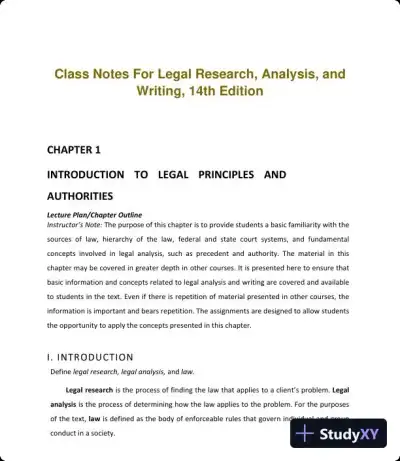 Class Notes
Lecture Notes For Legal Research, Analysis, and Writing, 14th Edition
Civil Law
618 pages57downloadsFeb 2025 Solved Assignments
Assessment 1 Long Answer Question
Civil Law
9 pagesJun 2025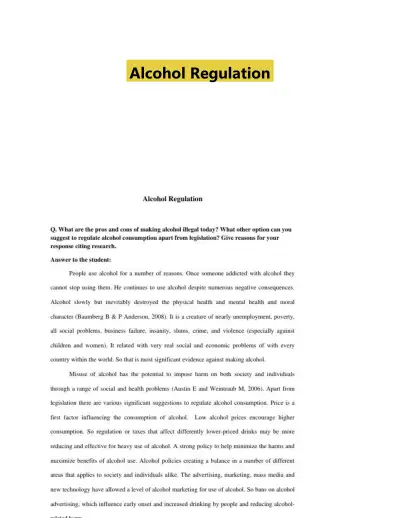 Solved Assignments
Alcohol Regulation
Civil Law
3 pagesMay 2025- Solved AssignmentsSolved Assignments
Ethical and Practical Challenges in Elder Law
Civil Law
1 pageJun 2025
Study this document with CramX
Once it is in your library, every tool can work from it.