
The Path of the Law

An analysis of Oliver Wendell Holmes Jr.'s The Path of the Law, exploring his views on ontology, epistemology, axiology, and teleology, and comparing them with Karl Llewellyn’s legal realism to advocate for a more practical, evolving legal system.

Mason Bennett
Contributor
4.7
30
10 months ago
Preview (2 of 4 Pages)
100%
Log in to unlock

Page 1

The Path of the Law - Page 1 preview image

Loading page ...

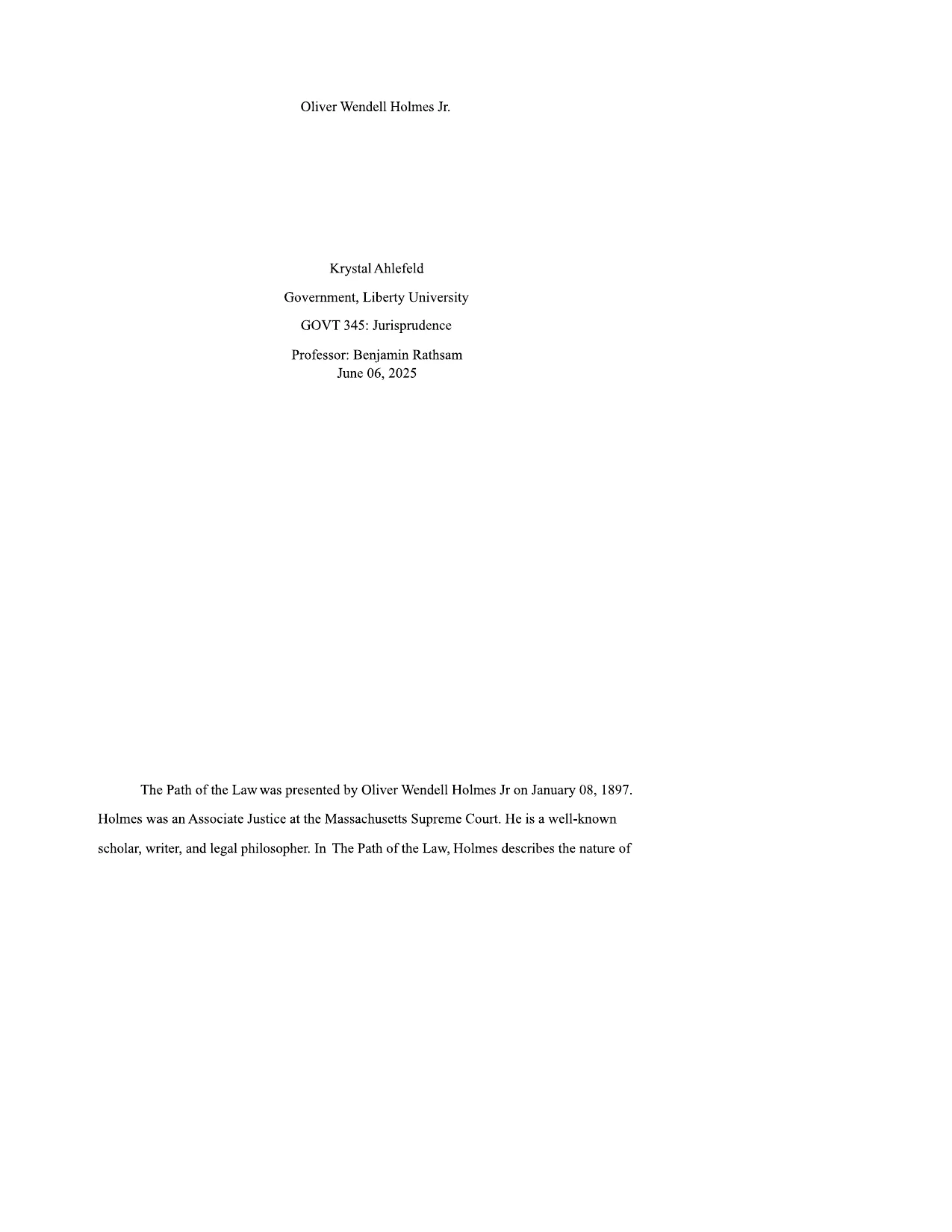
Oliver Wendell Holmes Jr.Krystal AhlefeldGovernment, Liberty UniversityGOVT 345: JurisprudenceProfessor: Benjamin RathsamJune 06, 2025The Path of the Law was presented by Oliver Wendell Holmes Jr on January 08, 1897.Holmes was an Associate Justice at the Massachusetts Supreme Court. He is a well-knownscholar, writer, and legal philosopher. In The Path of the Law, Holmes describes the nature of

Page 2

The Path of the Law - Page 2 preview image

Loading page ...

common law and also calls for a reconsideration of the structure of legal practices and education,and judicial reasoning. The proceeding essay will analyze Holmes' ontology, epistemology,axiology, and teleology. It will also discuss Llewellyn's nine-point manifesto of Legal Realismfound within "The Path of the Law" by Oliver Wendell Holmes Jr at Boston University School ofLaw back in 1897.The definition of ontology is the philosophy which studies "existence".Ontology breaksinto four categories such as realism, empiricism, positivism and post-modernism. Each of theseare the brain's way of understanding, perceptions, and the brain's way of interpreting reality ofone's reality of the world around them. Holmes was a strong advocate of legal realism. Hisinterpretation was that the law should be based on reason and logic instead of moral standards orabstract concepts. This is reinforced by his statement in his speech that states "When we studylaw, we are not studying a mystery but a well-known profession (Holmes, 1897)." This wouldsuggest that he understood that the law should be embraced as a more natural law v. scientific.Epistemology is defined as the philosophical "study or theory of the nature and groundsof knowledge especially with reference to its limits and validity (Webster, 1856)". According toWacks's Understanding Jurisprudence , "Holmes firmly believed that legal developments couldbe scientifically justified: the "true science of law", consist in the establishments of its postulatesfrom within upon accurately measure social desires instead of traditions." Holmes' epistemologyis that he believed that all law was literal interpretations that were scientifically justified.Merriam-Webster defines axiology as "the study of the nature, types, and criteria ofvalues and of value judgements especially in ethics". The axiology of Holmes' is that "the badman is only going to obey the law due to them not wanting to deal with the consequences, jailtime or fines, that were to come from not obeying the law. The bad man isn't motivated to obeythe law due to having or maintaining a good conscience but he is only not breaking the law dueto the unfavorable outcome or punishments of breaking the law.Lastly, the definition of teleology is "1: a. the study of evidence of design in nature b.Doctrine (as in vitalism) that ends is immanent in nature. C. a doctrine explaining phenomena by
Preview Mode

This document has 4 pages. Sign in to access the full document!