
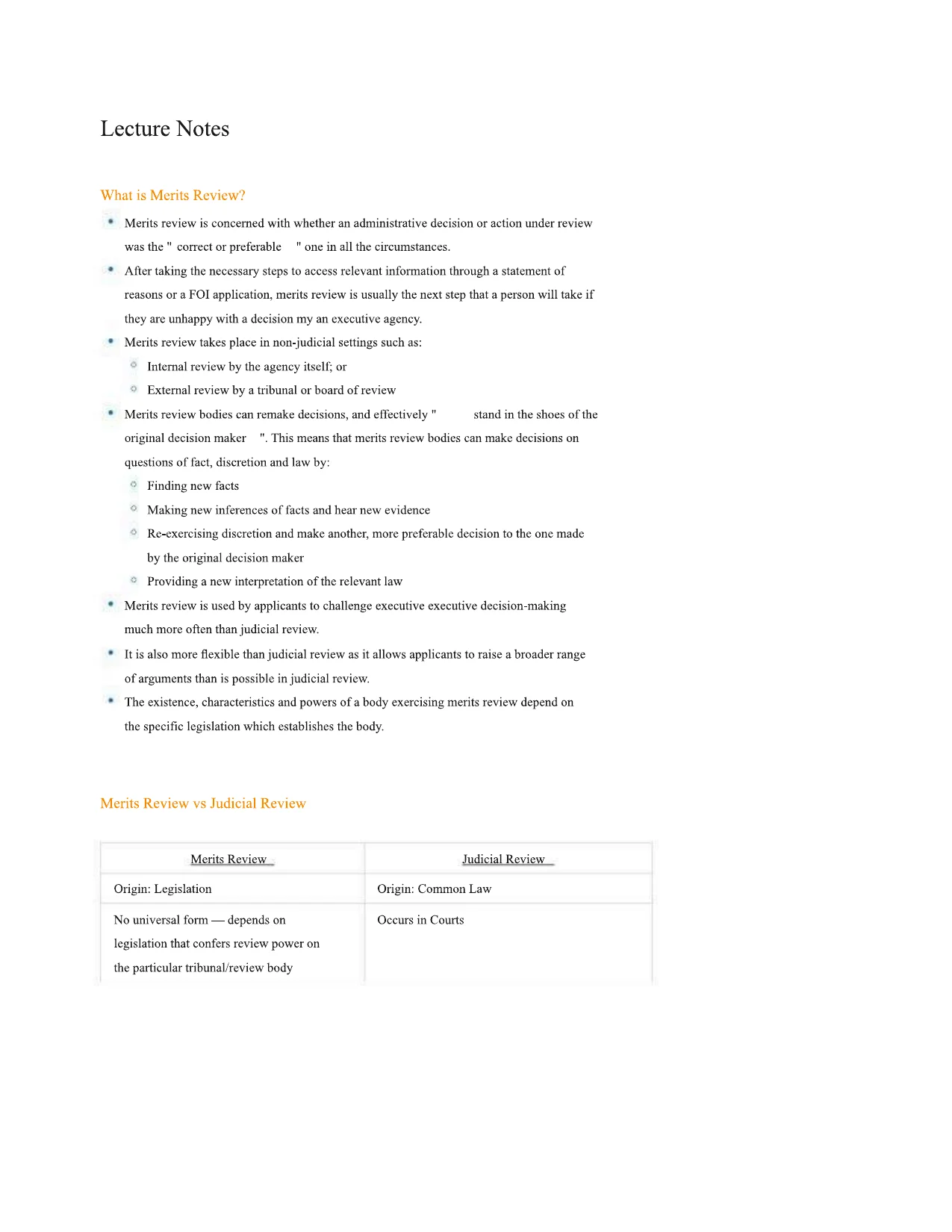
 Lecture NotesWhat is Merits Review?*Merits review is concerned with whether an administrative decision or action under reviewwas the " correct or preferable" one in all the circumstances.*After taking the necessary steps to access relevant information through a statement ofreasons or a FOI application, merits review is usually the next step that a person will take ifthey are unhappy with a decision my an executive agency.■Merits review takes place in non-judicial settings such as:*Internal review by the agency itself; or°External review by a tribunal or board of review•Merits review bodies can remake decisions, and effectively "stand in the shoes of theoriginal decision maker". This means that merits review bodies can make decisions onquestions of fact, discretion and law by:,;1Finding new facts°Making new inferences of facts and hear new evidence°Re-exercising discretion and make another, more preferable decision to the one madeby the original decision maker°Providing a new interpretation of the relevant law•Merits review is used by applicants to challenge executive executive decision-makingmuch more often than judicial review.■It is also more flexible than judicial review as it allows applicants to raise a broader rangeof arguments than is possible in judicial review.■The existence, characteristics and powers of a body exercising merits review depend onthe specific legislation which establishes the body.Merits Review vs Judicial ReviewMerits ReviewJudicial ReviewOrigin: LegislationOrigin: Common LawNo universal form — depends onOccurs in Courtslegislation that confers review power onthe particular tribunal/review body
Preview Mode
This document has 9 pages. Sign in to access the full document!