
Week 7 Lecture Notes

Comprehensive notes on procedural fairness in administrative law, covering key cases, statutory references, the implication principle, hearing rights, and the rule against bias. Focuses on fair decision-making processes affecting rights or interests.

Daniel Miller
Contributor
5.0
37
10 months ago
Preview (4 of 13 Pages)
100%
Log in to unlock

Page 1

Week 7 Lecture Notes - Page 1 preview image

Loading page ...

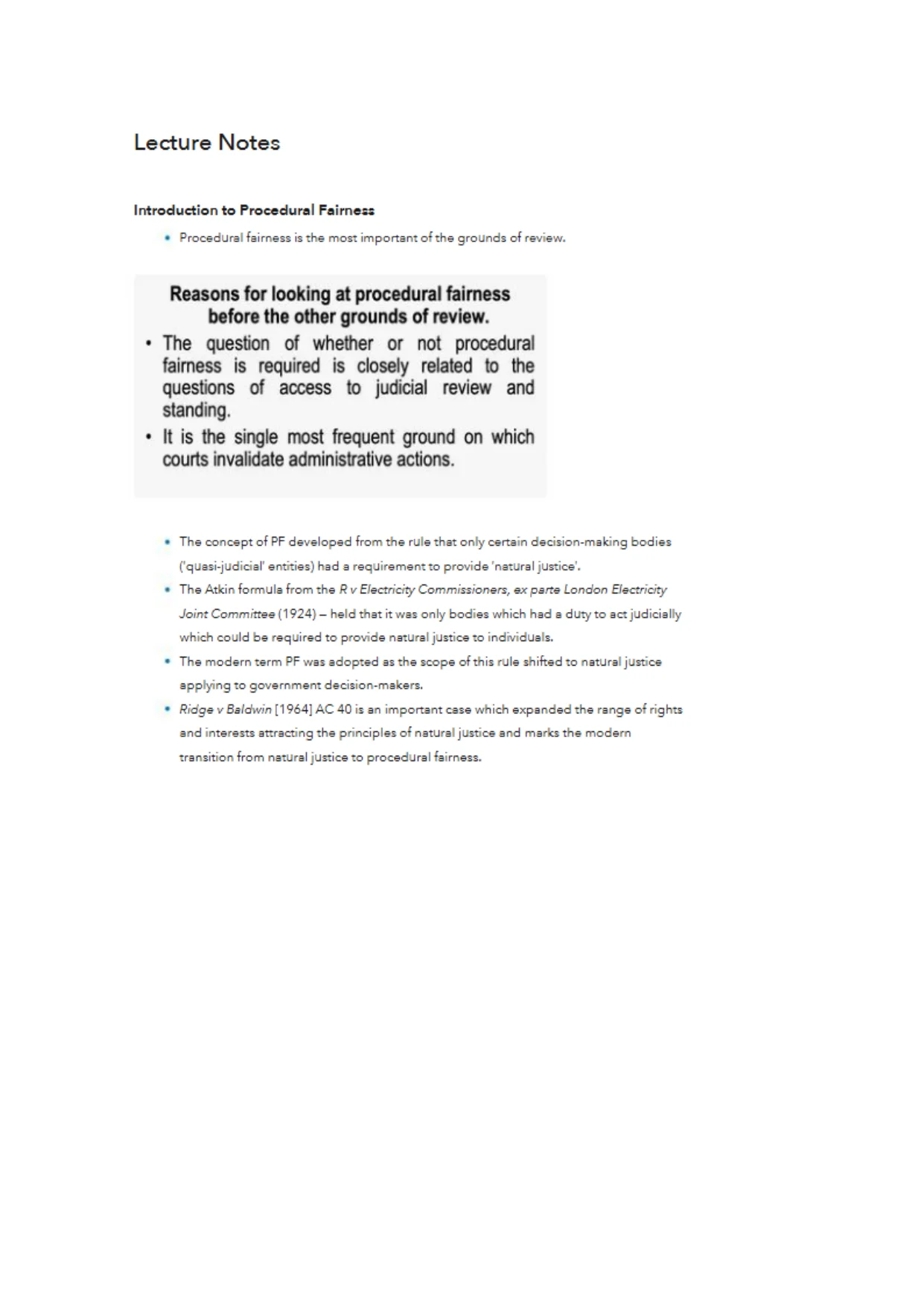
L e c t u r e N o t e sIntroduction to Procedural Fairness»Procedurefairness is the most i m p o r t a n tofthe g r o u n d s of review.Reasons for l o o k i n g at procedural fairnessbefore the other grounds of review.Thequestionofwhetherornotproceduralfairnessisrequirediscloselyrelatedtothequestionsofaccesstojudicialreviewandstanding.It isthesingle mostfrequent groundonwhichcourts invalidate administrative actions.The c o n c e p t of PF d e v e l o p e d from the rule that only certain d e c i s i o n - m a k i n g b o d i e s('qUasi-juidicial' entities) bad a r e q u i r eme nt to p r o v i d e nature I justice'.The Atkin f o r m u l a from the .RvEJectricrty Commissioners, ex parte London EfecfncrtyJoint Committee (1924) -held that it was only b o d i e s which had a duty to act j u d i c i a l l ywhich c o u l d berequired to provide natural justice to individua s.The m o d e r n term PF was adopted as the scope of this rule s h i f t e d to naturejusticeapplyingto g o v e r n m e n t decision-makers.Ridge v Baldwin [ 1 9 6 4 ] AC 40 is an i m p o r t a n t case 'which e x p a n d e d the range of r i g h t sand interests attracting the p r i n c i p l e s of n a t u r a l justice a r dmarksthe m o d e r nt r a n s i t i o n f r o m natural justice to p r o c e d u r a l fairness.

Page 2

Week 7 Lecture Notes - Page 2 preview image

Loading page ...

Note thatnatural justice' is still the term used in the judicial reviewstatutes, rather than 'procedural fairness'.ADJRA ss5(1Xa).6(1)(a)Sect S Applications for review of decisions(1)A person who is aggrieved bya decision io which this Actapples that is made after the commencement of this Act mayapply to the Federal Court or the Federal Circuit Court for anorder of review in respect ol the decision on any one or more of|he following grounds:(a)thata breach oftherulesofnatural justice occurred inconnection with the making of the decision;See also: JRA ss2ty2Xa). 2l(2Xa)PF isn’t concerned with the merits of a decision -justitsproceduralaspectsbeingcarriedoutproperly.Itisconcernedwiththewaythedecisionwasmade not whether the outcome is fair.This reflects the traditional judicial preoccupationwiththelegalityofadecisionratherthanitssubstance.Procedural Fairness in AustraliaThe d e v e l o p m e n t of p r o c e d u r a l fairness in Australia was slow and it wasn t Until the1 98 Os that the co Jrts acce pre d the sh rft fro m nature I ' Ustice.*Unless p a r l i a m e n t has made it clear that p r o c e d u r a l fairness will not a p p l y , then thereis a g e n e r a l c o m m o naw duty to act fairly where administrative d e c i s i o n s affect rights,interests, or l e g i t i m a t e expectations.

Page 3

Week 7 Lecture Notes - Page 3 preview image

Loading page ...

InKioa v West(1985) 159 CLR 550, Mason J held(at 584):The law has now developed to a point where it maybe accepted that there is a common law duty to adfairly, in the sense of according procedural fairness,inthemakingofadministrativedecisionswhichaffect rights, interests or legitimate expectations,subject only to the clear manifestation of a contraryintention.InKioav West (1985) 159 CLR 550, Mason J held (at582-3):It is a fundamental rule of the common law doctrine ofnatural justice that, generally speaking, when an orderis to be made which will deprive some person of someright or interest or legitimate expectation of a benefit,he (sic) is entitled to know the case sought to bemade against him and to be given an opportunity ofreplying to it.Thisistheessenceofnaturaljustice/proceduralfairnessinrelationtotheopportunitytohaveahearing, be informed of the case being made againstyou, and being able to respond to it.Legitimateexpectationshasbeenleftoutoftheformula for the availability of procedural fairness insubsequent cases so not highlighted here.

Page 4

Week 7 Lecture Notes - Page 4 preview image

Loading page ...

In K/oavWesf, MasonJ stated (at 585), thatthecritical issue is not whether natural justice applies in agiven situation but -what does the duty to act fairlyrequire in the circumstances of the particular case?'Whatisappropriateintermsofnaturaljusticedepends on the circumstances ofthecase, andthey will include, inter alia, the nature of the inquiry,the subject matter and the rules under which thedecision-maker is acting/ (at 584-5)PlaintiffS10/2011vMinisterforImmigrationandCitizenship(2012) 290 ALR 516:*HC majority (Gummow, Hayne, Grennan and Bell JJ)rejectedtheuseofthephraselegitimateexpectation in a public law context*It either adds nothing or poses more questions than itanswers and thus is an unfortunate expression whichshould be disregarded/ [at 65]*Legitimate expectations are now understood as part ofa broad approach to 'interests/The Implication Principle*Procedural fairness may either be:expresslyrequired by a statute, orimpliedby the common law.Where the statute is more generous than the commonlaw, the court will enforce the express requirements of thestatute-Moreusually,thestatuteislessgenerousthanthecommon law and the courts will supplement the statute toensure procedures are fair.>This is known as the rmpfcafronprinciple.
Preview Mode

This document has 13 pages. Sign in to access the full document!