

Comptia Security+ Practice Tests : exam sy0-601, 2nd Edition (2021)
- CompTIA Certifications
- 339 pages
- Shared February 2025
- 144 downloads
Build your confidence with Comptia Security+ Practice Tests : exam sy0-601, 2nd Edition (2021), a must-have for certification seekers.
Preview 31 of 339 pages
See the first 31 pages exactly as they appear in the document.
Page 1 Read page 1 as text
T= StudyX
Page 2 Read page 2 as text
Downloaded from StudyXY.com & + StudyXY nas, as . a TB Study L Anything This ContentHas been Posted On StudyXY.com as supplementary learning material. StudyXY does not endrose any university, college or publisher. Allmaterials posted are under the liability of the contributors. wv 6) www.studyxy.com
Page 3 Read page 3 as text
T= StudyX
Page 4 Read page 4 as text
(up to a $35 value) *Some restrictions apply. See web page for details. Get details at www.wiley.com/go/sybextestprep To get the discount code, you'll need to register and log on the test bank. Then go to Resources. > 3 _1SYBEX
Page 5 Read page 5 as text
T= StudyX
Page 6 Read page 6 as text
Security+® Practice Tests Second Edition
Page 7 Read page 7 as text
T= StudyX
Page 8 Read page 8 as text
Security+® Practice Tests Second Edition David Seidl
Page 9 Read page 9 as text
Copyright © 2021 by John Wiley & Sons, Inc., Indianapolis, Indiana Published simultaneously in Canada ISBN: 978-1-119-73546-5 ISBN: 978-1-119-73545-8 (ebk.) ISBN: 978-1-119-73544-1 (ebk.) No part of this publication may be reproduced, stored in a retrieval system or transmitted in any form or by any means, electronic, mechanical, photocopying, recording, scanning or otherwise, except as permitted under Sections 107 or 108 of the 1976 United States Copyright Act, without either the prior written permission of the Publisher, or authorization through payment of the appropriate per-copy fee to the Copyright Clearance Center, 222 Rosewood Drive, Danvers, MA 01923, (978) 750-8400, fax (978) 646-8600. Requests to the Publisher for permission should be addressed to the Permissions Department, John Wiley & Sons, Inc., 111 River Street, Hoboken, NJ 07030, (201) 748-6011, fax (201) 748-6008, or online at www. wiley. com/go/permissions. Limit of Liability/Disclaimer of Warranty: The publisher and the author make no representations or warranties with respect to the accuracy or completeness of the contents of this work and specifically disclaim all warranties, including without limitation warranties of fitness for a particular purpose. No warranty may be created or extended by sales or promotional materials. The advice and strategies contained herein may not be suitable for every situation. This work is sold with the understanding that the publisher is not engaged in rendering legal, accounting, or other professional services. If professional assistance is required, the services of a competent professional person should be sought. Neither the publisher nor the author shall be liable for damages arising herefrom. The fact that an organization or Web site is referred to in this work as a citation and/or a potential source of further information does not mean that the author or the publisher endorses the information the organization or Web site may provide or recommendations it may make. Further, readers should be aware that Internet Web sites listed in this work may have changed or disappeared between when this work was written and when it is read. For general information on our other products and services or to obtain technical support, please contact our Customer Care Department within the U.S. at (877) 762-2974, outside the U.S. at (317) 572-3993 or fax (317) 572-4002. Wiley publishes in a variety of print and electronic formats and by print-on-demand. Some material included with standard print versions of this book may not be included in e-books or in print-on-demand. If this book refers to media such as a CD or DVD that is not included in the version you purchased, you may download this material at booksupport.wi ley. com. For more information about Wiley products, visit www. wi ley . com. Library of Congress Control Number: 2020950198 TRADEMARKS: Wiley, the Wiley logo, and the Sybex logo are trademarks or registered trademarks of John Wiley & Sons, Inc. and/or its affiliates, in the United States and other countries, and may not be used without written permission. CompTIA and Security+ are registered trademarks of CompTIA Properties, LLC. All other trademarks are the property of their respective owners. John Wiley & Sons, Inc. is not associated with any product or vendor mentioned in this book. Study
Page 10 Read page 10 as text
This book is dedicated to Mike Chapple, who helped me get my start in the writing field. After most of a decade writing together, this is my first entirely solo project. Mike, thank you for helping me get my start almost a decade ago, for encouraging me along the way, and for continuing to challenge me to do more each time we take on another book. —David Study
Page 11 Read page 11 as text
T= StudyX
Page 12 Read page 12 as text
Acknowledgments Books like this involve work from many people who put countless hours of time and effort into producing them from concept to final printed and electronic copies. The hard work and dedication of the team at Wiley always shows. I especially want to acknowledge and thank senior acquisitions editor Kenyon Brown, who continues to be a wonderful person to work with on book after book. I also greatly appreciated the editing and production team for the book, including Tom Dinse, the project editor, who brought years of experience and great talent to the project; Chris Crayton, the technical editor, who provided insightful advice and gave wonderful feedback throughout the book; and Saravanan Dakshinamurthy, the production editor, who guided me through layouts, formatting, and final cleanup to produce a great book. I would also like to thank the many behind-the-scenes contributors, including the graphics, produc- tion, and technical teams who make the book and companion materials into a finished product. My agent, Carole Jelen of Waterside Productions, continues to provide us with wonderful opportunities, advice, and assistance throughout our writing careers. Finally, I want to thank my friends and family, who have supported me through the late evenings, busy weekends, and long hours that a book like this requires to write, edit, and get to press.
Page 13 Read page 13 as text
T= StudyX
Page 14 Read page 14 as text
About the Author David Seidl is vice president for information technology and CIO at Miami University, where he is responsible for IT for Miami University. During his IT career, he has served in a variety of technical and information security roles, including serving as the senior director for Campus Technology Services at the University of Notre Dame, where he co-led Notre Dame’s move to the cloud and oversaw cloud operations, ERP, databases, identity management, and a broad range of other technologies and service. Prior to his senior leadership roles at Notre Dame, he served as Notre Dame’s director of information security and led Notre Dame’s information security program. He taught information security and networking undergraduate courses as an instructor for Notre Dame’s Mendoza College of Business and has written books on security certification and cyberwarfare, including coau- thoring CISSP (ISC)* Official Practice Tests (Sybex, 2018) as well as the current and previous editions of the CompTIA CySA+ Study Guide: Exam CS0-002 (Wiley, 2020, Chapple/Seidl) and CompTIA CySA+ Practice Tests: Exam CS0-002 (Wiley, 2020, Chapple/Seidl). David holds a bachelor’s degree in communication technology and a master’s degree in information security from Eastern Michigan University, as well as CISSP, CySA+, Pentest+, GPEN, and GCIH certifications.
Page 15 Read page 15 as text
T= StudyX
Page 16 Read page 16 as text
About the Technical Editor Chris Crayton, MSCE, CISSP, CySA+, A+, N+, S+, is a technical consultant, trainer, author, and industry-leading technical editor. He has worked as a computer technology and net- working instructor, information security director, network administrator, network engineer, and PC specialist. Chris has served as technical editor and content contributor on numerous technical titles for several of the leading publishing companies. He has also been recognized with many professional and teaching awards. Study
Page 17 Read page 17 as text
T= StudyX
Page 18 Read page 18 as text
Contents at a Glance Introduction xix Chapter 1 Threats, Attacks, and Vulnerabilities 1 Chapter 2 Architecture and Design 45 Chapter 3 Implementation 81 Chapter 4 Operations and Incident Response 129 Chapter 5 Governance, Risk, and Compliance 159 Appendix Answers and Explanations 185 Index 299 1 StudyX
Page 19 Read page 19 as text
T= StudyX
Page 20 Read page 20 as text
Contents Introduction xix Chapter 1 Threats, Attacks, and Vulnerabilities 1 Chapter 2 Architecture and Design 45 Chapter 3 Implementation 81 Chapter 4 Operations and Incident Response 129 Chapter 5 Governance, Risk, and Compliance 159 Appendix Answers and Explanations 185 Index 299 1 StudyX
Page 21 Read page 21 as text
T= StudyX
Page 22 Read page 22 as text
Introduction CompTIA Security+ Practice Tests: Exam SY0-601, Second Edition is the perfect companion volume to the CompTIA Security+ Study Guide: Exam SY0-601, Eighth Edition (Wiley, 2020, Chapple/Seidl). If you're looking to test your knowledge before you take the Security+ exam, this book will help you by providing a combination of 1,100 questions that cover the Security+ domains and easy-to-understand explanations of both right and wrong answers. If you're just starting to prepare for the Security+ exam, we highly recommend that you use the CompTIA Security+ Study Guide, Eighth Edition to help you learn about each of the domains covered by the Security+ exam. Once you're ready to test your knowledge, use this book to help find places where you may need to study more or to practice for the exam itself. Since this is a companion to the Security+ Study Guide, this book is designed to be sim- ilar to taking the Security+ exam. The book itself is broken up into seven chapters: five domain-centric chapters with questions about each domain, and two chapters that contain 100-question practice tests to simulate taking the Security+ exam itself. If you can answer 90 percent or more of the questions for a domain correctly, you can feel safe moving on to the next chapter. If youre unable to answer that many correctly, reread the chapter and try the questions again. Your score should improve. oe Don't just study the questions and answers! The questions on the actual exam << will be different from the practice questions included in this book. The exam is designed to test your knowledge of a concept or objective, so use this book to learn the objectives behind the questions. The Security+ Exam The Security+ exam is designed to be a vendor-neutral certification for cybersecurity pro- fessionals and those seeking to enter the field. CompTIA recommends this certification for those currently working, or aspiring to work, in roles, including: = Systems administrator = Security administrator = Security specialist = Security engineer = Network administrator = Junior IT auditor/penetration tester = Security consultant Study
Page 23 Read page 23 as text
xx Introduction The exam covers five major domains: 1. Threats, Attacks, and Vulnerabilities 2. Architecture and Design 3. Implementation 4. Operations and Incident Response 5. Governance, Risk, and Compliance These five areas include a range of topics, from firewall design to incident response and forensics, while focusing heavily on scenario-based learning. That's why CompTIA recom- mends that those attempting the exam have at least two years of hands-on work experience, although many individuals pass the exam before moving into their first cybersecurity role. The Security+ exam is conducted in a format that CompTIA calls “performance-based assessment.” This means that the exam combines standard multiple-choice questions with other, interactive question formats. Your exam may include multiple types of questions, such as multiple-choice, fill-in-the-blank, multiple-response, drag-and-drop, and image- based problems. CompTIA recommends that test takers have two years of information security-related experience before taking this exam. The exam costs $349 in the United States, with roughly equivalent prices in other locations around the globe. More details about the Security+ exam and how to take it can be found here: www.comptia.org/certifications/security This book includes a discount code for the Security+ exam —make sure you TE use it! You'll have 90 minutes to take the exam and will be asked to answer up to 90 questions during that time period. Your exam will be scored on a scale ranging from 100 to 900, with a passing score of 750. You should also know that CompTIA is notorious for including vague questions on all of its exams. You might see a question for which two of the possible four answers are correct— but you can choose only one. Use your knowledge, logic, and intuition to choose the best answer and then move on. Sometimes, the questions are worded in ways that would make English majors cringe—a typo here, an incorrect verb there. Don’t let this frustrate you; answer the question and move on to the next one. CompTIA frequently does what is called item seeding, which is the practice TE of including unscored questions on exams. It does so to gather psychometric data, which is then used when developing new versions of the exam. Before you take the exam, you will be told that your exam may include these unscored questions. So, if you come across a question that does not appear to map to any of the exam objectives—or for that matter, does not appear to belong in the exam—it is likely a seeded question. You never know whether or not a question is seeded, however, so always make your best effort to answer every question. Study
Page 24 Read page 24 as text
Introduction xxi Taking the Exam Once you are fully prepared to take the exam, you can visit the CompTIA website to pur- chase your exam voucher: www. comptiastore.com/Articles.asp?ID=265&category=vouchers CompTIA partners with Pearson VUE’s testing centers, so your next step will be to locate a testing center near you. In the United States, you can do this based on your address or your ZIP code, whereas non-U.S. test takers may find it easier to enter their city and country. You can search for a test center near you at the Pearson Vue website, where you will need to nav- igate to “Find a test center.” www. pearsonvue . com/comptia Now that you know where you'd like to take the exam, simply set up a Pearson VUE test- ing account and schedule an exam: home. pearsonvue. com/comptia/onvue On the day of the test, take two forms of identification, and make sure to show up with plenty of time before the exam starts. Remember that you will not be able to take your notes, electronic devices (including smartphones and watches), or other materials in with you, and that other requirements may exist for the test. Make sure you review those require- ments before the day of your test so you're fully prepared for both the test itself as well as the testing process and facility rules. After the Security+ Exam Once you have taken the exam, you will be notified of your score immediately, so you'll know if you passed the test right away. You should keep track of your score report with your exam registration records and the email address you used to register for the exam. Maintaining Your Certification CompTIA certifications must be renewed on a periodic basis. To renew your certification, you can pass the most current version of the exam, earn a qualifying higher-level Comp- TIA or industry certification, or complete sufficient continuing education activities to earn enough continuing education units (CEUs) to renew it. CompTIA provides information on renewals via their website at: www. comptia.org/continuing-education When you sign up to renew your certification, you will be asked to agree to the CE pro- gram’s Code of Ethics, to pay a renewal fee, and to submit the materials required for your chosen renewal method. A full list of the industry certifications you can use to acquire CEUs toward renewing the Security+ can be found at: www. comptia.org/continuing-education/choose/ renew-with-a-single-activity/earn-a-higher-level-comptia-certification Study
Page 25 Read page 25 as text
xxii Introduction Using This Book to Practice This book is composed of seven chapters with over 1,000 practice test questions. Each of the first five chapters covers a domain, with a variety of questions that can help you test your knowledge of real-world, scenario, and best practices-based security knowledge. The final two chapters are complete practice exams that can serve as timed practice tests to help deter- mine whether you're ready for the Security+ exam. ‘We recommend taking the first practice exam to help identify where you may need to spend more study time and then using the domain-specific chapters to test your domain knowledge where it is weak. Once you're ready, take the second practice exam to make sure you've covered all the material and are ready to attempt the Security+ exam. As you work through questions in this book, you will encounter tools and technology that you may not be familiar with. If you find that you are facing a consistent gap or that a domain is particularly challenging, we recommend spending some time with books and materials that tackle that domain in depth. This approach can help you fill in gaps and help you be more prepared for the exam. om To access our interactive test bank and online learning environment, simply visit 5 www. wi Ley . com/go/sybextestprep, register to receive your unique PIN, and instantly gain one year of FREE access after activation to the interactive test bank with 2 practice exams and hundreds of domain-by-domain questions. Over 1,000 questions total! Exam SY0-601 Exam Objectives CompTIA goes to great lengths to ensure that its certification programs accurately reflect the IT industry’s best practices. They do this by establishing committees for each of its exam programs. Each committee consists of a small group of IT professionals, training providers, and publishers who are responsible for establishing the exam’s baseline competency level and who determine the appropriate target-audience level. Once these factors are determined, CompTIA shares this information with a group of hand-selected subject matter experts (SMEs). These folks are the true brainpower behind the certification program. The SMEs review the committee’s findings, refine them, and shape them into the objectives that follow this section. CompTIA calls this process a job-task anal- ysis (JTA). Finally, CompTIA conducts a survey to ensure that the objectives and weightings truly reflect job requirements. Only then can the SMEs go to work writing the hundreds of ques- tions needed for the exam. Even so, they have to go back to the drawing board for further refinements in many cases before the exam is ready to go live in its final state. Rest assured that the content you're about to learn will serve you long after you take the exam.
Page 26 Read page 26 as text
Introduction ii CompTIA also publishes relative weightings for each of the exam’s objectives. The following table lists the five Security+ objective domains and the extent to which they are represented on the exam. Domain % of Exam 1.0 Threats, Attacks, and Vulnerabilities 24% 2.0 Architecture and Design 21% 3.0 Implementation 25% 4.0 Operations and Incident Response 16% 5.0 Governance, Risk, and Compliance 14% SY0-601 Certification Exam Objective Map Objective Chapter 1.0 Threats, Attacks and Vulnerabilities 1.1 Compare and contrast different types of social engineering techniques Chapter 1 1.2 Given a scenario, analyze potential indicators to determine the Chapter 1 type of attack 1.3 Given a scenario, analyze potential indicators associated with applica- Chapter 1 tion attacks 1.4 Given a scenario, analyze potential indicators associated with net- Chapter 1 work attacks 1.5 Explain different threat actors, vectors, and intelligence sources Chapter 1 1.6 Explain the security concerns associated with various types of vul- Chapter 1 nerabilities 1.7 Summarize the techniques used in security assessments Chapter 1 1.8 Explain the techniques used in penetration testing Chapter 1 2.0 Architecture and Design 2.1 Explain the importance of security concepts in an enterprise environment ~~ Chapter 2 2.2 Summarize virtualization and cloud computing concepts Chapter 2 2.3 Summarize secure application development, deployment, and automa- Chapter 2 tion concepts 2.4 Summarize authentication and authorization design concepts Chapter 2 2.5 Given a scenario, implement cybersecurity resilience Chapter 2 2.6 Explain the security implications of embedded and specialized systems Chapter 2
Page 27 Read page 27 as text
xxiv Introduction Objective Chapter 2.7 Explain the importance of physical security controls Chapter 2 2.8 Summarize the basics of cryptographic concepts Chapter 2 3.0 Implementation 3.1 Given a scenario, implement secure protocols Chapter 3 3.2 Given a scenario, implement host or application security solutions Chapter 3 3.3 Given a scenario, implement secure network designs Chapter 3 3.4 Given a scenario, install and configure wireless security settings Chapter 3 3.5 Given a scenario, implement secure mobile solutions Chapter 3 3.6 Given a scenario, apply cybersecurity solutions to the cloud Chapter 3 3.7 Given a scenario, implement identity and account management controls ~~ Chapter 3 3.8 Given a scenario, implement authentication and authorization solutions ~~ Chapter 3 3.9 Given a scenario, implement public key infrastructure Chapter 3 4.0 Operations and Incident Response 4.1 Given a scenario use the appropriate tool to assess organizational security Chapter 4 4.2 Summarize the importance of policies, processes, and procedures for Chapter 4 incident response 4.3 Given an incident, utilize appropriate data sources to support an Chapter 4 investigation 4.4 Given an incident, apply mitigation techniques or controls to secure an Chapter 4 environment 4.5 Explain the key aspects of digital forensics Chapter 4 5.0 Governance, Risk, and Compliance 5.1 Compare and contrast various types of controls Chapter 5 5.2 Explain the importance of applicable regulations, standards, or frame- Chapter 5 works that impact organizational security posture 5.3 Explain the importance of policies to organizational security Chapter 5 5.4 Summarize risk management processes and concepts Chapter 5 5.5 Explain privacy and sensitive data concepts in relation to security Chapter 5 jor Exam objectives are subject to change at any time without prior notice and at TE CompTIA discretion. Please visit CompTIA's website (www. comptia.org) for the most current listing of exam objectives.
Page 28 Read page 28 as text
Chapter Threats, Attacks, 1 and Vulnerabilities THE COMPTIA SECURITY + EXAM SY0-601 TOPICS COVERED INTHIS CHAPTER INCLUDE THE FOLLOWING: v 1.1 Compare and contrast different types of social engi- neering techniques v 1.2 Given a scenario, analyze potential indicators to deter mine the type of attack v 1.3 Given a scenario, analyze potential indicators associ- ated with application attacks v 1.4 Given a scenario, analyze potential indicators associ- ated with network attacks v 1.5 Explain different threat actors, vectors, and intelli- gence sources v 1.6 Explain the security concerns associated with various types of vulnerabilities v 1.7 Summarize the techniques used in security assessments v 1.8 Explain the techniques used in penetration testing + StudyXy
Page 29 Read page 29 as text
2 Chapter 1 = Threats, Attacks, and Vulnerabilities 1. Ahmed is a sales manager with a major insurance company. He has received an email that is encouraging him to click on a link and fill out a survey. He is suspicious of the email, but it does mention a major insurance association, and that makes him think it might be legitimate. Which of the following best describes this attack? A. Phishing B. Social engineering C. Spear phishing D. Trojan horse 2. You are a security administrator for a medium-sized bank. You have discovered a piece of software on your bank’s database server that is not supposed to be there. It appears that the software will begin deleting database files if a specific employee is terminated. What best describes this? A. Worm B. Logic bomb C. Trojan horse D. Rootkit 3. You are responsible for incident response at Acme Bank. The Acme Bank website has been attacked. The attacker used the login screen, but rather than enter login credentials, they entered some odd text: ' or '1' = '1. What is the best description for this attack? A. Cross-site scripting. B. Cross-site request forgery C. SQL injection D. ARP poisoning 4. Users are complaining that they cannot connect to the wireless network. You discover that the WAPs are being subjected to a wireless attack designed to block their Wi-Fi signals. Which of the following is the best label for this attack? A. IV attack B. Jamming C. WPS attack D. Botnet 5. Frank is deeply concerned about attacks to his company’s e-commerce server. He is particu- larly worried about cross-site scripting and SQL injection. Which of the following would best defend against these two specific attacks? A. Encrypted web traffic B. Input validation C. A firewall D. AnIDS Study
Page 30 Read page 30 as text
Threats, Attacks, and Vulnerabilities 3 6. You are responsible for network security at Acme Company. Users have been reporting that personal data is being stolen when using the wireless network. They all insist they only con- nect to the corporate wireless access point (AP). However, logs for the AP show that these users have not connected to it. Which of the following could best explain this situation? A. Session hijacking B. Clickjacking C. Rogue access point D. Bluejacking 7. What type of attack depends on the attacker entering JavaScript into a text area that is intended for users to enter text that will be viewed by other users? A. SQL injection B. Clickjacking C. Cross-site scripting D. Bluejacking 8. Rick wants to make offline brute-force attacks against his password file very difficult for attackers. Which of the following is not a common technique to make passwords harder to crack? A. Use of a salt B. Use of a pepper C. Use of a purpose-built password hashing algorithm D. Encrypting password plain text using symmetric encryption 9. What term is used to describe spam over Internet messaging services? A. SPIM B. SMSPAM C. IMSPAM D. TwoFaceTiming 10. Susan is analyzing the source code for an application and discovers a pointer e-reference and returns NULL. This causes the program to attempt to read from the NULL pointer and results in a segmentation fault. What impact could this have for the application? A. A data breach B. A denial-of-service condition C. Permissions creep D. Privilege escalation
Page 31 Read page 31 as text
4 Chapter 1 = Threats, Attacks, and Vulnerabilities 1. Teresa is the security manager for a mid-sized insurance company. She receives a call from law enforcement, telling her that some computers on her network participated in a massive denial-of-service (DoS) attack. Teresa is certain that none of the employees at her company would be involved in a cybercrime. What would best explain this scenario? A. Itis a result of social engineering. B. The machines all have backdoors. C. The machines are bots. D. The machines are infected with crypto-viruses. 12. Unusual outbound network traffic, geographical irregularities, and increases in database read volumes are all examples of what key element of threat intelligence? A. Predictive analysis B. OSINT C. Indicators of compromise D. Threat maps 13. Chris needs visibility into connection attempts through a firewall because he believes that a TCP handshake is not properly occurring. What security information and event management (SIEM) capability is best suited to troubleshooting this issue? A. Reviewing reports B. Packet capture C. Sentiment analysis D. Log collection and analysis 14. Chris wants to detect a potential insider threat using his security information and event management (SIEM) system. What capability best matches his needs? A. Sentiment analysis B. Log aggregation C. Security monitoring D. User behavior analysis 15. Chris has hundreds of systems spread across multiple locations and wants to better handle the amount of data that they create. What two technologies can help with this? A. Log aggregation and log collectors B. Packet capture and log aggregation C. Security monitoring and log collectors D. Sentiment analysis and user behavior analysis 16. What type of security team establishes the rules of engagement for a cybersecurity exercise? A. Blue team B. White team
308 more pages in the full document
Unlock it once and it stays in your library, ready to chat with or turn into flashcards.
Unlock the full documentMore CompTIA Certifications study materials
See all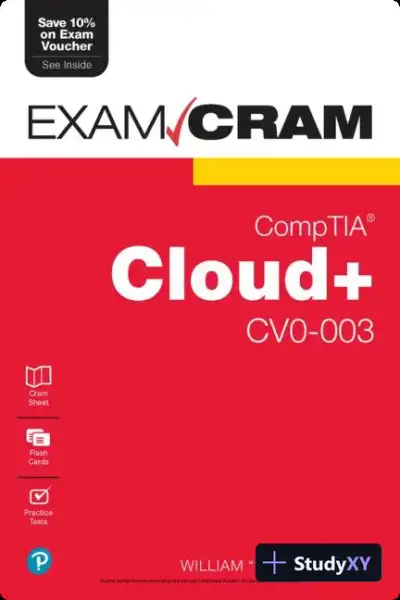 Certification Guides
CompTIA Cloud+ CV0-003 Exam Cram (2021)
CompTIA Certifications
434 pages156downloadsFeb 2025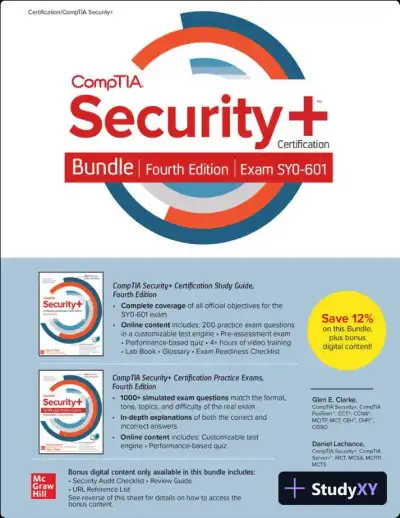 Certification Guides
CompTIA Security+ SY0-601 Exam Certification Bundle, 4th Edition (2021)
CompTIA Certifications
1897 pages152downloadsFeb 2025 Certification Guides
CompTIA Server+ SK0-005 Certification All-in-One Exam Guide, 2nd Edition (2021)
CompTIA Certifications
628 pages144downloadsFeb 2025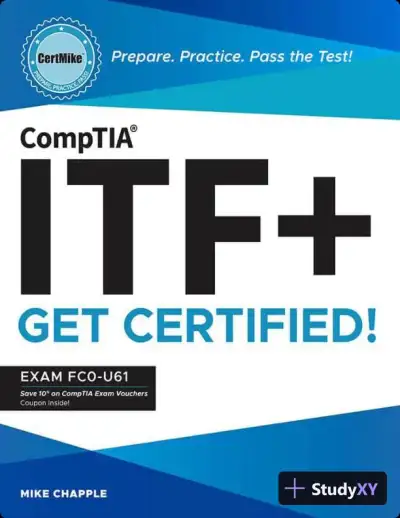 Certification Guides
CompTIA ITF+ CertMike: Exam FC0-U61 (2023)
CompTIA Certifications
464 pages144downloadsFeb 2025 Certification Guides
CompTIA Security+ All-in-One SY0-601 Exam Guide, 6th Edition (2021)
CompTIA Certifications
1093 pages144downloadsFeb 2025 Certification Guides
CompTIA Network+ N10-008 Exam Cram (2021)
CompTIA Certifications
654 pages143downloadsFeb 2025 Certification Guides
CompTIA Security+ Certification Study Guide Exam SY0-601 (2022)
CompTIA Certifications
1024 pages134downloadsFeb 2025 Certification Guides
CompTIA Cloud Essentials+ Study Guide: Exam CLO-002 2nd Edition (2020)
CompTIA Certifications
370 pages115downloadsFeb 2025
Study this document with CramX
Once it is in your library, every tool can work from it.