

Essentials of Criminal Justice 10th Edition Test Bank
- Criminal Justice
- 308 pages
- Shared May 2025
Essentials of Criminal Justice 10th Edition Test Bank simplifies revision with detailed notes, practice sets, and a strategic study plan.
Preview 16 of 308 pages
See the first 16 pages exactly as they appear in the document.
Page 1 Read page 1 as text
Cengage Learning Testing, Powered by Cognero Page 1 True / False 1. According to the Federal Bureau of Investigation (FBI), there are about 500 justified fatal police shootings each year. This number is an increase from 5 years ago. a. True b. False ANSWER: True REFERENCES: Developing the Criminal Justice System LEARNING OBJECTIVES: ESCJ.SIEG.17.01.01 - Discuss the formation of the criminal justice system in the United States. KEYWORDS: Remember 2. Crime is higher today than it was in the nineteenth and early twentieth centuries. a. True b. False ANSWER: False REFERENCES: Developing the Criminal Justice System LEARNING OBJECTIVES: ESCJ.SIEG.17.01.01 - Discuss the formation of the criminal justice system in the United States. KEYWORDS: Remember 3. The Law Enforcement Assistance Administration (LEAA) continues to provide grants to local and state justice agencies to fund criminal justice activities. a. True b. False ANSWER: False REFERENCES: Developing the Criminal Justice System LEARNING OBJECTIVES: ESCJ.SIEG.17.01.01 - Discuss the formation of the criminal justice system in the United States. KEYWORDS: Remember 4. Of the components in the Criminal Justice System, usually the correctional component comes before the other two components. a. True b. False ANSWER: False REFERENCES: The Contemporary Criminal Justice System LEARNING OBJECTIVES: ESCJ.SIEG.17.01.03 - Identify the basic component agencies of the criminal justice system. KEYWORDS: Analyze 5. The police department was created in the United States; the first formed in Philadelphia after the Civil War. a. True b. False ANSWER: False REFERENCES: Developing the Criminal Justice System LEARNING OBJECTIVES: ESCJ.SIEG.17.01.01 - Discuss the formation of the criminal justice system in the United States.
Page 2 Page 3 Read page 3 as text
Cengage Learning Testing, Powered by Cognero Page 2 KEYWORDS: Remember 6. The contemporary criminal justice system is society ’ s instrument of formal social control. a. True b. False ANSWER: True REFERENCES: The Contemporary Criminal Justice System LEARNING OBJECTIVES: ESCJ.SIEG.17.01.02 - Define the concept of a criminal justice system. KEYWORDS: Remember 7. Most criminal cases are processed through the entire formal justice system. a. True b. False ANSWER: False REFERENCES: The Formal Criminal Justice Process LEARNING OBJECTIVES: ESCJ.SIEG.17.01.06 - Articulate what is meant by the term criminal justice assembly line. KEYWORDS: Remember 8. Police officers can arrest someone if they have a “gut feeling” that the person is guilty of a criminal offense. a. True b. False ANSWER: False REFERENCES: The Formal Criminal Justice Process LEARNING OBJECTIVES: ESCJ.SIEG.17.01.06 - Articulate what is meant by the term criminal justice assembly line. KEYWORDS: Apply 9. In a probable cause hearing, the defendant and his or her attorney may appear and dispute the prosecutor’s charges . a. True b. False ANSWER: True REFERENCES: The Formal Criminal Justice Process LEARNING OBJECTIVES: ESCJ.SIEG.17.01.05 - Trace the formal criminal justice process. KEYWORDS: Remember 10. Less serious felonies make up the bottom layer (Level 4) of the criminal justice system wedding cake. a. True b. False ANSWER: False REFERENCES: The Informal Criminal Justice Process LEARNING OBJECTIVES: ESCJ.SIEG.17.01.08 - Describe the “wedding cake” model of justice. KEYWORDS: Apply 11. The crime control perspective views the justice system as a means of caring for and treating people who cannot manage themselves. a. True b. False
Page 4 Read page 4 as text
Cengage Learning Testing, Powered by Cognero Page 3 ANSWER: False REFERENCES: Perspectives on Justice LEARNING OBJECTIVES: ESCJ.SIEG.17.01.09 - Discuss the various perspectives on justice. KEYWORDS: Remember 12. Decriminalization of marijuana would most likely be advocated by those having a perspective of equal justice. a. True b. False ANSWER: False REFERENCES: Perspectives on Justice LEARNING OBJECTIVES: ESCJ.SIEG.17.01.09 - Discuss the various perspectives on justice. KEYWORDS: Understand 13. Noninterventionists support the placement of first - time offenders who commit minor crimes into informal community - based treatment programs. a. True b. False ANSWER: True REFERENCES: Perspectives on Justice LEARNING OBJECTIVES: ESCJ.SIEG.17.01.09 - Discuss the various perspectives on justice. KEYWORDS: Remember 14. The issue of ethics is becoming less important in the criminal justice system, due to an increasing number of checks and balances. a. True b. False ANSWER: False REFERENCES: Ethics in Criminal Justice LEARNING OBJECTIVES: ESCJ.SIEG.17.01.10 - Discuss the ethical issues that arise in criminal justice. KEYWORDS: Understand 15. An ethical issue that has received recent attention is that of sexual violence by correctional officers against inmates. a. True b. False ANSWER: True REFERENCES: Ethics in Criminal Justice LEARNING OBJECTIVES: ESCJ.SIEG.17.01.10 - Discuss the ethical issues that arise in criminal justice. KEYWORDS: Remember 16. Use of discretion at all levels of the criminal justice system is one way in which ethical considerations arise. a. True b. False ANSWER: True REFERENCES: Ethics in Criminal Justice LEARNING OBJECTIVES: ESCJ.SIEG.15.01.10 - Discuss the ethical issues that arise in criminal justice. KEYWORDS: Understand
Page 5 Read page 5 as text
Cengage Learning Testing, Powered by Cognero Page 4 17. There has been a substantial decline in the crime rate, yet more than 11 million individuals are still arrested annually. a. True b. False ANSWER: True REFERENCES: The Contemporary Criminal Justice System LEARNING OBJECTIVES: ESCJ.SIEG.17.01.02 - Define the concept of a criminal justice system. KEYWORDS: Remember 18. Federal funding accounts for most of all direct justice system spending. a. True b. False ANSWER: False REFERENCES: The Contemporary Criminal Justice System LEARNING OBJECTIVES: ESCJ.SIEG.17.01.03 - Identify the basic component agencies of the criminal justice system. KEYWORDS: Remember 19. A courtroom work group is made up of a prosecutor and defense attorney and helps to streamline the process of justice through the extensive use of deal making and plea bargaining. a. True b. False ANSWER: False REFERENCES: The Informal Criminal Justice Process LEARNING OBJECTIVES: ESCJ.SIEG.17.01.07 - Characterize the informal criminal justice system. KEYWORDS: Remember Multiple Choice 20. Which of the following is true regarding the relationship between criminal justice and the media? a. The media routinely features stories exposing brutal cops and violent prisons. b. Most criminal defendants receive a lengthy trial by jury in media representations of cases. c. The media leads many individuals to false impressions and unrealized expectations about criminal justice. d. All of the above statements are true regarding the relationship between criminal justice and the media. ANSWER: d REFERENCES: Introduction LEARNING OBJECTIVES: ESCJ.SIEG.17.05. - Discuss the concept of community - oriented policing. KEYWORDS: Understand 21. Which of the following statements is true? a. During the nineteenth century, the United States experienced a surge in violent behavior. b. Organized gangs flourished in the largest cities of the United States in the early 1900s. c. The first criminal gangs formed before the Civil War in urban slums. d. All of the statements are true. ANSWER: d REFERENCES: Developing the Criminal Justice System LEARNING OBJECTIVES: ESCJ.SIEG.17.01.01 - Discuss the formation of the criminal justice system in the United States. KEYWORDS: Remember
Page 6 Read page 6 as text
Cengage Learning Testing, Powered by Cognero Page 5 22. What commission, appointed by President Herbert Hoover, made a detailed analysis of the US justice system and helped usher in the era of treatment and rehabilitation? a. Chicago Crime Commission b. American Bar Foundation Commission c. Wickersham Commission d. President ’ s Commission on Law Enforcement and Administration of Justice ANSWER: c REFERENCES: Developing the Criminal Justice System LEARNING OBJECTIVES: ESCJ.SIEG.17.01.01 - Discuss the formation of the criminal justice system in the United States. KEYWORDS: Remember 23. The mean state corrections expenditure per inmate in approximately _______ per year. a. $12,000 b. $18,000 c. $28,000 d. $40,000 ANSWER: c REFERENCES: The Contemporary Criminal Justice System LEARNING OBJECTIVES: ESCJ.SIEG.17.01.04 - Comprehend the size and scope of the contemporary justice system. KEYWORDS: Remember 24. Federal funding makes up ___ percent of the contemporary criminal justice system. a. 10 b. 19 c. 27 d. 38 ANSWER: b REFERENCES: The Contemporary Criminal Justice System LEARNING OBJECTIVES: ESCJ.SIEG.15.01.04 - Comprehend the size and scope of the contemporary justice system. KEYWORDS: Remember 25. The contemporary criminal justice system can be divided into three main components: a. law enforcement, the courts, and the legislature. b. the courts, the correctional system, and the legislature. c. law enforcement, the courts, and the correctional system. d. law enforcement, the correctional system, and the legislature. ANSWER: c REFERENCES: The Contemporary Criminal Justice System LEARNING OBJECTIVES: ESCJ.SIEG.17.01.03 - Identify the basic component agencies of the criminal justice system. KEYWORDS: Remember 26. The corrections system is vast and costs federal, state, and local governments approximately $_____ billion annually. a. $75 b. $110 c. $165 d. $264
Page 7 Read page 7 as text
Cengage Learning Testing, Powered by Cognero Page 6 ANSWER: d REFERENCES: The Contemporary Criminal Justice System LEARNING OBJECTIVES: ESCJ.SIEG.17.01.04 - Comprehend the size and scope of the contemporary justice system. KEYWORDS: Remember 27. There are about ____ people employed in local, state, and county law enforcement agencies. a. 350,000 b. 50 0,000 c. 1.1 million d. 2 million ANSWER: c REFERENCES: The Contemporary Criminal Justice System LEARNING OBJECTIVES: ESCJ.SIEG.17.01.04 - Comprehend the size and scope of the contemporary justice system. KEYWORDS: Remember 28. Which of the following is not required as a legal condition for an arrest? a. Probable cause b. Deprivation of the individual’s freedom c. Use of handcuffs d. Belief by the suspect that he or she is in police custody ANSWER: c REFERENCES: The Formal Criminal Justice Process LEARNING OBJECTIVES: ESCJ.SIEG.17.01.05 - Trace the formal criminal justice process. KEYWORDS: Understand 29. What is known about the correctional population in the United States? a. The correctional population has been consistently decreasing over the past decade with 5 million people currently under the control of the correctional system. b. The correctional population currently consists of 7 million people under correctional supervision. c. The correctional population has fluctuated widely over the past decade with 21 million people currently under the control of the correctional system. d. The correctional population has decreased dramatically over the past decade and now consists of 2 million people under the control of the correctional system. ANSWER: b REFERENCES: The Contemporary Criminal Justice System LEARNING OBJECTIVES: ESCJ.SIEG.17.01.04 - Comprehend the size and scope of the contemporary justice system. KEYWORDS: Remember 30. Criminal justice can be viewed as a process that takes an offender through a series of decision points, beginning with arrest and concluding with reentry. Which of the following is an extralegal factor that critics argue may be involved in this process? a. Offender ’ s race b. Offender ’ s prior record c. Seriousness of offense d. Available evidence ANSWER: a REFERENCES: The Formal Criminal Justice Process LEARNING OBJECTIVES: ESCJ.SIEG.17.01.06 - Articulate what is meant by the term criminal justice assembly line. KEYWORDS: Remember 31. Discretion by police officers occurs during the first four stages of the criminal justice process. In order, what
Page 8 Read page 8 as text
Cengage Learning Testing, Powered by Cognero Page 7 are those stages? a. Initial contact, arrest, charging, custody b. Initial contact, investigation, arrest, charging c. Initial contact, investigation, arrest, custody d. Initial contact, arrest, investigation, charging ANSWER: c REFERENCES: The Formal Criminal Justice Process LEARNING OBJECTIVES: ESCJ.SIEG.17.01.05 - Trace the formal criminal justice process. KEYWORDS: Remember 32. Which of the following stages of the criminal justice process comes earliest in the process? a. Charging b. Investigation c. Preliminary hearing d. Arraignment ANSWER: c REFERENCES: The Formal Criminal Justice Process LEARNING OBJECTIVES: ESCJ.SIEG.17.01.05 - Trace the formal criminal justice process. KEYWORDS: Remember 33. What percentage of cases proceeds to a criminal trial? a. 1 percent b. 10 percent c. 25 percent d. 50 percent ANSWER: b REFERENCES: The Formal Criminal Justice Process LEARNING OBJECTIVES: ESCJ.SIEG.17.01.05 - Trace the formal criminal justice process. KEYWORDS: Remember 34. Which of the following is not a reason for a nolle prosequi — the term used when a prosecutor decides to drop a case after a complaint has been formally made? a. Race of the defendant b. Insufficient evidence c. Reluctance of witnesses to testify d. Police error ANSWER: a REFERENCES: The Formal Criminal Justice Process LEARNING OBJECTIVES: ESCJ.SIEG.17.01.05 - Trace the formal criminal justice process. KEYWORDS: Remember 35. In the formal criminal justice process, all defendants must go through which stage to ensure proper sentencing/punishment/dismissal/closure? a. Arraignment b. Criminal trial c. Grand jury hearing d. Bail hearing ANSWER: a
Page 9 Read page 9 as text
Cengage Learning Testing, Powered by Cognero Page 8 REFERENCES: The Formal Criminal Justice Process LEARNING OBJECTIVES: ESCJ.SIEG.17.01.05 - Trace the formal criminal justice process. KEYWORDS: Remember 36. If the prosecution can present sufficient evidence, the grand jury will issue a(n) ____, which specifies the exact charges on which the accused must stand trial. a. true bill of indictment b. information c. charging bill d. nolle prosequi ANSWER: a REFERENCES: The Formal Criminal Justice Process LEARNING OBJECTIVES: ESCJ.SIEG.17.01.05 - Trace the formal criminal justice process. KEYWORDS: Remember 37. At what stage of the formal criminal justice process does the defendant enter a plea of guilty or not guilty? a. Arraignment b. Criminal trial c. Preliminary hearing d. Bail hearing ANSWER: a REFERENCES: The Formal Criminal Justice Process LEARNING OBJECTIVES: ESCJ.SIEG.17.01.05 - Trace the formal criminal justice process. KEYWORDS: Remember 38. For every 1000 serious crimes, about _____ adults are sent to prison. a. 5 b. 10 c. 20 d. 30 ANSWER: c REFERENCES: The Formal Criminal Justice Process LEARNING OBJECTIVES: ESCJ.SIEG.17.01.06 - Articulate what is meant by the term criminal justice assembly line. KEYWORDS: Remember 39. For every 1000 serious crimes, about ____ percent are reported to the police. a. 15 b. 35 c. 50 d. 75 ANSWER: c REFERENCES: The Formal Criminal Justice Process LEARNING OBJECTIVES: ESCJ.SIEG.17.01.06 - Articulate what is meant by the term criminal justice assembly line. KEYWORDS: Remember 40. The case of Jared Lee Loughner, who shot Congresswoman Gabrielle Giffords, is an example of _______ of the “wedding cake” model of justice. a. Level I b. Level II c. Level III d. Level IV ANSWER: a REFERENCES: The Informal Criminal Justice Process LEARNING OBJECTIVES: ESCJ.SIEG.17.01.08 - Describe the “wedding cake” model of justice.
Page 10 Read page 10 as text
Cengage Learning Testing, Powered by Cognero Page 9 KEYWORDS: Apply 41. Approximately ____ percent of felony cases are settled without a trial. a. 20 b. 40 c. 60 d. 80 ANSWER: d REFERENCES: The Informal Criminal Justice Process LEARNING OBJECTIVES: ESCJ.SIEG.17.01.07 - Characterize the informal criminal justice system. KEYWORDS: Remember 42. About ____ percent of misdemeanors are settled without a trial. a. 30 b. 50 c. 70 d. 90 ANSWER: d REFERENCES: The Informal Criminal Justice Process LEARNING OBJECTIVES: ESCJ.SIEG.17.01.07 - Characterize the informal criminal justice system. KEYWORDS: Remember 43. Which of the following crimes would be placed in Level II of the criminal justice “wedding cake”? a. A noted celebrity is arrested for shooting her bodyguard. b. A violent act committed by a stranger who uses a weapon. c. An individual is arrested for public drunkenness. d. A first - time offender assaults a friend. ANSWER: b REFERENCES: The Informal Criminal Justice Process LEARNING OBJECTIVES: ESCJ.SIEG.17.01.08 - Describe the “wedding cake” model of justice. KEYWORDS: Apply 44. A case of domestic violence would be considered _____ of the criminal justice “wedding cake”? a. Level I b. Level II c. Level III d. Level IV ANSWER: c REFERENCES: The Informal Criminal Justice Process LEARNING OBJECTIVES: ESCJ.SIEG.17.01.08 - Describe the “wedding cake” model of justice. KEYWORDS: Apply 45. Shoplifting and public drunkenness would be considered _____ of the criminal justice “wedding cake”? a. Level I b. Level II c. Level III d. Level IV ANSWER: d REFERENCES: The Informal Criminal Justice Process LEARNING OBJECTIVES: ESCJ.SIEG.17.01.08 - Describe the “wedding cake” model of justice.
Page 11 Read page 11 as text
Cengage Learning Testing, Powered by Cognero Page 10 KEYWORDS: Apply 46. According to this justice perspective, the proper role of the justice system is to prevent crime through the judicious use of criminal sanctions. It demands an efficient system that hands out tough sanctions to those who violate the law. a. Crime control b. Rehabilitation c. Due process d. Equal justice ANSWER: a REFERENCES: Perspectives on Justice LEARNING OBJECTIVES: ESCJ.SIEG.17.01.09 - Discuss the various perspectives on justice. KEYWORDS: Remember 47. Which of the following is false? a. Crime control advocates call for harsh punishment as a deterrent to crime. b. Crime control advocates do not want legal technicalities to help the guilty go free and tie the hands of justice. c. Crime control advocates argue the more efficient the system, the greater its effectiveness. d. Crime control advocates do not question the criminal justice system ’ s ability to rehabilitate offenders. ANSWER: d REFERENCES: Perspectives on Justice LEARNING OBJECTIVES: ESCJ.SIEG.17.01.09 - Discuss the various perspectives on justice. KEYWORDS: Understand 48. According to this justice perspective, the justice system serves as a mechanism of caring for and treating people who cannot manage themselves. It assumes people are at the mercy of social, economic, and interpersonal conditions. a. Crime control b. Rehabilitation c. Due process d. Equal justice ANSWER: b REFERENCES: Perspectives on Justice LEARNING OBJECTIVES: ESCJ.SIEG.17.01.09 - Discuss the various perspectives on justice. KEYWORDS: Remember 49. Proponents of this justice perspective believe that the greatest concern of the justice system should be providing fair and equitable treatment to those accused of committing a crime. a. Crime control b. Rehabilitation c. Due process d. Equal justice ANSWER: c REFERENCES: Perspectives on Justice LEARNING OBJECTIVES: ESCJ.SIEG.17.01.09 - Discuss the various perspectives on justice. KEYWORDS: Understand 50. Proponents of this justice perspective are concerned about the effect of the stigma that criminal suspects bear when they are given negative labels such as “rapist” or “child molester.” a. Rehabilitation b. Nonintervention c. Equal justice d. Restorative justice
Page 12 Read page 12 as text
Cengage Learning Testing, Powered by Cognero Page 11 ANSWER: b REFERENCES: Perspectives on Justice LEARNING OBJECTIVES: ESCJ.SIEG.17.01.09 - Discuss the various perspectives on justice. KEYWORDS: Understand 51. Which justice perspective advocates mediation rather than coercive punishment? a. Rehabilitation b. Nonintervention c. Equal justice d. Restorative justice ANSWER: d REFERENCES: Perspectives on Justice LEARNING OBJECTIVES: ESCJ.SIEG.17.01.09 - Discuss the various perspectives on justice. KEYWORDS: Remember 52. If you believe that procedural fairness, civil rights, and the rule of law are inviolate principles, which justice perspective do you favor? a. Crime control b. Due process c. Equal justice d. Rehabilitation ANSWER: b REFERENCES: Perspectives on Justice LEARNING OBJECTIVES: ESCJ.SIEG.17.01.09 - Discuss the various perspectives on justice. KEYWORDS: Remember 53. A concern with constitutional rights and privileges is a main focus of which justice perspective? a. Crime control b. Due process c. Equal justice d. Rehabilitation ANSWER: b REFERENCES: Perspectives on Justice LEARNING OBJECTIVES: ESCJ.SIEG.17.01.09 - Discuss the various perspectives on justice. KEYWORDS: Remember 54. “Widening the net of justice” is of concern to you if you favor which justice perspective? a. Nonintervention b. Due process c. Equal justice d. Rehabilitation ANSWER: a REFERENCES: Perspectives on Justice LEARNING OBJECTIVES: ESCJ.SIEG.17.01.09 - Discuss the various perspectives on justice. KEYWORDS: Remember 55. This justice perspective advocates standardization of rules and regulations within the criminal justice system. a. Nonintervention b. Due process c. Equal justice
Page 13 Read page 13 as text
Cengage Learning Testing, Powered by Cognero Page 12 d. Rehabilitation ANSWER: c REFERENCES: Perspectives on Justice LEARNING OBJECTIVES: ESCJ.SIEG.17.01.09 - Discuss the various perspectives on justice. KEYWORDS: Remember 56. According to noninterventionists, the efforts to treat offenders may lead to further stigma beyond the scope of the original offense. This is referred to as: a. deinstitutionalization b. nolle prosequi c. victimless crime d. widening the net of justice ANSWER: d REFERENCES: Perspectives on Justice LEARNING OBJECTIVES: ESCJ.SIEG.17.01.09 - Discuss the various perspectives on justice. KEYWORDS: Remember 57. Advocates of this justice perspective argue that the justice system remains an adversarial process that pits the forces of the state against those of a solitary individual accused of a crime. a. Crime control b. Due process c. Nonintervention d. Rehabilitation ANSWER: b REFERENCES: Perspectives on Justice LEARNING OBJECTIVES: ESCJ.SIEG.17.01.09 - Discuss the various perspectives on justice. KEYWORDS: Remember 58. Ethical issues transcend all elements of the justice system. Why are ethical standards so important in criminal justice? a. Without ethical decision making, it is possible that individual civil rights and liberties will suffer. b. Agents of the criminal justice system have access to citizens ’ most personal information, raising concerns of privacy and confidentiality. c. Justice system personnel may work in an environment where moral ambiguity is widespread. d. Ethical standards are important in the justice system for all these reasons. ANSWER: d REFERENCES: Ethics in Criminal Justice LEARNING OBJECTIVES: ESCJ.SIEG.17.01.10 - Discuss the ethical issues that arise in criminal justice. KEYWORDS: Understand 59. Which of the following is false? a. Ethical issues transcend all elements of the criminal justice system. b. It is often difficult to determine what is fair and just and balance ; this concerns with the needs of the public. c. Ethical issues end with the arrest of a suspect. d. Ethical behavior is important in law enforcement because officers have the authority to deprive individuals of their liberty. ANSWER: c REFERENCES: Ethics in Criminal Justice LEARNING OBJECTIVES: ESCJ.SIEG.17.01.10 - Discuss the ethical issues that arise in criminal justice.
Page 14 Read page 14 as text
Cengage Learning Testing, Powered by Cognero Page 13 KEYWORDS: Understand Jessica has been in trouble with the law for as long as she can remember. Her first crime was shoplifting a candy bar from the drugstore. Since then she has moved on to more substantial shoplifting and stealing. She is currently on probation and is paying restitution to a victim for a previous theft. Now Jessica has been arrested for home invasion and robbery. 60. As Jessica recalls her past history of stealing and theft, she realizes that her parents weren’t around very much and she doesn’t remember regularly attending school. Parents and school represent what aspect when discussing criminal behavior? a. Formal social control b. Informal social control c. Legal and immoral control d. Illegal and moral control ANSWER: b REFERENCES: The Informal Criminal Justice Process PREFACE NAME: Case 1.1 LEARNING OBJECTIVES: ESCJ.SIEG.17.01.07 - Characterize the informal criminal justice system. KEYWORDS: Apply 61. With Jessica’s new charge of home invasion and robbery, she will likely be sentenced to prison time. What component of the system will she serve her sentence in? a. Corrections b. Institutional supervision c. Courts d. Police ANSWER: a REFERENCES: The Formal Criminal Justice Process PREFACE NAME: Case 1.1 LEARNING OBJECTIVES: ESCJ.SIEG.17.01.05 - Trace the formal criminal justice process. KEYWORDS: Apply 62. Jessica was asked to participate in a rehabilitation program that is designed to provide a more successful readjustment to society without theft and robbery. Her participation in this program will occur during what stage of the criminal justice process? a. Sentencing/disposition b. Prerelease c. Correctional treatment d. Post release ANSWER: c REFERENCES: The Formal Criminal Justice Process PREFACE NAME: Case 1.1 LEARNING OBJECTIVES: ESCJ.SIEG.17.01.05 - Trace the formal criminal justice process. KEYWORDS: Remember Jackson has been arrested for possession of drugs. When he was taken into custody, the officer had just witnessed Jackson taking money from someone and handing them a small bag that looked as if it were drugs. After obtaining that probable cause, the officer searched Jackson’s backpack where he found approximately 4 ounces of marijuana packaged in smaller
Page 15 Read page 15 as text
Cengage Learning Testing, Powered by Cognero Page 14 bags for resale. 63. After arrest, Jackson will be in what stage of the criminal justice process while the officer searches his home for more evidence? a. Initial contact b. Booking c. Custody d. Holding ANSWER: c REFERENCES: The Formal Criminal Justice Process PREFACE NAME: Case 1.2 LEARNING OBJECTIVES: ESCJ.SIEG.17.01.05 - Trace the formal criminal justice process. KEYWORDS: Apply 64. Upon searching Jackson’s home, the officer found an additional 3 ounces of marijuana packaged for resale. The prosecutor has decided to charge Jackson with possession with intent to distribute. What is the next stage of the criminal justice process after charging? a. Custody b. Preliminary hearing c. Arraignment d. Plea bargaining ANSWER: b REFERENCES: The Formal Criminal Justice Process PREFACE NAME: Case 1.2 LEARNING OBJECTIVES: ESCJ.SIEG.17.01.05 - Trace the formal criminal justice process. KEYWORDS: Apply 65. At arraignment, Jackson accepts a plea deal that will shorten his sentence in return for naming one of his marijuana dealer. About what percentage of cases every year end in plea bargains instead of a criminal trial? a. 60 percent b. 70 percent c. 80 percent d. 90 percent ANSWER: d REFERENCES: The Formal Criminal Justice Process PREFACE NAME: Case 1.2 LEARNING OBJECTIVES: ESCJ.SIEG.17.01.05 - Trace the formal criminal justice process. KEYWORDS: Remember Patricia, a famous child actor, has been arrested yet again. She has had many brushes with the law but has yet to be sentenced to prison .This time, the arrest was for was stealing but in the end, the charges are reduced after the star agrees to return the stolen goods. She has a team of attorneys on retainer and is always in the spotlight. 66. With Patricia’s retained counsel, the judge was convinced that she had learned her lesson and the challenge of the spotlight led her to her most current crime. This type of scenario is most likely to happen in what level of the criminal justice “wedding cake”? a. Level 1
Page 16 Read page 16 as text
Cengage Learning Testing, Powered by Cognero Page 15 b. Level 2 c. Level 3 d. Level 4 ANSWER: a REFERENCES: The Informal Criminal Justice Process PREFACE NAME: Case 1.3 LEARNING OBJECTIVES: ESCJ.SIEG.17.01.08 - Describe the “wedding cake” model of justice. KEYWORDS: Apply 67. When Patricia had her charges reduced in exchange for the return of stolen goods, what agency of crime control did she most likely deal with? a. Police b. Prosecution and defense c. Courts d. Corrections ANSWER: b REFERENCES: The Formal Criminal Justice Process PREFACE NAME: Case 1.3 LEARNING OBJECTIVES: ESCJ.SIEG.17.01.06 - Articulate what is meant by the term criminal justice assembly line. KEYWORDS: Apply Henry Huggins is a state’s attorney who wants to be mayor of Baltimore. He knows that mayors before him have run and won on the “tough on crime” platform. Henry also believes in being tough but fair and knows that he has the winning record both in the courtroom and in politics. He feels that every person deserves a full array of constitutional rights and preserving democratic ideals is paramount over the need to punish the guilty. 68. If Henry believes in democratic ideals and careful scrutiny of decisions made in the justice system, what perspective on justice does Henry take? a. Noninterventionist b. Crime control c. Due process d. Equal justice ANSWER: c REFERENCES: Perspectives on Justice PREFACE NAME: Case 1.4 LEARNING OBJECTIVES: ESCJ.SIEG.17.01.09 - Discuss the various perspectives on justice. KEYWORDS: Apply 69. What is the concept called that describes Henry’s involvement with the defense attorney, judge, and other courtroom personnel that helps to streamline the process of justice through extensive use of deal making and plea bargaining? a. Safe streets control group b. Courtroom work group c. The center work group d. Cooperative work group ANSWER: b REFERENCES: The Informal Criminal Justice Process
292 more pages in the full document
Unlock it once and it stays in your library, ready to chat with or turn into flashcards.
Unlock the full documentMore Criminal Justice study materials
See all Exam Guides
Test Bank For Forensic Science, 4th Edition
Criminal Justice
370 pages132downloadsFeb 2025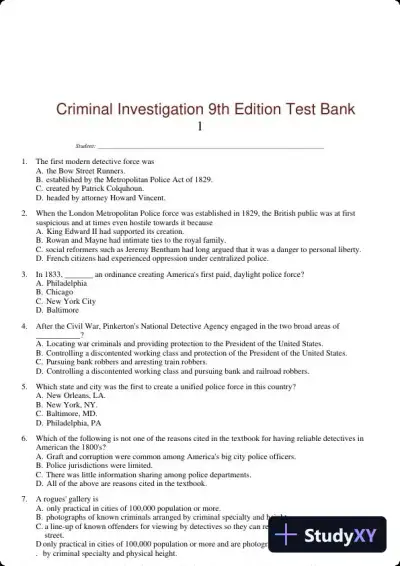 Exam Guides
Criminal Investigation 9th Edition Test Bank
Criminal Justice
344 pages103downloadsFeb 2025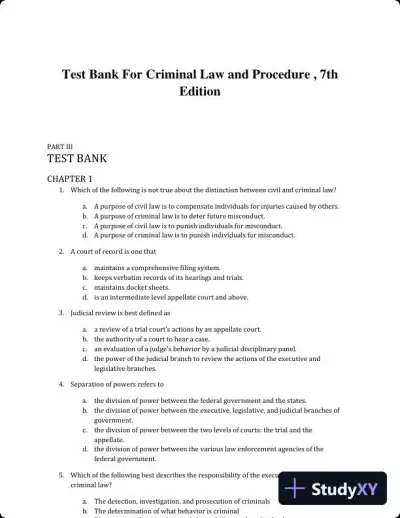 Exam Guides
Test Bank For Criminal Law and Procedure , 7th Edition
Criminal Justice
65 pages96downloadsFeb 2025 Past Exams
2024-2025 TCOLE Basic Jailer Course Practice Exam with Answers (259 Solved Questions)
Criminal Justice
33 pages47downloadsFeb 2025 Class Presentation
The Future Of The Juvenile System
Criminal Justice
11 pagesMay 2025 Class Notes
Lecture Notes For Crime Control In America: What Works, 4th Edition
Criminal Justice
66 pagesMay 2025- Past ExamsPast Exams
Technology in Criminal Justice CJ305-6-0
Criminal Justice
1 pageJun 2025 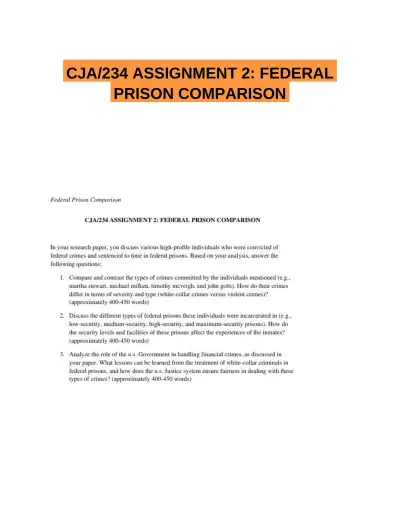 Solved Assignments
CJA/234 ASSIGNMENT 2: FEDERAL PRISON COMPARISON
Criminal Justice
9 pagesMay 2025
Study this document with CramX
Once it is in your library, every tool can work from it.