

Lecture Notes For Crime Control In America: What Works, 4th Edition
- Criminal Justice
- 66 pages
- Shared May 2025
Lecture Notes For Crime Control In America: What Works, 4th Edition helps you stay on track with well-organized lecture notes that focus on the most important concepts.
Preview 16 of 66 pages
See the first 16 pages exactly as they appear in the document.
Page 1 Read page 1 as text
Online Instructor’s Manual for Crime Control in America What Works? Fourth Edition John L. Worrall University of Texas at Dallas CLASS NOTES
Page 2 Page 3 Read page 3 as text
3 Contents Introduction……………………………………………………………………………….….5 Sample Syllabus………………………………………………………………………….…..7 Chapter Outlines Chapter 1 Identifying and Evaluating Crime Control………………………………….…….10 Chapter 2 Crime Control Perspectives………………………………………………………14 Chapter 3 Traditional Policing…………………………………………………………...… 18 Chapter 4 Proactive Policing, Directed Patrol, and Other Advancements………………......22 Chapter 5 Community Involvement in Policing………………………………………...… . 27 Chapter 6 Prosecutors and Crime Control……………………………………………..…... 31 Chapter 7 Crime Control through Legislation……...……………………………………... 35 Chapter 8 Crime Control in the Courts and Beyond.…………………………………........ 39 Chapter 9 Sentencing…………………………………………………………………........ 43 Chapter 10 Probation, Parole, and Intermediate Sanctions.………………………………. 48 Chapter 11 Rehabilitation, Treatment, and Job Training………………………………..… 52 Chapter 12 Individual, Family, and Household Crime Control…………………………... . 56 Chapter 13 Crime Control in the Community and in Schools…………………………….. 59 Chapter 14 Reducing Criminal Opportunities Through Environmental Manipulation…… 63 Chapter 15: Putting it all Together and Explaining Crime Trends…………………...… … 67
Page 4 Read page 4 as text
5 Introduction The Instructor’s Manual and Test Item Bank are designed to accompany Crime Control in America: What Works? by John L. Worrall. The Instructor’s Manual is designed to parallel the text book in a chapter-by-chapter format. A sample syllabus is constructed and placed at beginning of the manual. Following the manual, you will find a test item bank to utilize. Each chapter of the Instructor’s Manual contains: 1. Learning Objectives This section contains learning objectives for each chapter’s material. These learning outcomes are to provide the instructor with a basis for assessing student learning. It is to help make the instructor’s expectations explicit and to set appropriate criteria and high standards for learning quality. 2. Chapter Outline The chapter outline provides a chronological list of individual topics in each chapter, including both major and secondary headings. 3. Key Concepts and Definitions This section provides key terms and definitions used by the author. A definition and a corresponding page number for reference to its location in the text are cited. 4. Student Activities The Instructor’s manual also contains a series of suggested activities for your students. You can choose to assign these activities as out-of-class assignments, weekly homework, research projects, or extra-credit. Some of the activities involve Internet projects, while others involve off campus contacts with criminal justice professionals. 5. Suggested Readings Additional readings are suggested for students’ interested in learning more about a key chapter topic. 6. Test Item Bank Immediately following the Instructor’s Manual is a series of test questions. The test item bank contains 20 multiple choice, 15 true-or-false, and 10 fill-in the blank questions for each chapter. Additionally, there are three essay questions and two critical thinking exercises with suggested answers.
Page 5 Read page 5 as text
6 We trust this manual will assist you in better organizing your instruction time, and enhance the students’ learning experience in your course. We encourage you to offer any suggestions that you believe would improve this manual. Please send your comments to worrall@utdallas.edu. John L. Worrall, Ph.D. University of Texas at Dallas
Page 6 Read page 6 as text
7 Sample Syllabus Course Syllabus for Students Course Information Course Title: CRJ 201 Course Title: Crime Control in America Section number: 001 Days and Times Course Meets: Monday/Wednesday/Friday, 11:00 a.m. to 11:50 a.m. Room Location: Assessment Hall, Room 1342 Instructor Information Instructor Name: Professor Carl Brawner, Professor of Criminal Justice Phone Number: 531-0000 E-Mail: Carl.Brawner@Eastern.edu Location of instructor’s office: Room 2824 ICB Office hours: Tuesday and Thursday, 12:30 p.m. to 2:30 p.m. Introduction Crime control in America focuses on the research regarding the effectiveness of various crime control programs. This course is designed to provide students with a broad analysis of both historic and contemporary crime control strategies implemented by the police, courts, legislators, and the correctional system. Studies indicating strengths and weaknesses of each strategy are examined. Special approaches outside the criminal justice system are reviewed, as well as juvenile crime issues. The course will offer suggestions as to where more research in this area might be best directed. Required Textbook Worrall, John L. (2015). Crime Control in America: What Works?, 3ed , Pearson Inc. Course Objectives (Learning Outcomes) Upon completion of this course, students will be able to: 1. Explain the strategies used by the police, the courts and the correctional system in various crime control efforts. 2. Describe the dynamic growth of the criminal justice system, and how crime Prevention became an industry. 3. Distinguish which methods to control crime have been successful and which ones have failed. 4. Give examples of the evidence presented from scholarly studies regarding the effectiveness of various crime control policies.
Page 7 Read page 7 as text
8 Course Outline Section One Introduction Chapter 1: Identifying and Evaluating Crime Control Chapter 2: Crime Control Perspectives Section Two Law Enforcement Approaches Chapter 3: Traditional Policing Chapter 4: Proactive Policing, Directed Patrol, and Other Advancements Chapter 5: Community Involvement in Policing Chapter 6: Prosecutors and Crime Control Section Three Legislation, Courts, and Corrections Chapter 7: Crime Control Through Legislation Chapter 8: Crime Control in the Courts and Beyond Chapter 9: Sentencing Chapter 10: Probation, Parole, and Intermediate Sanctions Chapter 11: Rehabilitation, Treatment, and Job Training Section Four Approaches Beyond the Criminal Justice System Chapter 12: Individual, Family, and Household Crime Control Chapter 13: Crime Control in the Community and in Schools Chapter 14: Reducing Criminal Opportunities Through Environmental Manipulation Section Five Conclusion Chapter 15: Putting it all Together and Explaining Crime Trends Method of Evaluation Exam one 100 points Exam two 100 points Final Exam 100 points Research Paper 100 points Web-based homework 50 points Attendance and participation 50 points ________ Total possible points 500 points Your aggregate points will equate to the following letter grade: 450 to 500 points = 90% - 100% A 400 to 449 points = 80% - 89% B 350 to 399 points = 70% - 79% C 300 to 349 points = 60% - 69% D 299 points or less = 0 to - 59% F Course Calendar This is a tentative schedule of readings and exam dates. The instructor reserves the right to change dates to accommodate additional topics, guest speakers, field trips, weather or unforeseen scheduling conflicts.
Page 8 Read page 8 as text
9 WEEK ASSIGNMENT Week One Chapter 1: Identifying and Evaluating Crime Control Week Two Chapter 2: Crime Control Perspectives Week Three Chapter 3: Traditional Policing Week Four Chapter 4: Proactive Policing, Directed Patrol, and Other Advancements Week Five Chapter 5: Community Involvement in Policing Week Six Chapter 6: Prosecutors and Crime Control Week Seven Chapter 7: Crime Control Through Legislation Week Eight Chapter 8: Crime Control in the Courts in the Courts and Beyond Week Nine Chapter 9: Sentencing Week Ten Chapter 10: Probation, Parole, and Intermediate Sanctions Week Eleven Chapter 11: Rehabilitation, Treatment, and Job Training Week Twelve Chapter 12: Individual, Family, and Household Crime Control Week Thirteen Chapter 13: Crime Control in the Community and in Schools Week Fourteen Chapter 14: Reducing Criminal Opportunities Through Environmental Manipulation Week Fifteen Chapter 15: Putting it all Together and Explaining Crime Trends Week Sixteen Chapter 16: Final Exam
Page 9 Read page 9 as text
10 Chapter 1: Identifying and Evaluating Crime Control Learning Objectives After reading this chapter students should be able to: 1. Distinguish between crime control and prevention. 2. Discuss the dimensions of the crime problem in America. 3. Explain various “approaches” to the crime problem. 4. Summarize the importance of definitions in the crime control debate. 5. Discuss what crime control evaluations are problematic. 6. Define displacement and diffusion. 7. Explain why scientific knowledge is tentative. 8. Explain how resources and political ideologies guide crime control priorities. 9. Summarize the concept of evidence-based justice. Chapter Outline Crime Control and Prevention Crime Problem in America Types of Crime The Ever-Expanding Criminal Law Incidence of Crime Costs of Crime and Criminals Is Fear of Crime Worse Than Crime Itself? Approaches, Not Just Policies Laws Official Policies, Written and Unwritten Unofficial Approaches On the Importance of Definitions Defining the Crime Problem Defining the Solution Defining the Desired Outcome
Page 10 Read page 10 as text
11 Evaluating Success: An Impossible Task? The Hard and Soft Sciences The Elusive Criminal Justice Experiment You Can Prove Anything with Statistics Qualitative and Quantitative Research Macro- and Micro-Level Crime Control Displacement and Diffusion Measuring Displacement and Diffusion The Tentative Nature of Scientific Knowledge The Measures Used When New Data Become Available Alternate Settings: The Generalization Problem Other Concerns Funding and Political Priorities Academic Crusaders and Bandwagon Science Evidence-Based Justice Effective Does Not Always Mean Best A Preview of the Book Guns and Drugs: The Real Attention Getters Summary Key Concepts and Definitions Academic crusade (p. 21) when research loses objectivity and is used to further a political agenda, often in the face of overwhelming evidence to the contrary. Bandwagon science (p. 21) focusing research on what is trendy or popular at a given time, perhaps ignoring other worthy problems and avenues of inquiry. Classical experiment (p. 14) the gold standard for scientific research, a study that includes (1) a treatment group and a control group, (2) a pretest and a posttest, and (3) a controlled intervention. Diffusion (crime control) (p. 17) a reduction in crime not only in the area targeted by an intervention, but also in surrounding areas. Also referred to as a diffusion of benefit. Displacement (p. 17) the spillover or movement of crime (in the case of crime control) into a surrounding area not targeted by the intervention in question. Evidence-based justice (p. 22) use of the best available scientific evidence to guide criminal justice policy and practice.
Page 11 Read page 11 as text
12 Hard sciences (p. 14) scientific fields of study characterized by research that is usually conducted in tightly controlled laboratory settings (e.g., chemistry and biology). Macro-level crime control (p. 16) consists of approaches to the crime problem that are intended to have a dramatic and desirable effect on crime in an entire neighborhood, city, or state or even across the nation. Meta-analysis (p.22) a research technique that amounts to synthesizing the literature devoted to a specific topic. Micro-level crime control (p. 16) consists of approaches to the crime problem that are more isolated geographically. Outcome (crime control) (p. 12) that which is likely to be affected by the solution. Outcome evaluation (p. 13) a method of determining whether some form of social action is a success or a failure. Process evaluation (p. 13) a method of determining whether a program or policy is operating as it should be. Qualitative research (p. 16) a largely exploratory method of inquiry characterized by in-depth research on a specific location or group of subjects. Quantitative research (p. 16) a method of inquiry characterized by the analysis of numerical data designed to represent concepts of interest. Soft sciences (p. 13) the social sciences primarily, fields that focus on the study of social phenomena in their natural settings. Solution (crime control) (p. 12) the means to an end, in this case crime control. Victimization paradox (p. 8) A high level of fear with a correspondingly low likelihood of victimization.
Page 12 Read page 12 as text
13 Student Activities Activity One Crime control is frequently presented in the media. More specifically, many television shows, music videos, daytime soaps and prime-time specials portray different perspectives regarding the criminal justice system. On the lines below, list at least four television shows that you have seen depicting police operations, investigative work, court cases, or a correctional setting. How did these shows represent that criminal justice agency? Could you identify any problems regarding crime control? Do you think the shows provided a realistic image of a criminal justice agency? Why or Why not? ______________________________________________________________________________ ______________________________________________________________________________ ______________________________________________________________________________ ______________________________________________________________________________ ______________________________________________________________________________ Activity Two An effective way for you to explore the difficulty in evaluating crime control policies is to talk to criminal justice practitioners. This assignment requires you to interview at least one representative of a criminal justice agency. For example, you could interview a police detective, a state’s attorney, a deputy sheriff, or even a probation officer. Prepare a short list of questions to find out what criminal activity is considered to be a serious problem in your city or town. After identifying a specific crime, ask this person if there are any special programs, crackdowns or special units that are targeting this particular criminal element. Finally, ask this criminal justice practitioner to comment on the success of such programs that attempt to control this criminal behavior. Prepare a short summary of your questions and answers to share with your classmates. __________________________________________________________________ __________________________________________________________________ __________________________________________________________________ __________________________________________________________________ __________________________________________________________________ Suggested Readings Bureau of Justice Statistics, Crime in the Nation’s Households, 2000 . Washington D.C.: U.S. Department of Justice, 2002. J. Austin. “Why Criminology is Irrelevant,” Criminology and Public Policy 2(2003):557-564. Office of National Drug Control Policy, The Economic Costs of Drug Abuse in the United States , 1992-1998. Washington D.C. Executive Office of the President, September 2001.
Page 13 Read page 13 as text
14 Chapter 2: Crime Control Perspectives Learning Objectives After reading this chapter students should be able to: 1. Summarize operational perspectives of criminal justice. 2. Summarize political perspectives of criminal justice. 3. Discuss other perspectives of criminal justice. 4. Explain the goals of crime control. Chapter Outline Operational Perspectives Due Process and Crime Control Due Process Values Crime Control Values System and Non-system A Well-Oiled Machine? A Disorganized Mess? The Funnel Model of Justice The Criminal Justice Wedding Cake Political Perspectives Liberals and Conservatives Causes of Crime Consequences of Crime for Society What Should Be Done about Crime? Consensus and Conflict Causes of Crime Consequences of Crime for Society What Should Be Done about Crime? Other Perspectives Faith and Fact Crime Control and Revenue Generation Politics and Ivory Towers
Page 14 Read page 14 as text
15 Goals of Crime Control Deterrence General and Specific Deterrence Absolute and Marginal Deterrence The Limitations of Deterrence Retribution The Limitations of Retribution Incapacitation The Limitations of Incapacitation Rehabilitation The Limitations of Rehabilitation Goals of Crime Control Compared Summary Key Concepts and Definitions Absolute deterrence (p. 42) the belief that the collective actions of the criminal justice system on the whole discourage criminality. Conflict perspective (p. 37) a belief that self-interest, coercion, division, opposition, exclusion, hostility, sectional interests, political power, contradictions, and other such factors best describe social interactions. Consensus perspective (p. 36) a set of beliefs that (1) certain norms and values are the core elements of social life, (2) people are committed to a certain social order, (3) solidarity is evident in the interaction between people of all groups, and (4) everyone willingly submits to a legitimate authority, typically the government. Conservative perspective (p. 36) with respect to crime control, an emphasis on tough punishment and crime control. Corresponds closely with a crime control orientation. Crime control perspective (p. 27) a belief that the key aim of criminal justice policy is the control of crime, perhaps at the expense of individual liberties and due process protections. Criminal justice wedding cake model (p. 31) a model of the criminal process emphasizing how cases are processed. Top layer cases are the fewest in number and receive the full gamut of the criminal process while the lowest level cases, which are the greatest in number, receive quick and informal processing. Due process perspective (p. 27) a belief that the key aim of criminal justice policy is the protection of due process and people’s rights, even if crime control suffers. General deterrence (p. 42) when others besides the sentenced offender are discouraged from committing additional crime due to sentencing/incarceration practices.
Page 15 Read page 15 as text
16 Incapacitation (p. 44) removing criminals from society, usually through incarceration (or sometimes through home confinement, electronic monitoring, or a similar method of restraint). Just deserts (p. 43) the punishment an offender “deserves.” That which one deserves. Liberal perspective (p. 34) with respect to crime control, an emphasis on the protection of people’s rights and liberties. Corresponds closely with a due process perspective. Marginal deterrence (p. 42) incremental changes in the deterrability of crime due to changes in various dimensions of the criminal justice system and process. Rehabilitation (p. 44) a planned intervention intended to change a behavior Retribution (p. 43) a goal of criminal justice concerned with punishing criminals on the basis of the severity of their crimes. Specific deterrence (p. 42) when a sentenced offender is discouraged from committing additional crimes due to his or her capture/incarceration.
Page 16 Read page 16 as text
17 Student Activities Activity One A pressing issue in today’s criminal justice system is how to provide security from terrorism, so that citizens can continue to move freely throughout society. On the lines below, list five recommendations that you believe would improve federal or state law enforcement agencies, in their efforts to better protect the United States from terrorism. 1. Why is it difficult to protect United States citizens from terrorist attacks? 2. Would recommendations you listed create controversy under the individual rights perspective? Why or why not? ______________________________________________________________________________ ______________________________________________________________________________ ______________________________________________________________________________ ______________________________________________________________________________ ______________________________________________________________________________ Activity Two In the space provided below, provide an answer to the following scenario. Kathy Doherty was arrested for possession of cocaine. This is her first drug offense, and she had no prior arrest record. Additionally, she was charged with fencing stolen property to make money to support her drug habit. The police had seized exactly $3,000 of stolen jewelry and $1,200 of clothing that had been stolen from a local shopping mall. Kathy was subsequently convicted on felony drug charges, as well as felony possession of stolen property. You are to be the judge deciding her sentence. Before rendering your decision, review the goals of crime control in chapter 2. Decide which punishment best serves the offender and society. Then decide what type of sentence you want to give Kathy. ______________________________________________________________________________ ______________________________________________________________________________ ______________________________________________________________________________ ______________________________________________________________________________ ______________________________________________________________________________ Suggested Readings John L. Worrall, Criminal Procedure: From First Contact To Appeal , 2004. Boston: Allyn and Bacon. Nils Christie, (1994). Crime Control as Industry . 2 nd ed. London: Routledge. J. Reiman, The Rich get Richer and the Poor get Prison. (6 th ed.) Boston: Allyn and Bacon, 2001.
50 more pages in the full document
Unlock it once and it stays in your library, ready to chat with or turn into flashcards.
Unlock the full documentMore Criminal Justice study materials
See all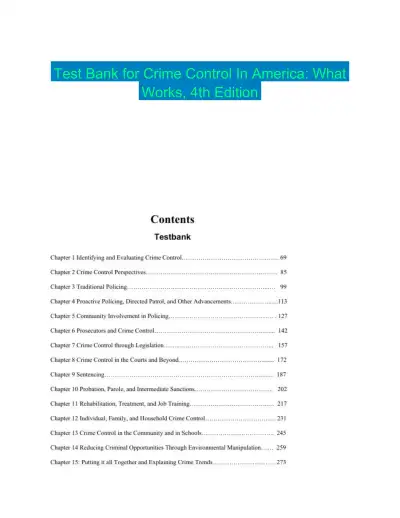 Exam Guides
Test Bank for Crime Control In America: What Works, 4th Edition
Criminal Justice
219 pagesMay 2025 Exam Guides
Test Bank For Forensic Science, 4th Edition
Criminal Justice
370 pages132downloadsFeb 2025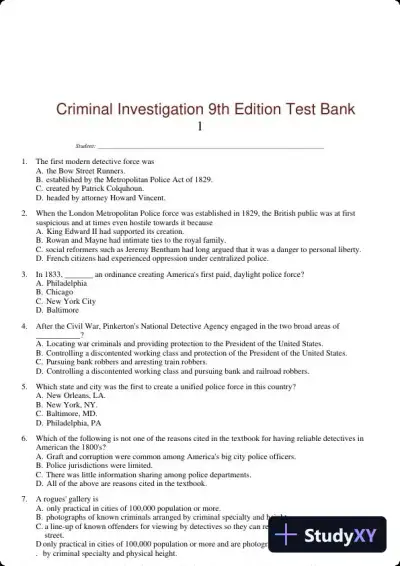 Exam Guides
Criminal Investigation 9th Edition Test Bank
Criminal Justice
344 pages103downloadsFeb 2025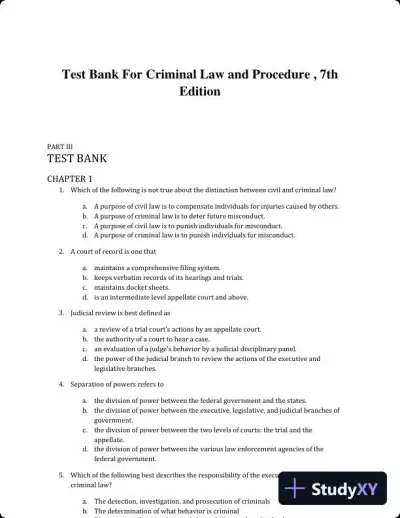 Exam Guides
Test Bank For Criminal Law and Procedure , 7th Edition
Criminal Justice
65 pages96downloadsFeb 2025 Past Exams
2024-2025 TCOLE Basic Jailer Course Practice Exam with Answers (259 Solved Questions)
Criminal Justice
33 pages47downloadsFeb 2025 Solved Assignments
CJA234 Prisoners with Special Needs
Criminal Justice
5 pagesMay 2025 Solved Assignments
Evaluating Restorative Justice and Procedural Justice in Reducing Recidivism and Enhancing Social Order
Criminal Justice
8 pagesMay 2025- Past ExamsPast Exams
Technology in Criminal Justice CJ305-6-0
Criminal Justice
1 pageJun 2025
Study this document with CramX
Once it is in your library, every tool can work from it.