

Earth Science - Insolation and Seasons on Earth
- Earth Science
- Texas A&M University
- 7 pages
- Shared March 2026
Preview 3 of 7 pages
See the first 3 pages exactly as they appear in the document.
Page 1 Read page 1 as text
Study Guide Earth Science – Insolation and Seasons on Earth 1. Changes in Insolation Insolation is the amount of solar energy (sunlight) that reaches a specific area on Earth. This amount doesn’t stay the same — it changes throughout the day and across the year. 1.1 Changes During the Day As the Sun moves across the sky each day, its height changes. • When the Sun reaches its highest point in the sky , that is when the maximum intensity of insolation reaches the Earth’s surface for that day. • You might expect this to be the warmest time of the day — but it usually isn’t. The warmest part of the day typically happens a few hours after the Sun is at its highest point. This delay occurs because: • The land first absorbs sunlight . • Then it slowly reradiates (releases) that energy into the atmosphere. • This released energy warms the air, and air temperature is what we measure when we talk about how hot or cold it is. On the other hand, the coldest part of the day is usually just before sunrise . By this time: • The Earth’s surface has already reradiated most of the energy it absorbed during daylight. • With no incoming sunlight at night, temperatures continue to drop until the Sun rises again. 1.2 Changes Over the Year Insolation also changes with the seasons. • For people living north of the Tropic of Cancer , the Sun reaches its highest point in the sky on June 21 .
Page 2 Read page 2 as text
Study Guide • Even though this is the day with the most intense sunlight, the hottest temperatures usually occur in July . This happens for the same reason as the daily delay: • The ground needs time to absorb solar energy . • It then slowly reradiates that energy into the atmosphere, warming the air over time. Similarly: • The Sun reaches its lowest noontime position on December 21 . • However, the coldest month is usually January , not December. • Again, this delay is because the Earth continues to lose heat after receiving the least insolation. 2. Greenhouse Effect The greenhouse effect explains how Earth stays warm enough to support life. 2.1 How Energy from the Sun Enters Earth The Sun sends energy to Earth in the form of visible light . • This incoming energy has a short wavelength . • When it reaches Earth’s surface, the land and water absorb this energy.
Page 3 Read page 3 as text
Study Guide 2.2 What Happens to the Energy Next? After absorbing the Sun’s energy, Earth does not keep it forever. • The surface reradiates (releases) the energy back into the atmosphere. • During this process, some energy is lost. • Because of this energy loss, the radiation changes into longer wavelengths , such as infrared radiation . These longer wavelengths are what we feel as heat . 2.3 Trapping the Heat: The Greenhouse Effect Normally, some of this heat escapes back into space. However: • If the reradiated heat gets trapped , a greenhouse situation is created. • This trapping can happen due to clouds or greenhouse gases . A good example is Venus , where thick clouds and gases trap a lot of heat, making the planet extremely hot. 2.4 Greenhouse Gases and Their Role Certain gases in Earth’s atmosphere help trap heat: • Carbon dioxide • Water vapor • Methane These gases act like the glass walls of a greenhouse or hothouse: • The Sun’s energy can easily enter the atmosphere. • But once it is converted into heat, it has a harder time escaping . In simple terms, the Sun’s rays check in , but they don’t fully check out .
4 more pages in the full document
Unlock it once and it stays in your library, ready to chat with or turn into flashcards.
Unlock the full documentMore Earth Science study materials
See all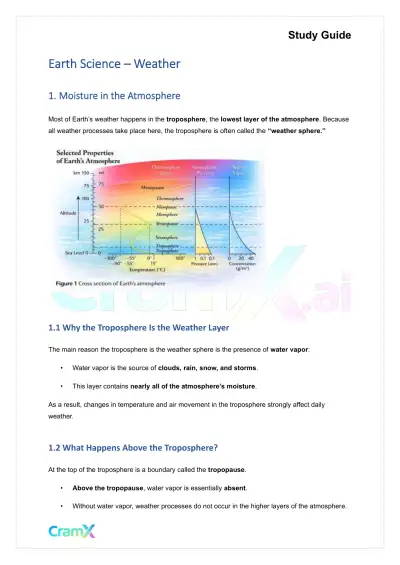 Quick Guides
Earth Science - Weather
Earth Science
36 pagesMar 2026 Exam Guides
Test Bank For Contemporary World Regional Geography, 4th Edition
Earth Science
210 pages84downloadsFeb 2025 Class Notes
Lecture Notes For The Cultural Landscape: An Introduction to Human Geography, 11th Edition
Earth Science
268 pages76downloadsFeb 2025 Textbook Guides
World Regional Geography without Subregions: Global Patterns, Local Lives Sixth Edition Solution Manual
Earth Science
571 pages39downloadsFeb 2025 Solved Assignments
Understanding Bakersfield's Rainfall Patterns Prec
Earth Science
2 pagesJun 2025 Exam Guides
Understanding Earth Seventh Edition Test Bank
Earth Science
506 pagesMay 2025 Solved Assignments
Building Topographic Maps Creating 3D Maps with Wa
Earth Science
6 pagesJun 2025 Solved Assignments
Comprehensive Review for Exam 2: Middle America, South America, Sub-Saharan Africa, and North Africa/Southwest Asia
Earth Science
8 pagesMay 2025
Study this document with CramX
Once it is in your library, every tool can work from it.