
Earth Science Notes, Questions, and Study Resources
academicEarth science is the study of the Earth’s structure, processes, and systems, including the interactions between land, water, atmosphere, and living organisms. It helps explain how the planet works and how natural events and environmental changes occur.
On CramX, you can explore a wide range of earth science resources, including study notes and learning materials, practice questions with explanations, and flashcards for quick revision. These resources are designed to help you understand key concepts and prepare effectively for exams.
Earth science includes major areas such as geology, meteorology, oceanography, and astronomy. Students learn about processes like plate tectonics, the rock cycle, weather systems, ocean currents, and Earth's position in the solar system.
This subject is important for understanding natural hazards, climate change, and the use of natural resources, helping students develop scientific reasoning and environmental awareness.
Key areas you can study:
- Plate tectonics and the rock cycle
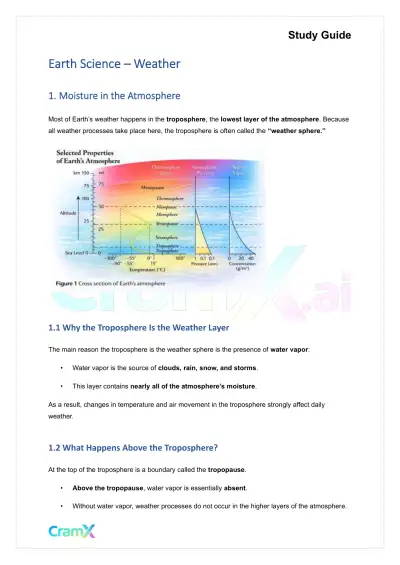
- Weather patterns and atmospheric processes
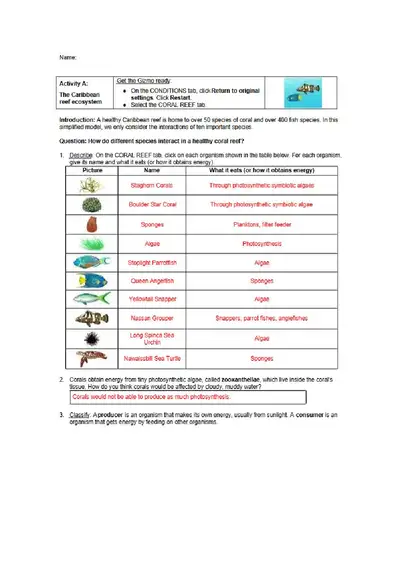
- Ocean currents and marine systems
- Earth’s structure and geologic history
- Climate change and environmental systems
You may also find useful resources in related subjects such as Geology, Environmental Science, Physics, and Chemistry.
Recent Earth Science Documents
Explore the latest Earth Science notes, study materials, and exam resources. These documents help you understand key concepts and prepare effectively for coursework and exams. These resources cover essential topics, key concepts, and commonly studied areas within Earth Science. Latest Earth Science documents include notes, assignments, and practice materials from various courses and universities.
Most Popular Earth Science Documents
Explore the most popular Earth Science notes, study materials, and solution manuals trusted by students. Ranked based on student ratings, downloads, and engagement.
Recent Earth Science Flashcards
Explore recently created Earth Science flashcard decks that simplify complex topics and support quick revision and active recall. Browse interactive flashcard decks created by students to help with Earth Science revision and exam preparation. Perfect for quick revision and spaced repetition learning.
Properties of Water
Oce1001: Test 1 Exploring the Depths of the Pacific Ocean Part 2
Oce1001: Test 1 Exploring the Depths of the Pacific Ocean Part 1
Chapter 5: Ecosystems
Chapter 4 - Climate Change
Chapter 3 - Flooding In Cumbria
Chapter 3 - Weather Hazards
Chapter 2 - Comparing Italy and Nepal Earthquakes
Recent Earth Science Questions & Answers
Explore recently answered Earth Science questions, including step-by-step solutions and explanations to support your learning and exam preparation. These questions cover important topics, concepts, and real-world problems commonly asked in Earth Science courses and exams. Perfect for homework help, quick problem-solving, and concept clarification. New questions and answers are added regularly to keep content fresh and relevant.
Graph of P & S Wave Travel Times, showing Travel time in minutes across distance in kilometers for P and S waves. S wave starts at zero kilometers, zero minutes, and increases to 10,000 kilometers, 25 minutes. P wave starts at zero kilometers, zero minutes and increases to 10,000 kilometers, 13 minutes. About how far does the S wave travel through Earth in 13 minutes? A. 2,000 km B. 4,000 km C. 6,000 km D. 8,000 km
Earth and Planetary Surface Processes Winter 2017 Problem set 6 Due in class Wed 8 March, 3pm. Office hours 10am-11am, Hinds 467 Monday 6 March (note change in time from 9am). Q1. Plot the expected steady-state pattern (as a function of distance from the crest) of discharge of regolith on a convex hillslope in a climate in which the production rate of regolith is 20 mm/yr. Report your answer in m2/year. If the regolith was 0.8 m thick, what would be the spatial pattern of the mean downslope velocity of the regolith? How would these numbers change if 25% of the mass loss occurred in solution (dissolved in rainwater)? (From Anderson & Anderson) Q2. From Hartley et al., Nature Geoscience, 2011: Seismic reflection profiling between Iceland and the UK shows a drowned landscape that was above sea level 55 Ma. The landscape was cut into mudstones and is now buried beneath >1 km of sediment, plus 700m of water. The landscape (black square in the below figure) was uplifted and then reburied due to the arrival of the head of mantle plume whose “stalk” now fuels volcanism at Iceland: River profiles (gray is data, black is model): What is the slope of the knickpoint marked β? What is the (range of) approximate drainage areas at β? Assuming n=1 in the streampower law (so that knickpoint shape is preserved on retreat), what is the knickpoint retreat rate vAm ? You can assume v = 2.75 Myr-1 and m = 0.5 for this question. Approximately how many years prior to the landscape becoming “drowned” (frozen in shape) was the knickpoint initiated? Refer to Figure 1. Assume the initiation of knickpoint β corresponds to the arrival of the “mushroom head” of the mantle plume, and the drowning of the landscape corresponds to the switch to the modern, narrow “plume tail” configuration. What is the area over which uplift occurred? Assuming the red-circled area was horizontal and below sea level before the plume arrived, what is the volume of uplifted rocks? Assuming the drowned landscape under investigation is representative of the fractional erosion of the uplifted landscape across the whole red-circled area, what is the volume of rocks fluvially eroded in the plume area during the plume event? What is the erosion flux in km3 yr-1? How does this compare to the Holocene pre-dam global sediment flux of 8 km3 yr-1? Q3. In lecture we discussed accumulation of a stable cosmogenic isotope in a rock undergoing exhumation, and we also discussed accumulation of a radioactive cosmogenic isotope in a rock that has no erosion. In this question we will combine exhumation and decay. Assume a production rate of 10Be of 5 atoms/(gram quartz)/yr at the surface, with an e-folding depth of 1 m (so the production rate is 1.84 atoms/(gram quartz)/yr at 1m depth). 10Be decays exponentially with a half-life of 1.4 Myr. Plot the expected concentration of 10Be at the surface, as a function of erosion/exhumation rate, for a quartzite rock. Make sure to consider the endmembers of very slow erosion/exhumation (for which the 10Be concentration will reach equilibrium between production and decay), and the endmember of very fast erosion/exhumation (for which decay is unimportant in setting the 10Be concentration)
why is the s-p interval used to determine the distance of an earthquake
what are seismic waves
"If Earth were the size of a basketball, how big would the Moon be? How far away would it be? A. The Moon would be the size of a grapefruit and would be about 5 feet away. B. The Moon would be about the size of a tennis ball and would be 30 feet away. C. The Moon would be the size of a golf ball and would be about 5 feet away. D. The Moon would be the size of a basketball and would be about 20 feet away."
"Which choice best describes the phosphorus cycle? A. Movement of phosphorus between the atmosphere and land. B. Movement of phosphorus in the atmosphere. C. Movement of phosphorus between land, ocean, and living organisms."
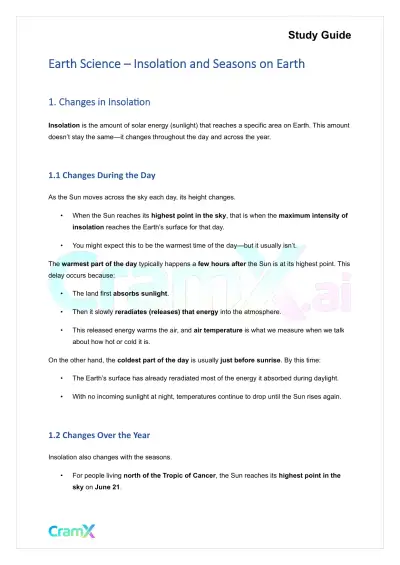
State at least five differences between solstice and equinox.
"Graph of P & S Wave Travel Times, showing Travel time in minutes across distance in kilometers for P and S waves. S wave starts at zero kilometers, zero minutes, and increases to 10,000 kilometers, 25 minutes. P wave starts at zero kilometers, zero minutes and increases to 10,000 kilometers, 13 minutes. About how far does the S wave travel through Earth in 13 minutes? A. 2,000 km B. 4,000 km C. 6,000 km D. 8,000 km"
Explore Related Subjects and Topics
Discover related subjects and academic topics connected to Earth Science. Explore study materials, notes, flashcards, and questions across multiple disciplines. These subjects share important concepts with Earth Science and can help you build a broader understanding. Browse study materials, documents, flashcards, and answers across these subjects.
Earth Science Study Materials from Top Universities
Explore Earth Science study materials, notes, and documents from top universities and institutions. Access resources created by students and educators from leading academic programs. These universities offer a wide range of Earth Science resources across different courses and levels of study. Trusted by students from universities worldwide. Browse documents, notes, and study materials from these universities.