

2020 HESI Fundamentals Practice Exam With Answers (5 Solved Questions)
- Health Education Systems, Inc.
- 2 pages
- Shared May 2025
2020 HESI Fundamentals Practice Exam With Answers helps you identify frequently tested concepts in past exams.
Preview 2 of 2 pages
See the first 2 pages exactly as they appear in the document.
Page 1 Read page 1 as text
HESI FUNDAMENTALS 2020 QUESTIONS AND ANSWERS 1. An older patient has been diagnosed with possible white coat hypertension. Which planned action by the nurse best addresses the suspected cause of the hypertension? a. Instruct the patient about the need to decrease stress levels. b. Teach the patient how to self-monitor and record BPs at home. c. Schedule the patient for regular blood pressure (BP) checks in the clinic. d. Inform the patient and caregiver that major dietary changes will be needed. ANS: B In the phenomenon of “white coat” hypertension, patients have elevated BP readings in a clinical setting and normal readings when BP is measured elsewhere. Having the patient self-monitor BPs at home will provide a reliable indication about whether the patient has hypertension. Regular BP checks in the clinic are likely to be high in a patient with white coat hypertension. There is no evidence that this patient has elevated stress levels or a poor diet, and those factors do not cause white coat hypertension. 2. Which blood pressure (BP) finding by the nurse indicates that no changes in therapy are needed for a 48- yr- old patient with newly diagnosed hypertension? a. 98/56 mm Hg c. 128/92 mm Hg b. 128/76 mm Hg d. 142/78 mm Hg ANS: B The 8th Joint National Committee’s recommended goal for antihypertensive therapy for a 30- to 59-yr-old patient with hypertension is a BP below 140/90 mm Hg. The BP of 98/56 mm Hg may indicate overtreatment of the hypertension and an increased risk for adverse drug effects. The other two blood pressures indicate a need for modifications in the patient’s treatment. 3. Which information is most important for the nurse to include when teaching a patient with newly diagnosed hypertension? a. Most people are able to control BP through dietary changes. b. Annual BP checks are needed to monitor treatment effectiveness. c. Hypertension is usually asymptomatic until target organ damage occurs. d. Increasing physical activity alone controls blood pressure (BP) for most people. ANS: C Hypertension is usually asymptomatic until target organ damage has occurred. Lifestyle changes (e.g., physical activity, dietary changes) are used to help manage BP, but drugs are needed for most patients. Home BP monitoring should be taught to the patient and findings checked by the health care provider frequently when starting treatment for hypertension and then every 3 months when stable. 4. The nurse on the intermediate care unit received change-of-shift report on four patients with hypertension. Which patient should the nurse assess first? a. 48-yr-old with a blood pressure of 160/92 mm Hg who reports chest pain b. 52-yr-old with a blood pressure of 198/90 mm Hg who has intermittent claudication c. 50-yr-old with a blood pressure of 190/104 mm Hg who has a creatinine of 1.7 mg/dL d. 43-yr-old with a blood pressure of 172/98 mm Hg whose urine shows microalbuminuria ANS: A
Page 2
More Health Education Systems, Inc. study materials
See all Past Exams
2023-2024 RN HESI Exit Exam Version 3 with Answers (53 Solved Questions)
Health Education Systems, Inc.
13 pages163downloadsFeb 2025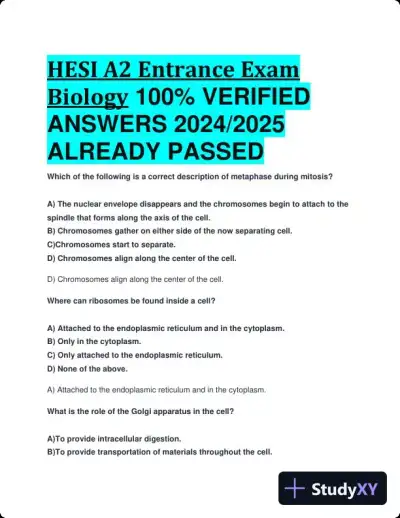 Past Exams
2024-2025 HESI A2 Biology Entrance Exam with Answers (42 Solved Questions)
Health Education Systems, Inc.
13 pages154downloadsFeb 2025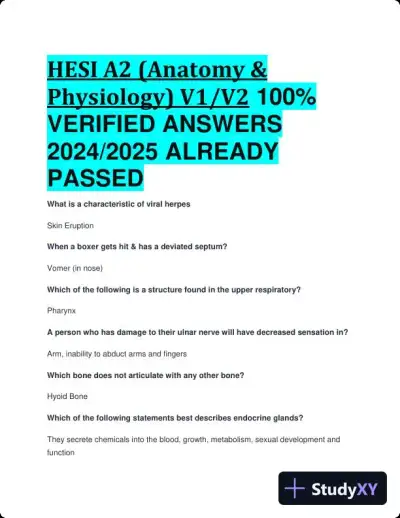 Past Exams
2024-2025 HESI A2 Anatomy and Physiology V1/V2 Practice Exam with Answers (134 Solved Questions)
Health Education Systems, Inc.
15 pages134downloadsFeb 2025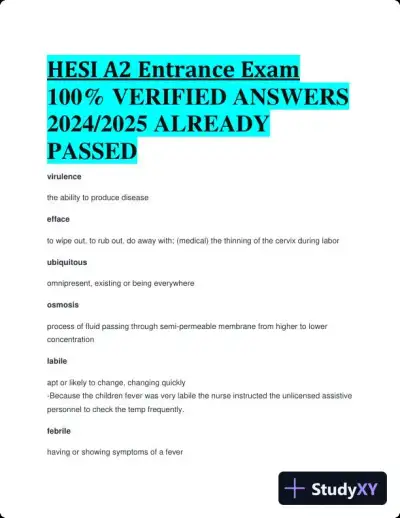 Past Exams
2024-2025 HESI A2 Entrance Exam with Answers (232 Solved Questions)
Health Education Systems, Inc.
26 pages132downloadsFeb 2025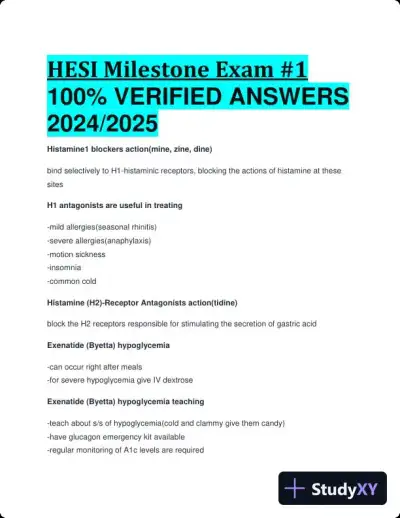 Past Exams
2024-2025 HESI Milestone Exam 1 with Answers (162 Solved Questions)
Health Education Systems, Inc.
26 pages119downloadsFeb 2025 Past Exams
2024-2025 HESI A2 Critical Thinking with Answers (124 Solved Questions)
Health Education Systems, Inc.
114 pages106downloadsFeb 2025 Past Exams
2024-2025 HESI RN Exit Exam with Answers (156 Solved Questions)
Health Education Systems, Inc.
44 pages92downloadsFeb 2025 Past Exams
HESI Leadership/Management Exit Exam with Answers (59 Solved Questions)
Health Education Systems, Inc.
4 pages54downloadsFeb 2025
Study this document with CramX
Once it is in your library, every tool can work from it.