

Core Concepts in Health, Canadian Edition Test Bank
- Healthcare
- 1423 pages
- Shared May 2025
Core Concepts in Health, Canadian Edition Test Bank is your ultimate exam companion, providing you with all the tools necessary to succeed.
Preview 16 of 1423 pages
See the first 16 pages exactly as they appear in the document.
Page 1 Read page 1 as text
1 1. The six dimensions of wellness include all of the following, EXCEPT A. emotional wellness. B. environmental, or planetary, wellness. C. spiritual wellness. D. dietary wellness. 2. Which one of the following qualities contributes positively to one's physical wellness? A. eating a balanced diet B. maintaining an optimistic attitude C. being open to new ideas D. maintaining satisfying relationships 3. Optimism, trust, and self - confidence are components of A. physical wellness. B. emotional wellness. C. spiritual wellness. D. interpersonal wellness. 4. Adam's parents are not unduly concerned about their son's ability to adapt to college because he has always had a good sense of humor, been curious, and demonstrated an openness to ideas. These qualities are reflective of Adam's _______________ wellness. A. interpersonal B. spiritual C. intellectual D. emotional 5. Spiritual wellness is best described as having A. a strong support network of family and friends. B. meaning and purpose in one's life. C. the ability to express oneself creatively. D. the ability to share one's feelings.
Page 2 Page 3 Read page 3 as text
6. Protecting yourself from exposure to toxic substances in the workplace is an example of promoting _______________ wellness. A. social B. spiritual C. intellectual D. environmental 7. The six dimensions of wellness A. affect health independently of each other. B. are interrelated. C. seldom influence one another. D. demonstrate the separateness of mind and body. 8. The environmental health threats faced by our ancestors included all of the following, EXCEPT A. water pollution. B. poor sanitary conditions. C. acid rain. D. natural disasters. 9. If you were born in 1900, your life expectancy was approximately A. 32 years. B. 47 years. C. 62 years. D. 77 years. 10. The average life span in the twentieth century A. did not change significantly. B. increased slightly. C. nearly doubled. D. nearly tripled.
Page 4 Read page 4 as text
11. The top three causes of death among Canadians age 15 to 24 are A. accidents, cancer, and suicide. B. smoking, heart disease, and suicide. C. accidents, heart disease, and cancer. D. homicide, cancer, and accidents. 12. The best response to behaviour - related diseases is A. chemical treatment. B. surgical treatment. C. prevention. D. rehabilitation. 13. By far, the leading preventable cause of death among Canadians is A. alcohol consumption. B. poor health care. C. smoking. D. careless driving. 14. Occupational wellness is measured by how much _____________ the job offers. A. money B. happiness C. prestige D. work 15. In the past 100 years, the major causes of death have shifted from ______________ to _____________. A. infectious diseases; heart disease B. accidents; AIDS C. childbirth; infectious diseases D. heart disease; cancer
Page 5 Read page 5 as text
16. The health determinant over which we have least control is A. diet. B. exercise. C. tobacco use. D. genetic makeup. 17. Which of the following is currently Canada's number - one cause of death? A. cancer B. heart disease C. unintentional injuries D. suicide 18. The single most important factor in determining an individual's level of wellness is A. genetics. B. environment. C. behaviour. D. age. 19. John, an Inuit Aboriginal student, has chosen to incorporate exercise into his daily routine and to reduce the amount of salt in his diet after finding out that his blood pressure is high. His decision to make these lifestyle changes is most likely based on the following health concerns for Inuit Aboriginals. A. They have a higher incidence of tuberculosis than males in other population groups. B. They have higher rates of heart disease and obesity. C. They have higher rates of infant mortality. D. They have higher suicide rates. 20. When compared to the general Canadian population, those of French - Canadian heritage have A. higher overall death rates. B. shorter life expectancies. C. higher rates of Tay - Sachs disease. D. lower overall death rates.
Page 6 Read page 6 as text
21. Men have higher rates of death than women from all of the following, EXCEPT A. suicide. B. unintentional injuries. C. stroke. D. homicide. 22. Income and education are closely linked with health status. The _____________ the poverty rate and the _____________ the education level, the better the health. A. lower; higher B. lower; lower C. higher; higher D. higher; lower 23. Heart disease, a leading cause of death in Canada, is strongly related to A. a sedentary lifestyle. B. cigarette smoking. C. high levels of stress. D. all of the above. 24. People with disabilities are more likely to A. have cancer. B. be obese. C. have HIV. D. die at a young age. 25. Homosexual teens are at greater risk for A. cancer. B. obesity. C. asthma. D. suicide.
Page 7 Read page 7 as text
26. The complete set of genetic material in an individual's cells is referred to as her or his A. genes. B. genome. C. proteome. D. RNA. 27. The following are all environmental factors, EXCEPT the A. air you breathe. B. water you drink. C. amount of alcohol consumption in your home. D. genetic make - up in your body. 28. The top health issue affecting students' academic performance today is A. depression. B. alcohol abuse. C. stress. D. relationship problems. 29. The most harmful consequence of environmental abuse is A. pesticides. B. global warming. C. contaminated drinking water. D. acid rain. 30. The "greenhouse" effect is A. an invisible insulating blanket that traps heat and increases the temperature of the atmosphere. B. not yet proven. C. a complex system of burning coal. D. more pronounced in under - developed nations.
Page 8 Read page 8 as text
31. The first step in improving wellness by lifestyle management is to A. begin with a self - assessment. B. ask friends what you should improve. C. ask your family for assistance. D. reward yourself. 32. Part of a successful plan to change an unhealthy behaviour is to A. start small. B. pick your top three unhealthy behaviours. C. keep the plan to yourself. D. choose your most unhealthy behaviour. 33. The behaviour one identifies for change is called A. bad news. B. enabling behaviour. C. target behaviour. D. predisposed behaviour. 34. Eduardo has identified gambling as a target behaviour because it is interfering with his schoolwork. To aid him in stopping this behaviour, he may need to A. find outside help. B. use a self - management approach. C. spend more time with his friends. D. buy a self - help book. 35. A target behaviour can best be defined as A. several bad habits in need of change. B. a lifelong habit you want to stop immediately. C. an isolated behaviour that is the focus of your behaviour change plan. D. a friend's behaviour that you urge him or her to change.
Page 9 Read page 9 as text
36. The belief in one's ability to be successful in the performance of a given task is termed A. self - esteem. B. self - concept. C. self - efficacy. D. self - fulfilling prophecy. 37. A comparison survey of North American smokers and non - smokers found that A. smokers report more energy. B. smokers report fewer days of troubled sleep. C. non - smokers report fewer days of sadness. D. non - smokers report eating more. 38. "Your ability to successfully take action and perform specific tasks" defines the term A. self - efficacy. B. self - control. C. self - talk. D. self - esteem. 39. Those with an internal locus of control believe that events turn out as they do based on A. fate. B. heredity. C. their actions. D. luck. 40. Donna is about 25 pounds overweight, has tried a variety of diets, and has repeatedly failed to maintain weight loss. She defends her weight with the explanation that almost all of her relatives are overweight, and none has ever been successful with attempts to lose weight. Donna can best be described as A. being unmotivated. B. having an external locus of control. C. having an internal locus of control. D. being a victim of genetics.
Page 10 Read page 10 as text
41. The technique of visualization is one of the best ways to A. keep an eye on your future. B. boost your confidence. C. improve physical strength. D. None of these choices is correct. 42. A strategy to increase your chances of success in the pursuit of a new behaviour is to A. rationalize temporary setbacks to minimize feelings of failure. B. stick with the program even during periods of high stress. C. find a new behaviour to change if you experience a temporary failure. D. frequently visualize goal attainment and enjoy its benefits. 43. The precontemplation stage is characterized by A. an awareness of the problem. B. a modification of behavior. C. a belief that there is no need for change. D. a planning for change. 44. During a "stages of change" behaviour change program, some people may lapse. If this occurs, the best strategy for them is to A. learn from the lapse as they recycle through earlier stages. B. give up. C. choose a different behaviour for change. D. start over from the beginning. 45. The order in which a behaviour change strategy is implemented is A. analyze data, monitor behaviour, devise a plan of action, set goals, make contract. B. monitor behaviour, analyze data, set goals, devise a plan of action, make contract. C. devise a plan of action, set goals, monitor behaviour, analyze data, make contract. D. make contract, set goals, devise a plan of action, monitor behaviour, analyze data.
Page 11 Read page 11 as text
46. Entries made into a health journal about a behaviour should note all the following, EXCEPT A. what the activity was. B. when and where it happened. C. how you felt at the time. D. what your friends/family did. 47. Which of the following health journal information would be of little benefit in promoting personal behaviour change? A. identification of other people's reactions to your behaviour B. descriptions of exactly what your behaviours are C. identification of when and where activities occurred D. recording your feelings at the time you were engaging in the behaviour 48. Anne wants to lose weight and is keeping a health journal to record her progress. Which of the following questions might be appropriately asked in the course of analyzing data from her health journal? A. When am I most likely to overeat? B. What behaviour do I want to change? C. How many behaviours in my life are serious health threats? D. What will be the consequences of not changing my risky health behaviour? 49. The best plan for behaviour change A. begins with a negative self - assessment. B. concentrates on several behaviours. C. refuses to tolerate temporary setbacks. D. works at change systematically. 50. To help ensure success with a behaviour change program, you should A. consider potential genetic factors. B. develop a reward system. C. re - evaluate your friendships. D. do none of these choices.
Page 12 Read page 12 as text
51. Chances of success in behaviour management DECREASE if A. efforts are cost - effective. B. change in behaviour is real and lasting. C. programs are those that can be followed over a long time. D. environmental cues are ignored. 52. According to the "SMART" criteria; a behaviour change such as "drink eight cups of water every day" is an example of being A. realistic. B. truthful. C. too easy. D. specific. 53. Rewards included in health action plans should A. reinforce your efforts. B. be provided only when you reach your overall goal. C. be meaningful and affordable. D. include limited participation in the behaviour you are trying to eliminate. 54. A primary purpose of developing a personal contract for behaviour change is to A. commit you to your word of behaviour modification. B. notify others of your intent to change your behaviour. C. prioritize the behaviours that you are considering changing. D. assess your motivation for changing a health behaviour. 55. Writing a contract for behaviour change involves all of the following, EXCEPT A. setting a date to begin. B. clearly stating your goal. C. identifying the steps to be used to measure progress. D. identifying the consequences of failure to reach the established goal.
Page 13 Read page 13 as text
56. Someone you know at work who is attempting to lose weight has been repeatedly "derailed" by coworkers who bring high - calorie snacks to work every day. It would be fair to say that this person does NOT A. want to change. B. have the support to change. C. have the skills to change. D. have the knowledge to change. 57. Information from a health journal maintained after a behaviour change plan is put into action should be used to do all of the following, EXCEPT A. track progress. B. identify barriers to progress. C. make revisions in the plan. D. identify new behaviours to change. 58. Obstacles in the process of behaviour change A. are a sign of failure in the pursuit of a new behaviour. B. should be avoided, if possible, in the pursuit of a new behaviour. C. are a natural part of the process. D. often cause us to settle for a level of success that is less than our original goal. 59. The most constructive response to a temporary setback in the pursuit of a new behaviour is A. not tolerating temporary failure. B. increasing rewards to make efforts more worthwhile. C. accepting the blame for failing if you return to your old behaviour. D. accepting the fact that problems may periodically occur. 60. Which of the following is a positive social influence on health behaviours? A. personal skills B. attitudes C. supportive friends D. money
Page 14 Read page 14 as text
61. Which of the following is NOT a recommended strategy for maintaining behaviour change? A. assessing stress levels B. rationalizing C. evaluating social influences D. refocusing 62. With regard to one's health, which one of the following elements is most within an individual's control? A. heredity B. health care C. environment D. behaviour 63. Which of the following is an example of taking action to modify the environment and support health behaviours? A. encouraging legislators to pass legislation increasing the number of public areas where smoking is prohibited B. serving nonalcoholic drinks at your parties C. voting for measures that reduce air pollution D. All of these are examples. 64. When evaluating health topics on the Internet, check the A. qualifications of the people behind the site. B. latest media post on the topic. C. testimonials for evidence. D. blogs first. 65. Which of the following is NOT a modifiable risk factor? A. smoking B. exercising C. family history D. healthy diet
Page 15 Read page 15 as text
66. The six dimensions of wellness include all of the following, EXCEPT A. emotional wellness. B. intellectual wellness. C. physical activity wellness. D. environmental wellness. 67. Emotional wellness includes all of the following, EXCEPT A. attending to your own thoughts and feelings. B. monitoring your reactions. C. identifying obstacles to emotional stability. D. making choices to avoid illnesses and injuries. 68. Your ability to develop and maintain satisfying and supportive relationships is referred to as _____________ wellness. A. emotional B. spiritual C. interpersonal D. intellectual 69. Openness to new ideas, capacity to question, and creativity are components of A. intellectual wellness. B. emotional wellness. C. spiritual wellness. D. interpersonal wellness. 70. Altruism, compassion, and fulfillment are components of A. intellectual wellness. B. emotional wellness. C. spiritual wellness. D. interpersonal wellness.
Page 16 Read page 16 as text
71. Communication skills, intimacy, and satisfying relationships are components of A. intellectual wellness. B. emotional wellness. C. spiritual wellness. D. interpersonal wellness. 72. The level of happiness and fulfillment you gain through your work is referred to as A. intellectual wellness. B. emotional wellness. C. spiritual wellness. D. occupational wellness. 73. All of the following are key aspects of occupational wellness, EXCEPT A. enjoyable work. B. job dissatisfaction. C. feelings of achievement. D. opportunities to learn and grow. 74. All of the following are characteristic of people with low socioeconomic status, EXCEPT A. higher rates of death. B. less likely to have access to health services. C. more likely to engage in unhealthy habits. D. lower rates of injury. 75. The percentage of cases of type 2 diabetes that could be avoided or postponed with good nutrition, regular physical activity, the elimination of smoking, and effective stress management is A. 50 percent. B. 65 percent. C. 75 percent. D. 90 percent.
1407 more pages in the full document
Unlock it once and it stays in your library, ready to chat with or turn into flashcards.
Unlock the full documentMore Healthcare study materials
See all Exam Guides
Test Bank for Core Concepts in Health, Second Canadian Edition
Healthcare
723 pagesMay 2025 Exam Guides
Test Bank for Access To Health, 15th Edition
Healthcare
594 pages146downloadsFeb 2025 Exam Guides
Health Promotion Throughout the Life Span 9th Edition Test Bank
Healthcare
184 pages142downloadsFeb 2025 Exam Guides
Test Bank for Principles and Foundations of Health Promotion and Education, 7th Edition
Healthcare
107 pages135downloadsFeb 2025 Class Notes
Class Notes for Introduction to Hospitality, 7th Edition
Healthcare
243 pages120downloadsFeb 2025 Class Notes
Technology Strategies for the Hospitality Industry, 3rd Edition Class Notes
Healthcare
75 pages86downloadsFeb 2025 Textbook Guides
Professional Server, The: A Training Manual, 3rd Edition Solution Manual
Healthcare
113 pages70downloadsFeb 2025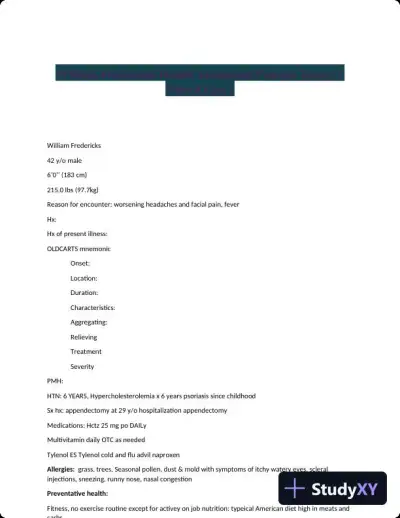 Past Exams
William Fredericks Health Assessment Practice Exam (1 Solved Case)
Healthcare
21 pages68downloadsFeb 2025
Study this document with CramX
Once it is in your library, every tool can work from it.