

Compensation 5th Edition Test Bank
- Human Resource Management
- 194 pages
- Shared May 2025
Get the ultimate practice with Compensation 5th Edition Test Bank, filled with solved test bank questions and answers.
Preview 16 of 194 pages
See the first 16 pages exactly as they appear in the document.
Page 1 Read page 1 as text
Exam Name___________________________________ MULTIPLE CHOICE. Choose the one alternative that best completes the statement or answers the question. 1) Which of the following is NOT a form of cash compensation? 1) A) allowances B) pensions C) stock options D) financial planning E) insurance Answer: C Explanation: A) B) C) D) E) 2) Which of the following is NOT a benefit component of total compensation? 2) A) relational returns B) cost-of-living adjustment C) allowances D) incentives E) merit increase Answer: C Explanation: A) B) C) D) E) 3) Which of the following best describes cost-of-living adjustment? 3) A) one-time payments for meeting previously established performance objectives B) consolidated pay which is not subject to any change regardless of the cost-of-living C) percentage increment to base pay provided to all employees regardless of performance D) compensation to provide for items that are in short supply E) increment to base pay in recognition of past work behaviour Answer: C Explanation: A) B) C) D) E) 1
Page 2 Page 3 Read page 3 as text
4) Which of the following is a work/life program? 4) A) health insurance B) cost-of-living adjustment C) stock options D) employment Insurance E) telecommuting Answer: E Explanation: A) B) C) D) E) 5) ________ refer to one-time payments for meeting previously established performance objectives. 5) A) Allowances B) Merit increments C) Relational returns D) Cost-of-living adjustments E) Incentives Answer: E Explanation: A) B) C) D) E) 6) Which of the following is a form of relational return? 6) A) life Insurance B) monitory incentives C) allowances D) benefits E) recognition and status Answer: E Explanation: A) B) C) D) E) 2
Page 4 Read page 4 as text
7) ________ refers to the compensation given to purchase items that are in short supply. 7) A) Allowance B) Incentive C) Cost-of-living adjustment D) Variable pay E) Wage Answer: A Explanation: A) B) C) D) E) 8) External competitiveness refers to: 8) A) the relative importance of jobs within a company B) inflationary pressure caused by external market factors C) comparison of compensation with that of competitors D) competitiveness between different departments in a company E) comparison of product prices with that of competitors Answer: C Explanation: A) B) C) D) E) 9) Which of the following pay policies lays emphasis on performance? 9) A) Employee contributions B) Management C) Administration of the pay system D) Internal alignment E) External competitiveness Answer: A Explanation: A) B) C) D) E) 3
Page 5 Read page 5 as text
10) All forms of financial returns and tangible services and benefits that employees receive as part of an employment relationship are known as ________. 10) A) relational returns B) merit pay C) compensation D) base pay E) total rewards Answer: C Explanation: A) B) C) D) E) 11) Which of the following is true of the present value perspective? 11) A) It creates an external competitiveness through future promises. B) It assesses the present value of a company to offer stock options to employees. C) It considers today's initial offers to employees. D) It considers future bonuses, merit increases, and promotions. E) It establishes a limit on the amount spent on benefits. Answer: D Explanation: A) B) C) D) E) 12) Total compensation does NOT include: 12) A) base pay B) insurance benefits C) allowances D) relational returns E) incentives Answer: D Explanation: A) B) C) D) E) 4
Page 6 Read page 6 as text
13) Which of the following best describes allowances? 13) A) percentage increment to base pay provided to all employees regardless of performance B) one-time payments for meeting previously established performance objectives C) compensation to provide for items that are in short supply D) pay calculated at an annual or monthly rate E) programs that help employees better integrate their work and life responsibilities Answer: C Explanation: A) B) C) D) E) 14) A merit increase is best described as: 14) A) a one-time reward for past performance that does not increase base pay. B) an increment to base pay that recognizes past work behaviour. C) compensation given to provide for items that are in short supply. D) psychological returns employees believe they receive in the workplace. E) percentage increment to base pay provided to all employees regardless of performance. Answer: B Explanation: A) B) C) D) E) 15) Pay for executives should supposedly to be tied to: 15) A) the financial needs of the employee B) the company's financial performance C) the company's growth potential D) the cost of living index E) the company's reputation Answer: B Explanation: A) B) C) D) E) 5
Page 7 Read page 7 as text
16) Which of the following statements is true about the forms of pay? 16) A) Unlike relational returns, total compensation typically refers to the psychological returns people believe they receive in the workplace. B) Base pay tends to reflect the value of the work or skills and generally ignores differences attributable to individual employees. C) Relational returns are more transactional than total compensation. D) Merit increases refer to the same percentage increase that everyone receives regardless of performance in order to maintain pay levels relative to increases in the cost of living. E) Base pay, incentives, and cost-of-living adjustments are the typical relational returns. Answer: B Explanation: A) B) C) D) E) 17) Internal alignment may be achieved by: 17) A) paying below-market base wages but offering training and rapid promotion B) compensating employees at above-market rates C) comparing pay between jobs or skill levels inside a single organization D) creation of cross-functional departments E) matching competitors' wage rates Answer: C Explanation: A) B) C) D) E) 18) Which of the following best describes relational returns? 18) A) programs that help employees better integrate their work and life responsibilities B) the psychological returns people believe they receive in the workplace C) all rewards received by employees, including cash compensation, benefits, and psychological returns D) one-time payments for meeting previously established performance objectives E) all forms of financial returns and tangible services that employees receive as part of an employment Answer: B Explanation: A) B) C) D) E) 6
Page 8 Read page 8 as text
19) ________ include psychological aspects of work such as recognition and status, challenging work, and learning opportunities. 19) A) Relational returns B) Subjective returns C) Cognitive returns D) Compensational returns E) Qualitative returns Answer: A Explanation: A) B) C) D) E) 20) An incentive payment: 20) A) is part of an employee's base wage. B) is non-taxable and therefore highly preferred by employees. C) is made to provide for items that are in short supply. D) ties pay increases directly to an employee's performance. E) refers to psychological returns employees believe they receive in the workplace. Answer: D Explanation: A) B) C) D) E) 21) Which of the following refers to pay calculated at an hourly rate? 21) A) total reward B) salary C) merit increase D) compensation E) wage Answer: E Explanation: A) B) C) D) E) 7
Page 9 Read page 9 as text
22) Which of the following is true of internal alignment? 22) A) It places greater emphasis on performance than the other policies. B) It relates to comparison of compensation with that of competitors. C) It compares pay between jobs inside a single organization. D) It does not influence the company's compensation objectives. E) It uses incentive programs as a technique to implement the policy. Answer: C Explanation: A) B) C) D) E) 23) Which of the following is NOT part of an employee's total compensation? 23) A) health insurance B) paid vacation C) pay D) cost-of-living adjustments E) relational returns Answer: E Explanation: A) B) C) D) E) 24) ________ includes cash compensation, benefits, and relational returns. 24) A) Total compensation B) Total incentive C) Total reward D) Total base pay E) Total cash benefit Answer: C Explanation: A) B) C) D) E) 8
Page 10 Read page 10 as text
25) ________ as a pay objective involves abiding by various federal, provincial, and territorial compensation laws and regulations. 25) A) Efficiency B) Fairness C) Compliance D) Competitiveness E) Alignment Answer: C Explanation: A) B) C) D) E) TRUE/FALSE. Write 'T' if the statement is true and 'F' if the statement is false. 26) Procedural fairness is the fairness of the process used to make a decision about pay. 26) Answer: True False Explanation: 27) Merit pay is a one-time payment for meeting previously established performance objectives. 27) Answer: True False Explanation: 28) Pay relationships within the organization affect employee decisions to stay with the organization. 28) Answer: True False Explanation: 29) Total compensation includes psychological aspects of work such as recognition and status, challenging work, and learning opportunities. 29) Answer: True False Explanation: 30) Allowances are rewards given to employees based on their performance. 30) Answer: True False Explanation: 31) Total compensation only includes salary and incentives; not benefits. 31) Answer: True False Explanation: 32) When executive pay is excessive relative to company performance, profits are diverted away from stockholders to the executives. 32) Answer: True False Explanation: 9
Page 11 Read page 11 as text
33) External competitiveness refers to pay comparisons between different skill levels in an organization. 33) Answer: True False Explanation: 34) Making contributions to Workers' Compensation is at discretion of the employer. 34) Answer: True False Explanation: 35) While external competitiveness directly affects efficiency, it does not affect fairness. 35) Answer: True False Explanation: 36) Incentives may be long-term or short-term. 36) Answer: True False Explanation: 37) Cost-of-living adjustment refers to percentage increment to base pay provided to employees based on their performance. 37) Answer: True False Explanation: 38) Compensation objectives provide standards for evaluating the effectiveness of the pay system. 38) Answer: True False Explanation: 39) Base pay is the cash compensation an employer pays for the work performed. 39) Answer: True False Explanation: ESSAY. Write your answer in the space provided or on a separate sheet of paper. 40) Why is compensation important to managers? Answer: Managers have a stake in compensation: It directly influences their success in two ways: (1) compensation is a major expense, and (2) a manager uses it as a way to influence employee behaviour and consequently improve organization performance. 41) What are the two major categories of total rewards? Answer: Total compensation and relational returns 42) What is base pay? Distinguish between a wage and a salary. Answer: Base pay is the cash compensation an employer pays for the work performed. Base pay tends to reflect the value of the work or skills and generally ignores differences attributable to individual employees. A distinction is often made between a wage and a salary, with salary referring to pay that is calculated at an annual or monthly rate rather than hourly which is the basis for wage. 10
Page 12 Read page 12 as text
43) Explain the two major categories of total rewards. Answer: The two major categories of total rewards are relational returns and total compensation. The relational returns (development opportunities, status, opportunity to belong, challenging work, and so on) are the psychological returns people believe they receive in the workplace. Total compensation is more transactional and includes pay received directly as cash (e.g., base, merit increases, incentives, cost-of-living adjustments) and indirectly as benefits (e.g., pensions, medical insurance, programs to help balance work and life demands). 44) Why is executive pay in Canada of special interest to stockholders? Answer: In Canada, pay for executives should supposedly be tied to the financial performance of the company. When executive pay is excessive relative to company performance, profits are diverted away from stockholders to the executives. 45) List the three basic objectives of a compensation system. Answer: Efficiency, fairness and compliance to rules and regulations. 46) What is procedural fairness? Answer: Procedural fairness is concerned with the processes used to make decisions about pay. It suggests that the way a pay decision is made may be as important to employees as the result of the decision. 47) What are the basic building blocks of a pay model? Answer: A pay model contains three basic building blocks: (1) the strategic compensation objectives, (2) the strategic policies that form the foundation of the compensation system, and (3) the techniques of compensation. 48) What are long-term incentives? Answer: Long-term incentives are intended to focus employee efforts on multi-year results. Typically, they are in the form of stock ownership or options to buy stock at specified, advantageous prices. 49) What does base pay reflect? Answer: Base pay tends to reflect the value of the work or skills and generally ignores differences attributable to individual employees. 11
Page 13 Read page 13 as text
Answer Key Testname: C1 1) C 2) C 3) C 4) E 5) E 6) E 7) A 8) C 9) A 10) C 11) D 12) D 13) C 14) B 15) B 16) B 17) C 18) B 19) A 20) D 21) E 22) C 23) E 24) C 25) C 26) TRUE 27) FALSE 28) TRUE 29) FALSE 30) FALSE 31) FALSE 32) TRUE 33) FALSE 34) FALSE 35) FALSE 36) TRUE 37) FALSE 38) TRUE 39) TRUE 40) Managers have a stake in compensation: It directly influences their success in two ways: (1) compensation is a major expense, and (2) a manager uses it as a way to influence employee behaviour and consequently improve organization performance. 41) Total compensation and relational returns 42) Base pay is the cash compensation an employer pays for the work performed. Base pay tends to reflect the value of the work or skills and generally ignores differences attributable to individual employees. A distinction is often made between a wage and a salary, with salary referring to pay that is calculated at an annual or monthly rate rather than hourly which is the basis for wage. 12
Page 14 Read page 14 as text
Answer Key Testname: C1 43) The two major categories of total rewards are relational returns and total compensation. The relational returns (development opportunities, status, opportunity to belong, challenging work, and so on) are the psychological returns people believe they receive in the workplace. Total compensation is more transactional and includes pay received directly as cash (e.g., base, merit increases, incentives, cost-of-living adjustments) and indirectly as benefits (e.g., pensions, medical insurance, programs to help balance work and life demands). 44) In Canada, pay for executives should supposedly be tied to the financial performance of the company. When executive pay is excessive relative to company performance, profits are diverted away from stockholders to the executives. 45) Efficiency, fairness and compliance to rules and regulations. 46) Procedural fairness is concerned with the processes used to make decisions about pay. It suggests that the way a pay decision is made may be as important to employees as the result of the decision. 47) A pay model contains three basic building blocks: (1) the strategic compensation objectives, (2) the strategic policies that form the foundation of the compensation system, and (3) the techniques of compensation. 48) Long-term incentives are intended to focus employee efforts on multi-year results. Typically, they are in the form of stock ownership or options to buy stock at specified, advantageous prices. 49) Base pay tends to reflect the value of the work or skills and generally ignores differences attributable to individual employees. 13
Page 15 Read page 15 as text
Exam Name___________________________________ MULTIPLE CHOICE. Choose the one alternative that best completes the statement or answers the question. 1) Which of the following is a step in the formulation of the total compensation strategy that deals with employee or union needs? 1) A) implementing strategy B) mapping a total compensation strategy C) reassessing the fit D) implementing cultural and regulatory changes E) assessing total compensation implications Answer: E Explanation: A) B) C) D) E) 2) Internal alignment suggests that: 2) A) both smaller and larger pay differences among jobs inside an organization can affect results. B) paying higher than the average wage offered by competitors can affect results. C) rather than focusing on only one dimension of the pay strategy, such as pay for performance or internal pay differences, all dimensions need to be considered together. D) performance-based pay can affect results. E) embedding compensation strategy within the broader HR strategy affects results. Answer: A Explanation: A) B) C) D) E) 3) A pay strategy is a source of competitive advantage: 3) A) if it rarely aligns. B) if it seldom provides value. C) if it offers stock options. D) if it differentiates. E) if it defers taxes. Answer: D Explanation: A) B) C) D) E) 1
Page 16 Read page 16 as text
4) A supporting compensation approach for an innovator: 4) A) stresses delighting customers and bases employee pay on how well they do this. B) stresses doing more with less by minimizing costs and specifying in greater detail exactly how jobs should be performed. C) focuses on system control and work specifications. D) places less emphasis on evaluating skills and jobs and more emphasis on incentives designed to encourage innovations. E) seldom stresses on innovations or risk taking. Answer: D Explanation: A) B) C) D) E) 5) According to the pay model, the strategic compensation decisions regarding management involve: 5) A) how total compensation should be positioned against competitors. B) how compensation should support the business strategy and be adaptive to the cultural and regulatory pressures in a global environment. C) how open and transparent the pay decisions should be to all employees. D) how the different types and levels of skills and work should be paid within the organization. E) how pay increases should be based. Answer: C Explanation: A) B) C) D) E) 6) According to the pay model, the strategic compensation decisions regarding external competitiveness involve: 6) A) how total compensation should be positioned against competitors. B) how open and transparent the pay decisions should be to all employees. C) how compensation should support the business strategy and be adaptive to the cultural and regulatory pressures in a global environment. D) how the different types and levels of skills and work should be paid within the organization. E) how pay increases should be based. Answer: A Explanation: A) B) C) D) E) 2
178 more pages in the full document
Unlock it once and it stays in your library, ready to chat with or turn into flashcards.
Unlock the full documentMore Human Resource Management study materials
See all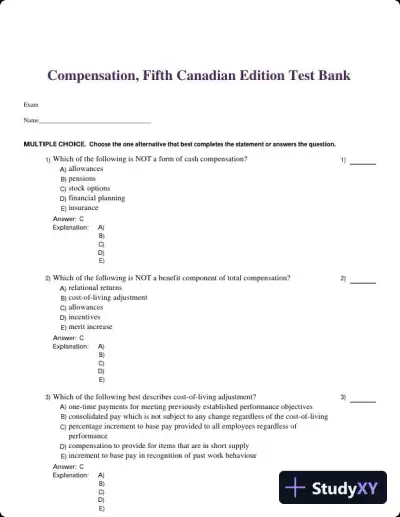 Exam Guides
Compensation, Fifth Canadian Edition Test Bank
Human Resource Management
194 pages89downloadsFeb 2025 Solved Assignments
Strategic Human Resource Management Assignment 4: HR Training Class
Human Resource Management
10 pagesMay 2025 Exam Guides
Human Resource Management: Functions, Applications, and Skill Development Second Edition Test Bank
Human Resource Management
692 pagesMay 2025 Exam Guides
Human Resource Management -, Fourth Canadian Edition Test Bank
Human Resource Management
243 pagesMay 2025 Solved Assignments
Module 3 Assignment 2: LASA 1: Human Resource Planning Argosy University
Human Resource Management
7 pagesMay 2025 Class Presentation
Talent Management: Tools And Software
Human Resource Management
11 pagesMay 2025 Solved Assignments
Travel Agency HR Plan
Human Resource Management
7 pagesMay 2025 Solved Assignments
Strategic Hiring: Identifying Top Talent and Fostering a Passionate, Innovative Workplace
Human Resource Management
3 pagesMay 2025
Study this document with CramX
Once it is in your library, every tool can work from it.