
Test Bank for Strategic Compensation: A Human Resource Management Approach, 10th Edition

Give yourself the best chance to succeed with Test Bank for Strategic Compensation: A Human Resource Management Approach, 10th Edition, featuring test bank questions designed to mirror your exam.

Benjamin Fisher
Contributor
4.6
40
10 months ago
Preview (16 of 201 Pages)
100%
Log in to unlock

Page 1

Test Bank for Strategic Compensation: A Human Resource Management Approach, 10th Edition - Page 1 preview image

Loading page ...

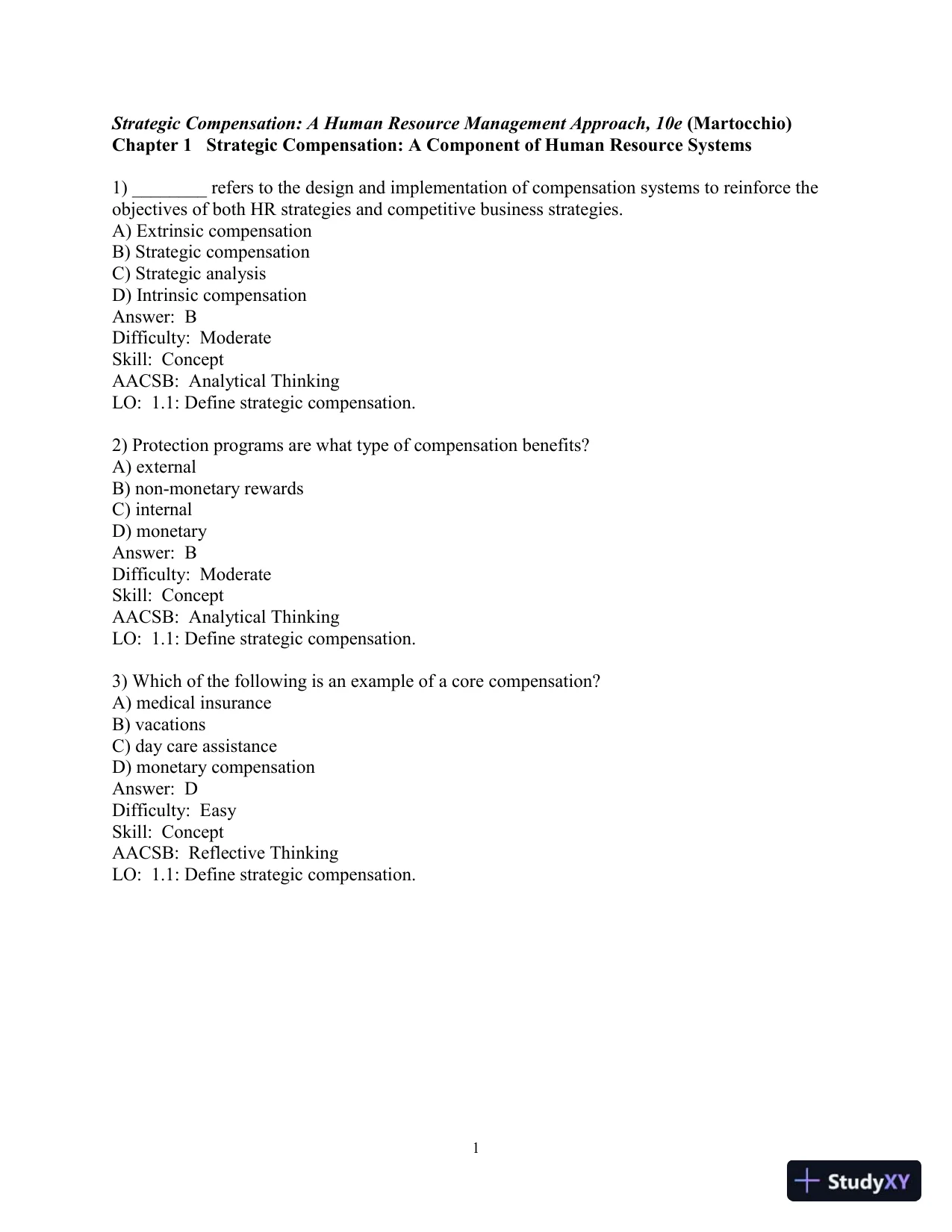
1Strategic Compensation: A Human Resource Management Approach, 10e(Martocchio)Chapter 1Strategic Compensation: A Component of Human Resource Systems1) ________ refers to the design and implementation of compensation systems to reinforce theobjectives of both HR strategies and competitive business strategies.A) Extrinsic compensationB) Strategic compensationC) Strategic analysisD) Intrinsic compensationAnswer: BDifficulty: ModerateSkill: ConceptAACSB: Analytical ThinkingLO: 1.1: Definestrategic compensation.2) Protection programs are what type of compensation benefits?A) externalB) non-monetary rewardsC) internalD) monetaryAnswer: BDifficulty: ModerateSkill: ConceptAACSB: Analytical ThinkingLO: 1.1: Define strategic compensation.3) Which of the following is an example of a core compensation?A) medical insuranceB) vacationsC) day care assistanceD) monetary compensationAnswer: DDifficulty: EasySkill: ConceptAACSB: Reflective ThinkingLO: 1.1: Define strategic compensation.

Page 2

Test Bank for Strategic Compensation: A Human Resource Management Approach, 10th Edition - Page 2 preview image

Loading page ...

Page 3

Test Bank for Strategic Compensation: A Human Resource Management Approach, 10th Edition - Page 3 preview image

Loading page ...

24) Since the economic recession (2007-2009) ended, fewer companies have offered payincreases, and those that do are offering lower amounts. Approximately, how much have payincreases been?A) less than 2 percentB) 2 percent up to 2.9 percentC) 3 percent up to 3.8 percentD) 4 percent or moreAnswer: CDifficulty: ChallengingSkill: ConceptAACSB: Reflective ThinkingLO: 1.1: Define strategic compensation.5) This concept describes a company's success when the company acquires ordevelopscapabilities that facilitate outperforming the competition.A) differentiationB) capitalC) compensation practicesD) competitive advantageAnswer: DDifficulty: EasySkill: ConceptAACSB: Reflective ThinkingLO: 1.1: Define strategic compensation.6) Which of the following refers to the planned use of company resources-financial capital,equipment capital, and human capital-to promote and sustain competitive advantage?A) strategic analysisB) comparative analysisC) 360 degree analysisD)competitive business strategyAnswer: DDifficulty: ModerateSkill: ConceptAACSB: Analytical ThinkingLO: 1.1: Define strategic compensation.7) ________ compensation refers to the mental state of employees as a result of theirperformance on the job.Answer: IntrinsicDifficulty: ModerateSkill: ConceptAACSB: Reflective ThinkingLO: 1.1: Define strategic compensation.

Page 4

Test Bank for Strategic Compensation: A Human Resource Management Approach, 10th Edition - Page 4 preview image

Loading page ...

38) Compensation represents both the intrinsic and extrinsic rewards employees receive forperforming their jobs. Together,both intrinsic and extrinsic compensation describe a company'stotal compensation system. Briefly describe both types of rewards and indicate the professionalswho are responsible for managing them.Answer: Intrinsic compensation reflects employees' psychological mind-sets that result fromperforming their jobs. Extrinsic compensation includes both monetary and nonmonetary rewards.Organizational development professionals promote intrinsic compensation through effective jobdesign. Compensation professionals are responsible for extrinsic compensation. Extrinsiccompensation includes both monetary and nonmonetary rewards. Compensation professionalsestablish monetary compensation programs to reward employees according to their jobperformance levels or forlearning job-related knowledge or skills. Nonmonetary rewards includeprotection programs (e.g., medical insurance), paid time off (e.g., vacations), and services (e.g.,day care assistance). Most compensation professionals refer to nonmonetary rewards asemployee benefits.Difficulty: ModerateSkill: ConceptAACSB: Analytical ThinkingLO: 1.1: Define strategic compensation.9) Which of following enables companies to generate income, higher company stock prices,economic value, strong positive brand identity, and reputation?A) capitalB) assetsC) competencyD) human capitalAnswer: ADifficulty: ModerateSkill: ConceptAACSB: Analytical ThinkingLO: 1.2: Summarize the role of compensation as a strategic business partner.10) As a strategic business partner, HR and compensation professionals today need to think mostlike whom?A) vice president of human resourcesB) chief financial officer (CFO)C) chief executive officer (CEO)D) comptrollerAnswer: CDifficulty: ModerateSkill: ConceptAACSB: Application of KnowledgeLO: 1.2: Summarize the role of compensation as a strategic business partner.

Page 5

Test Bank for Strategic Compensation: A Human Resource Management Approach, 10th Edition - Page 5 preview image

Loading page ...

411) In GE's human resource leadership program (HRLP), successful participants will achievewhich of the following?A) gain an understanding of the depth of specialization for each (HR) functionB) gain an understanding of HR competencies, global leadership skills, and business acumenC) gain an understanding of the depth of specialization for each HR functionD) gain an understanding of HR from a generalist's perspectiveAnswer: BDifficulty: EasySkill: Application of KnowledgeAACSB: Application of KnowledgeLO: 1.2: Summarize the role of compensation as a strategic business partner.12) Cash and equipment such as a mass spectrometer in a research lab are examples of which ofthe following?A) nonliquid assetsB) organizational structureC) capitalD) liquid assetsAnswer: CDifficulty: ModerateSkill: Application of KnowledgeAACSB: Application of KnowledgeLO: 1.2: Summarize the role of compensation as a strategic business partner.13) ________ and ________ programs are key to giving employees the necessary knowledgeand skills to use new workplace technology effectively.Answer:Pay-for-knowledge; skill-based payDifficulty: ModerateSkill: ConceptAACSB: Analytical ThinkingLO: 1.2: Summarize the role of compensation as a strategic business partner.14) Discerning threats and opportunities is the main focus of which activity?A) human resource planningB) environmental scanningC)job evaluationD) job analysisAnswer: BDifficulty: ModerateSkill: ConceptAACSB: Application of KnowledgeLO: 1.3: Explain strategic compensation decisions.

Page 6

Test Bank for Strategic Compensation: A Human Resource Management Approach, 10th Edition - Page 6 preview image

Loading page ...

515) This term suggests that a loss is likely for the firm, and that the individual will be left withlittle control.A) reverse opportunityB) negative equityC) threatD) foreclosureAnswer: CDifficulty: EasySkill: ConceptAACSB: Analytical ThinkingLO: 1.3: Explain strategic compensation decisions.16) Which of the following competitive strategies does Apple Computer use?A) lowest-cost strategyB) differentiation strategyC) total quality management strategyD) human capital strategyAnswer: BDifficulty: ModerateSkill: Application of KnowledgeAACSB: Application of KnowledgeLO: 1.3: Explain strategic compensation decisions.17) IKEA, a furniture manufacturer, sources its products to countries where labor is cheaper andprovides a low level of service. Which of the following competitive strategies does IKEA use?A) differentiation strategyB) high quality strategyC) brand notorietyD) lowest-cost strategyAnswer: DDifficulty: ModerateSkill: Application of KnowledgeAACSB: Application of KnowledgeLO: 1.3: Explain strategic compensation decisions.18) A company using this competitive strategy seeks to offer a product or service that iscompletely unique from other competitors in their market segment.A) differentiation strategyB) defender strategyC) prospector strategyD) lowest-cost strategyAnswer: ADifficulty: EasySkill: ConceptAACSB: Analytical ThinkingLO: 1.3: Explain strategic compensation decisions.

Page 7

Test Bank for Strategic Compensation: A Human Resource Management Approach, 10th Edition - Page 7 preview image

Loading page ...

619) Which of these actions would HR encourage in attempting to create a lowest-costcompetitive strategy?A) an employee's long-term focusB) unpredictable employee behaviorC) cost minimizationD) high concern for the quality of outputAnswer: CDifficulty: ChallengingSkill: ConceptAACSB: Analytical ThinkingLO: 1.3: Explain strategic compensation decisions.20) Saudi Arabia, which is one of the top oil producing countries in the world, continues to pumpcrude oil even as demand for oil decreases. This activity is considered to be a(n) ________ toother oil producing countries such as the United States.Answer: threatDifficulty: ChallengingSkill: ConceptAACSB: Analytical ThinkingLO: 1.3: Explain strategic compensation decisions.21) Strategic management involves distinguishing between ________ and ________ inattempting to achieve company goals, thus making strategic management an impreciseprocess.Answer:threats, opportunitiesDifficulty: ChallengingSkill: ConceptAACSB: Analytical ThinkingLO: 1.3: Explain strategic compensation decisions.22) Apple Computer's use of a differentiation strategy promotes both ________ and ________.Answer:market demand, loyaltyDifficulty: ChallengingSkill: Application of KnowledgeAACSB: Application of KnowledgeLO: 1.3: Explain strategic compensation decisions.

Page 8

Test Bank for Strategic Compensation: A Human Resource Management Approach, 10th Edition - Page 8 preview image

Loading page ...

723) What are the three questions that compensation professionals should answerto helpdetermine whether they are making a strategic contribution to the company?Answer:•Does compensation strategy fit well with the objectives of competitive business and HRstrategies?•Does the choice and design of compensation practices fit well to support compensationstrategy?•Does the implementation of compensation practices effectively direct employee behavior toenhance job performance that supports the choice of compensation practices?Difficulty: ChallengingSkill: ConceptAACSB: Analytical ThinkingLO: 1.3: Explain strategic compensation decisions.24) This law made it illegal to pay women less for performing equal work as men.A) Equal Pay Act of 1963B) Civil Rights Act of 1964C) Davis-Bacon Act of 1931D) Fair Labor Standards Act of 1938Answer: ADifficulty: ModerateSkill: ConceptAACSB: Reflective ThinkingLO: 1.4: Identify and discuss the building blocks and structural elements of strategiccompensation systems.25) Cost-of-living adjustments (COLAs) are typically based on which index?A) Producer Price IndexB) Consumer Price IndexC) Employment Cost IndexD) Employee Benefit IndexAnswer: BDifficulty: ModerateSkill: ConceptAACSB: Reflective ThinkingLO: 1.4: Identify and discuss the building blocks and structural elements of strategiccompensation systems.

Page 9

Test Bank for Strategic Compensation: A Human Resource Management Approach, 10th Edition - Page 9 preview image

Loading page ...

826) What type of pay system rewards employees for partially or completely attaining apredetermined work objective?A) seniority payB) merit payC) incentive payD) skill-based payAnswer: CDifficulty: ModerateSkill: ConceptAACSB: Analytical ThinkingLO: 1.4: Identify and discuss the building blocks and structural elements of strategiccompensation systems.27) Jason works at a call center for an insurance company, and he has been answering callsregarding auto insurance. Recently, he started to attend a training program about home insurance.Upon successful completion of this training program, Jason will be able to handle homeinsurance questions and queries as well. If this insurance companyhas a compensation policythat rewards Jason's completion of this training, then what type of pay system does it employ?A) incentive payB) merit payC) seniority payD) pay-for-knowledgeAnswer: DDifficulty: ModerateSkill: Application of KnowledgeAACSB: Application of KnowledgeLO: 1.4: Identify and discuss the building blocks and structural elements of strategiccompensation systems.28) Sandra's position changed from supervisor at the planning department to supervisor at thenew projects department. In terms of career development, which of the following describesSandra's situation?A) maintaining focus with less responsibilitiesB) making a lateral move across the company's hierarchyC) moving upward through a company's hierarchyD) maintaining the focus and assuming greater responsibilitiesAnswer: BDifficulty: ModerateSkill: Application of KnowledgeAACSB: Application of KnowledgeLO: 1.4: Identify and discuss the building blocks and structural elements of strategiccompensation systems.

Page 10

Test Bank for Strategic Compensation: A Human Resource Management Approach, 10th Edition - Page 10 preview image

Loading page ...

929) What do compensation managers use to recognize differences in the relative worth of jobsand to establish pay differentials based upon management priorities?A) job evaluationB) internal consistencyC) job analysisD) strategic analysisAnswer: ADifficulty: ModerateSkill: ConceptAACSB: Analytical ThinkingLO: 1.4: Identify and discuss the building blocks and structural elements of strategiccompensation systems.30) These compensation systems go a long way in attracting and retaining the most qualifiedemployees and are based upon market and compensation surveys.A) internally consistent compensation systemsB) market-competitive pay systemsC) job evaluation compensation systemsD) externally consistent compensation systemsAnswer: BDifficulty: ModerateSkill: ConceptAACSB: Analytical ThinkingLO: 1.4: Identify and discuss the building blocks and structural elements of strategiccompensation systems.31) Which of the following represents the pay rate differences for jobs and employeecontributions of unequal worth to a company?A) merit payB) incentive payC) retention payD) pay structuresAnswer: DDifficulty: ModerateSkill: ConceptAACSB: Analytical ThinkingLO: 1.4: Identify and discuss the building blocks and structural elements of strategiccompensation systems.

Page 11

Test Bank for Strategic Compensation: A Human Resource Management Approach, 10th Edition - Page 11 preview image

Loading page ...

1032) What are the three goals of compensation professionals?Answer: Compensation professionals promote effective compensation systems by meeting threeimportant goals: internal consistency, market competitiveness, and recognition of individualcontributions.Internally consistent compensation systemsclearly define the relative value of each job amongall jobs within a company. This ordered set of jobs represents the job structure or hierarchy.Companiesrely on a simple, yet fundamental, principle for building internally consistentcompensation systems: Employees in jobs that require greater qualifications, moreresponsibilities, and more complex job duties should be paid more than employees whose jobsrequire lesser qualifications, fewer responsibilities, and less-complex job duties. Internallyconsistent job structures formally recognize differences in job characteristics, which thereforeenable compensation managers to set pay accordingly.Market-competitive pay systemsplay a significant role in attracting and retaining the mostqualified employees. Compensation professionals build market-competitive compensationsystems based on the results of market surveys and compensation surveys.Recognizing Individual Contributionsare captured inpaystructures, which represent pay ratedifferences for jobs of unequal worth and the framework for recognizing differences in employeecontributions. No two employees possess identical credentials or perform the samejob equallywell. Companies recognize these differences by paying individuals according to their credentials,knowledge, or job performance. When completed, pay structures should define the boundariesfor recognizing employee contributions. Well-designed structures should promote the retentionof valued employees.Difficulty: ChallengingSkill: ConceptAACSB: Analytical ThinkingLO: 1.4: Identify and discuss the building blocks and structural elements of strategiccompensation systems.33) This agreement describes the terms of employment that are set between management andunion bargaining representatives.A) employee relationship agreementB) collective bargaining agreementC) joint employment agreementD) workplace requisite agreementAnswer: BDifficulty: EasySkill: ConceptAACSB: Analytical ThinkingLO: 1.5: Describe the fit of the compensation function in organizations.

Page 12

Test Bank for Strategic Compensation: A Human Resource Management Approach, 10th Edition - Page 12 preview image

Loading page ...

1134) Which type of professional is involved in the compensation functions such as building jobstructures, market competitive pay systems, and merit pay structures?A) compensation generalistB) HR specialistC) compensation specialistD) HR generalistAnswer: ADifficulty: EasySkill: ConceptAACSB: Analytical ThinkingLO: 1.5: Describe the fit of the compensation function in organizations.35) Oftentimes, companies use this method to trim their payroll responsibilities by encouraginghigher-paid workers with more seniority to voluntarily leave the company earlier than previouslyplanned.A) resignation plansB) severance plansC) early retirement programsD) employee expenditure plansAnswer: CDifficulty: ModerateSkill: ConceptAACSB: Analytical ThinkingLO: 1.5: Describe the fit of the compensation function in organizations.36) The demand for human resource professionals is ________.Answer: increasingDifficulty: ChallengingSkill: ConceptAACSB: Analytical ThinkingLO: 1.5: Describe the fit of the compensation function in organizations.37) Companies that implement ________ and ________ plans generally increase the amount ofclassroom and on-the-job training as these types of plans make training necessary rather thanoptional.Answer:pay-for-knowledge; person-focusedDifficulty: ModerateSkill: ConceptAACSB: Analytical ThinkingLO: 1.5: Describe the fit of the compensation function in organizations.

Page 13

Test Bank for Strategic Compensation: A Human Resource Management Approach, 10th Edition - Page 13 preview image

Loading page ...

1238) Employment ________ occurs when an employee's agreement to perform work is ended,whether it is voluntarily or involuntarily.Answer: terminationDifficulty: EasySkill: ConceptAACSB: Reflective ThinkingLO: 1.5: Describe the fit of the compensation function in organizations.39) Due to the recent economic downturn, XYZ Co. decided to shut down one of its appliancemanufacturing plants in the United States, and therefore around 300 workers were laid off. XYZCo. has chosen to award laid-off workers 6 months of ________ pay.Answer: severanceDifficulty: ChallengingSkill: Application of KnowledgeAACSB: Application of KnowledgeLO: 1.5: Describe the fit of the compensation function in organizations.40) This group is directly involved in producing goods and delivering services for a company.A) staff employeesB) line employeesC) managersD) executivesAnswer: BDifficulty: ModerateSkill: ConceptAACSB: Analytical ThinkingLO: 1.6: Identify the stakeholders of the compensation function and summarize their stakes inthe work compensation professionals perform.41) The success of HR departments depends on how well they serve the interests of which of thefollowing stakeholder groups?A) employees, line managers, executives, unions, and the U.S. governmentB) unions and the U.S. governmentC) executives and shareholdersD) employees and line managersAnswer: ADifficulty: EasySkill: ConceptAACSB: Analytical ThinkingLO: 1.6: Identify the stakeholders of the compensation function and summarize their stakes inthe work compensation professionals perform.

Page 14

Test Bank for Strategic Compensation: A Human Resource Management Approach, 10th Edition - Page 14 preview image

Loading page ...

1342) Which of the following group is a stakeholder within a company?A) Equal Employment Opportunity CommissionB) Department of LaborC) prospective employeesD) line managersAnswer: DDifficulty: EasySkill: ConceptAACSB: Analytical ThinkingLO: 1.6: Identify the stakeholders of the compensation function and summarize their stakes inthe work compensation professionals perform.43) Which stakeholder group turns to compensation professionals for advice about appropriatepay rates for jobs?Answer: Line managersDifficulty: EasySkill: ConceptAACSB: Analytical ThinkingLO: 1.6: Identify the stakeholders of the compensation function and summarize their stakes inthe work compensation professionals perform.44) What is a constituency? How does it affect the HR department?Answer: The HR department does not exist in isolation. Rather, it must respond to a variety ofparties, each with its own interests. In fact, the success of an HR department may depend on howwell it serves various constituencies. Constituencies can include employees, line managers,executives, unions, the U.S. government, and customers. Each of thesegroups expects certainactions by the HR department, rates these actions according to its own standards, and tries to setup goals or present constraints within their realm of understanding. As a result, the HRdepartment plays the role of a juggler, trying to meet often-competing goals presented bymultiple constituencies.Difficulty: ChallengingSkill: ConceptAACSB: Analytical ThinkingLO: 1.6: Identify the stakeholders of the compensation function and summarize their stakes inthe work compensationprofessionals perform.

Page 15

Test Bank for Strategic Compensation: A Human Resource Management Approach, 10th Edition - Page 15 preview image

Loading page ...

1445) Which of the following is the use of oral, written, and non-verbal skills for multiplepurposes?A) ethicsB) data literacyC) information technologyD) communicationAnswer: DDifficulty: EasySkill: ConceptAACSB: Reflective ThinkingLO: 1.7: Explore essential skills for developing your career in compensation or any other careerpath.46) Which of the following is used to define and solve problems and to make decisions or formjudgments related to a situation or set ofcircumstances?A) collaborationB) critical thinkingC) information technologyD) communicationAnswer: BDifficulty: EasySkill: ConceptAACSB: Reflective ThinkingLO: 1.7: Explore essential skills for developing your career in compensation or any other careerpath.47) When individuals work together on a task, constructing meaning and knowledge as a groupthrough dialogue and negotiation is known asA) collaboration.B) data literacy.C) social responsibility.D) critical thinking.Answer: ADifficulty: EasySkill: ConceptAACSB: Reflective ThinkingLO: 1.7: Explore essential skills for developing your career in compensation or any other careerpath.

Page 16

Test Bank for Strategic Compensation: A Human Resource Management Approach, 10th Edition - Page 16 preview image

Loading page ...

1548) ________ is/are guiding principles that influence the way individuals and organizationsbehave within the society that they operateA) Business ethicsB) Data literacyC) Information technologyD) CommunicationAnswer: ADifficulty: EasySkill: ConceptAACSB: Reflective ThinkingLO: 1.7: Explore essential skills for developing your career in compensation or any other careerpath.49) ________ is/are the ability to access, assess, interpret, manipulate, summarize, andcommunicate data.A) Business ethicsB) Data literacyC) Information technologyD) CommunicationAnswer: BDifficulty:EasySkill: ConceptAACSB: Reflective ThinkingLO: 1.7: Explore essential skills for developing your career in compensation or any other careerpath.
Preview Mode

This document has 201 pages. Sign in to access the full document!