

INFA610: Final Exam - Information Security and Intellectual Property
- Information Technology
- University of Maryland
- 8 pages
- Shared May 2025
A similar exam on information security and intellectual property for INFA610, covering topics in data protection and legal considerations.
Preview 3 of 8 pages
See the first 3 pages exactly as they appear in the document.
Page 1 Read page 1 as text
Page 1 of 8 INFA610: Final Exam - Information Security and Intellectual Property FINAL – INFA610 Name_________________________ Date____________________ Instructions • You are to take this final exam during the twelfth week of the class. Thi s final ex am will be posted before noon, Sunday, April 19, 2015 and is due on or before noon , Sunday, April 26 , 201 5 . • Work alone . You may not confer with other class members, or anyone else, directly or by e - mail or otherwise, regarding the questions, issues or your answers. You may use your notes, textbooks, other published materials, the LEO site for this class, and the Internet. • Wherever possible, make sure answers are stated in your own words, and where applicable provide your own examples, rather than repeating the ones used in the course materials. When composing your answers, be thorough . The more complete your answer, the higher your score will be. Be sure to identify any assumptions you are making in developing your answers. While composing your descriptive answers, be very careful to cite your sources. It is easy to get careless and forget to footnote a source. Remember, failure to cite sources constitutes an academic integrity violation. Use APA style for citations and references. • This final is worth 25% of your final grade for the course. It is scored on the basis of 100 points. • Please provide your answers immediately below the questions. (Do not submit answers alone in a separate sheet.) • Please submit your work using the Final Exam assignment folder. • No late submission for the final exam. Exam Questions Part 1: True (T) or False (F) . IMPORTANT : If you answer False (F) , then you MUST say WHY it is in a few words to receive full credit . (5 questions at 2point each, 10 points in all) EXAMPLE QUESTIONS ONLY T F Your Professor’s last name is Douglas. Answer: ___F ___ (it is Kelly) T F This course is INFO610. Answer: ___ T___ 1. T F Deep packet inspection firewalls protect networks by blocking packets based on the packets’ header information at the network (IP) layer. Answer: __ False ___ If F , why? Employers have the right (and in some cases the obligation) to see any information
Page 2 Page 3 Read page 3 as text
Page 2 of 8 stored, transmitted, or communicated within the employer's environment. This legal right is the basis for monitoring (or at least explicitly stating the right to monitor) email, network traffic, voice, wireless, and other communications. Answer: _ True ____ 2. T F Intrusion Detection Systems (IDS) provide no protection from internal threats. Answer: false it analysis both external and internal threat and reports to the administration for further action. 3. T F A Denial - of - Service attack does not require the attacker to penetrate the target's security defenses. Answer: _ false an attacker can send multiple request to the serve for authentication in these case if you want to block the user from gaining access to your network you can use a sniffer to detect a certain address that needs to authorization which originates from the same address from a certain address and block the attacker 4. T F S ecurity awareness, t raining, and education programs are key components of organizational risk management strategies. Answer: ___ True __ Part 2: Multiple Choice Questions. Print the correct answer in the blank f ollowing the question . (22 questions at 2 points each, 40 points plus 4 bonus points in all) 1. Match the following TCP/IP protocol layer with its function ( select a. , b. , c. , or d. below ) : A. Network 1. C oordinat es communication between applications. B. Physical 2. Supports useful functions over the transport layer such identity/location of applications. C. Application 3. Moves information between hosts that are not directly co nnected. D. Transport 4. Moves bits between the nodes in the network. a. A --- >3; B --- >4; C --- >2; D --- >1 b. A --- >2; B --- >4; C --- >1; D --- >4 c. A --- >2; B --- >3; C --- >4; D --- >1 d. A --- >3; B --- >4; C --- >1; D --- >2 Answer: _____________ 2. Protection of a software program that uses a unique, novel algorithm could legally be protected by: a. A patent b. A copyright c. A trademark d. Ethical standards Answer: _ A ____ 3. Security threats include which of the following: a. Unlocked doors b. Disgruntled employees
5 more pages in the full document
Unlock it once and it stays in your library, ready to chat with or turn into flashcards.
Unlock the full documentMore Information Technology study materials
See all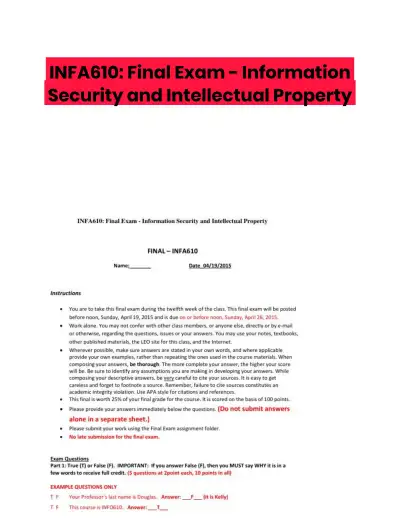 Solved Assignments
INFA610: Final Exam - Information Security and Intellectual Property
Information Technology
10 pagesMay 2025 Exam Guides
Test Bank for Managing and Using Information Systems: A Strategic Approach, 7th Edition (Chapters 1-13)
Information Technology
452 pages149downloadsFeb 2025 Exam Guides
Test Bank for Essentials of MIS, 12th Edition
Information Technology
342 pages146downloadsFeb 2025 Exam Guides
A+ Guide to Hardware, 9th Edition Test Bank
Information Technology
116 pages142downloadsFeb 2025 Textbook Guides
Solution Manual for Essentials of System Analysis and Design, 4th Edition
Information Technology
282 pages140downloadsFeb 2025 Textbook Guides
Guide To Networking Essentials, 7th Edition Solution Manual
Information Technology
48 pages139downloadsFeb 2025 Past Exams
2023-2024 SOPHOS FIREWALL V19.5 Practice Exam with Answers (75 Solved Questions)
Information Technology
7 pages134downloadsFeb 2025 Class Notes
Lecture Notes for CCNP Enterprise: Core Networking (ENCOR) v8 Lab Manual, 2nd Edition
Information Technology
1089 pages123downloadsFeb 2025
Study this document with CramX
Once it is in your library, every tool can work from it.