

Lecture Notes for New Perspectives on Computer Concepts 2018: Comprehensive, 20th Edition
- Information Technology
- 275 pages
- Shared May 2025
Make revision effortless with Lecture Notes for New Perspectives on Computer Concepts 2018: Comprehensive, 20th Edition, a reliable resource that breaks down lectures into digestible content.
Preview 16 of 275 pages
See the first 16 pages exactly as they appear in the document.
Page 1 Read page 1 as text
New Perspectives on Computer Concepts 2018 Instructor’s Manual 1 of 22 © 2018 Cengage. May not be scanned, copied or duplicated, or posted to a publicly accessible website, in whole or in part . Computer Concepts Module One: Digital Content A Guide to T his Instructor’s Manual: We have designed this Instructor’s Manual to supplement and enhance your teaching experience through classroom activities. This document is organized chronologically, using the same heading in blue that you see in the textbook. Under each heading you will find (in order): Lecture Notes that summarize the section, Figures and Boxes found in the section (if any), Teacher Tips, and Classroom Activities . Pay special attention to teaching tips and activities geared toward quizzing your students, enhancing their critical thinking skills, and encouraging experimentation within the software. In addition to this Instructor’s Manual, our Instructor’s Resources includes PowerPoint Presentations, Test Banks, and other supplements to aid in your teaching experience. Module Contents Objectives 2 Section A: Digital Basics 2 Section B: Digital Sound 6 Section C: Bitmap Graphics 10 Section D: Vector Graphics 1 4 Section E: Digital Video 1 7 Glossary of Key Terms 2 0
Page 2 Page 3 Read page 3 as text
New Perspectives on Computer Concepts 2018 Instructor’s Manual 2 of 22 © 2018 Cengage. May not be scanned, copied or duplicated, or posted to a publicly accessible website, in whole or in part . Objectives: Compress files containing various types of data, including text, photos, music, and videos. Record audio files. Select an audio sampling rate and file format for high - quality sound in files that won’t use up all your storage space. Convert audio files from one format to another. Use voice commands to control your digital devices. Select the best file format for digital images, such as photos and scans, taking into account which formats reduce image quality with lossy compression. Convert a paper document into a digital file that can be edited using word processing software. Work with RGB colors in decimal, hexadecimal, or binary notation. Use resolution to gauge the maximum size for an image. Use “photoshopping” techniques to enhance, colorize, clone, inpaint, clip, and merge photo images. Capture 360 - degree images on your smartphone. Draw vector images for logos and infographics. Convert vector images into bitmaps. Render a 3D image from a wireframe. Use video editing software to combine video footage with a soundtrack. Select output settings for a video, including aspect ratio, resolution, bit rate, compression level, and file format. Transcode a video from one file format to another. View vector and bitmap images in a VR headset. SECTION A: DIGITAL BASICS Section A: OBJECTIVES Students will have mastered the material in Section A when they can answer the following questions: List three technologies that digital devices use to physically store or transmit 1s and 0s . Write the numbers 1 through 10 in binary . Decipher ASCII text . Demonstrate how to use the terms bit , byte , megabyte , megabit , and gigabyte in the context o f dat a storage and digital device s. Distinguish between data that would be represented by binary numbers and data that would be represented by ASCII or Unicode . Explain how OCR relates to ASCII and Unicode . Describe the difference between lossy and lossless compression . Demonstrate how to compress a file . SECTION A OPENER QUESTION: Data refers to the symbols that represent people, events, things, and ideas. (Answer a) a. True b. False
Page 4 Read page 4 as text
New Perspectives on Computer Concepts 2018 Instructor’s Manual 3 of 22 © 2018 Cengage. May not be scanned, copied or duplicated, or posted to a publicly accessible website, in whole or in part . The Digital Revolut ion LECTURE NOTES Is there a difference between data and information? What is data representation? What’s the difference between analog and digital? How does digital data work? How is digital data stored? FIGURE Figure 1 - 1 C LASSROOM ACTIVITIES Quick Check : Which of the devices on the left illustrate analog data representation? a. The speedometer an d YouTube b. The television and the vinyl record c. All but the speedometer d. All but YouTube and the clock Digital devices work with bits in all of the following ways except: a. voltage variations b. light and dark spots c. analog values d. orientation of magnetized particles Re presenti n g Numbers LECTURE NOTE How do digital devices represent numbers? FIGURE Figure 1 - 2
Page 5 Read page 5 as text
New Perspectives on Computer Concepts 2018 Instructor’s Manual 4 of 22 © 2018 Cengage. May not be scanned, copied or duplicated, or posted to a publicly accessible website, in whole or in part . TEACHER TIP If you need to brush up on binary numbers refer to Figure 1 - 2. Quick Check : Which one of the following is considered numeric data? a. Passport number 47756902231 b. Telephone number 906 - 222 - 3450 c. The $28,995.00 cost of a car d. The address 22 E. Main Street Figure 1 - 2 shows the binary equivalent for numbers 0 through 11 and 1000. What is the binary equivalent for the number 12? a. 10111 b. 1100 c. 10000 d. 1111 Representing Text LECTURE NOTES How do digital devices represent text? Why are there ASCII codes for numbers? Where is digital text used? What is plain text? How does formatting get added to documents? What happens when I scan a document? FIGURES Figure 1 - 3, Figure 1 - 4, Figure 1 - 5 TEACHER TIP Take a look at the ASCII codes in Figure 1 - 3. Notice there is a code for th e space character in addition to codes for symbols, numerals, uppercase letters, and lowercase letters. Fig ure 1 - 4 illustrates an ASCII text file and the actual binary code that is stored for it. Fig ure 1 - 5 gives you a behind - the - scenes look at the Roller Coasters document with all th e embedded formatting codes revealed. CLASSROOM ACTIVITIES Lab Activity Scan a one - page document using a scanner or a multifunction printer. The default format for the scan is probably a JPEG or PNG graphic. Try using your scanner’s OCR feature or a free online OCR service to convert the scan into a document that can be edited using word processing software.
Page 6 Read page 6 as text
New Perspectives on Computer Concepts 2018 Instructor’s Manual 5 of 22 © 2018 Cengage. May not be scanned, copied or duplicated, or posted to a publicly accessible website, in whole or in part . Quick Check : Write out Hi! in Extended ASCII code. (Hint: Use an uppercase H , but a lowercase i .) a. H _______________ b. i ________________ c. ! ________________ If your address is 10 B Street, what are the first three bytes in ASCII? a. 00110001 00110000 01000010 b. 00110001 00110000 00100000 c. 00110001 00110111 00100000 What is the seventh byte in the Roller Coasters file? a. Uppercase C (01000011) b. Lowercase c (01100011) c. Space (00100000) d. Carriage return (00001101) Which one of the following would most likely require OCR? a. A two - page bibliography of award - winning books from 1945 that you would like to annotate b. An excerpt from a magazine article that you want to include in a term paper c. A football poster containing the home game schedule d. A page from a handwritten diary that you want to include in a historical biography Bits and Bytes LECTURE NOTES What is the difference between bits and bytes? What do the prefixes kilo - , mega - , giga - , and tera - mean? Why such odd numbers? When do I use bits and when do I use bytes? FIGURES Figure 1 - 6 , Figure 1 - 7 TEACHER TIP Fig ure 1 - 7 provides examples for file sizes and storage capacities . CLASSROOM ACTIVITIES Group Discussion: What’s a kibibyte ? Some computer scientists have proposed alternative terminology to dispel the ambiguity in terms such as kilo that can mean 1,000 or 1,024. They suggest the following prefixes: Kibi = 1,024; Mebi = 1,048,576; and Gibi = 1,073,741,824. Quick Check: My iPhone has 8 ______ of storage space; I uploaded a high - resolution 8 - ______ graphic; and I am going to download a small 8 ______ file. a. GB, MB, Mbps b. MB, GB, KB
Page 7 Read page 7 as text
New Perspectives on Computer Concepts 2018 Instructor’s Manual 6 of 22 © 2018 Cengage. May not be scanned, copied or duplicated, or posted to a publicly accessible website, in whole or in part . c. GB, MB, KB d. Mbps, MB, GB C ompression LECTURE NOTES What is the difference between lossless and lossy compression? How do I compress data? How do I return files to their uncompressed state? FIGURES Figure 1 - 8, Figure 1 - 9 CLASSROOM ACTIVITIES Lab Activity : Experiment with compressing files to see how much they shrink. Try compressing a document, and then try a graphic. Quick Check: Which one of the following requires lossless compression? a. A very large document that you intend to send as an email attachment b. A photo of your class reunion that you intend to post on your Facebook page c. An iTunes track saved to your iPod that you want to back up on your computer Compression utilities can be used to accomplish all of the following except: a. bundle two or more files into a single small file b. enlarge a file to increase its resolution c. zip a single file to decrease its size d. extract a file to its original size and content Q uick Q uiz : 1. A(n) ______________ is a 0 or 1 used in the digital representation of data. 2. Most computers use Unicode, UTF - 8, or Extended __________ code to represent character data. (Hint: Use the acronym.) 3. Formatting codes can be added to documents using a(n) ____________, such as slashes // and angle brackets< >. 4. In the computer world, TB is the abbreviation for ______________________. 5. The data files containing photos, videos, and music are typically compressed using ______________ compression that throws away some of the original data. SECTION B: DIGITAL SOUND Section B : OBJECTIVES Students will have mastered the material in Section B when they can answer the following questions:
Page 8 Read page 8 as text
New Perspectives on Computer Concepts 2018 Instructor’s Manual 7 of 22 © 2018 Cengage. May not be scanned, copied or duplicated, or posted to a publicly accessible website, in whole or in part . • Describe the process of digital sampling. • Select the appropriate sampling rate for a digital audio recording . • Identify digital audio files by their file name extensions. • Convert digital audio files from one format to another. • Understand why most audio files are compressed and how this affects sound quality. • Decide when to download, live stream, or stream music on demand. • Explain the difference between digital audio and MIDI. • Explain how Siri and similar services work. SECTION B OPENER QUESTION: __________ is music, speech, and other sounds represented in binary format for use in digital devices. (Answer d) a. MIDI b. S peech recognition c. S peech synthesis d. Digital audio Digital Audio Basics LECTURE NOTES How do I record sound? How is sound digitized? Does sampling rate affect sound quality? How much space is required to store an audio file? Is there any way to compress audio files? FIGURES Figure 1 - 10, Figure 1 - 11 TEACHER TIP F ig ure 1 - 10 shows how a sound wave is digitally sampled. Fig ure 1 - 11 illustrates how sampling rate affects sound quality and file size. C LASSROOM ACTIVITIES Quick Check : What is the purpose of sampling? a. To measure the height of each sound wave b. To take multiple height measurements of a wave and convert them into binary c. To determine the type of instrument that makes each sound d. To record a sound at the highest fidelity In this calculation, the sampling rate is _____________ . a. 32 bits b. 44.1 kHz c. 1.4 Mbps d. None of the above
Page 9 Read page 9 as text
New Perspectives on Computer Concepts 2018 Instructor’s Manual 8 of 22 © 2018 Cengage. May not be scanned, copied or duplicated, or posted to a publicly accessible website, in whole or in part . Audio compression is usually ___________________. a. Lossy b. Lossless c. Raw L ab A ctivity Try recording a short narration. Does your digital device have a built - in microphone and recording software? Digital Audio File Formats LECTURE NOTES Which audio formats are most popular? What are the best sources for digital music? What type of software is required to work with digital audio files? FIGURES Figure 1 - 1 2, Figure 1 - 13, Figure 1 - 14 TEACHER TIP The table in Figure 1 - 12 provides an overview of the most popular digital audio formats, which include AAC , MP3 , Ogg Vorbis , WAV , FLAC , and WMA . C LASSROOM ACTIVITIES Lab Activit ies : 1. Make a short audio recording using your favorite digital device. What are the default file format and sampling rate? If you record at a higher sampling rate, can you tell the difference in sound quality? 2. Find the names of two live streaming music services and the names of two on - demand streaming services. Quick Check : 1. You’ve selected a music track on your smartphone, but there is a pause before it begins. This pause is associated with __________________ . a. downloading audio tracks b. live streaming audio c. on - demand streaming 2. The term ripping applies to: a. converting CD tracks to formats such as MP3 and AAC b. downloading MP3 files illegally from the Internet c. compressing AAC files with digital audio extraction M IDI LECTURE NOTES What is MIDI music?
Page 10 Read page 10 as text
New Perspectives on Computer Concepts 2018 Instructor’s Manual 9 of 22 © 2018 Cengage. May not be scanned, copied or duplicated, or posted to a publicly accessible website, in whole or in part . What is the data representation for a MIDI message? What are the advantages and disadvantages of MIDI? Who uses MIDI? FIGURE Figure 1 - 15 CLASSROOM ACTIVITIES Quick Check : Which of the following files is likely to contain synthesized music? a. Bongos.mp3 b. Screech.wav c. Waltz.ogg d. Sugar.mid DIGITIZED SPEECH LECTURE NOTES What’s the difference between speech synthesis and speech recognition? How does speech synthesis work? How does speech recognition work? How does Siri work? FIGURES Figure 1 - 16, Figure 1 - 17 CLASSROOM ACTIVITIES Lab Activit ies : If you have a laptop with Windows 10, it includes a comprehensive speech recognition system called Cortana. Try it out. You can speak commands to launch apps, navigate menus, and dictate text for email messages and documents. Are you wondering what a Speak & Spell is? Go to YouTube and search for “Speak & Spell” to see a demonstration. Quick Check : Which of the following files requires digital - to - analog conversion? a. Speech synthesis b. Speech recognition c. Entering a Google Voice command d. Voice dialing CLASSROOM ACTIVITIES • Quick Quiz : 1. ____________ rate refers to the number of times per second that a sound is measured during the recording process.
Page 11 Read page 11 as text
New Perspectives on Computer Concepts 2018 Instructor’s Manual 10 of 22 © 2018 Cengage. May not be scanned, copied or duplicated, or posted to a publicly accessible website, in whole or in part . 2. Audio formats such as MP3, Ogg Vorbis, and AAC have good sound quality even though they use __________ compression. 3. The process of ripping tracks from an audio CD to a digital format such as MP3 is called digital audio ______________. 4. _____________________ files store a series of instructions that specify which notes to play, their duration, and their volume. 5. The audio components for Siri and similar services are obtained by recording real voices and then applying __________ speech synthesis. SECTION C: BITMAP GRAPHICS Section C : OBJECTIVES Students will have mastered the material in Section C when they can answer the following questions : • Describe the differences between bitmap and vector graphics file formats. • Explain how pixel color is represented in decimal, hexadecimal, and binary. • Calculate the size of a bitmap file given its resolution. • Decide which graphics format to use for school, work, or personal projects. • List six popular bitmap file formats. • Describe how cameras and scanners produce digital images. • Explain how 3D images are created. • Describe the RG B and CMYK color models. • Explain what a color histogram represents and how to use one. • Provide examples of image stitching. • Describe two types of stereoscopic imaging. SECTION C OPENER QUESTION: A bitmap graphic is composed of a grid of tiny rectangular cells. (Answer b) a. True b. False Bitmap Basics LECTURE NOTES What is a bitmap graphic? Where would I encounter bitmap graphics? How do I create bitmap images? How do I convert a printed image into a bitmap? How does a digital camera capture bitmap images? What are the most common bitmap file formats? FIGURES Figure 1 - 18 , Figure 1 - 19, Figure 1 - 20, Figure 1 - 21 TEACHER TIP
Page 12 Read page 12 as text
New Perspectives on Computer Concepts 2018 Instructor’s Manual 11 of 22 © 2018 Cengage. May not be scanned, copied or duplicated, or posted to a publicly accessible website, in whole or in part . Fig ure 1 - 18 illustrates these basic characteristics of a bitmap graphic. Figure 1 - 21 summarizes popular bitmap formats and their uses. C LASSROOM ACTIVITIES Group Discussion: The term 3D is used today to refer to a variety of commercial products that should be called stereoscopic. For example, those so - called 3D glasses with blue and red lenses are technically stereoscopic, not 3D. As you continue in this module, pay attention to the difference between 3D and stereoscopic. Lab Activity: Check the features of the photo app on your smartphone. Which of the following does it provide? Retouch Crop Special effects Exposure adjustment Quick Check: Bitmap graphics are based on: a. c odecs b. p ixels c. r asters d. v ectors Bitmap Data Represen tation LECTURE NOTES How does each pixel get a color number? How are colors specified? How much data is required for each pixel color? How does resolution relate to image quality? Can I shrink and enlarge bitmaps? Can I change a bitmap’s resolution? So how much resolution does a bitmap need to be printed as a poster? FIGURES Figure 1 - 22, Figure 1 - 23, Figure 1 - 24 CLASSROOM ACTIVITIES Assign a Project: Open an image with Photoshop or similar graphics software. Check its size and its ppi. At 300 ppi, how large can the image be printed before its quality begins to deteriorate?
Page 13 Read page 13 as text
New Perspectives on Computer Concepts 2018 Instructor’s Manual 12 of 22 © 2018 Cengage. May not be scanned, copied or duplicated, or posted to a publicly accessible website, in whole or in part . Group Discussion : The CMYK color model defines four color values: cyan, magenta, yellow, and black. It is a subtractive system, whereas RGB is an additive system. In CMYK, white is 00000000; but in RGB, 11111111 is white. CMYK is typically used for projects that require color printing. Quick Check: 1. To represent the color violet in Figure 1 - 22, the decimal value for green is 130. What are the equivalent hexadecimal and binary values for green? a. 82 and 10000010 b. 255 and 11111111 c. EE and 11101110 Image Compression LECTURE NOTES • What is image compression? • Which formats apply lossless compression? • How does lossless compression shrink a file without throwing away data? • Which formats apply lossless compression? • What happens during lossy compression? • Can I compress images using general compression tools? FIGURES Figure 1 - 25, Figure 1 - 26, Figure 1 - 27 TEACHER TIP Figure 1 - 27 illustrates a section of a noncompressed image and a section of that same image after JPEG compression has been applied. Can you see any difference? CLASSROOM ACTIVITIES Assign a Project: Open a JPEG image. Use the Save As command or Duplicate command to make a copy of the image with a name different from the original. As you save the copy, apply as much compression as possible. Close both files and then reopen them. Is there a visible difference in quality? Quick Check : 1. Run - length encoding is a type of __________ . bitmap digitization RLE graphics format lossless compression pixelation Modifying Bitmap Images LECTURE NOTE What characteristics of a bitmap can I modify?
Page 14 Read page 14 as text
New Perspectives on Computer Concepts 2018 Instructor’s Manual 13 of 22 © 2018 Cengage. May not be scanned, copied or duplicated, or posted to a publicly accessible website, in whole or in part . FIGURES Figure 1 - 28 , Figure 1 - 29, Figure 1 - 30, Figure 1 - 31, Figure 1 - 32 CLASSROOM ACTIVITIES Assign an Activity: Histograms can perform miracles! Open a photo using software such as Photoshop, Apple Photos, or Photo Gallery. Locate the histogram control and experiment to see what you can reveal in the shadows. You can see digital compositing in action by going to YouTube and searching for Content - Aware Fill . If you have access to Photoshop, open a few of your own photos and see what kind of crazy composite you can create. Quick Check : When modifying a JPEG image, which of the following is true? a. It is stored in a compressed format . b. It cannot be modified until you unzip it . c. You can no longer edit individual pixels in the image . Panoramic and 360 Images LECTURE NOTES What is image stitching? What kinds of images does stitching produce? Are special software and equipment required to capture photos for stitched images? FIGURE Figure 1 - 33 CLASSROOM ACTIVITIES Quick Check : Image stitching knits photos into panoramic, cylindrical, and spherical images, but what technique is used to insert parts of one image into another image? a. Cloning b. Inpainting c. Compression d. Compositing Stereoscopy LECTURE NOTES What is stereoscopic imaging? What’s the modern version of stereoscopic imaging? What about those red and blue stereo glasses? FIGURES
Page 15 Read page 15 as text
New Perspectives on Computer Concepts 2018 Instructor’s Manual 14 of 22 © 2018 Cengage. May not be scanned, copied or duplicated, or posted to a publicly accessible website, in whole or in part . Figure 1 - 3 4, Figure 1 - 35 , Figure 1 - 36 CLASSROOM ACTIVITIES Quick Check : Name two techniques for creating stereoscopic images. a. Anaglyphs and stereograms b. Compositing and overlays c. Blue and red d. Steganography and depthing Quick Quiz: 1. A digital camera captures images on the photosites of a(n) ___________. (Hint: Use the acronym.) 2. A characteristic of bitmap graphics is that they are resolution ______________, so that reducing the resolution also reduces the image quality. 3. Graphics stored in True Color format require _______ bits for each pixel. 4. Two images from a stereo pair displayed side by side are called a(n) ___________. 5. The most popular True Color formats for Web graphics include ____________ and JPEG. (Hint: Use the acronym.) SECTION D: VECTOR GRAPHICS Section D : OBJECTIVES Students will have mastered the material in Section D when they can answer the following questions : Identify vector graphics used on Web sites and social media. Based on the characteristics of vector graphics, determine when they are more suitable for a project than bitmaps. Draw simple vector shapes and outlines using drawing software. Convert a vector drawing into a bitmap. Explain the process of rendering a 3D wireframe into an image. Identify the key difference between rendering 3D graphics for computer games and creating special effects for movies. Explain how vector graphics relate to augmented reality. Describe the type of graphics commonly used for virtual reality. SECTION D OPENER QUESTION: A vector graphic consists of a set of instructions for creating a picture. (Answer a) a. True b. False Vector Graphics Basics LECTURE NOTES What is a vector graphic?
Page 16 Read page 16 as text
New Perspectives on Computer Concepts 2018 Instructor’s Manual 15 of 22 © 2018 Cengage. May not be scanned, copied or duplicated, or posted to a publicly accessible website, in whole or in part . How do vector graphics compare with bitmap images? Where are vector graphics used? How can I identify vector graphics? FIGURES Figure 1 - 37 , Figure 1 - 38 , Figure 1 - 3 9, Figure 1 - 40 TEACHER TIP Fig ure 1 - 39 illustrates the difference between vector and bitmap graphics when you try to edit out parts of the Stonehenge image. CLASSROOM ACTIVITIES Quick Check : Vector commands in the example at left are written using ________________. a. Flash b. Basic c. #00BF00 d. XML scripts Which format tends to require the least storage space ? a. Bitmap b. Vector c. Compressed bitmap d. MIDI Vector Tools LECTURE NOTES What tools do I need to create vector graphics? Is it possible to convert a vector graphic into a bitmap? FIGURES Figure 1 - 41, Figure 1 - 42 TEACHER TIP Figure 1 - 41 illustrates how to use drawing tools to create a vector graphic. CLASSROOM ACTIVITIES Assign a n Activity: You can find drawing tools such as ImageBot and Janvas online, or use Adobe Illustrator if it is installed on your computer. Try drawing the sky, sun, clouds, and grass from the Stonehenge image in Figure 1 - 41. Save your work to use for another TRY IT! later in the module. Quick Check : Which of the following input devices is used to create vector images? a. Camera b. Scanner c. Digitizing tablet
259 more pages in the full document
Unlock it once and it stays in your library, ready to chat with or turn into flashcards.
Unlock the full documentMore Information Technology study materials
See all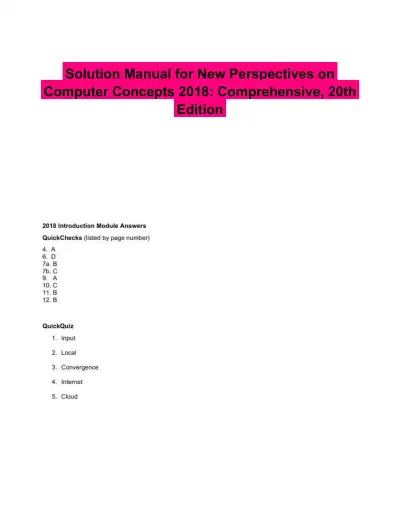 Textbook Guides
Solution Manual for New Perspectives on Computer Concepts 2018: Comprehensive, 20th Edition
Information Technology
93 pagesMay 2025 Exam Guides
Test Bank for Managing and Using Information Systems: A Strategic Approach, 7th Edition (Chapters 1-13)
Information Technology
452 pages149downloadsFeb 2025 Exam Guides
Test Bank for Essentials of MIS, 12th Edition
Information Technology
342 pages146downloadsFeb 2025 Exam Guides
A+ Guide to Hardware, 9th Edition Test Bank
Information Technology
116 pages142downloadsFeb 2025 Textbook Guides
Solution Manual for Essentials of System Analysis and Design, 4th Edition
Information Technology
282 pages140downloadsFeb 2025 Textbook Guides
Guide To Networking Essentials, 7th Edition Solution Manual
Information Technology
48 pages139downloadsFeb 2025 Past Exams
2023-2024 SOPHOS FIREWALL V19.5 Practice Exam with Answers (75 Solved Questions)
Information Technology
7 pages134downloadsFeb 2025 Class Notes
Lecture Notes for CCNP Enterprise: Core Networking (ENCOR) v8 Lab Manual, 2nd Edition
Information Technology
1089 pages123downloadsFeb 2025
Study this document with CramX
Once it is in your library, every tool can work from it.