

Solution Manual for Concepts of Programming Languages, 12th Edition
- Information Technology
- 60 pages
- Shared February 2025
- 60 downloads
Struggling with assignments? Solution Manual for Concepts of Programming Languages, 12th Edition has all the answers you need!
Preview 19 of 60 pages
See the first 19 pages exactly as they appear in the document.
Page 1 Read page 1 as text
Instructor’s Solutions Manual to Concepts of Programming Languages Twelfth Edition R.W. Sebesta
Page 2 Page 3 Read page 3 as text
2 Preface Changes for the Twelf th Edition he goals, overall structure, and approach of this twelft h edition of Concepts of Programming La n guages re main the same as those of the eleven earlier editions. The principal goals are to introduce the fundamental constructs of contemporary programming languages and to provide the reader with the tools necessary for the critical evaluation of existing and future programming languages. A secondary goal is to prepare the reader for the study of compiler design, by providing an in - depth discussion of programming language structures, presenting a formal method of describing syntax, and introducing a p proaches to lexical and syntactic analysis. The twelft h edition evolved from the eleventh through several different kinds of changes. To maintain the currency of the material, nearly all of the discussion of some programming languages, specifically Lua and Objective - C , has been removed. Material on the newer language, Swift, was added to several chapters . In addition, a new section on optional types was added to Chapter 6. Material was added to Section 8.3.4 to describe iterators in Python. In numerous places in the manus cript small changes were made to correct and/or clarify the discussion . The Vision This book describes the fundamental concepts of programming languages by discussing the d e sign issues of the various language constructs, examining the design choices for t hese constructs in some of the most common languages, and critically comparing design alternatives. Any serious study of programming languages requires an examination of some related topics, among which are formal methods of describing the syntax and semantics of programming languages, which are covered in Chapter 3. Also, implementation techniques for various language constructs must be considered: Lexical and syntax analysis are discussed in Chapter 4, and implementation of T
Page 4 Read page 4 as text
3 subprogram linkage is co v ered i n Chapter 10. Implementation of some other la n guage constructs is discussed in various other parts of the book. The following paragraphs outline the contents of the twelfth edition. Chapter Outlines Chapter 1 begins with a rationale for studying programmi ng languages. It then discusses the crit e ria used for evaluating programming languages and language constructs. The primary influences on language design, common design trade - offs, and the basic approaches to implementation are also examined. Chapter 2 outlines the evolution of the languages that are discussed in this book. Although no attempt is made to describe any language completely, the origins, purposes, and contributions of each are discussed. This historical overview is valuable, because it provides the background necessary to understanding the practical and theoretical basis for contemporary language design. It also motivates further study of language design and evaluation. Because none of the remainder of the book depends on Chapter 2, it can be read on its own, independent of the other chapters. Chapter 3 describes the primary formal method for describing the syntax of programming la n guage — BNF. This is followed by a description of attribute grammars, which describe both the syntax and static semantics of languages. The difficult task of semantic description is then explored, including brief i n troductions to the three most common methods: operational, denotational, and axiomatic semantics. Chapter 4 introduces lexical and syntax analysis. This chapter is targeted to those Computer Science departments that no longer require a compiler design course in their curricula. Similar to Chapter 2, this chapter stands alone and can be studied independently of the rest of the book, e x cept for Chapter 3, on which it depends. Chapters 5 through 14 describe in detail the design issues for the primary constructs of programming languages. In each case, the design choices for several example languages are presented and evaluated. Sp e cifically, Chapter 5 covers the many characteristics of variables, Cha p ter 6 covers data types, and Chapter 7 explains expressions and assignment statements. Chapter 8 describes control statements, and Chapters 9 and 10 discuss subprograms and their implementation. Chapter 11 examines data abstraction fa cilities. Chapter 12 provides an in - depth
Page 5 Read page 5 as text
4 discussion of language features that support object - oriented programming (inhe r itance and dynamic method binding), Chapter 13 discusses concurrent program units, and Chapter 14 is about exception ha n dling, along with a brief discussion of event handling. Chapters 15 and 16 describe two of the most important alternative programming paradigms: functional programming and logic programming. However, some of the data structures and control constructs of fun c tional programming languages are discussed in Chapters 6 and 8. Chapter 15 presents an introduction to Scheme, including descriptions of some of its primitive functions, special forms, and functional forms, as well as some examples of simple functions written in Scheme. Brief introductions to ML, Haskell, and F# are given to illustrate some different directions in functional language design. Chapter 16 introduces logic programming and the logic programming la n guage, Prolog. To the Instructor Chapters 1 and 3 are typically covered in detail, and though students find it interesting and beneficial reading, Chapter 2 receives little lecture time due to the lack of hard technical content. Because no material in subsequent chapters depends on Chap ter 2, it can be skipped entirely . If a course in compiler design is required, Chapter 4 is not covered . Chapters 5 through 9 should be relatively easy for students with extensive programming exp e rience in C ++ , Java, or C#. Chapters 10 through 14 are more challenging and require more detailed le c tures. Chapters 15 and 16 are entirely new to most students at the junior level. Ideally, language processors for Scheme and Prolog should be available for students required to learn the material in these chapters. Suff i cient material is included to allow students to dabble with some simple pr o grams. Undergraduate courses will probably not be able to cover all of the material in the last two chapters. Graduate courses, however, should be able to completely discuss the material in those chapters by skipping over some parts of the early chapters on imperative languages.
Page 6 Read page 6 as text
5 Supplemental Materials The following supplements are available to all readers of this book at www.pearsonhighered.com/cs - resources/ . • A set of lecture note slides. PowerPoint slides are available for each chapter in the book. • All of the figures from the book. A companion We b site to the book is available at www.pearson.com /cs - resources/ . This site co n tains mini - manuals (approximately 100 - page tutorials) on a handful of languages. Solutions to many of the problem sets are available to qualified instructors in our Instructor Resource Ce n ter at www.pearson.com . Please contact your school’s Pearson Education representative or visit www.pearson.com to register . Language Processor Availability Processors for and information about some of the programming languages discussed in this book can be found at the following Web sites: C, C ++ , Fortran, and Ada gcc.gnu.org C# and F# microsoft.com Java java.sun.com Haskell haskell.org Scheme www.plt - s cheme.org/software/drscheme Perl www.perl.com Python www.python.org Ruby www.ruby - lang.org JavaScript is included in virtually all browsers; PHP is included in virtually all Web servers. All this information is also included on the companion Web site.
Page 7 Read page 7 as text
6 Acknowledgments The suggestions from outstanding reviewers contributed greatly to this book’s present form and contents. In alphabetical order, they are: Aaron Rababaah University of Maryland at Eastern Shore Amar Raheja California State Polytechnic Univers i t y – P omona Amer Diwan University of Colorado Bob Neufeld Wichita State University Bruce R. Maxim University of Michigan – Dearborn Charles Nicholas University of Maryland – Baltimore County Cristian Videira Lopes University of California – Irvine Curtis Meadow University of Maine David E. Goldschmidt Donald Kraft Louisiana State University Duane J. Jarc University of Maryland, University Co l lege Euripides Montagne University of Central Florida Frank J. Mitropoulos Nova Southeastern University Gloria Melara California State University – Northridge Hossein Saiedian University of Kansas I - ping Chu DePaul University Ian Barland Radford University K. N. King Georgia State University Karina Assiter Wentworth Institute of Technology Mark Llewellyn University of Central Florida
Page 8 Read page 8 as text
7 Matthew Michael Burke Michael Prentice SUNY Buffalo Nancy Tinkham Rowan University Neelam Soundarajan Ohio State University Nigel Gwee Southern University – Baton Rouge Pamela Cutter Kalamazoo College Paul M. Jackowitz University of Scranton Paul Tymann Rochester Institute of Technology Richard M. Osborne University of Colorado – Denver Richard Min University of Texas at Dallas Robert McCloskey University of Scranton Ryan Stansifer Florida Institute of Technology Salih Yurttas Texas A&M University Saverio Perugini University of Dayton Serita Nelesen Calvin College Simon H. Lin California State University – Northridge Stephen Edwards Virginia Tech Stuart C. Shapiro SUNY Buffalo Sumanth Yenduri University of Southern Mississippi Teresa Cole Boise State University Thomas Turner University of Central Oklahoma Tim R. Norton University of Colorado – Colorado Springs Timothy Henry University of Rhode Island Walter Pharr College of Charleston X iangyan Zeng Fort Valley State University Numerous other people provided input for the previous editions of Concepts of Programming La n guages at various stages of its development. All of their
Page 9 Read page 9 as text
8 comments were useful and greatly appreciated. In alphabetical order, they are: Vicki Allan, Henry Bauer, Carter Bays, Manuel E. Bermudez, Peter Brouwer, Margaret Burnett, Paosheng Chang, Liang Cheng, John Crenshaw, Charles Dana, Barbara Ann Griem, Mary Lou Haag, John V. Harrison, Eileen Head, Ralph C. Hilzer, Eric Joanis, Leon Jololian, Hikyoo Koh, Jiang B. Liu, Meiliu Lu, Jon Mauney, Robert McCoard, Dennis L. Mumaugh, Michael G. Murphy, Andrew Oldroyd, Young Park, Rebecca Parsons, Steve J. Phelps, Jeffery Popyack, Steven Rapkin, Hamilton Richard, Tom Sager, Raghvinder Sangwan, Joseph Schell, Sibylle Schupp, Mary Louise Soffa, Neelam Soundarajan, Ryan Stansifer, Steve Stevenson, Virginia Teller, Yang Wang, John M. Weiss, Franck Xia, and Salih Yurnas. Matt Goldstein, Portfolio Management Specialist ; Megh an Jacoby, Portfolio Management Assistant; Managing Content Producer, Scott Disanno; and Prathiba Rajagopal, all deserve my gratitude for their efforts to produce the twelfth edition both quickly and carefully. About the Author Robert Sebesta is an Ass ociate Professor Emeritus in the Computer Science Department at the University of Colorado – Colorado Springs. Professor Sebesta received a BS in applied mathema t ics from the University of Colorado in Boulder and MS and PhD degrees in computer science from Pennsylvania State University. He taught computer science for more than 40 years..
Page 10 Read page 10 as text
9 Contents Chapter 1 Preliminaries 1 1.1 Reasons for Studying Concepts of Programming Languages ................... 2 1.2 Programming Domains ................................ ................................ .......... 5 1.3 Language Evaluation Criteria ................................ ................................ . 6 1.4 Influences on Language Design ................................ ........................... 17 1.5 Language Categories ................................ ................................ ........... 20 1.6 Language Design Trade - Offs ................................ ............................... 21 1.7 Implementation Methods ................................ ................................ ..... 22 1.8 Programming Environments ................................ ................................ 29 Summary • Review Questions • Problem Set ................................ ................... 30 Chapter 2 Evolution of the Major Programming Languages 33 2.1 Zuse’s Plankalkül ................................ ................................ ................ 36 2.2 Pseudocodes ................................ ................................ ........................ 37 2.3 The IBM 704 and Fortran ................................ ................................ .... 40 2.4 Functional Programming: Lisp ................................ ............................. 45 2.5 The First Step Toward Sophistication: ALGOL 60 ............................... 50 2.6 Computerizing Business Records: COBOL ................................ .......... 56 2.7 The Beginnings of Timesharing: Basic ................................ ................. 61 Interview: ALAN COOPER — User Design and Language Design ................ 64 2.8 Everything for Everybody: PL/I ................................ ........................... 66
Page 11 Read page 11 as text
10 2.9 Two Early Dynamic Languages: APL and SNOBOL ............................ 69 2.10 The Beginnings of Data Abstraction: SIMULA 67 ............................... 70 2.11 Orthogonal Design: ALGOL 68 ................................ ........................... 71 2.12 Some Early Descendants of the ALGOLs ................................ ............. 73 2.13 Programming Based on Logic: Prolog ................................ .................. 77 2.14 History’s Largest Design Effort: Ada ................................ ................... 79 2.15 Object - Oriented Programming: Smalltalk ................................ ............. 83 2.16 Combining Imperative and Object - Oriented Features: C ++ ................... 85 2.17 An Imperative - Based Object - Oriented Language: Java ......................... 88 2.18 Scripting Languages ................................ ................................ ............ 91 2.19 The Flagship .NET Language: C# ................................ ........................ 98 2.20 Markup - Programming Hybrid Languages ................................ .......... 100 Summary • Bibliographic Notes • Review Questions • Problem Set •Programming Exercises ................................ ................................ ................................ ...... 102 Chapter 3 Describing Syntax and Semantics 109 3.1 Introduction ................................ ................................ ....................... 110 3.2 The General Problem of Describing Syntax ................................ ........ 111 3.3 Formal Methods of Describing Syntax ................................ ............... 113 3.4 Attribute Grammars ................................ ................................ ........... 128 History Note ................................ ................................ ........................... 128 3.5 Describing the Meanings of Programs: Dynamic Semantics ............... 134 History Note ................................ ................................ ........................... 142 Summary • Bibliographic Notes • Review Questions • Problem Set ................ 155 Chapter 4 Lexical and Syntax Analysis 161 4.1 Introduction ................................ ................................ ....................... 162 4.2 Lexical Analysis ................................ ................................ ................ 163
Page 12 Read page 12 as text
11 4.3 The Parsing Problem ................................ ................................ ......... 171 4.4 Recursive - Descent Parsing ................................ ................................ . 175 4.5 Bottom - Up Parsing ................................ ................................ ............ 183 Summary • Review Questions • Problem Set • Programming Exercises .......... 191 Chapter 5 Names, Bindings, and Scopes 197 5.1 Introduction ................................ ................................ ....................... 198 5.2 Names ................................ ................................ ............................... 199 History Note ................................ ................................ ........................... 199 5.3 Variables ................................ ................................ ........................... 200 5.4 The Concept of Binding ................................ ................................ ..... 203 5.5 Scope ................................ ................................ ................................ 211 5.6 Scope and Lifetime ................................ ................................ ............ 222 5.7 Referencing Environments ................................ ................................ . 223 5.8 Named Constants ................................ ................................ ............... 224 Summary • Review Questions • Problem Set •Programming Exercises ........... 227 Chapter 6 Data Types 235 6.1 Introduction ................................ ................................ ....................... 236 6.2 Primitive Data Types ................................ ................................ ......... 238 6.3 Character String Types ................................ ................................ ...... 242 History Note ................................ ................................ ........................... 243 6.4 Enumeration Types ................................ ................................ ............ 247 6.5 Array Types ................................ ................................ ...................... 250 History Note ................................ ................................ ........................... 251 History Note ................................ ................................ ........................... 251 6.6 Associative Arrays ................................ ................................ ............. 261
Page 13 Read page 13 as text
12 6.7 Record Types ................................ ................................ .................... 265 6.8 Tuple Types ................................ ................................ ...................... 268 6.9 List Types ................................ ................................ ......................... 270 6.10 Union Types ................................ ................................ ...................... 272 6.11 Pointer and Reference Types ................................ .............................. 275 History Note ................................ ................................ ........................... 278 6.12 Optional Type s ................................ ................................ .................. 287 6.1 3 Type Checking ................................ ................................ .................. 287 6.1 4 Strong Typing ................................ ................................ ................... 288 6.1 5 Type Equivalence ................................ ................................ .............. 289 6.1 6 Theory and Data Types ................................ ................................ ...... 293 Summary • Bibliographic Notes • Review Questions • Problem Set •Programming Exercises ................................ ................................ ................................ ...... 295 Chapter 7 Expressions and Assignment Statements 301 7.1 Introduction ................................ ................................ ....................... 302 7.2 Arithmetic Expressions ................................ ................................ ...... 302 7.3 Overloaded Operators ................................ ................................ ........ 311 7.4 Type Conversions ................................ ................................ .............. 313 History Note ................................ ................................ ........................... 315 7.5 Relational and Boolean Expressions ................................ ................... 316 History Note ................................ ................................ ........................... 316 7.6 Short - Circuit Evaluation ................................ ................................ .... 318 7.7 Assignment Statements ................................ ................................ ...... 319 History Note ................................ ................................ ........................... 323 7.8 Mixed - Mode Assignment ................................ ................................ .. 324 Summary • Review Questions • Problem Set • Programming Exercises ........... 324
Page 14 Read page 14 as text
13 Chapter 8 Statement - Level Control Structures 329 8.1 Introduction ................................ ................................ ....................... 330 8.2 Selection Statements ................................ ................................ .......... 332 8.3 Iterative Statements ................................ ................................ ........... 343 8.4 Unconditional Branching ................................ ................................ ... 355 History Note ................................ ................................ ........................... 355 8.5 Guarded Commands ................................ ................................ .......... 356 8.6 Conclusions ................................ ................................ ....................... 358 Summary • Review Questions • Problem Set • Programming Exercises ............ 359 Chapter 9 Subprograms 365 9.1 Introduction ................................ ................................ ....................... 366 9.2 Fundamentals of Subprograms ................................ ........................... 366 9.3 Design Issues for Subprograms ................................ .......................... 374 9.4 Local Referencing Environments ................................ ....................... 375 9.5 Parameter - Passing Methods ................................ ............................... 377 History Note ................................ ................................ ........................... 385 History Note ................................ ................................ ........................... 385 9.6 Parameters That Are Subprograms ................................ ..................... 393 History Note ................................ ................................ ........................... 395 9.7 Calling Subprograms Indirectly ................................ ......................... 395 9.8 Design Issues for Functions ................................ ............................... 397 9.9 Overloaded Subprograms ................................ ................................ ... 399 9.10 Generic Subprograms ................................ ................................ ........ 400 9.11 User - Defined Overloaded Operators ................................ .................. 406 9.12 Closures ................................ ................................ ............................ 406 9.13 Coroutines ................................ ................................ ......................... 408
Page 15 Read page 15 as text
14 Summary • Review Questions • Problem Set • Programming Exercises ............ 411 Chapter 10 Implementing Subprograms 417 10.1 The General Semantics of Calls and Returns ................................ ...... 418 10.2 Implementing “Simple” Subprograms ................................ ................ 419 10.3 Implementing Subprograms with Stack - Dynamic Local Variables ...... 421 10.4 Nested Subprograms ................................ ................................ .......... 429 10.5 Blocks ................................ ................................ ............................... 436 10.6 Implementing Dynamic Scoping ................................ ........................ 437 Summary • Review Questions • Problem Set • Programming Exercises ............ 441 Chapter 11 Abstract Data Types and Encapsulation Constructs 447 11.1 The Concept of Abstraction ................................ ............................... 448 11.2 Introduction to Data Abstraction ................................ ........................ 449 11.3 Design Issues for Abstract Data Types ................................ ............... 452 11.4 Language Examples ................................ ................................ ........... 453 Interview: BJARNE STROUSTRUP — C++: Its Birth, Its Ubiquitousness, and Common Criticisms ................................ .............. 454 11.5 Parameterized Abstract Data Types ................................ .................... 472 11.6 Encapsulation Constructs ................................ ................................ ... 476 11.7 Naming Encapsulations ................................ ................................ ..... 480 Summary • Review Questions • Problem Set • Programming Exercises ............ 483 Chapter 12 Support for Object - Oriented Programming 489 12.1 Introduction ................................ ................................ ....................... 490 12.2 Object - Oriented Programming ................................ ........................... 491 12.3 Design Issues for Object - Oriented Languages ................................ .... 495 12.4 Support for Object - Oriented Programming in Specific Languages ..... 500
Page 16 Read page 16 as text
15 Interview: BJARNE STROUSTRUP — On Paradigms and Better Programming 504 12.5 Implementation of Object - Oriented Constructs ................................ ... 528 12.6 Reflection ................................ ................................ .......................... 531 Summary • Review Questions • Problem Set • Programming Exercises ............ 537 Chapter 13 Concurrency 543 13.1 Introduction ................................ ................................ ....................... 544 13.2 Introduction to Subprogram - Level Concurrency ................................ . 549 13.3 Semaphores ................................ ................................ ....................... 554 13.4 Monitors ................................ ................................ ............................ 559 13.5 Message Passing ................................ ................................ ................ 561 13.6 Ada Support for Concurrency ................................ ............................ 562 13.7 Java Threads ................................ ................................ ...................... 570 13.8 C# Threads ................................ ................................ ........................ 580 13.9 Concurrency in Functional Languages ................................ ................ 585 13.10 Statement - Level Concurrency ................................ ............................ 588 Summary • Bibliographic Notes • Review Questions • Problem Set • Programming Exercises ................................ ................................ ................................ ....... 590 Chapter 14 Exception Handling and Event Handling 597 14.1 Introduction to Exception Handling ................................ ................... 598 History Note ................................ ................................ ........................... 602 14.2 Exception Handling in C ++ ................................ ................................ 604 14.3 Exception Handling in Java ................................ ............................... 608 14.4 Exception Handling in Python and Ruby ................................ ............ 615 14.5 Introduction to Event Handling ................................ .......................... 618 14.6 Event Handling with Java ................................ ................................ .. 619
Page 17 Read page 17 as text
16 14.7 Event Handling in C# ................................ ................................ ........ 623 Summary • Bibliographic Notes • Review Questions • Problem Set • Programming Exercises ................................ ................................ ................................ ....... 626 Chapter 15 Functional Programming Languages 633 15.1 Introduction ................................ ................................ ....................... 634 15.2 Mathematical Functions ................................ ................................ ..... 635 15.3 Fundamentals of Functional Programming Languages ........................ 638 15.4 The First Functional Programming Language: Lisp ............................ 639 15.5 An Introduction to Scheme ................................ ................................ 643 15.6 Common Lisp ................................ ................................ .................... 661 15.7 ML ................................ ................................ ................................ .... 663 15.8 Haskell ................................ ................................ .............................. 668 15.9 F# ................................ ................................ ................................ ..... 673 15.10 Support for Functional Programming in Primarily Imperative Languages ................................ ................................ ................................ ......... 676 15.11 A Comparison of Functional and Imperative Languages ..................... 679 Summary • Bibliographic Notes • Review Questions • Problem Set • Programming Exercises ................................ ................................ ................................ ....... 681 Chapter 16 Logic Programming Languages 689 16.1 Introduction ................................ ................................ ....................... 690 16.2 A Brief Introduction to Predicate Calculus ................................ ......... 690 16.3 Predicate Calculus and Proving Theorems ................................ .......... 694 16.4 An Overview of Logic Programming ................................ ................. 696 16.5 The Origins of Prolog ................................ ................................ ........ 698 16.6 The Basic Elements of Prolog ................................ ............................ 698 16.7 Deficiencies of Prolog ................................ ................................ ....... 713
Page 18 Read page 18 as text
17 16.8 Applications of Logic Programming ................................ .................. 719 Summary • Bibliographic Notes • Review Questions • Problem Set • Programming Exercises ................................ ................................ ................................ ....... 720 Bibliography ................................ ................................ ..................... 725 Index ................................ ................................ ................................ .. 737 Answers to Selected Problems Chapter 1 Problem Set: 3. Some arguments for having a single language for all programming domains are: It would dramatically cut the costs of programming training and compiler purchase and maintenance; it would simplify programmer recruiting and justify the development of numerous language dependent software development aids. 4. Some arguments against having a single language for all programming domains are: The language would necessarily be huge and complex; compilers would be expensive and costly to maintain; the language would probably not be very good for any programming domain, either in compiler efficiency or in the efficiency of the code it generated. More importantly, it would not be easy to use, because regardless of the application area, the language would include many unnecessary and confusing features and constructs (those meant for other application areas). Different users would learn different subsets, making maintenance difficult. 5. One possibility is wordiness. In some languages, a great deal of text is required for even simple complete programs. For example, COBOL is a very wordy language. In Ada, programs require a lot of duplication of declarations. Wordiness is usually considered a disadvantage, because it slows program creation, takes more file space for the source programs, and can cause programs to be more difficult to read. 7. The argument for using the right brace to close all compounds is simplicity — a right brace always terminates a compound. The argument against it is that when you see a right brace in a program, the location of its matching left brace is not always obvious, in part because all multiple - statement control constructs end with a right brace. 8. The reasons why a language would distinguish between uppercase and lowercase in its identifiers are: (1) So that variable identifiers may look different than identifiers that are names for constants, such as the convention of using uppercase for constant names and using lowercase for variable names in C, and (2) so that catenated words as names can have their first letter distinguished, as in TotalWords . (Some think it is better to include a connector, such as underscore.) The primary reason why a lang uage would not
Page 19 Read page 19 as text
18 distinguish between uppercase and lowercase in identifiers is it makes programs less readable, because words that look very similar are actually completely different, such as SUM and Sum . 10. One of the main arguments is that regardless of the cost of hardware, it is not free. Why write a program that executes slower than is necessary. Furthermore, the difference between a well - written efficient program and one that is poorly written can be a factor of two or three. In many other fields of endeavor, the difference between a good job and a poor job may be 10 or 20 percent. In programming, the difference is much greater. 15. The use of type declaration statements for simple scalar variables may have very little effect on the readability of programs. If a language has no type declarations at all, it may be an aid to readability, because regardless of where a variable is seen in the program text, its type can be determined without looking elsewhere. Unfortunately, most languages that allow implicitly declared variables also include explicit declarations. In a program in such a language, the declaration of a variable must be found before the reader can determine the type of that variable when it is used in the program. 18. The main disadvantage of using paired delimiters for comments is that it results in diminished reliability. It is easy to inadvertently leave off the final delimiter, which extends the comment to the end of the next comment, effectively removing code from the program. The advantage of paired delimiters is that you can comment out areas of a program. The disadvantage of using only beginning delimiters is that they must be repeated on every line of a block of comments. This can be tedious and therefore error - prone. The advantage is that you cannot make the mistake of forgetting the closing delimiter. Chapter 2 Problem Set: 6. Because of the simple syntax of LISP, few syntax errors occur in LISP programs. Unmatched parentheses is the most common mistake. 7. The main reason why imperative features were put in LISP was to increase its execution efficiency. 10. The main motivation for the development of PL/I was to provide a single tool for computer centers that must support both scientific and commercial applications. IBM believed that the needs of the two classes of applications were merging, at least to some degree. They felt that the simplest solution for a provider of systems, both hardware and software, was to furnish a single hardware system running a single programming language that served both scientific and commercial applications. 11. IBM was, for the most part, incorrect in its view of the future of the uses of computers, at least as far as languages are concerned. Commercial applications are nearly all done in languages that are specifically designed for them. Likewise for scientific applications. On the other hand, the IBM design of the 360 line of computers was a great success -- it still dominates the area of computers between supercomputers and minicomputers. Furthermore, 360 series computers and their descendants have been widely used for both scientific and commercial applications. These applications have been done, in large part, in F ortran and COBOL.
41 more pages in the full document
Unlock it once and it stays in your library, ready to chat with or turn into flashcards.
Unlock the full documentMore Information Technology study materials
See all Exam Guides
Test Bank for Managing and Using Information Systems: A Strategic Approach, 7th Edition (Chapters 1-13)
Information Technology
452 pages149downloadsFeb 2025 Exam Guides
Test Bank for Essentials of MIS, 12th Edition
Information Technology
342 pages146downloadsFeb 2025 Exam Guides
A+ Guide to Hardware, 9th Edition Test Bank
Information Technology
116 pages142downloadsFeb 2025 Textbook Guides
Solution Manual for Essentials of System Analysis and Design, 4th Edition
Information Technology
282 pages140downloadsFeb 2025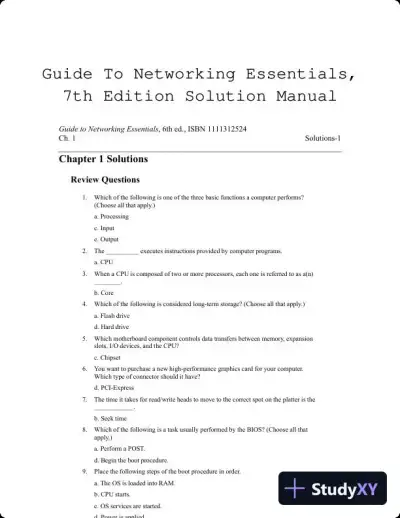 Textbook Guides
Guide To Networking Essentials, 7th Edition Solution Manual
Information Technology
48 pages139downloadsFeb 2025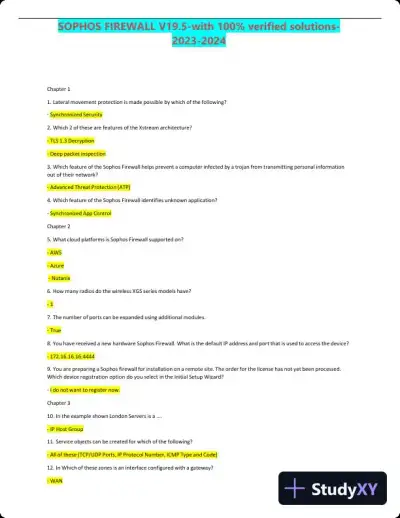 Past Exams
2023-2024 SOPHOS FIREWALL V19.5 Practice Exam with Answers (75 Solved Questions)
Information Technology
7 pages134downloadsFeb 2025 Class Notes
Lecture Notes for CCNP Enterprise: Core Networking (ENCOR) v8 Lab Manual, 2nd Edition
Information Technology
1089 pages123downloadsFeb 2025 Class Notes
Lecture Notes for Adobe XD Classroom in a Book (2020 release)
Information Technology
66 pages118downloadsFeb 2025
Study this document with CramX
Once it is in your library, every tool can work from it.