

LSAT Prep For Dummies (+5 Practice Tests Online) (2024)
- Law School Admission Test
- 352 pages
- Shared May 2025
Simulate a real testing experience with LSAT Prep For Dummies (+5 Practice Tests Online) (2024), a comprehensive practice exam.
Preview 16 of 352 pages
See the first 16 pages exactly as they appear in the document.
Page 1 Page 2 Page 3 Read page 3 as text
LSAT® Prep For Dummies® To view this book's Cheat Sheet, simply go to www.dummies.com and search for “LSAT Prep For Dummies Cheat Sheet” in the Search box. Table of Contents Cover Title Page Copyright Introduction About This Book Foolish Assumptions Icons Used in This Book Beyond the Book Where to Go from Here Part 1: Getting Started with the LSAT Chapter 1: The L Team: The LSAT and Its Administrators Getting to Know the Enemy Taking a Quick Look at the Types of Questions You Gotta Score! Scoring the LSAT Registering for the LSAT Preparing for the LSAT What Have You Done for Me Lately? The LSAC Chapter 2: Test-Taking Basics: Setting Yourself Up for Success Planning Your LSAT Test-Taking Tactics To Guess or Not to Guess Readying Yourself for Battle Life after the LSAT: What to Do Now? Chapter 3: The Lowdown on Law School Admissions Choosing a Law School Filling Out All the Forms — Applying to Law School Part 2: Logical Reasoning: Picking Apart an Argument Chapter 4: Analyzing Arguments: The Basics of Logical Reasoning What You Can Expect in the Logical Reasoning Sections Taking a Systematic Approach
Page 4 Read page 4 as text
Making a Case: Essentials of Informal Logic Chapter 5: Conclusions, Inferences, Assumptions, and Flaws in Logical Reasoning Questions Jumping to Logical Conclusions Using Your Noggin to Make Inferences Making Assumptions Finding Flaws in an Argument Chapter 6: Strengthening and Weakening Arguments Understanding How These Questions Work Build It Up: Strengthen/Support Questions Tear It Down: Weakening Questions A Twist: EXCEPT Questions Chapter 7: Examining Other Logical Reasoning Question Types Reconciling Discrepancies and Paradoxes Finding Points of Agreement and Disagreement Reasoning by Pattern Exploring Arguments Based on Principles Figuring Out an Argument’s Structure Knowing the Role Played by a Claim Part 3: Reading Comprehension: Read ’Em but Don’t Weep Chapter 8: Rites of Passage(s): Types of Reading Passages and Questions Presenting Reading Passages Approaching Reading Questions Chapter 9: Safe Landing: Mastering the Approach to Reading Comprehension Reading Comprehension Strategy Pacing Yourself through the Passages Starting with the Questions Giving Sample Passage 1 a Shot: Influenza Vaccination Conquering Sample Passage 2: Manifest Destiny Part 4: The Writing Sample: Penning a Persuasive Argument Chapter 10: Pick a Side, Any Side: Responding to the Writing Sample Prompt Picking a Side — No Ridin’ the Fence Walking through a Practice Essay Chapter 11: Practice Writing Samples Topic 1: Choosing a Law School Topic 2: The Sporting Goods Store Part 5: The Real Deal: Full-Length Practice LSATs
Page 5 Read page 5 as text
Chapter 12: Some Rainy-Day “Fun”: LSAT Practice Exam 1 Answer Sheet for Practice Exam 1 Section I: Logical Reasoning Section II: Reading Comprehension Section III: Logical Reasoning Writing Sample Chapter 13: Practice Exam 1: Answers and Explanations Section I: Logical Reasoning Section II: Reading Comprehension Section III: Logical Reasoning Answer Key for Practice Exam 1 Computing Your Score Chapter 14: Perfecting with Practice: LSAT Practice Exam 2 Answer Sheet for Practice Exam 2 Section I: Logical Reasoning Section II: Reading Comprehension Section III: Logical Reasoning Writing Sample Chapter 15: Practice Exam 2: Answers and Explanations Section I: Logical Reasoning Section II: Reading Comprehension Section III: Logical Reasoning Answer Key for Practice Exam 2 Chapter 16: Even More “Fun”: LSAT Practice Exam 3 Answer Sheet for Practice Exam 3 Section I: Logical Reasoning Section II: Reading Comprehension Section III: Logical Reasoning Writing Sample Chapter 17: Practice Exam 3: Answers and Explanations Section I: Logical Reasoning Section II: Reading Comprehension Section III: Logical Reasoning Answer Key for Practice Exam 3 Part 6: The Part of Tens Chapter 18: Ten Myths about the LSAT The LSAT Doesn’t Have Anything to Do with Law School You Can’t Study for the LSAT You Must Take a Prep Course to Do Well on the LSAT
Page 6 Read page 6 as text
You Can Spot Difficult Questions Before You Work Them B Is the Best Letter to Guess No One Reads the Writing Sample Finishing a Section Is Better Than Concentrating on Two-Thirds of It A Great LSAT Score Guarantees Admission to a Great Law School The LSAT Is Used Only for Admissions Purposes Your Score Won’t Improve if You Retake the LSAT Chapter 19: Ten Kinds of Law You Can Practice Business/Corporate Criminal Domestic Relations/Family Law Employment/Labor Intellectual Property International Personal Injury/Insurance Defense Real Estate Tax Trusts and Estates/Probate Index About the Authors Connect with Dummies End User License Agreement
Page 7 Page 8 Page 9 Read page 9 as text
LSAT® Prep For Dummies® with Online Practice, 4th Edition Published by: John Wiley & Sons, Inc., 111 River Street, Hoboken, NJ 07030-5774, www.wiley.com Copyright © 2024 by John Wiley & Sons, Inc., Hoboken, New Jersey Published simultaneously in Canada No part of this publication may be reproduced, stored in a retrieval system or transmitted in any form or by any means, electronic, mechanical, photocopying, recording, scanning or otherwise, except as permitted under Sections 107 or 108 of the 1976 United States Copyright Act, without the prior written permission of the Publisher. Requests to the Publisher for permission should be addressed to the Permissions Department, John Wiley & Sons, Inc., 111 River Street, Hoboken, NJ 07030, (201) 748-6011, fax (201) 748-6008, or online at http://www.wiley.com/go/permissions . Trademarks: Wiley, For Dummies, the Dummies Man logo, Dummies.com , Making Everything Easier, and related trade dress are trademarks or registered trademarks of John Wiley & Sons, Inc., and may not be used without written permission. LSAT and LSAC Law Hub are registered trademarks of the Law School Admission Council (LSAC) ™ . The LSAC does not endorse and is not affiliated with the owner or content of LSAT® Prep For Dummies®, with Online Practice . All other trademarks are the property of their respective owners. John Wiley & Sons, Inc., is not associated with any product or vendor mentioned in this book. LIMIT OF LIABILITY/DISCLAIMER OF WARRANTY: WHILE THE PUBLISHER AND AUTHOR HAVE USED THEIR BEST EFFORTS IN PREPARING THIS BOOK, THEY MAKE NO REPRESENTATIONS OR WARRANTIES WITH RESPECT TO THE ACCURACY OR COMPLETENESS OF THE CONTENTS OF THIS BOOK AND SPECIFICALLY DISCLAIM ANY IMPLIED WARRANTIES OF MERCHANTABILITY OR FITNESS FOR A PARTICULAR PURPOSE. NO WARRANTY MAY BE CREATED OR EXTENDED BY SALES REPRESENTATIVES OR WRITTEN SALES MATERIALS. THE ADVICE AND STRATEGIES CONTAINED HEREIN MAY NOT BE SUITABLE FOR YOUR SITUATION. YOU SHOULD CONSULT WITH A PROFESSIONAL WHERE APPROPRIATE. NEITHER THE PUBLISHER NOR THE AUTHOR SHALL BE LIABLE FOR DAMAGES ARISING HEREFROM. For general information on our other products and services, please contact our Customer Care Department within the U.S. at 877-762-2974, outside the U.S. at 317-572-3993, or fax 317-572-4002. For technical support, please visit https://hub.wiley.com/community/support/dummies . Wiley publishes in a variety of print and electronic formats and by print-on-demand. Some material included with standard print versions of this book may not be included in e-books or in print-on-demand. If this book refers to media such as a CD or DVD that is not included in the version you purchased, you may download this material at http://booksupport.wiley.com . For more information about Wiley products, visit www.wiley.com . Library of Congress Control Number: 2024936648 ISBN 978-1-394-26231-1 (pbk); ISBN 978-1-394-26233-5 (ebk); ISBN 978-1-394- 26232-8 (ebk)
Page 10 Read page 10 as text
Introduction Welcome to LSAT Prep For Dummies, 4th Edition! This book contains updates to the content of the Law School Admission Test (LSAT). After the June 2024 test, the LSAT eliminated the infamous “logic games.” This edition reflects the change. Yes, the LSAT is no walk in the park, but it’s not the hardest test in the universe. It doesn’t require you to brush off your math and science texts from high school, and it doesn’t expect you to remember anything from your history classes. It really just expects you to be able to read and analyze. If you can read carefully and quickly and then apply what you’ve read, you already have the skills you need to succeed on the LSAT. This book helps you refine those skills and apply them to the particular tasks on the LSAT. If you go through this book and work through a healthy number of practice questions, you should have a good idea of what awaits you on test day. About This Book First, allow us to tell you what this book can do: This book introduces you to the LSAT and helps you get a handle on how to take it. It describes the two types of multiple-choice sections — logical reasoning and reading comprehension — and provides guidance on how to handle them, with plenty of practice questions and explanations. It also touches on the writing sample, which is unscored but still merits a bit of attention. The first three chapters discuss some basics of law school admissions, test-taking strategy, and other logistical entertainment. On to what the book can’t do: This book doesn’t give you a bunch of tricks to help you “crack” the LSAT. The LSAT isn’t a nut; it’s a test, and to do well on it you have to apply your natural intelligence and experience. We give you plenty of advice on how to approach each question type to maximize your talents and train your mind to think in the most effective way. Included in this book are three full-length practice tests, which you can use to try out the tips and techniques we provide throughout the chapters. The difficulty levels and thought patterns on the practice tests are similar to those on real LSATs. Actual LSAT test-prep instructors and LSAT-takers assisted us by massaging and tweaking the questions to make sure that they’re equivalent to the real LSAT questions. You can get real and valuable practice by using the questions in this book. But the fact is, no one makes real LSAT questions but the real Law School Admission Council (LSAC). If you want real LSAT questions, get yourself some LSAT PrepTests, which are real LSATs administered in previous years. That’s the most authentic practice you can find, and we highly recommend it. Creating an account on the LSAC website ( www.lsac.org ) gives you access to LawHub, which, in addition to providing valuable information about applying to and preparing for law school, contains four official LSAT PrepTests for practice. For an additional yearly fee of just over $100, you can upgrade to LawHub Advantage, which gives you unlimited access to more than 75 PrepTests and enhanced law school prep features. The official PrepTests come with answers but (in most cases) not explanations, so they’re great practice, but to figure out why your answers are right or wrong, you should work through this book first to get a sense of how the questions work.
Page 11 Read page 11 as text
Because this book is a test-prep, you probably want to read most everything here. Besides, we worked really hard on this book! However, if you’re pressed for time or just have a short attention span, you can skip the sidebars and any text marked with a Technical Stuff icon without missing out on too much. We italicize new LSAT-related terms that you’re likely unfamiliar with when we use them the first time. Foolish Assumptions We make a few assumptions about you, the reader (we hope you don’t mind): Call us crazy, but we’re guessing you’ve signed up to take the LSAT or you’re at least seriously considering taking the LSAT. We know, of course, that you’re not a dummy. You’ve likely received or are in the process of receiving an undergraduate degree and are no stranger to thinking analytically. You simply need guidance regarding how to apply your already sharp skills to the unfamiliar question types on the LSAT. Our third and final assumption is that you’ve chosen this book for one of several reasons — the fabulous For Dummies reputation for providing information in an easily accessible format, the price, or the attention-grabbing yellow-and-black cover — but mainly because you think you want to go to law school, and the LSAT is the primary way to that destination. Icons Used in This Book This book, like all For Dummies books, uses icons to help you spot important tidbits of information and break up the monotony of otherwise plain and ordinary pages. Here are the icons you’ll encounter in this book: This icon marks useful bits of information that may come in handy when you study for or take the LSAT. This icon reminds you of valuable strategies to keep in mind as you work through the test content. This icon marks stuff to avoid, potential mistakes, and traps for the unwary.
Page 12 Read page 12 as text
This icon identifies practice questions that demonstrate how to apply specific techniques. This icon highlights extra tidbits of info that enhance your reading but aren’t essential to preparing for the LSAT. Beyond the Book By now we’re hoping that you’re impressed with the wealth of content contained in this book. But to quote your favorite infomercials: Wait! There’s more! In addition to what you’re reading right now, this book comes with a free access-anywhere Cheat Sheet that includes tips to help you prepare for the LSAT. To get this Cheat Sheet, simply go to www.dummies.com and type “LSAT For Dummies Cheat Sheet” in the Search box. You also get access to five full-length online practice tests and approximately 500 flashcards. To gain access to the online practice, all you have to do is register. Just follow these simple steps: 1. Register your book or ebook at Dummies.com to get your PIN. Go to www.dummies.com/go/getaccess . 2. Select your product from the dropdown list on that page. 3. Follow the prompts to validate your product, and then check your email for a confirmation message that includes your PIN and instructions for logging in. If you don’t receive this email within two hours, please check your spam folder before contacting us through our Technical Support website at http://support.wiley.com or by phone at 877-762-2974. Now you’re ready to go! You can come back to the practice material as often as you want — simply log on with the username and password you created during your initial login. No need to enter the access code a second time. Your registration is good for one year from the day you activate your PIN. Where to Go from Here If you bought this book, you must have some plan — definite or tentative — to take the LSAT. But just buying the book alone won’t help you much. To get the full benefit, you have to open it up, read it, and work the problems. There are two approaches you can take:
Page 13 Read page 13 as text
Read all the explanatory materials, work your way through all the practice problems, and then take the practice tests at the end and see how you did. Take one of the full-length tests to see how well you do. Score your test. Then study the sections that give you the most trouble, concentrating on the questions you find difficult. It’s up to you. You’re the one taking the test, and you’re the one who has to decide what you need to study and how much time you want to allocate to the process.
Page 14 Read page 14 as text
Part 1 Getting Started with the LSAT
Page 15 Read page 15 as text
IN THIS PART … Gain insight into the minds that create the LSAT. Discover tips for managing the LSAT and each of its question types. Be prepared for exam day by knowing exactly what and what not to bring to the testing site. Discover other important considerations for getting into your top-choice law school.
Page 16 Read page 16 as text
Chapter 1 The L Team: The LSAT and Its Administrators IN THIS CHAPTER Exploring the sections of the LSAT Understanding the LSAT scoring system Knowing how and when to register for the LSAT Studying for the LSAT Meeting the LSAC If you want to go to law school, you’ll likely take the Law School Admission Test, also known as the LSAT. Most of the more than 200 law schools that belong to the Law School Admission Council (LSAC) require the LSAT (see the later section “What Have You Done for Me Lately? The LSAC” for info about the LSAC). Some schools may allow you to substitute a GRE score for the LSAT. Testing requirements for law school have relaxed somewhat since 2020, but some law schools that don’t require either the LSAT or GRE for admission may not be approved by the American Bar Association (ABA), which in turn may not qualify you for admission to a state bar, so research throroughly a school that doesn’t require or highly recommend the LSAT. The LSAT, annoying though it can be, provides a significant metric for law schools to evaluate their applicants on the same playing field. Colleges are different, backgrounds are different, and cultures are different, but the LSAT is the same for everyone. The LSAT is carefully designed so that the testing experience of test-takers is virtually identical. Each LSAT test is crafted so that test-takers have a 90 percent chance of scoring the same on a different version. So, law schools feel confident that the LSAT is an objective measure of student ability. Grade point averages, unlike the LSAT, are highly subjective; they vary depending on the difficulty of a school, the difficulty of particular courses, and other random and unpredictable factors (like the grading policies of individual professors). Law school applications include other information like personal statements that can give schools an idea of a student’s abilities, but the schools still can’t know for sure that they’re getting the real goods — plenty of students get help writing those essays. That leaves the LSAT as one of the most reliable and objective means to compare candidates. In this chapter, you get an introduction to the LSAT and its various parts and learn all about registering and preparing for the big day. You also get a peek at the organization behind all this madness, the LSAC. If you’re going to be a lawyer, you have to get used to disclaimers, and here’s ours for this chapter. The technical information we offer about fees and procedures
336 more pages in the full document
Unlock it once and it stays in your library, ready to chat with or turn into flashcards.
Unlock the full documentMore Law School Admission Test study materials
See all Certification Guides
LSAT logic Games workbook (2020)
Law School Admission Test
391 pages124downloadsFeb 2025 Certification Guides
Powerscore: LSAT reading Comprehension (2020)
Law School Admission Test
740 pages102downloadsFeb 2025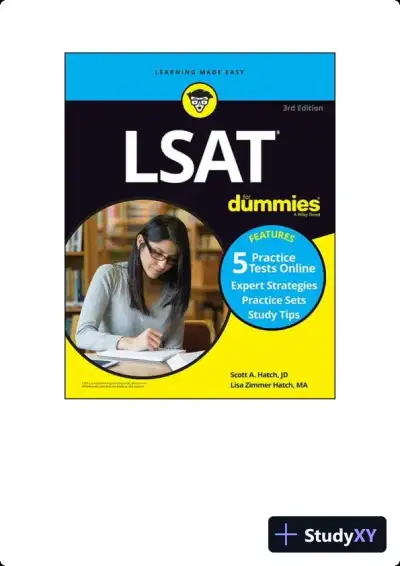 Certification Guides
LSAT for Dummies (2021)
Law School Admission Test
471 pages69downloadsFeb 2025 Certification Guides
LSAT PrepTest 1 - 89 (2021)
Law School Admission Test
50 pages66downloadsFeb 2025 Certification Guides
The Official LSAT PrepTest 90: (June 2020 LSAT) (2020)
Law School Admission Test
40 pages50downloadsFeb 2025 Certification Guides
LSAT Logic Games Prep 2022: Real Preptest Questions + Proven Strategies + Online (2021)
Law School Admission Test
518 pagesMay 2025 Certification Guides
LSAT PrepTest 84 Unlocked: Exclusive Data + Analysis + Explanations (2019)
Law School Admission Test
157 pagesMay 2025 Certification Guides
LSAT Logic Games (Manhattan Prep LSAT Strategy Guides) (2020)
Law School Admission Test
939 pagesMay 2025
Study this document with CramX
Once it is in your library, every tool can work from it.