

Principles of Management - Control The Linking Function
- Management
- Texas A&M University
- 9 pages
- Shared March 2026
Preview 3 of 9 pages
See the first 3 pages exactly as they appear in the document.
Page 1 Read page 1 as text
Study Guide Principles of Management – Control: The Linking Function 1. Effective Organizational Control Systems Every organization needs a control system to make sure its goals are met and resources are used efficiently. A good control system helps managers monitor performance, prevent problems, and keep operations on track . Effective control systems share several key characteristics: 1. 1 Focus on Critical Points Controls should target areas where failure is not an option or where costs cannot exceed certain limits . These are the parts of the organization that directly affect the success of core operations. 1. 2 Integration into Established Processes Controls should work smoothly within existing workflows . They should support operations , not create bottlenecks or slow down processes. 1. 3 Acceptance by Employees Employees are more likely to follow controls when they are involved in designing them. Participation increases buy - in and reduces resistance. 1. 4 Availability of Information When Needed A good control system provides timely and relevant information . This includes: • Deadlines • Time required to complete tasks • Project costs • Priority needs By tracking these, managers can identify problems quickly and make adjustments before issues escalate.
Page 2 Read page 2 as text
Study Guide 1.5 Economic Feasibility Controls must be cost - effective . Managers should ask: • “How much does it cost?” • “What will it save?” • “What is the return on investment?” A control system is effective only if its benefits outweigh its costs . 1. 6 Accuracy Controls must provide reliable, valid, and consistent information . Decisions are only as good as the data behind them. 1. 7 Comprehensibility Controls should be simple and easy to understand . Overly complex systems can confuse employees and reduce effectiveness. 2. Organizational Control Techniques Control techniques give managers the information they need to measure and monitor performance . Different types of controls are used depending on the management level, department, or operation . To get consistent and complete information, organizations often use standardized reports , like financial statements, status updates, or project reports. Each department also has its own specific control techniques. 2.1 Financial Controls Once an organization has a strategy, it allocates funds for resources and labor . Managers track how money is spent using financial statements , which help monitor progress: • Income statement: Shows revenues, expenses, and profit or loss over a period of time. • Balance sheet: Shows the organization’s assets, liabilities, and owner’s equity at a specific point in time.
Page 3 Read page 3 as text
Study Guide Financial audits are formal checks to ensure that practices follow laws, policies, and ethical guidelines. These can be internal or external . Financial ratio analysis helps managers understand numbers in the statements: • Liquidity ratios: Can the organization generate cash quickly? • Profitability ratios: How well does the organization make profits? • Debt ratios: Can the organization pay its debts? • Activity ratios: How efficiently are assets and operations being used? Managers of financial responsibility centers must account for how their unit is performing in terms of profits, costs, revenues, or investments. 2.2 Budget Controls A budget shows how much an organization plans to spend and earn over a period of time. It is both a planning tool and a control mechanism . Budgeting methods include: • Top - down budgeting: Managers prepare the budget and give it to subordinates. • Bottom - up budgeting: Lower - level employees submit figures, which are then coordinated and adjusted. • Zero - based budgeting: Every expense must be justified based on its contribution to goals. • Flexible budgeting: Allows for adjustable standards that can be compared to actual spending. 2.3 Marketing Controls Marketing controls track progress toward customer satisfaction, product/service performance, pricing, and delivery . Common techniques include: • Market research: Gathers data on customer needs and competitor activity. • Test marketing: Small - scale trials to see if customers will accept a product. • Marketing statistics: Use ratios, quotas, and data analysis to measure sales, profitability, and market share. Regular evaluations of marketing programs are often skipped, but frequent checks help prevent problems before they become crises.
6 more pages in the full document
Unlock it once and it stays in your library, ready to chat with or turn into flashcards.
Unlock the full documentMore Management study materials
See all Quick Guides
Principles of Management - Management in a Global Environment
Management
14 pagesMar 2026 Quick Guides
Principles of Management - Managing Change
Management
16 pagesMar 2026 Quick Guides
Principles of Management - The Nature of Management
Management
10 pagesMar 2026 Quick Guides
Principles of Management - Communication and Interpersonal Skills
Management
13 pagesMar 2026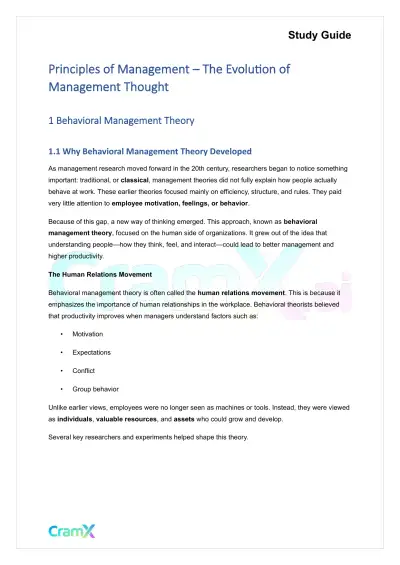 Quick Guides
Principles of Management - The Evolution of Management Thought
Management
21 pagesMar 2026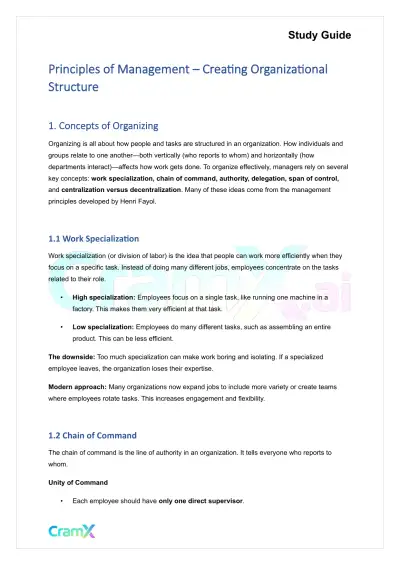 Quick Guides
Principles of Management - Creating Organizational Structure
Management
9 pagesMar 2026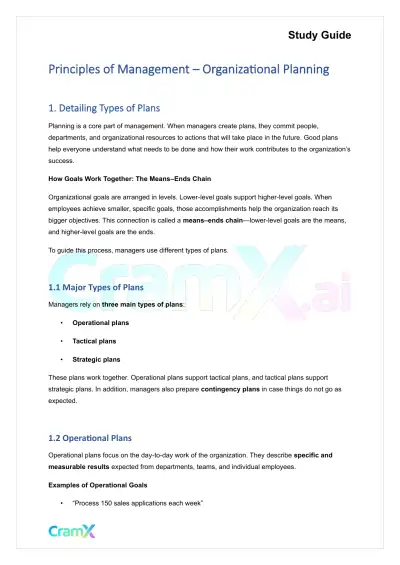 Quick Guides
Principles of Management - Organizational Planning
Management
10 pagesMar 2026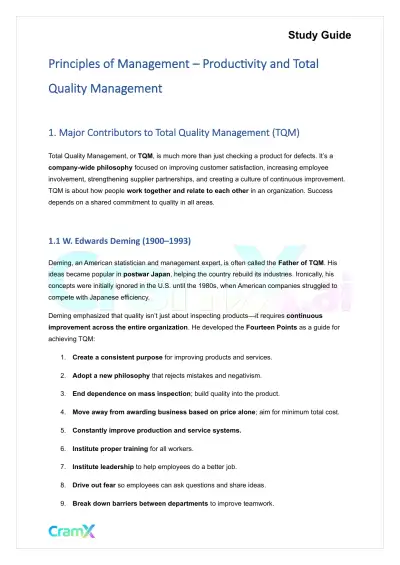 Quick Guides
Principles of Management - Productivity and Total Quality Management
Management
9 pagesMar 2026
Study this document with CramX
Once it is in your library, every tool can work from it.