

Principles of Management - Creating Organizational Structure
- Management
- Texas A&M University
- 9 pages
- Shared March 2026
Preview 3 of 9 pages
See the first 3 pages exactly as they appear in the document.
Page 1 Read page 1 as text
Study Guide Principles of Management – Creating Organizational Structure 1. Concepts of Organizing Organizing is all about how people and tasks are structured in an organization. How individuals and groups relate to one another — both vertically (who reports to whom) and horizontally (how departments interact) — affects how work gets done. To organize effec tively, managers rely on several key concepts: work specialization, chain of command, authority, delegation, span of control, and centralization versus decentralization . Many of these ideas come from the management principles developed by Henri Fayol. 1.1 Work Specialization Work specialization (or division of labor) is the idea that people can work more efficiently when they focus on a specific task. Instead of doing many different jobs, employees concentrate on the tasks related to their role. • High specialization: Employees focus on a single task, like running one machine in a factory. This makes them very efficient at that task. • Low specialization: Employees do many different tasks, such as assembling an entire product. This can be less efficient. The downside: Too much specialization can make work boring and isolating. If a specialized employee leaves, the organization loses their expertise. Modern approach: Many organizations now expand jobs to include more variety or create teams where employees rotate tasks. This increases engagement and flexibility. 1.2 Chain of Command The chain of command is the line of authority in an organization. It tells everyone who reports to whom. Unity of Command • Each employee should have only one direct supervisor .
Page 2 Read page 2 as text
Study Guide • Reporting to multiple bosses can cause confusion and conflicting instructions. Exceptions: Sometimes, employees report to more than one person, such as in project teams or when coordinating special initiatives. These are special cases, not the norm. Scalar Principle • This principle defines a clear, unbroken line of authority from the top manager down to all employees. • Larger organizations tend to have taller structures (more management levels), which can slow decision - making and increase costs. 1.3 Authority Authority is the formal right to make decisions, give orders, and allocate resources to achieve organizational goals. Key principles of authority: 1. Based on position — people in the same position have the same authority. 2. Accepted by subordinates — they comply because the authority is legitimate. 3. Flows down the hierarchy — higher positions have more authority than lower ones. Types of Authority 1. Line Authority: Directs employees and makes decisions related to core activities. 2. Staff Authority: Advises and supports line managers but cannot issue orders that must be followed. 3. Functional Authority: Allows certain individuals to direct activities in other departments within a limited scope. Why functional authority exists: It helps coordinate specialized skills. For example, separating planning from doing ensures experts focus on planning while workers focus on execution. 1.4 Delegation Delegation is when managers transfer authority to subordinates, letting them make decisions and take actions within their responsibilities. Benefits of delegation:
Page 3 Read page 3 as text
Study Guide • Empowers employees • Improves job satisfaction • Increases overall productivity Steps for effective delegation: 1. Assign tasks clearly to specific employees. 2. Give enough authority to accomplish the tasks. 3. Ensure employees accept responsibility for their tasks. 4. Establish accountability — employees should answer for outcomes. Challenges managers face: • Time to explain tasks initially • Lack of confidence in subordinates • Dual accountability (for their work and their team’s) • Insecurity about their own value Tips for successful delegation: • Match tasks to capable and willing employees. • Communicate instructions clearly. • Transfer authority and accountability together. • Decide the level of control to maintain based on task importance and employee skill. 1.5 Span of Control Span of control refers to how many employees report to one manager. • Wide span: Manager supervises many employees. Works well if employees are skilled, tasks are standard, and few new problems arise. • Narrow span: Manager supervises few employees. Needed when workers are spread out, tasks are complex, frequent guidance is required, or problems arise often. Span of control can differ between departments based on needs.
6 more pages in the full document
Unlock it once and it stays in your library, ready to chat with or turn into flashcards.
Unlock the full documentMore Management study materials
See all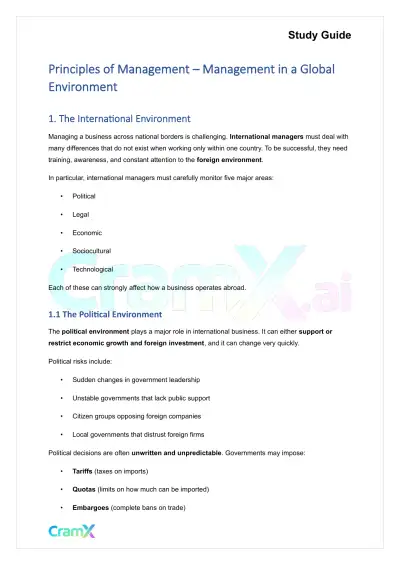 Quick Guides
Principles of Management - Management in a Global Environment
Management
14 pagesMar 2026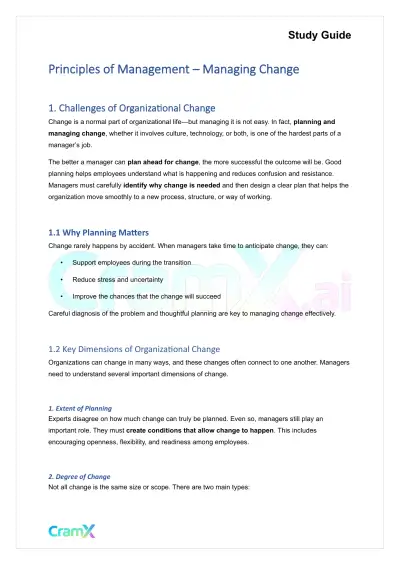 Quick Guides
Principles of Management - Managing Change
Management
16 pagesMar 2026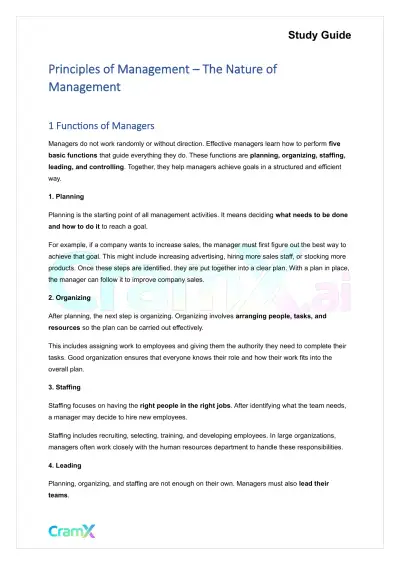 Quick Guides
Principles of Management - The Nature of Management
Management
10 pagesMar 2026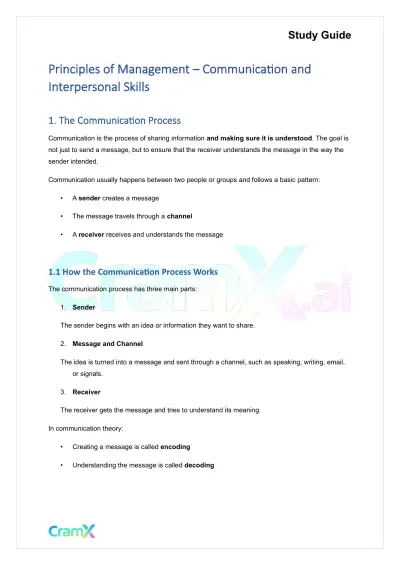 Quick Guides
Principles of Management - Communication and Interpersonal Skills
Management
13 pagesMar 2026 Quick Guides
Principles of Management - The Evolution of Management Thought
Management
21 pagesMar 2026 Quick Guides
Principles of Management - Organizational Planning
Management
10 pagesMar 2026 Quick Guides
Principles of Management - Productivity and Total Quality Management
Management
9 pagesMar 2026 Quick Guides
Principles of Management - Understanding Teams
Management
12 pagesMar 2026
Study this document with CramX
Once it is in your library, every tool can work from it.