

Principles of Management - Decision Making and Problem Solving
- Management
- Texas A&M University
- 10 pages
- Shared March 2026
Preview 3 of 10 pages
See the first 3 pages exactly as they appear in the document.
Page 1 Read page 1 as text
Study Guide Principles of Management – Decision Making and Problem Solving 1. Conditions That Influence Decision Making Managers make decisions every day, but not all decisions are made under the same conditions. In management, decision making usually happens under three main conditions : certainty, risk, and uncertainty . While all managers experience each condition at times, risk and uncertainty are more common when dealing with complex problems — especially at higher management levels. 1.1 Decision Making Under Certainty Decision making under certainty happens when a manager has complete and accurate information . All the facts are known, and the outcomes of each option are clear. This is the ideal situation for problem solving. The manager’s main task is to: • Review the available alternatives • Choose the best possible solution Programmed Decisions When problems occur repeatedly , managers often rely on programmed decisions . These are standard, preplanned responses based on past experience. Example: Automatically reordering inventory when stock drops below a certain level. Today, many programmed decisions are supported — or even handled entirely — by computers and decision - support software , making the process faster and more consistent. Structured Problems Problems handled under certainty are usually structured problems . These problems are: • Familiar • Clearly defined • Easy to understand
Page 2 Read page 2 as text
Study Guide Managers can often anticipate these problems and prepare solutions in advance. Common examples include: • Pay raises • Promotions • Vacation requests • Committee assignments Proactive managers create systems to handle these issues efficiently before they arise. 1.2 Decision Making Under Risk In a risk environment , managers do not have complete information. They understand the problem and possible solutions, but they cannot be sure which option will work best. Risk is a common condition in management, especially when dealing with new or changing situations. Nonprogrammed Decisions New or unusual problems require nonprogrammed decisions . These decisions are: • Custom - made for the specific situation • Based on detailed analysis and judgment • Less routine and more complex Although computers can help process information, human judgment plays a key role. Most decisions made by top - level managers fall into this category. That’s why conceptual skills — the ability to think broadly and strategically — become more important at higher management levels. Crisis Problems A crisis problem is a sudden and unexpected issue that can cause serious harm if not handled quickly and correctly. Well - known examples include: • The Chernobyl nuclear plant explosion • The Exxon Valdez oil spill
Page 3 Read page 3 as text
Study Guide Since no organization is immune to crises, many modern managers now expect crises to occur . As a result, they: • Develop crisis management plans • Install early - warning information systems • Train employees to respond effectively Being prepared can significantly reduce damage when a crisis strikes. 1.3 Decision Making Under Uncertainty Decision making under uncertainty is the most difficult condition. Here, managers: • Lack sufficient information • Cannot even estimate the probability of outcomes This situation is like entering unknown territory with no map. Creativity and Intuition Matter Because reliable data is unavailable, managers must rely heavily on: • Creativity • Intuition • Educated guesses • Experience - based judgment These decisions leave room for error , but they are often unavoidable in unpredictable situations. Groups are frequently used in uncertain situations because collective thinking can generate more innovative ideas and reduce blind spots. Unstructured Problems Uncertainty usually involves unstructured problems , which are: • Ambiguous • Unexpected • Lacking clear information
7 more pages in the full document
Unlock it once and it stays in your library, ready to chat with or turn into flashcards.
Unlock the full documentMore Management study materials
See all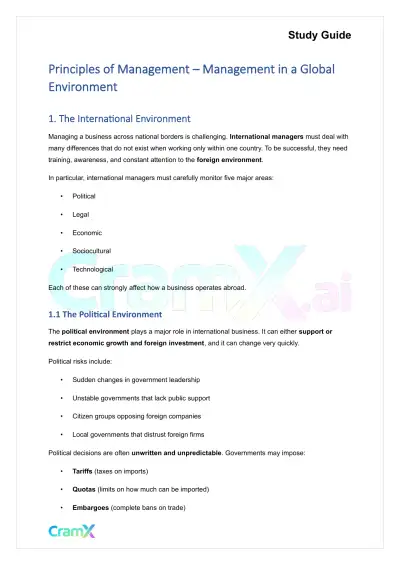 Quick Guides
Principles of Management - Management in a Global Environment
Management
14 pagesMar 2026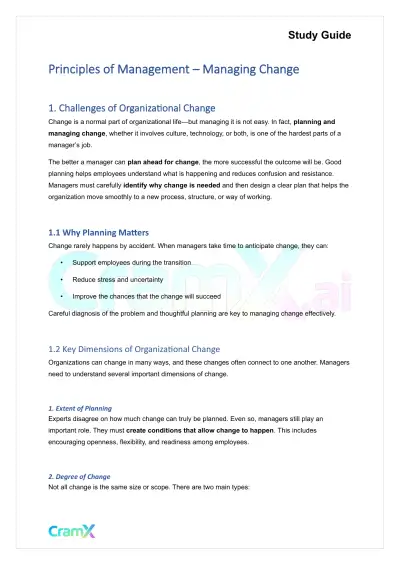 Quick Guides
Principles of Management - Managing Change
Management
16 pagesMar 2026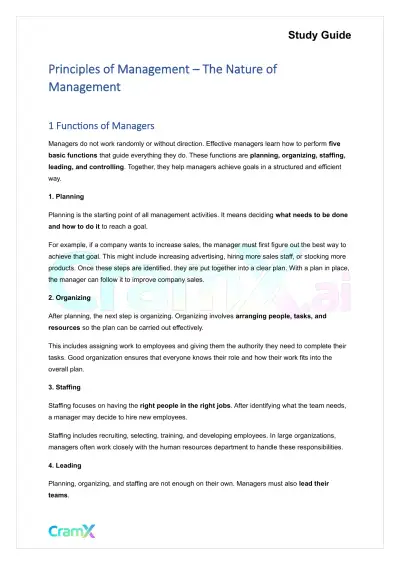 Quick Guides
Principles of Management - The Nature of Management
Management
10 pagesMar 2026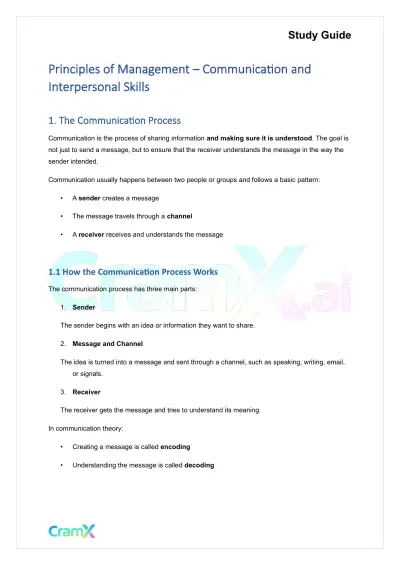 Quick Guides
Principles of Management - Communication and Interpersonal Skills
Management
13 pagesMar 2026 Quick Guides
Principles of Management - The Evolution of Management Thought
Management
21 pagesMar 2026 Quick Guides
Principles of Management - Creating Organizational Structure
Management
9 pagesMar 2026 Quick Guides
Principles of Management - Organizational Planning
Management
10 pagesMar 2026 Quick Guides
Principles of Management - Productivity and Total Quality Management
Management
9 pagesMar 2026
Study this document with CramX
Once it is in your library, every tool can work from it.