

Principles of Management - Leadership and Management
- Management
- Texas A&M University
- 13 pages
- Shared March 2026
Preview 4 of 13 pages
See the first 4 pages exactly as they appear in the document.
Page 1 Read page 1 as text
Study Guide Principles of Management – Leadership and Management 1. Challenges Facing Leaders Being a leader today is not easy. Organizations demand that leaders provide vision, guide change, and make tough decisions — all while keeping teams motivated and focused. To meet these challenges, leaders must be flexible, adaptable, and innovative . 1.1 Transformational Leadership Transformational leaders go beyond simply managing tasks — they inspire and motivate people to achieve more than they thought possible. • Unlike transactional leaders , who focus on guiding employees toward established goals through rules and rewards, transformational leaders are charismatic, visionary, and motivating . • They appeal to followers’ ideals and values and encourage new ways of thinking. Key ways transformational leaders influence their teams: 1. Vision – They unite people around a shared idea or goal. 2. Framing – They give meaning to their initiatives and explain why they matter. 3. Impression Management – They create a positive image that inspires confidence and trust. Transformational leaders: • Build confidence and commitment • Coach and delegate authority • Encourage intellectual growth and problem - solving • Use rewards to reinforce performance • Step in only when problems arise Why it matters: Research shows transformational leadership is linked to lower turnover, higher productivity, and greater employee satisfaction . These leaders are essential for organizations that want to innovate and stay competitive.
Page 2 Read page 2 as text
Study Guide 1.2 Change Leadership In today’s fast - paced business world, organizations must adapt quickly to survive . Leaders play a key role in helping employees move from resistance to acceptance of change . The change process often follows five emotional stages: 1. Denial 2. Anger 3. Bargaining 4. Depression 5. Acceptance Common employee reactions: • Fear that change will make their jobs harder • Concern about losing control over their work • Comfort in performing tasks the same way How leaders can help: • Shift questions from negative to positive: o “Why?” → “What new opportunities will this change provide?” o “How will this affect me?” → “What problems will this solve?” o “We don’t do it this way” → “What will be the result if we try it this new way?” o “When will this be over?” → “What can I do to help?” • Promote a positive attitude — feelings are contagious • Give employees authority and responsibility to participate in the change • Make employees feel valued and essential to the process
Page 3 Read page 3 as text
Study Guide 1.3 Leading in a Learning Organization A learning organization encourages employees to continuously identify problems, experiment, and improve . This environment helps organizations grow, adapt, and achieve their goals. Key traits of learning organizations: • Employees actively seek and solve problems • Information is shared freely , building a knowledgeable workforce • Teams are flexible and open to new ideas • Shared vision guides decisions and actions Leadership in learning organizations: • Focuses on “control with” employees rather than “control over” them • Builds relationships based on trust and shared vision • Facilitates teamwork and empowers employees to shape the organization’s future Peter Senge’s five essential ingredients of a learning organization: 1. Mental Models – Challenge old ways of thinking 2. Personal Mastery – Develop self - awareness and openness to others 3. Systems Thinking – Understand how all parts of the organization work together 4. Shared Vision – Align everyone toward the same goals 5. Team Learning – Work together to achieve objectives
Page 4 Read page 4 as text
Study Guide 2 Leadership Defined Leadership means setting a direction and influencing others to follow it . In simple terms, a leader helps guide people toward a shared goal. Although this definition sounds straightforward, leadership can take many forms. What all leadership definitions have in common is this idea: leaders influence people to work together toward a common goal . Because of this, leadership is best understood as an influence process . 2.1 Leader vs. Leadership It is important to understand the difference between a leader and leadership . • A leader is a person. • Leadership is what that person does. In organizations, managers are often called leaders because they hold positions of authority. However, having a title does not automatically make someone a good leader . A manager may have authority but still fail to inspire or guide others effectively. 2.2 Leadership and Management: Are They the Same? Many professionals debate whether leadership and management are different. According to John Kotter of Harvard University , they are related but not the same. • Management focuses on handling complexity. It involves planning, organizing, staffing, and controlling. • Leadership focuses on dealing with change. It helps organizations adapt and move forward. Kotter explains that leadership is only one part of management . Good organizations need both strong management and strong leadership . He also believes that many organizations are overmanaged but underled . 2.3 Leadership Traits Early leadership theories tried to identify traits that make a person an effective leader. Traits are personal qualities or characteristics.
9 more pages in the full document
Unlock it once and it stays in your library, ready to chat with or turn into flashcards.
Unlock the full documentMore Management study materials
See all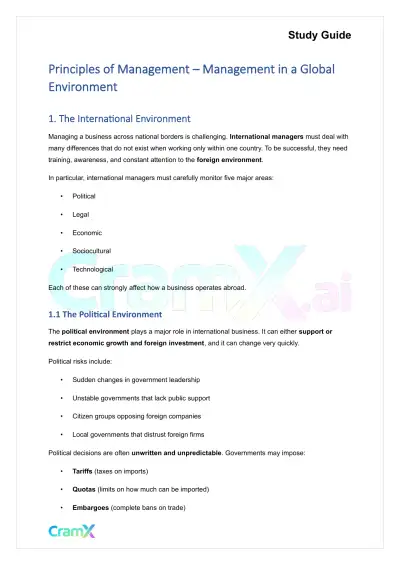 Quick Guides
Principles of Management - Management in a Global Environment
Management
14 pagesMar 2026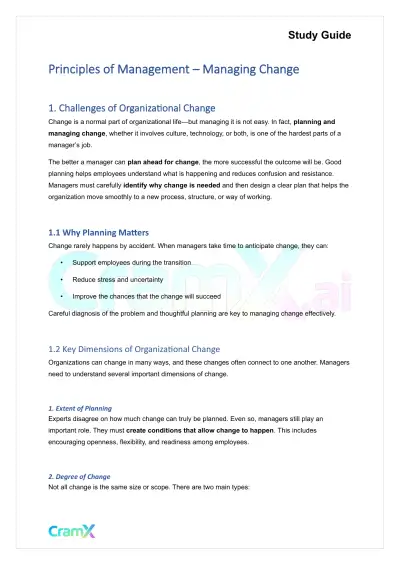 Quick Guides
Principles of Management - Managing Change
Management
16 pagesMar 2026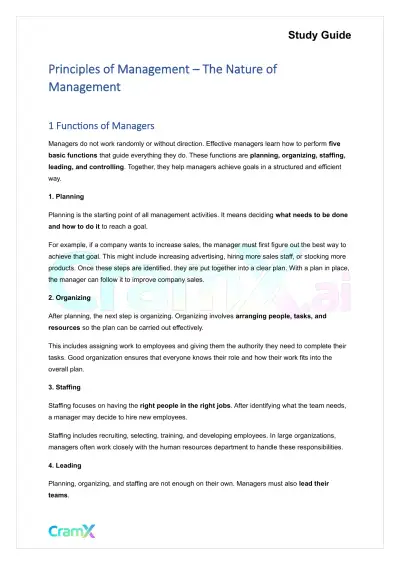 Quick Guides
Principles of Management - The Nature of Management
Management
10 pagesMar 2026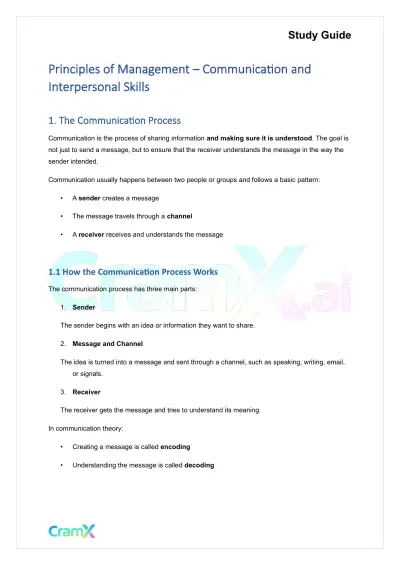 Quick Guides
Principles of Management - Communication and Interpersonal Skills
Management
13 pagesMar 2026 Quick Guides
Principles of Management - The Evolution of Management Thought
Management
21 pagesMar 2026 Quick Guides
Principles of Management - Creating Organizational Structure
Management
9 pagesMar 2026 Quick Guides
Principles of Management - Organizational Planning
Management
10 pagesMar 2026 Quick Guides
Principles of Management - Productivity and Total Quality Management
Management
9 pagesMar 2026
Study this document with CramX
Once it is in your library, every tool can work from it.