

Basic Math and Pre-Algebra - Measurements
- Mathematics
- Texas A&M University
- 55 pages
- Shared March 2026
Preview 10 of 55 pages
See the first 10 pages exactly as they appear in the document.
Page 1 Read page 1 as text
Study Guide Basic Math and Pre - Algebra – Measurements 1. Metric System 1.1 What Is the Metric System? The metric system is a system of measurement based on powers of ten . That means everything is built around multiples of 10 — which makes it simple and organized. To understand the metric system, you need to know what the prefixes mean. Prefixes are small words added to the beginning of a unit (like meter or gram) to show how big or small something is. 1.2 Metric Pre fi xes Here are the most common prefixes you need to know: • kilo = thousand (1,000) • hecto = hundred (100) • deka = ten (10) • deci = tenth (1/10) • centi = hundredth (1/100) • milli = thousandth (1/1,000) Notice the pattern: • Prefixes above the base unit mean larger amounts . • Prefixes below the base unit mean smaller amounts . Because everything is based on powers of ten, conversions are much easier than in other systems.
Page 2 Read page 2 as text
Study Guide 1.3 Applying Pre fi xes to Length The base unit for length is the meter (m) . Here’s how the prefixes change it: • 1 kilometer (km) = 1,000 meters • 1 hectometer (hm) = 100 meters • 1 dekameter (dkm) = 10 meters • 10 decimeters (dm) = 1 meter • 100 centimeters (cm) = 1 meter • 1,000 millimeters (mm) = 1 meter So moving between units is just multiplying or dividing by 10, 100, or 1,000. 1.4 Applying Pre fi xes to Volume The base unit for volume is the liter (L or l) . • 1,000 milliliters (mL or ml) = 1 liter • 1,000 liters = 1 kiloliter (kL or kl) Again, everything changes by powers of 10. 1.5 Applying Pre fi xes to Mass The base unit for mass is the gram (g) . • 1,000 milligrams (mg) = 1 gram • 1,000 grams = 1 kilogram (kg) • 1,000 kilograms = 1 metric ton (t) Just like length and volume, the pattern stays consistent.
Page 3 Read page 3 as text
Study Guide 1.6 Helpful Approxima Ɵ ons It can also help to compare metric units to familiar U.S. customary units: • A meter is a little more than a yard. • A kilometer is about 0.6 mile. • A kilogram is about 2.2 pounds. • A liter is slightly more than a quart. These comparisons help you estimate measurements in real life. 1.7 Why the Metric System Is Easy to Use The biggest advantage of the metric system is its simplicity: • Everything is based on powers of 10 • Conversions only require moving the decimal point • The same prefixes work for length, mass, and volume Once you learn the prefixes, you can measure almost anything! Summary The metric system is based on powers of ten, which makes conversions simple and consistent. Key prefixes: • kilo = 1,000 • hecto = 100 • deka = 10 • deci = 1/10 • centi = 1/100 • milli = 1/1,000
Page 4 Read page 4 as text
Study Guide Base units: • Length → meter • Volume → liter • Mass → gram Conversions always involve multiplying or dividing by 10, 100, or 1,000. Because the system follows a clear pattern, it is easier to learn and use than many other measurement systems. 2. Conver Ɵ ng Units of Measure Converting units means changing one type of measurement into another — like yards to inches or pounds to kilograms. There are two main ways to solve conversion problems: 1. Use what you already know (basic multiplication or division). 2. Set up a proportion and solve it. Example 1: Yards to Inches Question: If 36 inches equal 1 yard, how many inches are in 3 yards? Method 1: Think it through If 1 yard = 36 inches, then 3 yards = 3 × 36. So, 3 yards = 108 inches .
Page 5 Read page 5 as text
Study Guide Method 2: Use a Proportion Set up matching units across from each other: Cross multiply: So, x = 108 inches . ✔ Always place the same units across from each other (inches with inches, yards with yards). Example 2: Pounds to Kilograms Question: If 2.2 pounds equal 1 kilogram, how many kilograms are in 10 pounds? Step 1: Think about it Divide 10 by 2.2: So the answer should be about 4.5 kilograms . Step 2: Solve Using a Proportion Set up kilograms over pounds: Cross multiply:
Page 6 Read page 6 as text
Study Guide Divide: Rounded to the nearest tenth: Example 3: Decades to Weeks Question: How many weeks are in 3 decades? Step 1: Convert decades to years 1 decade = 10 years 3 decades = 30 years Step 2: Convert years to weeks 1 year = 52 weeks So, 3 decades = 1,560 weeks . One - Step Method You can also do it in one calculation: Example 4: Miles to Yards Question: If 1 mile equals 1,760 yards, how many yards are in 5 miles?
Page 7 Read page 7 as text
Study Guide Multiply: So, 5 miles = 8,800 yards . Example 5: Kilometers to Dekameters Question: If 1 kilometer equals 1,000 meters, and 1 dekameter equals 10 meters, how many dekameters are in 3 kilometers? Step 1: Convert kilometers to meters 1 km = 1,000 m 3 km = 3,000 m Step 2: Convert meters to dekameters 1 dekameter = 10 meters Set up the proportion: Cross multiply: Divide: So, 3 kilometers = 300 dekameters . 2.2 Reminders for Conversions • Keep matching units across from each other in proportions. • Multiply when converting to smaller units. • Divide when converting to larger units. • Check if your answer makes sense.
Page 8 Read page 8 as text
Study Guide For example: • More yards should mean more inches. • More miles should mean more yards. Summary Unit conversions help us change measurements from one unit to another. To solve: • Use multiplication or division when possible. • Or set up a proportion and cross multiply. Examples covered: • 3 yards = 108 inches • 10 pounds ≈ 4.5 kilograms • 3 decades = 1,560 weeks • 5 miles = 8,800 yards • 3 kilometers = 300 dekameters The most important rule: Keep units organized and match them correctly. With practice, unit conversions become much easier and faster to solve. 3. Quiz: U.S. Customary System, Metric System, and Conver Ɵ ng Units of Measure 1. Question One mile is the same as Answer Choices • 1,560 yards • 5,280 feet • 53,360 inches
Page 9 Read page 9 as text
Study Guide Correct Answer 5,280 feet Why This Is Correct One mile equals 5,280 feet in the customary (U.S.) system of measurement. Since 1 yard equals 3 feet, one mile (1,760 yards) equals 1,760 × 3 = 5,280 feet. This is a standard distance conversion used in the U.S. 2. Question One square yard is the same as Answer Choices • 3 square feet • 6 square feet • 9 square feet Correct Answer 9 square feet Why This Is Correct One yard equals 3 feet. When converting square units, you must multiply both dimensions: 3 feet × 3 feet = 9 square feet. So, one square yard equals 9 square feet. 3. Question 1,000 pounds is the same as
Page 10 Read page 10 as text
Study Guide Answer Choices • 1,600 ounces • 1/2 ton • 1 ton Correct Answer 1/2 ton Why This Is Correct In the U.S. system, 1 ton equals 2,000 pounds. So, 1,000 pounds is half of 2,000 pounds. Therefore, 1,000 pounds equals 1/2 ton. 4. Question 1 gallon = ____ quarts Answer Choices • 2 • 4 • 6 Correct Answer 4 Why This Is Correct In the customary system, 1 gallon equals 4 quarts. This is a basic liquid measurement conversion.
45 more pages in the full document
Unlock it once and it stays in your library, ready to chat with or turn into flashcards.
Unlock the full documentMore Mathematics study materials
See all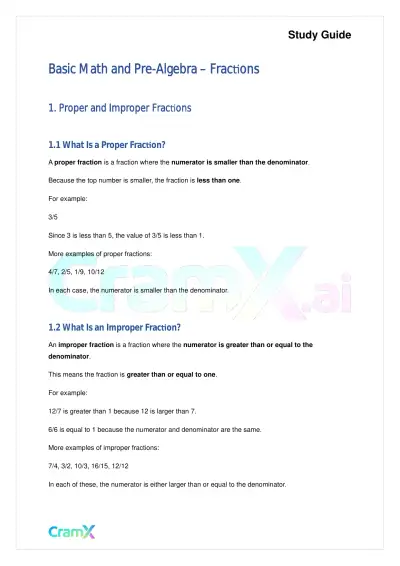 Quick Guides
Basic Math and Pre-Algebra – Fractions
Mathematics
82 pagesMar 2026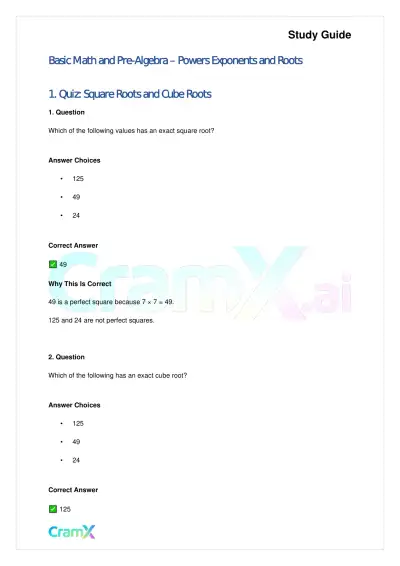 Quick Guides
Basic Math and Pre-Algebra - Powers Exponents and Roots
Mathematics
35 pagesMar 2026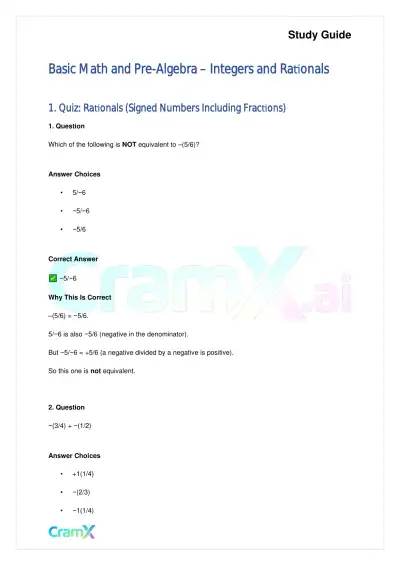 Quick Guides
Basic Math and Pre-Algebra - Integers and Rationals
Mathematics
46 pagesMar 2026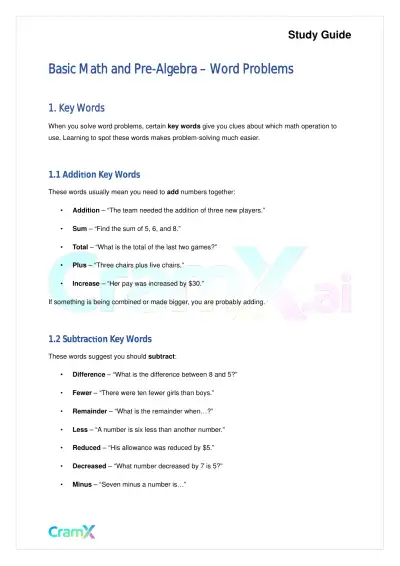 Quick Guides
Basic Math and Pre-Algebra - Word Problems
Mathematics
53 pagesMar 2026 Quick Guides
Basic Math and Pre-Algebra - Variables Algebraic Expressions and Simple Equations
Mathematics
40 pagesMar 2026 Quick Guides
Basic Math and Pre-Algebra - Whole Numbers
Mathematics
41 pagesMar 2026 Quick Guides
Basic Math and Pre-Algebra - Preliminaries
Mathematics
49 pagesMar 2026 Quick Guides
Basic Math and Pre-Algebra - Percents
Mathematics
42 pagesMar 2026
Study this document with CramX
Once it is in your library, every tool can work from it.