

Basic Math and Pre-Algebra - Whole Numbers
- Mathematics
- Texas A&M University
- 41 pages
- Shared March 2026
Preview 10 of 41 pages
See the first 10 pages exactly as they appear in the document.
Page 1 Read page 1 as text
Study Guide Basic Math and Pre - Algebra – Whole Numbers 1. Es Ɵ ma Ɵ ng Sums, Di ff erences, Products, and Quo Ɵ ents Estimating (or approximating) helps you: • Solve problems faster • Check if your exact answer makes sense • Work more confidently with large numbers When you estimate, you usually round numbers first , then solve. The symbol ≈ means “is approximately equal to.” 1.1 Es Ɵ ma Ɵ ng Sums To estimate a sum, round the numbers first , then add. Example 1: Estimate: 3,741 + 5,021 (round to the nearest thousand) Step 1: Round each number. 3,741 → 4,000 5,021 → 5,000 Step 2: Add. 4,000 + 5,000 = 9,000 So, 3,741 + 5,021 ≈ 9,000
Page 2 Read page 2 as text
Study Guide 1.2 Es Ɵ ma Ɵ ng Di ff erences To estimate a difference, round first , then subtract. Example 2: Estimate: 317,753 − 115,522 (round to the nearest hundred thousand) Step 1: Round each number. 317,753 → 300,000 115,522 → 100,000 Step 2: Subtract. 300,000 − 100,000 = 200,000 So, 317,753 − 115,522 ≈ 200,000 1.3 Es Ɵ ma Ɵ ng Products To estimate a product, round the numbers to friendly values, then multiply. Example 3: Estimate: 722 × 489 (round to the nearest hundred) Step 1: Round. 722 → 700 489 → 500 Step 2: Multiply. 700 × 500 = 350,000 So, 722 × 489 ≈ 350,000
Page 3 Read page 3 as text
Study Guide 1.4 One up and one down If both numbers end in 50 (or are halfway numbers), round one up and one down for a better estimate. This often gives a closer answer. Example 4: Estimate: 650 × 350 (round to the nearest hundred) One way: 650 → 700 350 → 300 700 × 300 = 210,000 So, 650 × 350 ≈ 210,000 Another way: 650 → 600 350 → 400 600 × 400 = 240,000 So, 650 × 350 ≈ 240,000 Both estimates are reasonable. Each is usually closer than rounding both numbers up.
Page 4 Read page 4 as text
Study Guide 1.5 Es Ɵ ma Ɵ ng Quo Ɵ ents To estimate a quotient, round to compatible numbers that divide easily. Example 5: Estimate: 891 ÷ 288 (round to the nearest hundred) Step 1: Round. 891 → 900 288 → 300 Step 2: Divide. 900 ÷ 300 = 3 So, 891 ÷ 288 ≈ 3 Summary When estimating: • Round numbers first. • Choose friendly numbers that are easy to work with. • Multiply and divide carefully after rounding. • Use your estimate to check if your exact answer makes sense. • For sums and differences, round the numbers to the required place value and then add or subtract. For products, round to friendly numbers that are easy to multiply. If numbers end in 50, you can round one up and one down to get a closer estimate.
Page 5 Read page 5 as text
Study Guide 2. Quiz: Es Ɵ ma Ɵ ng Sums, Di ff erences, Products, and Quo Ɵ ents 1. Question Which of the following is an estimate for the sum of the numbers 5,478 + 3,456 if each were rounded to the nearest thousand? Answer Choices • 9,000 • 8,900 • 8,000 Correct Answer 9,000 Why This Is Correct Round each number to the nearest thousand: 5,478 → 5,000 3,456 → 3,000 Now add: 5,000 + 3,000 = 8,000 But wait — check rounding carefully: 5,478 rounds up to 5,000 3,456 rounds up to 3,000 Actually, 5,478 rounds to 5,000 (since 478 < 500), and 3,456 rounds to 3,000 (since 456 < 500). So the estimated sum is 8,000 , not 9,000. Correct Answer: 8,000
Page 6 Read page 6 as text
Study Guide 2. Question Which of the following would NOT have an estimated answer of 4,500 if you were to round to the nearest ten? Answer Choices • 55 × 84 • 3,549 + 949 • 6,249 – 1,751 Correct Answer 55 × 84 Why This Is Correct Round to nearest ten: 55 × 84 → 60 × 80 = 4,800 (NOT 4,500) 3,549 + 949 → 3,550 + 950 = 4,500 6,249 – 1,751 → 6,250 – 1,750 = 4,500 Only 55 × 84 does NOT estimate to 4,500. 3. Question Estimate the product of 456 × 567 by rounding to the nearest hundred. Answer Choices • 300,000 • 250,000 • 240,000
Page 7 Read page 7 as text
Study Guide Correct Answer 250,000 Why This Is Correct Round to nearest hundred: 456 → 500 567 → 600 Multiply: 500 × 600 = 300,000 However, check rounding more carefully: 456 is closer to 500 567 is closer to 600 That gives 300,000 — which is an overestimate. If rounded properly: 456 → 500 567 → 600 So correct estimate is: Correct Answer: 300,000 4. Question Which of the following would NOT be an acceptable estimate of the product 250 × 750 if you were to round to the nearest hundred? Answer Choices • 240,000 • 210,000 • 160,000
Page 8 Read page 8 as text
Study Guide Correct Answer 160,000 Why This Is Correct Round to nearest hundred: 250 → 300 750 → 800 300 × 800 = 240,000 Actual product: 250 × 750 = 187,500 Reasonable estimates are around 200,000 – 240,000. 160,000 is far too low to be reasonable. 5. Question Estimate the quotient of 19,543 ÷ 4,426 by rounding to the nearest thousand. Answer Choices • 4 • 5 • 6 Correct Answer 5 Why This Is Correct Round to nearest thousand: 19,543 → 20,000 4,426 → 4,000 Now divide: 20,000 ÷ 4,000 = 5
Page 9 Read page 9 as text
Study Guide 6. Question Which of the following is a correct statement? Answer Choices • 200,000 is an estimate for the difference 564,123 – 359,783 rounded to the nearest ten thousand. • 40 is an estimate for the quotient 120,123 ÷ 3,456 rounded to the nearest thousand. • Both statements are correct. Correct Answer Both statements are correct. Why This Is Correct First statement: 564,123 → 560,000 359,783 → 360,000 560,000 – 360,000 = 200,000 ✔ Second statement: 120,123 → 120,000 3,456 → 3,000 120,000 ÷ 3,000 = 40 ✔ Both are correct.
Page 10 Read page 10 as text
Study Guide 3. Divisibility Rules 3.1 A Smarter (and Faster!) Way to Check Division Have you ever wondered if a number is divisible by another number — without actually doing long division? Good news! There are simple divisibility rules that help you figure this out quickly. Instead of dividing, you can use patterns and shortcuts. Let’s explore them step by step. Table 1: Divisibility Rules Example 1: Solve Is 126 divisible by 3? First, find the sum of the digits: 1 + 2 + 6 = 9 Since 9 is divisible by 3, 126 is divisible by 3.
31 more pages in the full document
Unlock it once and it stays in your library, ready to chat with or turn into flashcards.
Unlock the full documentMore Mathematics study materials
See all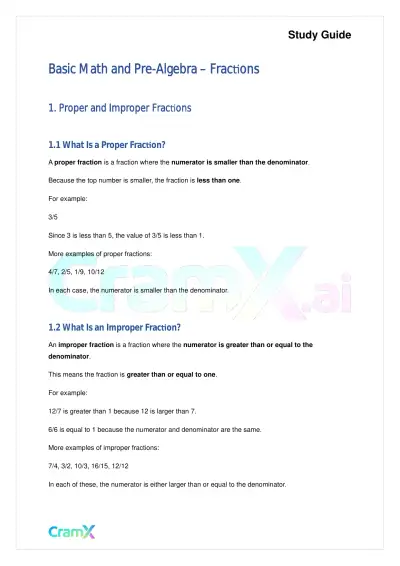 Quick Guides
Basic Math and Pre-Algebra – Fractions
Mathematics
82 pagesMar 2026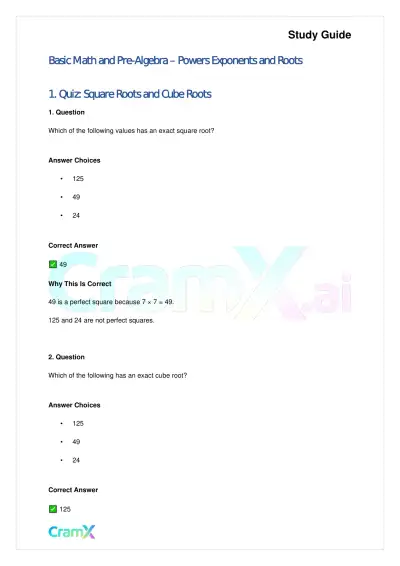 Quick Guides
Basic Math and Pre-Algebra - Powers Exponents and Roots
Mathematics
35 pagesMar 2026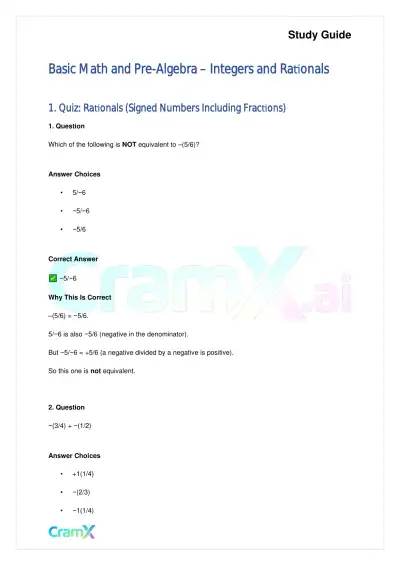 Quick Guides
Basic Math and Pre-Algebra - Integers and Rationals
Mathematics
46 pagesMar 2026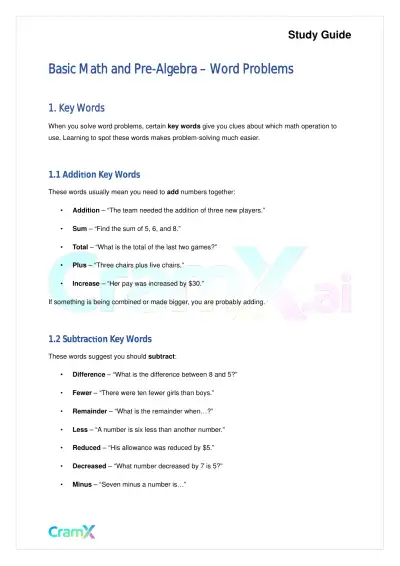 Quick Guides
Basic Math and Pre-Algebra - Word Problems
Mathematics
53 pagesMar 2026 Quick Guides
Basic Math and Pre-Algebra - Variables Algebraic Expressions and Simple Equations
Mathematics
40 pagesMar 2026 Quick Guides
Basic Math and Pre-Algebra - Preliminaries
Mathematics
49 pagesMar 2026 Quick Guides
Basic Math and Pre-Algebra - Percents
Mathematics
42 pagesMar 2026 Quick Guides
Basic Math and Pre-Algebra - Powers of Ten and Scientific Notation
Mathematics
32 pagesMar 2026
Study this document with CramX
Once it is in your library, every tool can work from it.