

Basic Math and Pre-Algebra - Number Series
- Mathematics
- Texas A&M University
- 10 pages
- Shared March 2026
Preview 3 of 10 pages
See the first 3 pages exactly as they appear in the document.
Page 1 Read page 1 as text
Study Guide Basic Math and Pre - Algebra – Number Series 1. Arithme Ɵ c Progressions 1.1 What Is an Arithme Ɵ c Progression? An arithmetic progression (AP) is a sequence of numbers where the difference between consecutive terms is always the same. In simple words: • You keep adding (or subtracting) the same number each time. • That fixed number is called the common difference . To check if a sequence is an AP: Subtract any term from the next one. If the result is always the same, it’s an arithmetic progression. Example 1: Finding the Next Term Question: What is the next number in the progression 4, 7, 10, 13, ... ? Step 1: Find the common difference 7 − 4 = 3 10 − 7 = 3 13 − 10 = 3 The difference is always 3 . Step 2: Add the common difference to the last term 13 + 3 = 16 So, the next number is 16 .
Page 2 Read page 2 as text
Study Guide Example 2: Finding the 40th Term Question: What is the 40th term in the progression 5, 10, 15, 20, ... ? Step 1: Find the common difference 10 − 5 = 5 So, the common difference is 5 . Step 2: Understand the position We know: • 1st term = 5 • 2nd term = 10 • 3rd term = 15 • 4th term = 20 We need the 40th term . Notice that the 40th term is 36 terms after the 4th term (because 40 − 4 = 36). Step 3: Calculate how much the value increases in 36 steps Each step increases by 5. So, 5 × 36 = 180 Step 4: Add this to the 4th term 20 + 180 = 200 Therefore, the 40th term is 200 .
Page 3 Read page 3 as text
Study Guide Summary • An arithmetic progression (AP) is a sequence where the difference between consecutive terms is constant. • This fixed value is called the common difference . • To find the next term, simply add the common difference to the last term. • To find a later term (like the 40th term), calculate how many steps forward you need to go and multiply that by the common difference. • Then add the result to a known term. 2. Geometric Progressions What Is a Geometric Progression? A geometric progression (GP) is a sequence of numbers where each term is multiplied by the same number to get the next term. Instead of adding the same number (like in an arithmetic progression), here we multiply by the same value each time. This fixed multiplying value is called the common ratio . To check if a sequence is a GP: Divide any term by the one before it. If the answer is always the same, that number is the common ratio . Example 1: Finding the Next Term Question: What is the next number in the progression 1, 2, 4, 8, 16, ... ? Step 1: Find the common ratio 2 ÷ 1 = 2 4 ÷ 2 = 2
7 more pages in the full document
Unlock it once and it stays in your library, ready to chat with or turn into flashcards.
Unlock the full documentMore Mathematics study materials
See all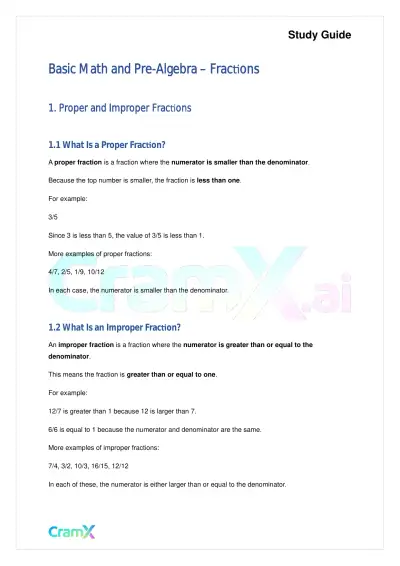 Quick Guides
Basic Math and Pre-Algebra – Fractions
Mathematics
82 pagesMar 2026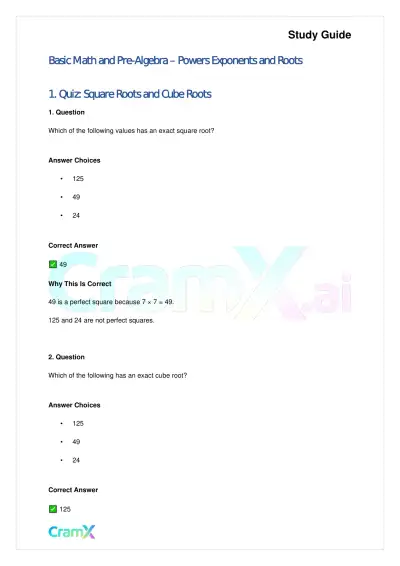 Quick Guides
Basic Math and Pre-Algebra - Powers Exponents and Roots
Mathematics
35 pagesMar 2026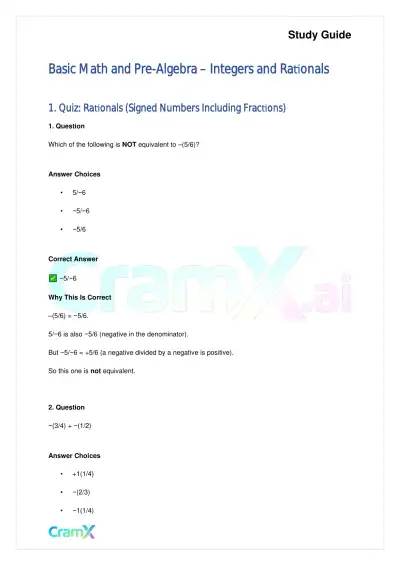 Quick Guides
Basic Math and Pre-Algebra - Integers and Rationals
Mathematics
46 pagesMar 2026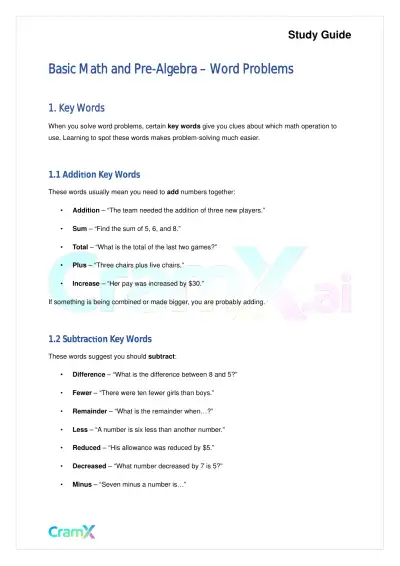 Quick Guides
Basic Math and Pre-Algebra - Word Problems
Mathematics
53 pagesMar 2026 Quick Guides
Basic Math and Pre-Algebra - Variables Algebraic Expressions and Simple Equations
Mathematics
40 pagesMar 2026 Quick Guides
Basic Math and Pre-Algebra - Whole Numbers
Mathematics
41 pagesMar 2026 Quick Guides
Basic Math and Pre-Algebra - Preliminaries
Mathematics
49 pagesMar 2026 Quick Guides
Basic Math and Pre-Algebra - Percents
Mathematics
42 pagesMar 2026
Study this document with CramX
Once it is in your library, every tool can work from it.