

Basic Math and Pre-Algebra - Preliminaries
- Mathematics
- Texas A&M University
- 49 pages
- Shared March 2026
Preview 10 of 49 pages
See the first 10 pages exactly as they appear in the document.
Page 1 Read page 1 as text
Study Guide Basic Math and Pre - Algebra – Preliminaries 1. Mul Ɵ plying and Dividing Using Zero It zero works in multiplication and division. Zero may seem simple, but it follows some very important rules! 1.1 Mul Ɵ plying by Zero Here’s the key rule: Any number multiplied by zero equals zero. It doesn’t matter how big or small the number is. If one of the factors is 0, the product will always be 0. Examples: • ( 0 × 2 = 0 ) • ( 8 × 2 × 3 × 6 × 0 = 0 ) Even in a long multiplication problem, if just one number is 0, the entire answer becomes 0. Why? Because multiplying means combining equal groups. If you have zero groups of something, you have nothing. So the result is zero. 1.2 Dividing Zero by a Number Now let’s talk about division. If you divide zero by any nonzero number , the answer is zero . Examples: • ( 0 ÷ 3 = 0 ) • (0/7 = 0 )
Page 2 Read page 2 as text
Study Guide Why? Division asks, “How many times does this number fit into another number?” If there’s nothing (zero) to divide, then the answer is zero. 1.3 Important: Dividing by Zero Dividing by zero is not allowed. It is called “undefined.” Examples that are not permitted : • (4/0) • (0/0) These do not have logical answers. The result is not zero — it simply doesn’t exist. That’s why we say dividing by zero is undefined. Summary • Multiply any number by 0 → Answer is 0 • Divide 0 by any nonzero number → Answer is 0 • Divide by 0 → Undefined (not allowed) 2. Common Math Symbols In math and algebra, symbols help us compare numbers and show relationships clearly. Learning what these symbols mean will make solving problems much easier. Let’s go through the most common ones step by step.
Page 3 Read page 3 as text
Study Guide 2.1 Equality Symbols These symbols show whether two values are the same or not. • = means is equal to • Example: ( 5 + 3 = 8 ) • ≠ means is not equal to • Example: ( 4 ≠ 7 ) 2.2 Greater Than and Less Than These symbols compare the size of numbers. • > means is greater than • Example: ( 9 > 4 ) • < means is less than • Example: ( 2 < 6 ) A helpful tip: The wide opening of the symbol always points toward the larger number. 2.3 Greater Than or Equal To / Less Than or Equal To Sometimes numbers can be equal, too. These symbols include that possibility. • ≥ means is greater than or equal to • (Also written as ≥ ) • Example: ( x ≥ 5 ) • ≤ means is less than or equal to • (Also written as ≤ ) • Example: ( y ≤ 10 )
Page 4 Read page 4 as text
Study Guide 2.4 “Not” Comparison Symbols These symbols show that something is not true. • ≯ means is not greater than • ≮ means is not less than • ≱ means is not greater than or equal to • ≰ means is not less than or equal to These are often used in higher - level math to clearly state what is not true. 2.5 Approximate Equality Sometimes a value isn’t exact, but it’s close. • ≈ means is approximately equal to • (Also written as ≅ in some cases) • Example: ( π ≈ 3.14 ) This symbol is useful when rounding numbers or working with estimates. Summary • = equal to • ≠ not equal to • > greater than • < less than • ≥ greater than or equal to • ≤ less than or equal to • ≈ approximately equal to
Page 5 Read page 5 as text
Study Guide 3. Quiz: Ways to Show Mul Ɵ plica Ɵ on and Division, Mul Ɵ plying and Dividing by Zero, and Common Math Symbols 1. Question Which of the following is NOT an acceptable way to show the multiplication of 5 with 4? Answer Choices • (5)(4) • 5/4 • 5·4 Correct Answer 5/4 Why This Is Correct Multiplication can be shown in several correct ways, such as: • Using parentheses: (5)(4) • Using a dot: 5 · 4 However, 5/4 represents division, not multiplication. So it is not an acceptable way to show 5 multiplied by 4. 2. Question Which of the following is an acceptable way to show the division of 12 with 5? Answer Choices • 12(5) • (12)(5) • 12/5
Page 6 Read page 6 as text
Study Guide Correct Answer 12/5 Why This Is Correct Division is properly shown using the division symbol (÷) or a fraction bar (/). • 12/5 clearly shows 12 divided by 5. • 12(5) and (12)(5) both represent multiplication, not division. 3. Question 0 ÷ 3 = ? Answer Choices • 0 • no such answer • 3 Correct Answer 0 Why This Is Correct Zero divided by any nonzero number equals zero. Think of it this way: If you have 0 objects and divide them into 3 groups, each group still has 0 objects. 4. Question 3 ÷ 0 = ?
Page 7 Read page 7 as text
Study Guide Answer Choices • 3 • 0 • no such answer Correct Answer no such answer Why This Is Correct Division by zero is undefined . There is no number you can multiply by 0 to get 3. Since it's impossible, the answer does not exist. 5. Question Which of the following is a true statement? Answer Choices • 12 × 3 × 0 × 1 = (5 ÷ 0) • 0 ÷ (12) = 0 × 12 • 0/0 = 0 Correct Answer 0 ÷ (12) = 0 × 12 Why This Is Correct • 12 × 3 × 0 × 1 = 0, but 5 ÷ 0 is undefined → ᤶ ᤷ Not equal • 0 ÷ 12 = 0 and 0 × 12 = 0 → True • 0/0 is undefined → ᤶ ᤷ False Only the second statement is true.
Page 8 Read page 8 as text
Study Guide 6. Question Which symbol has exactly the same meaning as “is not greater than”? Answer Choices • < • > • ≤ Correct Answer ≤ Why This Is Correct “Is not greater than” means the number is either: • Less than • Or equal to The symbol ≤ means “less than or equal to,” which matches perfectly. 7. Question Which of the following statements is true? Answer Choices • 12 ≰ 11 • 3 ≰ 5 • 6 ≱ 6
Page 9 Read page 9 as text
Study Guide Understanding the Symbols • ≤ means less than or equal to • ≥ means greater than or equal to • ≰ means not less than or equal to • ≱ means not greater than or equal to The slash means the statement is saying the opposite. Check Each Statement 12 ≰ 11 This means: “12 is not less than or equal to 11.” Since 12 is greater than 11, it is true that 12 is not less than or equal to 11. True 3 ≤ 5 This means: “3 is less than or equal to 5.” Since 3 is less than 5, this is also True 6 ≱ 6 This means: “6 is not greater than or equal to 6.” But 6 is equal to 6 , so 6 ≥ 6 is true. That means saying it is not greater than or equal to 6 is ᤶ ᤷ False
Page 10 Read page 10 as text
Study Guide Final Answer Both of these statements are true: 12 ≰ 11 3 ≤ 5 The only false statement is: ᤶ ᤷ 6 ≱ 6 8. Question Which statement says “x is approximately equal to 5”? Answer Choices • x ≈ 5 • x = 5 • x ≠ 5 Correct Answer x ≈ 5 Why This Is Correct The symbol ≈ means “approximately equal to.” • x = 5 means exactly equal • x ≠ 5 means not equal • x ≈ 5 means close to 5, but not exactly 5
39 more pages in the full document
Unlock it once and it stays in your library, ready to chat with or turn into flashcards.
Unlock the full documentMore Mathematics study materials
See all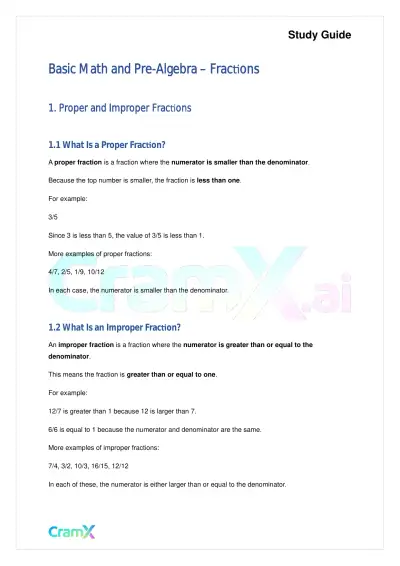 Quick Guides
Basic Math and Pre-Algebra – Fractions
Mathematics
82 pagesMar 2026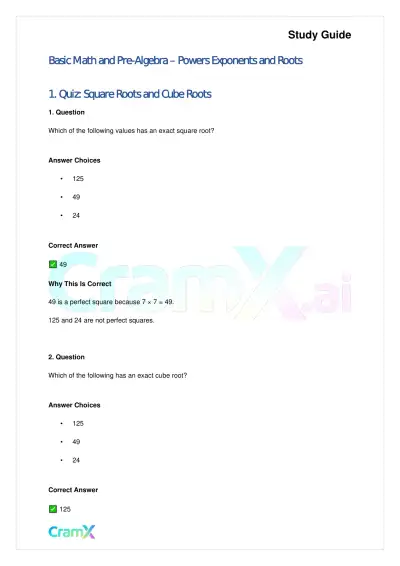 Quick Guides
Basic Math and Pre-Algebra - Powers Exponents and Roots
Mathematics
35 pagesMar 2026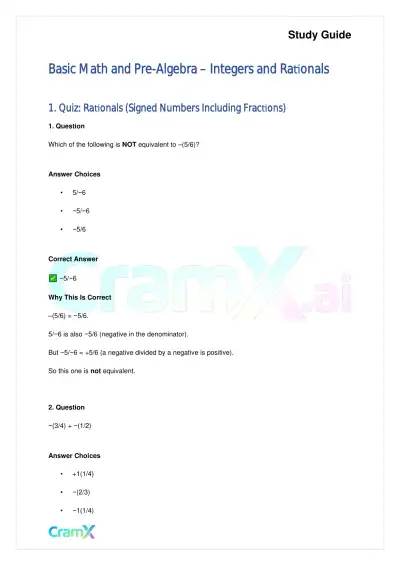 Quick Guides
Basic Math and Pre-Algebra - Integers and Rationals
Mathematics
46 pagesMar 2026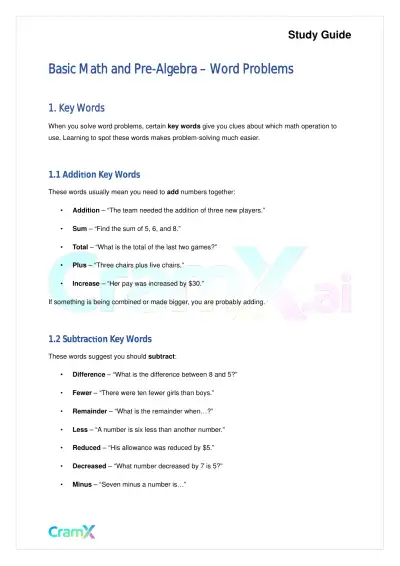 Quick Guides
Basic Math and Pre-Algebra - Word Problems
Mathematics
53 pagesMar 2026 Quick Guides
Basic Math and Pre-Algebra - Variables Algebraic Expressions and Simple Equations
Mathematics
40 pagesMar 2026 Quick Guides
Basic Math and Pre-Algebra - Whole Numbers
Mathematics
41 pagesMar 2026 Quick Guides
Basic Math and Pre-Algebra - Percents
Mathematics
42 pagesMar 2026 Quick Guides
Basic Math and Pre-Algebra - Powers of Ten and Scientific Notation
Mathematics
32 pagesMar 2026
Study this document with CramX
Once it is in your library, every tool can work from it.