

Solution Manual for Calculus Early Transcendentals, 3rd Edition
- Mathematics
- 1695 pages
- Shared May 2025
Unlock the answers to every textbook problem with Solution Manual for Calculus Early Transcendentals, 3rd Edition, making studying more efficient and effective.
Preview 16 of 1695 pages
See the first 16 pages exactly as they appear in the document.
Page 1 Read page 1 as text
S OLUTIONS M ANUAL M ARK W OODARD Furman University C ALCULUS E ARLY T RANSCENDENTALS T HIRD E DITION William Briggs University of Colorado at Denver Lyle Cochran Whitworth University Bernhard Gillett University of Colorado, Boulder Eric Schulz Walla Walla Community College
Page 2 Page 3 Read page 3 as text
Contents 1 Functions 3 1.1 Review of Functions . . . . . . . . . . . . . . . . . . . . . . . . . . . . . . . . . . . . . . . . . 3 1.2 Representing Functions . . . . . . . . . . . . . . . . . . . . . . . . . . . . . . . . . . . . . . . 12 1.3 Inverse, Exponential and Logarithmic Functions . . . . . . . . . . . . . . . . . . . . . . . . . 30 1.4 Trigonometric Functions and Their Inverses . . . . . . . . . . . . . . . . . . . . . . . . . . . . 39 Chapter One Review . . . . . . . . . . . . . . . . . . . . . . . . . . . . . . . . . . . . . . . . . . . . 52 2 Limits 65 2.1 The Idea of Limits . . . . . . . . . . . . . . . . . . . . . . . . . . . . . . . . . . . . . . . . . . 65 2.2 Definition of a Limit . . . . . . . . . . . . . . . . . . . . . . . . . . . . . . . . . . . . . . . . . 70 2.3 Techniques for Computing Limits . . . . . . . . . . . . . . . . . . . . . . . . . . . . . . . . . 85 2.4 Infinite Limits . . . . . . . . . . . . . . . . . . . . . . . . . . . . . . . . . . . . . . . . . . . . 95 2.5 Limits at Infinity . . . . . . . . . . . . . . . . . . . . . . . . . . . . . . . . . . . . . . . . . . . 104 2.6 Continuity . . . . . . . . . . . . . . . . . . . . . . . . . . . . . . . . . . . . . . . . . . . . . . 118 2.7 Precise Definitions of Limits . . . . . . . . . . . . . . . . . . . . . . . . . . . . . . . . . . . . 131 Chapter Two Review . . . . . . . . . . . . . . . . . . . . . . . . . . . . . . . . . . . . . . . . . . . . 140 3 Derivatives 153 3.1 Introducing the Derivative . . . . . . . . . . . . . . . . . . . . . . . . . . . . . . . . . . . . . 153 3.2 The Derivative as a Function . . . . . . . . . . . . . . . . . . . . . . . . . . . . . . . . . . . . 162 3.3 Rules of Di ↵ erentiation . . . . . . . . . . . . . . . . . . . . . . . . . . . . . . . . . . . . . . . 180 3.4 The Product and Quotient Rules . . . . . . . . . . . . . . . . . . . . . . . . . . . . . . . . . . 188 3.5 Derivatives of Trigonometric Functions . . . . . . . . . . . . . . . . . . . . . . . . . . . . . . 200 3.6 Derivatives as Rates of Change . . . . . . . . . . . . . . . . . . . . . . . . . . . . . . . . . . . 209 3.7 The Chain Rule . . . . . . . . . . . . . . . . . . . . . . . . . . . . . . . . . . . . . . . . . . . 224 3.8 Implicit Di ↵ erentiation . . . . . . . . . . . . . . . . . . . . . . . . . . . . . . . . . . . . . . . 238 3.9 Derivatives of Logarithmic and Exponential Functions . . . . . . . . . . . . . . . . . . . . . . 256 3.10 Derivatives of Inverse Trigonometric Functions . . . . . . . . . . . . . . . . . . . . . . . . . . 268 3.11 Related Rates . . . . . . . . . . . . . . . . . . . . . . . . . . . . . . . . . . . . . . . . . . . . 277 Chapter Three Review . . . . . . . . . . . . . . . . . . . . . . . . . . . . . . . . . . . . . . . . . . . 289 4 Applications of the Derivative 305 4.1 Maxima and Minima . . . . . . . . . . . . . . . . . . . . . . . . . . . . . . . . . . . . . . . . 305 4.2 Mean Value Theorem . . . . . . . . . . . . . . . . . . . . . . . . . . . . . . . . . . . . . . . . 320 4.3 What Derivatives Tell Us . . . . . . . . . . . . . . . . . . . . . . . . . . . . . . . . . . . . . . 328 4.4 Graphing Functions . . . . . . . . . . . . . . . . . . . . . . . . . . . . . . . . . . . . . . . . . 346 4.5 Optimization Problems . . . . . . . . . . . . . . . . . . . . . . . . . . . . . . . . . . . . . . . 380 4.6 Linear Approximation and Di ↵ erentials . . . . . . . . . . . . . . . . . . . . . . . . . . . . . . 403 4.7 L’Hˆ opital’s Rule . . . . . . . . . . . . . . . . . . . . . . . . . . . . . . . . . . . . . . . . . . . 413 4.8 Newton’s Method . . . . . . . . . . . . . . . . . . . . . . . . . . . . . . . . . . . . . . . . . . 427 4.9 Antiderivatives . . . . . . . . . . . . . . . . . . . . . . . . . . . . . . . . . . . . . . . . . . . . 443 Chapter Four Review . . . . . . . . . . . . . . . . . . . . . . . . . . . . . . . . . . . . . . . . . . . 454 1
Page 4 Read page 4 as text
2 Contents 5 Integration 477 5.1 Approximating Areas under Curves . . . . . . . . . . . . . . . . . . . . . . . . . . . . . . . . 477 5.2 Definite Integrals . . . . . . . . . . . . . . . . . . . . . . . . . . . . . . . . . . . . . . . . . . . 497 5.3 Fundamental Theorem of Calculus . . . . . . . . . . . . . . . . . . . . . . . . . . . . . . . . . 517 5.4 Working with Integrals . . . . . . . . . . . . . . . . . . . . . . . . . . . . . . . . . . . . . . . 534 5.5 Substitution Rule . . . . . . . . . . . . . . . . . . . . . . . . . . . . . . . . . . . . . . . . . . 544 Chapter Five Review . . . . . . . . . . . . . . . . . . . . . . . . . . . . . . . . . . . . . . . . . . . . 555 6 Applications of Integration 571 6.1 Velocity and Net Change . . . . . . . . . . . . . . . . . . . . . . . . . . . . . . . . . . . . . . 571 6.2 Regions Between Curves . . . . . . . . . . . . . . . . . . . . . . . . . . . . . . . . . . . . . . 585 6.3 Volume by Slicing . . . . . . . . . . . . . . . . . . . . . . . . . . . . . . . . . . . . . . . . . . 600 6.4 Volume by Shells . . . . . . . . . . . . . . . . . . . . . . . . . . . . . . . . . . . . . . . . . . . 608 6.5 Length of Curves . . . . . . . . . . . . . . . . . . . . . . . . . . . . . . . . . . . . . . . . . . . 618 6.6 Surface Area . . . . . . . . . . . . . . . . . . . . . . . . . . . . . . . . . . . . . . . . . . . . . 624 6.7 Physical Applications . . . . . . . . . . . . . . . . . . . . . . . . . . . . . . . . . . . . . . . . 632 Chapter Six Review . . . . . . . . . . . . . . . . . . . . . . . . . . . . . . . . . . . . . . . . . . . . 642 7 Logarithmic, Exponential, and Hyperbolic Functions 659 7.1 Logarithmic and Exponential Functions Revisited . . . . . . . . . . . . . . . . . . . . . . . . 659 7.2 Exponential Models . . . . . . . . . . . . . . . . . . . . . . . . . . . . . . . . . . . . . . . . . 667 7.3 Hyperbolic Functions . . . . . . . . . . . . . . . . . . . . . . . . . . . . . . . . . . . . . . . . 673 Chapter Seven Review . . . . . . . . . . . . . . . . . . . . . . . . . . . . . . . . . . . . . . . . . . . 685 8 Integration Techniques 691 8.1 Basic Approaches . . . . . . . . . . . . . . . . . . . . . . . . . . . . . . . . . . . . . . . . . . 691 8.2 Integration by Parts . . . . . . . . . . . . . . . . . . . . . . . . . . . . . . . . . . . . . . . . . 701 8.3 Trigonometric Integrals . . . . . . . . . . . . . . . . . . . . . . . . . . . . . . . . . . . . . . . 720 8.4 Trigonometric Substitutions . . . . . . . . . . . . . . . . . . . . . . . . . . . . . . . . . . . . 729 8.5 Partial Fractions . . . . . . . . . . . . . . . . . . . . . . . . . . . . . . . . . . . . . . . . . . . 746 8.6 Integration Strategies . . . . . . . . . . . . . . . . . . . . . . . . . . . . . . . . . . . . . . . . 761 8.7 Other Methods of Integration . . . . . . . . . . . . . . . . . . . . . . . . . . . . . . . . . . . . 796 8.8 Numerical Integration . . . . . . . . . . . . . . . . . . . . . . . . . . . . . . . . . . . . . . . . 805 8.9 Improper Integrals . . . . . . . . . . . . . . . . . . . . . . . . . . . . . . . . . . . . . . . . . . 816 Chapter Eight Review . . . . . . . . . . . . . . . . . . . . . . . . . . . . . . . . . . . . . . . . . . . 831 9 Di ↵ erential Equations 853 9.1 Basic Ideas . . . . . . . . . . . . . . . . . . . . . . . . . . . . . . . . . . . . . . . . . . . . . . 853 9.2 Direction Fields and Euler’s Method . . . . . . . . . . . . . . . . . . . . . . . . . . . . . . . . 859 9.3 Separable Di ↵ erential Equations . . . . . . . . . . . . . . . . . . . . . . . . . . . . . . . . . . 871 9.4 Special First-Order Linear Di ↵ erential Equations . . . . . . . . . . . . . . . . . . . . . . . . . 884 9.5 Modeling with Di ↵ erential Equations . . . . . . . . . . . . . . . . . . . . . . . . . . . . . . . 892 Chapter Nine Review . . . . . . . . . . . . . . . . . . . . . . . . . . . . . . . . . . . . . . . . . . . 901 10 Sequences and Infinite Series 909 10.1 An Overview . . . . . . . . . . . . . . . . . . . . . . . . . . . . . . . . . . . . . . . . . . . . . 909 10.2 Sequences . . . . . . . . . . . . . . . . . . . . . . . . . . . . . . . . . . . . . . . . . . . . . . . 917 10.3 Infinite Series . . . . . . . . . . . . . . . . . . . . . . . . . . . . . . . . . . . . . . . . . . . . . 931 10.4 The Divergence and Integral Tests . . . . . . . . . . . . . . . . . . . . . . . . . . . . . . . . . 942 10.5 Comparison Tests . . . . . . . . . . . . . . . . . . . . . . . . . . . . . . . . . . . . . . . . . . 953 10.6 Alternating Series . . . . . . . . . . . . . . . . . . . . . . . . . . . . . . . . . . . . . . . . . . 961 10.7 The Ratio and Root Tests . . . . . . . . . . . . . . . . . . . . . . . . . . . . . . . . . . . . . 968 10.8 Choosing a Convergence Test . . . . . . . . . . . . . . . . . . . . . . . . . . . . . . . . . . . . 974 Chapter Ten Review . . . . . . . . . . . . . . . . . . . . . . . . . . . . . . . . . . . . . . . . . . . . 991
Page 5 Read page 5 as text
Contents 3 11 Power Series 1003 11.1 Approximating Functions With Polynomials . . . . . . . . . . . . . . . . . . . . . . . . . . . 1003 11.2 Properties of Power Series . . . . . . . . . . . . . . . . . . . . . . . . . . . . . . . . . . . . . 1021 11.3 Taylor Series . . . . . . . . . . . . . . . . . . . . . . . . . . . . . . . . . . . . . . . . . . . . . 1030 11.4 Working with Taylor Series . . . . . . . . . . . . . . . . . . . . . . . . . . . . . . . . . . . . . 1045 Chapter Eleven Review . . . . . . . . . . . . . . . . . . . . . . . . . . . . . . . . . . . . . . . . . . 1059 12 Parametric and Polar Curves 1069 12.1 Parametric Equations . . . . . . . . . . . . . . . . . . . . . . . . . . . . . . . . . . . . . . . . 1069 12.2 Polar Coordinates . . . . . . . . . . . . . . . . . . . . . . . . . . . . . . . . . . . . . . . . . . 1086 12.3 Calculus in Polar Coordinates . . . . . . . . . . . . . . . . . . . . . . . . . . . . . . . . . . . 1106 12.4 Conic Sections . . . . . . . . . . . . . . . . . . . . . . . . . . . . . . . . . . . . . . . . . . . . 1121 Chapter Twelve Review . . . . . . . . . . . . . . . . . . . . . . . . . . . . . . . . . . . . . . . . . . 1141 13 Vectors and the Geometry of Space 1159 13.1 Vectors in the Plane . . . . . . . . . . . . . . . . . . . . . . . . . . . . . . . . . . . . . . . . . 1159 13.2 Vectors in Three Dimensions . . . . . . . . . . . . . . . . . . . . . . . . . . . . . . . . . . . . 1167 13.3 Dot Products . . . . . . . . . . . . . . . . . . . . . . . . . . . . . . . . . . . . . . . . . . . . . 1177 13.4 Cross Products . . . . . . . . . . . . . . . . . . . . . . . . . . . . . . . . . . . . . . . . . . . . 1185 13.5 Lines and Planes in Space . . . . . . . . . . . . . . . . . . . . . . . . . . . . . . . . . . . . . . 1194 13.6 Cylinders and Quadric Surfaces . . . . . . . . . . . . . . . . . . . . . . . . . . . . . . . . . . 1202 Chapter Thirteen Review . . . . . . . . . . . . . . . . . . . . . . . . . . . . . . . . . . . . . . . . . 1217 14 Vector-Valued Functions 1231 14.1 Vector-Valued Functions . . . . . . . . . . . . . . . . . . . . . . . . . . . . . . . . . . . . . . 1231 14.2 Calculus of Vector-Valued Functions . . . . . . . . . . . . . . . . . . . . . . . . . . . . . . . . 1239 14.3 Motion in Space . . . . . . . . . . . . . . . . . . . . . . . . . . . . . . . . . . . . . . . . . . . 1245 14.4 Length of Curves . . . . . . . . . . . . . . . . . . . . . . . . . . . . . . . . . . . . . . . . . . . 1264 14.5 Curvature and Normal Vectors . . . . . . . . . . . . . . . . . . . . . . . . . . . . . . . . . . . 1270 Chapter Fourteen Review . . . . . . . . . . . . . . . . . . . . . . . . . . . . . . . . . . . . . . . . . 1281 15 Functions of Several Variables 1297 15.1 Graphs and Level Curves . . . . . . . . . . . . . . . . . . . . . . . . . . . . . . . . . . . . . . 1297 15.2 Limits and Continuity . . . . . . . . . . . . . . . . . . . . . . . . . . . . . . . . . . . . . . . . 1309 15.3 Partial Derivatives . . . . . . . . . . . . . . . . . . . . . . . . . . . . . . . . . . . . . . . . . . 1315 15.4 The Chain Rule . . . . . . . . . . . . . . . . . . . . . . . . . . . . . . . . . . . . . . . . . . . 1327 15.5 Directional Derivatives and the Gradient . . . . . . . . . . . . . . . . . . . . . . . . . . . . . 1338 15.6 Tangent Planes and Linear Approximation . . . . . . . . . . . . . . . . . . . . . . . . . . . . 1352 15.7 Maximum/Minimum Problems . . . . . . . . . . . . . . . . . . . . . . . . . . . . . . . . . . . 1360 15.8 Lagrange Multipliers . . . . . . . . . . . . . . . . . . . . . . . . . . . . . . . . . . . . . . . . . 1371 Chapter Fifteen Review . . . . . . . . . . . . . . . . . . . . . . . . . . . . . . . . . . . . . . . . . . 1380 16 Multiple Integration 1391 16.1 Double Integrals over Rectangular Regions . . . . . . . . . . . . . . . . . . . . . . . . . . . . 1391 16.2 Double Integrals over General Regions . . . . . . . . . . . . . . . . . . . . . . . . . . . . . . . 1398 16.3 Double Integrals in Polar Coordinates . . . . . . . . . . . . . . . . . . . . . . . . . . . . . . . 1414 16.4 Triple Integrals . . . . . . . . . . . . . . . . . . . . . . . . . . . . . . . . . . . . . . . . . . . . 1428 16.5 Triple Integrals in Cylindrical and Spherical Coordinates . . . . . . . . . . . . . . . . . . . . 1440 16.6 Integrals for Mass Calculations . . . . . . . . . . . . . . . . . . . . . . . . . . . . . . . . . . . 1452 16.7 Change of Variables in Multiple Integrals . . . . . . . . . . . . . . . . . . . . . . . . . . . . . 1463 Chapter Sixteen Review . . . . . . . . . . . . . . . . . . . . . . . . . . . . . . . . . . . . . . . . . . 1475
Page 6 Read page 6 as text
4 Contents 17 Vector Calculus 1489 17.1 Vector Fields . . . . . . . . . . . . . . . . . . . . . . . . . . . . . . . . . . . . . . . . . . . . . 1489 17.2 Line Integrals . . . . . . . . . . . . . . . . . . . . . . . . . . . . . . . . . . . . . . . . . . . . 1502 17.3 Conservative Vector Fields . . . . . . . . . . . . . . . . . . . . . . . . . . . . . . . . . . . . . 1512 17.4 Green’s Theorem . . . . . . . . . . . . . . . . . . . . . . . . . . . . . . . . . . . . . . . . . . . 1518 17.5 Divergence and Curl . . . . . . . . . . . . . . . . . . . . . . . . . . . . . . . . . . . . . . . . . 1532 17.6 Surface Integrals . . . . . . . . . . . . . . . . . . . . . . . . . . . . . . . . . . . . . . . . . . . 1543 17.7 Stokes’ Theorem . . . . . . . . . . . . . . . . . . . . . . . . . . . . . . . . . . . . . . . . . . . 1554 17.8 Divergence Theorem . . . . . . . . . . . . . . . . . . . . . . . . . . . . . . . . . . . . . . . . . 1562 Chapter Seventeen Review . . . . . . . . . . . . . . . . . . . . . . . . . . . . . . . . . . . . . . . . . 1571 D2 Second-Order Di ↵ erential Equations 1583 D2.1 Basic Ideas . . . . . . . . . . . . . . . . . . . . . . . . . . . . . . . . . . . . . . . . . . . . . . 1583 D2.2 Linear Homogeneous Equations . . . . . . . . . . . . . . . . . . . . . . . . . . . . . . . . . . . 1602 D2.3 Linear Nonhomogeneous Equations . . . . . . . . . . . . . . . . . . . . . . . . . . . . . . . . . 1612 D2.4 Applications . . . . . . . . . . . . . . . . . . . . . . . . . . . . . . . . . . . . . . . . . . . . . 1626 D2.5 Complex Forcing Functions . . . . . . . . . . . . . . . . . . . . . . . . . . . . . . . . . . . . . 1664 Chapter D2 Review . . . . . . . . . . . . . . . . . . . . . . . . . . . . . . . . . . . . . . . . . . . . 1683
Page 7 Read page 7 as text
Chapter 1 Functions 1.1 Review of Functions 1.1.1 A function is a rule that assigns each to each value of the independent variable in the domain a unique value of the dependent variable in the range. 1.1.2 The independent variable belongs to the domain, while the dependent variable belongs to the range. 1.1.3 Graph A does not represent a function, while graph B does. Note that graph A fails the vertical line test, while graph B passes it. 1.1.4 The domain of f is [1 , 4), while the range of f is (1 , 5]. Note that the domain is the “shadow” of the graph on the x -axis, while the range is the “shadow” of the graph on the y -axis. 1.1.5 Item i. is true while item ii. isn’t necessarily true. In the definition of function, item i. is stipulated. However, item ii. need not be true – for example, the function f ( x ) = x 2 has two di ↵ erent domain values associated with the one range value 4, because f (2) = f ( 2) = 4. 1.1.6 g ( x ) = x 2 +1 x 1 = ( x +1)( x 1) x 1 = x + 1, x 6 = 1. The domain is { x : x 6 = 1 } and the range is { x : x 6 = 2 } . - � � � � � � � � � � = � ( � ) 5
Page 8 Read page 8 as text
6 Chapter 1. Functions 1.1.7 The domain of this function is the set of a real numbers. The range is [ 10 , 1 ). - ��� - ��� - ��� ��� ��� � - �� - � - � - � - � � 1.1.8 The independent variable t is elapsed time and the dependent variable d is distance above the ground. The domain in context is [0 , 8] 1.1.9 The independent variable h is the height of the water in the tank and the dependent variable V is the volume of water in the tank. The domain in context is [0 , 50] 1.1.10 f (2) = 1 2 3 + 1 = 1 9 . f ( y 2 ) = 1 ( y 2 ) 3 +1 = 1 y 6 +1 . 1.1.11 f ( g (1 / 2)) = f ( 2) = 3; g ( f (4)) = g (9) = 1 8 ; g ( f ( x )) = g (2 x + 1) = 1 (2 x + 1) 1 = 1 2 x . 1.1.12 One possible answer is g ( x ) = x 2 + 1 and f ( x ) = x 5 , because then f ( g ( x )) = f ( x 2 + 1) = ( x 2 + 1) 5 . Another possible answer is g ( x ) = x 2 and f ( x ) = ( x + 1) 5 , because then f ( g ( x )) = f ( x 2 ) = ( x 2 + 1) 5 . 1.1.13 The domain of f g consists of all x in the domain of g such that g ( x ) is in the domain of f . 1.1.14 ( f g )(3) = f ( g (3)) = f (25) = p 25 = 5. ( f f )(64) = f ( p 64) = f (8) = p 8 = 2 p 2. ( g f )( x ) = g ( f ( x )) = g ( p x ) = x 3 / 2 2. ( f g )( x ) = f ( g ( x )) = f ( x 3 2) = p x 3 2 1.1.15 a. ( f g )(2) = f ( g (2)) = f (2) = 4. b. g ( f (2)) = g (4) = 1. c. f ( g (4)) = f (1) = 3. d. g ( f (5)) = g (6) = 3. e. f ( f (8)) = f (8) = 8. f. g ( f ( g (5))) = g ( f (2)) = g (4) = 1. 1.1.16 a. h ( g (0)) = h (0) = 1. b. g ( f (4)) = g ( 1) = 1. c. h ( h (0)) = h ( 1) = 0. d. g ( h ( f (4))) = g ( h ( 1)) = g (0) = 0. e. f ( f ( f (1))) = f ( f (0)) = f (1) = 0. f. h ( h ( h (0))) = h ( h ( 1)) = h (0) = 1. g. f ( h ( g (2))) = f ( h (3)) = f (0) = 1. h. g ( f ( h (4))) = g ( f (4)) = g ( 1) = 1. i. g ( g ( g (1))) = g ( g (2)) = g (3) = 4. j. f ( f ( h (3))) = f ( f (0)) = f (1) = 0. 1.1.17 f (5) f (0) 5 0 = 83 6 5 = 15 . 4; the radiosonde rises at an average rate of 15.4 ft/s during the first 5 seconds after it is released.
Page 9 Read page 9 as text
1.1. Review of Functions 7 1.1.18 f (0) = 0. f (34) = 127852 . 4 109731 = 18121 . 4. f (64) = 127852 . 4 75330 . 4 = 52522. f (64) f (34) 64 34 = 52522 18121 . 4 30 ⇡ 1146 . 69 ft/s . 1.1.19 f ( 2) = f (2) = 2; g ( 2) = g (2) = ( 2) = 2; f ( g (2)) = f ( 2) = f (2) = 2; g ( f ( 2)) = g ( f (2)) = g (2) = 2. 1.1.20 The graph would be the result of leaving the portion of the graph in the first quadrant, and then also obtaining a portion in the third quadrant which would be the result of reflecting the portion in the first quadrant around the y -axis and then the x -axis. 1.1.21 Function A is symmetric about the y -axis, so is even. Function B is symmetric about the origin so is odd. Function C is symmetric about the y -axis, so is even. 1.1.22 Function A is symmetric about the y -axis, so is even. Function B is symmetric about the origin, so is odd. Function C is also symmetric about the origin, so is odd. 1.1.23 f ( x ) = x 2 5 x + 6 x 2 = ( x 2)( x 3) x 2 = x 3, x 6 = 2. The domain of f is { x : x 6 = 2 } . The range is { y : y 6 = 1 } . 1.1.24 f ( x ) = x 2 2 x = x 2 ( x 2) = 1, x 6 = 2. The domain is { x : x 6 = 2 } . The range is { 1 } . 1.1.25 The domain of the function is the set of numbers x which satisfy 7 x 2 0. This is the interval [ p 7 , p 7]. Note that f ( p 7) = 0 and f (0) = p 7. The range is [0 , p 7]. 1.1.26 The domain of the function is the set of numbers x which satisfy 25 x 2 0. This is the interval [ 5 , 5]. Note that f (0) = 5 and f (5) = 0. The range is [ 5 , 0]. 1.1.27 Because the cube root function is defined for all real numbrs, the domain is R , the set of all real numbers. 1.1.28 The domain consists of the set of numbers w for which 2 w 0, so the interval ( 1 , 2]. 1.1.29 The domain consists of the set of numbers x for which 9 x 2 0, so the interval [ 3 , 3]. 1.1.30 Because 1 + t 2 is never zero for any real numbered value of t , the domain of this function is R , the set of all real numbers. 1.1.31 a. The formula for the height of the rocket is valid from t = 0 until the rocket hits the ground, which is the positive solution to 16 t 2 + 96 t + 80 = 0, which the quadratic formula reveals is t = 3 + p 14. Thus, the domain is [0 , 3 + p 14]. b. � � � � � � � �� ��� ��� ��� � ( � ) The maximum appears to occur at t = 3. The height at that time would be 224. 1.1.32 a. d (0) = (10 (2 . 2) · 0) 2 = 100. b. The tank is first empty when d ( t ) = 0, which is when 10 (2 . 2) t = 0, or t = 50 / 11. c. An appropriate domain would [0 , 50 / 11].
Page 10 Read page 10 as text
8 Chapter 1. Functions 1.1.33 g (1 /z ) = (1 /z ) 3 = 1 z 3 1.1.34 F ( y 4 ) = 1 y 4 3 1.1.35 F ( g ( y )) = F ( y 3 ) = 1 y 3 3 1.1.36 f ( g ( w )) = f ( w 3 ) = ( w 3 ) 2 4 = w 6 4 1.1.37 g ( f ( u )) = g ( u 2 4) = ( u 2 4) 3 1.1.38 f (2 + h ) f (2) h = (2 + h ) 2 4 0 h = 4 + 4 h + h 2 4 h = 4 h + h 2 h = 4 + h 1.1.39 F ( F ( x )) = F ✓ 1 x 3 ◆ = 1 1 x 3 3 = 1 1 x 3 3( x 3) x 3 = 1 10 3 x x 3 = x 3 10 3 x 1.1.40 g ( F ( f ( x ))) = g ( F ( x 2 4)) = g ✓ 1 x 2 4 3 ◆ = ✓ 1 x 2 7 ◆ 3 1.1.41 f ( p x + 4) = ( p x + 4) 2 4 = x + 4 4 = x . 1.1.42 F ((3 x + 1) /x ) = 1 3 x +1 x 3 = 1 3 x +1 3 x x = x 3 x + 1 3 x = x . 1.1.43 g ( x ) = x 3 5 and f ( x ) = x 10 . 1.1.44 g ( x ) = x 6 + x 2 + 1 and f ( x ) = 2 x 2 . 1.1.45 g ( x ) = x 4 + 2 and f ( x ) = p x . 1.1.46 g ( x ) = x 3 1 and f ( x ) = 1 p x . 1.1.47 ( f g )( x ) = f ( g ( x )) = f ( x 2 4) = | x 2 4 | . The domain of this function is the set of all real numbers. 1.1.48 ( g f )( x ) = g ( f ( x )) = g ( | x | ) = | x | 2 4 = x 2 4. The domain of this function is the set of all real numbers. 1.1.49 ( f G )( x ) = f ( G ( x )) = f ⇣ 1 x 2 ⌘ = 1 x 2 = 1 | x 2 | . The domain of this function is the set of all real numbers except for the number 2. 1.1.50 ( f g G )( x ) = f ( g ( G ( x ))) = f ⇣ g ⇣ 1 x 2 ⌘⌘ = f ✓ ⇣ 1 x 2 ⌘ 2 4 ◆ = ⇣ 1 x 2 ⌘ 2 4 . The domain of this function is the set of all real numbers except for the number 2. 1.1.51 ( G g f )( x ) = G ( g ( f ( x ))) = G ( g ( | x | )) = G ( x 2 4) = 1 x 2 4 2 = 1 x 2 6 . The domain of this function is the set of all real numbers except for the numbers ± p 6. 1.1.52 ( g F F )( x ) = g ( F ( F ( x ))) = g ( F ( p x )) = g ( p p x ) = p x 4. The domain is [0 , 1 ). 1.1.53 ( g g )( x ) = g ( g ( x )) = g ( x 2 4) = ( x 2 4) 2 4 = x 4 8 x 2 + 16 4 = x 4 8 x 2 + 12. The domain is the set of all real numbers. 1.1.54 ( G G )( x ) = G ( G ( x )) = G (1 / ( x 2)) = 1 1 x 2 2 = 1 1 2( x 2) x 2 = x 2 1 2 x + 4 = x 2 5 2 x . Then G G is defined except where the denominator vanishes, so its domain is the set of all real numbers except for x = 5 2 . 1.1.55 Because ( x 2 + 3) 3 = x 2 , we may choose f ( x ) = x 3. 1.1.56 Because the reciprocal of x 2 + 3 is 1 x 2 +3 , we may choose f ( x ) = 1 x . 1.1.57 Because ( x 2 + 3) 2 = x 4 + 6 x 2 + 9, we may choose f ( x ) = x 2 .
Page 11 Read page 11 as text
1.1. Review of Functions 9 1.1.58 Because ( x 2 + 3) 2 = x 4 + 6 x 2 + 9, and the given expression is 11 more than this, we may choose f ( x ) = x 2 + 11. 1.1.59 Because ( x 2 ) 2 + 3 = x 4 + 3, this expression results from squaring x 2 and adding 3 to it. Thus we may choose f ( x ) = x 2 . 1.1.60 Because x 2 / 3 + 3 = ( 3 p x ) 2 + 3, we may choose f ( x ) = 3 p x . 1.1.61 a. True. A real number z corresponds to the domain element z/ 2 + 19, because f ( z/ 2 + 19) = 2( z/ 2 + 19) 38 = z + 38 38 = z . b. False. The definition of function does not require that each range element comes from a unique domain element, rather that each domain element is paired with a unique range element. c. True. f (1 /x ) = 1 1 /x = x , and 1 f ( x ) = 1 1 /x = x . d. False. For example, suppose that f is the straight line through the origin with slope 1, so that f ( x ) = x . Then f ( f ( x )) = f ( x ) = x , while ( f ( x )) 2 = x 2 . e. False. For example, let f ( x ) = x +2 and g ( x ) = 2 x 1. Then f ( g ( x )) = f (2 x 1) = 2 x 1+2 = 2 x +1, while g ( f ( x )) = g ( x + 2) = 2( x + 2) 1 = 2 x + 3. f. True. This is the definition of f g . g. True. If f is even, then f ( z ) = f ( z ) for all z , so this is true in particular for z = ax . So if g ( x ) = cf ( ax ), then g ( x ) = cf ( ax ) = cf ( ax ) = g ( x ), so g is even. h. False. For example, f ( x ) = x is an odd function, but h ( x ) = x + 1 isn’t, because h (2) = 3, while h ( 2) = 1 which isn’t h (2). i. True. If f ( x ) = f ( x ) = f ( x ), then in particular f ( x ) = f ( x ), so 0 = 2 f ( x ), so f ( x ) = 0 for all x . 1.1.62 f ( x + h ) f ( x ) h = 10 10 h = 0 h = 0. 1.1.63 f ( x + h ) f ( x ) h = 3( x + h ) 3 x h = 3 x + 3 h 3 x h = 3 h h = 3 . 1.1.64 f ( x + h ) f ( x ) h = 4( x + h ) 3 (4 x 3) h = 4 x + 4 h 3 4 x + 3 h = 4 h h = 4 . 1.1.65 f ( x + h ) f ( x ) h = ( x + h ) 2 x 2 h = ( x 2 + 2 hx + h 2 ) x 2 h = h (2 x + h ) h = 2 x + h . 1.1.66 f ( x + h ) f ( x ) h = 2( x + h ) 2 3( x + h ) + 1 (2 x 2 3 x + 1) h = 2 x 2 + 4 xh + 2 h 2 3 x 3 h + 1 2 x 2 + 3 x 1 h = 4 xh + 2 h 2 3 h h = h (4 x + 2 h 3) h = 4 x + 2 h 3 . 1.1.67 f ( x + h ) f ( x ) h = 2 x + h 2 x h = 2 x 2( x + h ) x ( x + h ) h = 2 x 2 x 2 h hx ( x + h ) = 2 h hx ( x + h ) = 2 x ( x + h ) . 1.1.68 f ( x + h ) f ( x ) h = x + h x + h +1 x x +1 h = ( x + h )( x +1) x ( x + h +1) ( x +1)( x + h +1) h = x 2 + x + hx + h x 2 xh x h ( x + 1)( x + h + 1) = h h ( x + 1)( x + h + 1) = 1 ( x + 1)( x + h + 1)
Page 12 Read page 12 as text
10 Chapter 1. Functions 1.1.69 f ( x ) f ( a ) x a = x 2 + x ( a 2 + a ) x a = ( x 2 a 2 ) + ( x a ) x a = ( x a )( x + a ) + ( x a ) x a = ( x a )( x + a + 1) x a = x + a + 1. 1.1.70 f ( x ) f ( a ) x a = 4 4 x x 2 (4 4 a a 2 ) x a = 4( x a ) ( x 2 a 2 ) x a = 4( x a ) ( x a )( x + a ) x a = ( x a )( 4 ( x + a )) x a = 4 x a. 1.1.71 f ( x ) f ( a ) x a = x 3 2 x ( a 3 2 a ) x a = ( x 3 a 3 ) 2( x a ) x a = ( x a )( x 2 + ax + a 2 ) 2( x a ) x a = ( x a )( x 2 + ax + a 2 2) x a = x 2 + ax + a 2 2. 1.1.72 f ( x ) f ( a ) x a = x 4 a 4 x a = ( x 2 a 2 )( x 2 + a 2 ) x a = ( x a )( x + a )( x 2 + a 2 ) x a = ( x + a )( x 2 + a 2 ). 1.1.73 f ( x ) f ( a ) x a = 4 x 2 4 a 2 x a = 4 a 2 +4 x 2 a 2 x 2 x a = 4( x 2 a 2 ) ( x a ) a 2 x 2 = 4( x a )( x + a ) ( x a ) a 2 x 2 = 4( x + a ) a 2 x 2 . 1.1.74 f ( x ) f ( a ) x a = 1 x x 2 ( 1 a a 2 ) x a = 1 x 1 a x a x 2 a 2 x a = a x ax x a ( x a )( x + a ) x a = 1 ax ( x + a ). 1.1.75 a. The slope is 12227 10499 3 1 = 864 ft/h. The hiker’s elevation increases at an average rate of 874 feet per hour. b. The slope is 12144 12631 5 4 = 487 ft/h. The hiker’s elevation decreases at an average rate of 487 feet per hour. c. The hiker might have stopped to rest during this interval of time or the trail is level on this portion of the hike. 1.1.76 a. The slope is 11302 9954 3 1 = 674 ft/m. The elevation of the trail increases by an average of 674 feet per mile for 1 d 3. b. The slope is 12237 12357 6 5 = 120 ft/m. The elevation of the trail decreases by an average of 120 feet per mile for 5 d 6. c. The elevation of the trail doesn’t change much for 4 . 5 d 5. 1.1.77 a. � � � � � � � ��� ��� ��� ��� � ( �� �� )) ( �� ��� )) b. The slope of the secant line is given by 400 64 5 2 = 336 3 = 112 feet per second. The object falls at an average rate of 112 feet per second over the interval 2 t 5.
Page 13 Read page 13 as text
1.1. Review of Functions 11 1.1.78 a. ��� ��� ��� ��� ��� � � � � � � ( � / �� � )) ( �� � )) b. The slope of the secant line is given by 4 1 . 5 2 = 3 1 . 5 = 2 cubic centimeters per at- mosphere. The volume decreases by an av- erage of 2 cubic centimeters per atmosphere over the interval 0 . 5 p 2. 1.1.79 This function is symmetric about the y -axis, because f ( x ) = ( x ) 4 + 5( x ) 2 12 = x 4 + 5 x 2 12 = f ( x ). 1.1.80 This function is symmetric about the origin, because f ( x ) = 3( x ) 5 + 2( x ) 3 ( x ) = 3 x 5 2 x 3 + x = (3 x 5 + 2 x 3 x ) = f ( x ). 1.1.81 This function has none of the indicated symmetries. For example, note that f ( 2) = 26, while f (2) = 22, so f is not symmetric about either the origin or about the y -axis, and is not symmetric about the x -axis because it is a function. 1.1.82 This function is symmetric about the y -axis. Note that f ( x ) = 2 | x | = 2 | x | = f ( x ). 1.1.83 This curve (which is not a function) is symmetric about the x -axis, the y -axis, and the origin. Note that replacing either x by x or y by y (or both) yields the same equation. This is due to the fact that ( x ) 2 / 3 = (( x ) 2 ) 1 / 3 = ( x 2 ) 1 / 3 = x 2 / 3 , and a similar fact holds for the term involving y . 1.1.84 This function is symmetric about the origin. Writing the function as y = f ( x ) = x 3 / 5 , we see that f ( x ) = ( x ) 3 / 5 = ( x ) 3 / 5 = f ( x ). 1.1.85 This function is symmetric about the origin. Note that f ( x ) = ( x ) | ( x ) | = x | x | = f ( x ). 1.1.86 This curve (which is not a function) is symmetric about the x -axis, the y -axis, and the origin. Note that replacing either x by x or y by y (or both) yields the same equation. This is due to the fact that | x | = | x | and | y | = | y | . 1.1.87 a. f ( g ( 2)) = f ( g (2)) = f ( 2) = 4 b. g ( f ( 2)) = g ( f (2)) = g (4) = 1 c. f ( g ( 4)) = f ( g (4)) = f ( 1) = 3 d. g ( f (5) 8) = g ( 2) = g (2) = 2 e. g ( g ( 7)) = g ( g (7)) = g ( 4) = 1 f. f (1 f (8)) = f ( 7) = 7 1.1.88 a. f ( g ( 1)) = f ( g (1)) = f (3) = 3 b. g ( f ( 4)) = g ( f (4)) = g ( 4) = g (4) = 2 c. f ( g ( 3)) = f ( g (3)) = f (4) = 4 d. f ( g ( 2)) = f ( g (2)) = f (1) = 2 e. g ( g ( 1)) = g ( g (1)) = g (3) = 4 f. f ( g (0) 1) = f ( 1) = f (1) = 2 g. f ( g ( g ( 2))) = f ( g ( g (2))) = f ( g (1)) = f ( 3) = 3 h. g ( f ( f ( 4))) = g ( f ( 4)) = g ( 4) = 2 i. g ( g ( g ( 1))) = g ( g ( g (1))) = g ( g (3)) = g ( 4) = 2
Page 14 Read page 14 as text
12 Chapter 1. Functions 1.1.89 We will make heavy use of the fact that | x | is x if x > 0, and is x if x < 0. In the first quadrant where x and y are both positive, this equation becomes x y = 1 which is a straight line with slope 1 and y -intercept 1. In the second quad- rant where x is negative and y is positive, this equation becomes x y = 1, which is a straight line with slope 1 and y -intercept 1. In the third quadrant where both x and y are negative, we ob- tain the equation x ( y ) = 1, or y = x + 1, and in the fourth quadrant, we obtain x + y = 1. Graphing these lines and restricting them to the appropriate quadrants yields the following curve: - 4 - 2 2 4 x - 4 - 2 2 4 y 1.1.90 We have y = 10 + p x 2 + 10 x 9, so by subtracting 10 from both sides and squaring we have ( y 10) 2 = x 2 + 10 x 9, which can be written as x 2 10 x + ( y 10) 2 = 9 . To complete the square in x , we add 25 to both sides, yielding x 2 10 x + 25 + ( y 10) 2 = 9 + 25 , or ( x 5) 2 + ( y 10) 2 = 16 . This is the equation of a circle of radius 4 centered at (5 , 10). Because y 10, we see that the graph of f is the upper half of this circle. The domain of the function is [1 , 9] and the range is [10 , 14]. 1.1.91 We have y = 2 p x 2 + 6 x + 16, so by subtracting 2 from both sides and squaring we have ( y 2) 2 = x 2 + 6 x + 16, which can be written as x 2 6 x + ( y 2) 2 = 16 . To complete the square in x , we add 9 to both sides, yielding x 2 6 x + 9 + ( y 2) 2 = 16 + 9 , or ( x 3) 2 + ( y 2) 2 = 25 . This is the equation of a circle of radius 5 centered at (3 , 2). Because y 2, we see that the graph of f is the lower half of this circle. The domain of the function is [ 2 , 8] and the range is [ 3 , 2]. 1.1.92 a. No. For example f ( x ) = x 2 + 3 is an even function, but f (0) is not 0. b. Yes. because f ( x ) = f ( x ), and because 0 = 0, we must have f ( 0) = f (0) = f (0), so f (0) = f (0), and the only number which is its own additive inverse is 0, so f (0) = 0. 1.1.93 Because the composition of f with itself has first degree, f has first degree as well, so let f ( x ) = ax + b . Then ( f f )( x ) = f ( ax + b ) = a ( ax + b ) + b = a 2 x + ( ab + b ). Equating coe cients, we see that a 2 = 9 and ab + b = 8. If a = 3, we get that b = 2, while if a = 3 we have b = 4. So the two possible answers are f ( x ) = 3 x 2 and f ( x ) = 3 x + 4.
Page 15 Read page 15 as text
1.1. Review of Functions 13 1.1.94 Since the square of a linear function is a quadratic, we let f ( x ) = ax + b . Then f ( x ) 2 = a 2 x 2 +2 abx + b 2 . Equating coe cients yields that a = ± 3 and b = ± 2. However, a quick check shows that the middle term is correct only when one of these is positive and one is negative. So the two possible such functions f are f ( x ) = 3 x 2 and f ( x ) = 3 x + 2. 1.1.95 Let f ( x ) = ax 2 + bx + c . Then ( f f )( x ) = f ( ax 2 + bx + c ) = a ( ax 2 + bx + c ) 2 + b ( ax 2 + bx + c ) + c . Expanding this expression yields a 3 x 4 + 2 a 2 bx 3 + 2 a 2 cx 2 + ab 2 x 2 + 2 abcx + ac 2 + abx 2 + b 2 x + bc + c , which simplifies to a 3 x 4 + 2 a 2 bx 3 + (2 a 2 c + ab 2 + ab ) x 2 + (2 abc + b 2 ) x + ( ac 2 + bc + c ). Equating coe cients yields a 3 = 1, so a = 1. Then 2 a 2 b = 0, so b = 0. It then follows that c = 6, so the original function was f ( x ) = x 2 6. 1.1.96 Because the square of a quadratic is a quartic, we let f ( x ) = ax 2 + bx + c . Then the square of f is c 2 + 2 bcx + b 2 x 2 + 2 acx 2 + 2 abx 3 + a 2 x 4 . By equating coe cients, we see that a 2 = 1 and so a = ± 1. Because the coe cient on x 3 must be 0, we have that b = 0. And the constant term reveals that c = ± 6. A quick check shows that the only possible solutions are thus f ( x ) = x 2 6 and f ( x ) = x 2 + 6. 1.1.97 f ( x + h ) f ( x ) h = p x + h p x h = p x + h p x h · p x + h + p x p x + h + p x = ( x + h ) x h ( p x + h + p x ) = 1 p x + h + p x . f ( x ) f ( a ) x a = p x p a x a = p x p a x a · p x + p a p x + p a = x a ( x a )( p x + p a ) = 1 p x + p a . 1.1.98 f ( x + h ) f ( x ) h = p 1 2( x + h ) p 1 2 x h = p 1 2( x + h ) p 1 2 x h · p 1 2( x + h ) + p 1 2 x p 1 2( x + h ) + p 1 2 x = 1 2( x + h ) (1 2 x ) h ( p 1 2( x + h ) + p 1 2 x ) = 2 p 1 2( x + h ) + p 1 2 x . f ( x ) f ( a ) x a = p 1 2 x p 1 2 a x a = p 1 2 x p 1 2 a x a · p 1 2 x + p 1 2 a p 1 2 x + p 1 2 a = (1 2 x ) (1 2 a ) ( x a )( p 1 2 x + p 1 2 a ) = ( 2)( x a ) ( x a )( p 1 2 x + p 1 2 a ) = 2 ( p 1 2 x + p 1 2 a ) . 1.1.99 f ( x + h ) f ( x ) h = 3 p x + h 3 p x h = 3( p x p x + h ) h p x p x + h = 3( p x p x + h ) h p x p x + h · p x + p x + h p x + p x + h = 3( x ( x + h )) h p x p x + h ( p x + p x + h ) = 3 p x p x + h ( p x + p x + h ) . f ( x ) f ( a ) x a = 3 p x 3 p a x a = 3 ⇣ p a p x p a p x ⌘ x a = ( 3)( p a p x ) ( x a ) p a p x · p a + p x p a + p x = (3)( x a ) ( x a )( p a p x )( p a + p x ) = 3 p ax ( p a + p x ) . 1.1.100 f ( x + h ) f ( x ) h = p ( x + h ) 2 + 1 p x 2 + 1 h = p ( x + h ) 2 + 1 p x 2 + 1 h · p ( x + h ) 2 + 1 + p x 2 + 1 p ( x + h ) 2 + 1 + p x 2 + 1 = ( x + h ) 2 + 1 ( x 2 + 1) h ( p ( x + h ) 2 + 1 + p x 2 + 1) = x 2 + 2 hx + h 2 x 2 h ( p ( x + h ) 2 + 1 + p x 2 + 1) = 2 x + h p ( x + h ) 2 + 1 + p x 2 + 1 .
Page 16 Read page 16 as text
14 Chapter 1. Functions f ( x ) f ( a ) x a = p x 2 + 1 p a 2 + 1 x a = p x 2 + 1 p a 2 + 1 x a · p x 2 + 1 + p a 2 + 1 p x 2 + 1 + p a 2 + 1 = x 2 + 1 ( a 2 + 1) ( x a )( p x 2 + 1 + p a 2 + 1) = ( x a )( x + a ) ( x a )( p x 2 + 1 + p a 2 + 1) = x + a p x 2 + 1 + p a 2 + 1 . 1.1.101 This would not necessarily have either kind of symmetry. For example, f ( x ) = x 2 is an even function and g ( x ) = x 3 is odd, but the sum of these two is neither even nor odd. 1.1.102 This would be an odd function, so it would be symmetric about the origin. Suppose f is even and g is odd. Then ( f · g )( x ) = f ( x ) g ( x ) = f ( x ) · ( g ( x )) = ( f · g )( x ). 1.1.103 This would be an even function, so it would be symmetric about the y -axis. Suppose f is even and g is odd. Then g ( f ( x )) = g ( f ( x )), because f ( x ) = f ( x ). 1.1.104 This would be an even function, so it would be symmetric about the y -axis. Suppose f is even and g is odd. Then f ( g ( x )) = f ( g ( x )) = f ( g ( x )). 1.2 Representing Functions 1.2.1 Functions can be defined and represented by a formula, through a graph, via a table, and by using words. 1.2.2 The domain of every polynomial is the set of all real numbers. 1.2.3 The slope of the line shown is m = 3 ( 1) 3 0 = 2 / 3. The y -intercept is b = 1. Thus the function is given by f ( x ) = 2 3 x 1. 1.2.4 Because it is to be parallel to a line with slope 2, it must also have slope 2. Using the point-slope form of the equation of the line, we have y 0 = 2( x 5), or y = 2 x 10. 1.2.5 The domain of a rational function p ( x ) q ( x ) is the set of all real numbers for which q ( x ) 6 = 0. 1.2.6 A piecewise linear function is one which is linear over intervals in the domain. 1.2.7 For x < 0, the graph is a line with slope 1 and y - intercept 3, while for x > 0, it is a line with slope 1 / 2 and y -intercept 3. Note that both of these lines contain the point (0 , 3). The function shown can thus be written f ( x ) = 8 < : x + 3 if x < 0; 1 2 x + 3 if x 0. 1.2.8 The transformed graph would have equation y = p x 2 + 3. 1.2.9 Compared to the graph of f ( x ), the graph of f ( x + 2) will be shifted 2 units to the left. 1.2.10 Compared to the graph of f ( x ), the graph of 3 f ( x ) will be scaled vertically by a factor of 3 and flipped about the x axis. 1.2.11 Compared to the graph of f ( x ), the graph of f (3 x ) will be compressed horizontally by a factor of 1 3 . 1.2.12 To produce the graph of y = 4( x + 3) 2 + 6 from the graph of x 2 , one must 1. shift the graph horizontally by 3 units to left 2. scale the graph vertically by a factor of 4 3. shift the graph vertically up 6 units.
1679 more pages in the full document
Unlock it once and it stays in your library, ready to chat with or turn into flashcards.
Unlock the full documentMore Mathematics study materials
See all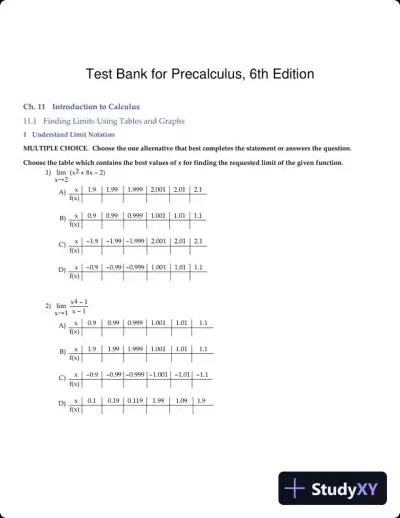 Exam Guides
Test Bank for Precalculus, 6th Edition
Mathematics
1051 pages175downloadsFeb 2025 Textbook Guides
Solution Manual For Introduction To Management Science, 11th Edition
Mathematics
437 pages167downloadsFeb 2025 Textbook Guides
Solution Manual For Derivatives Markets, 3rd Edition
Mathematics
358 pages143downloadsFeb 2025 Textbook Guides
Solution Manual for Geometry, 1st Edition
Mathematics
446 pages141downloadsFeb 2025 Textbook Guides
Solution Manual for Beginning Algebra, 7th Edition
Mathematics
479 pages139downloadsFeb 2025 Textbook Guides
Solution Manual for Developmental Mathematics, 1st Edition
Mathematics
1623 pages137downloadsFeb 2025 Textbook Guides
Solution Manual for Elementary and Intermediate Algebra: Graphs and Models, 5th Edition
Mathematics
1278 pages126downloadsFeb 2025 Exam Guides
Test Bank for Calculus: Concepts and Contexts, Enhanced 4th Edition
Mathematics
687 pages122downloadsFeb 2025
Study this document with CramX
Once it is in your library, every tool can work from it.