
Solution Manual For Calculus: Early Transcendentals, 8th Edition

Solution Manual For Calculus: Early Transcendentals, 8th Edition simplifies textbook problem-solving by offering clear and effective solutions to every problem.

Isabella White
Contributor
4.8
53
10 months ago
Preview (16 of 1630 Pages)
100%
Log in to unlock

Page 1

Solution Manual For Calculus: Early Transcendentals, 8th Edition - Page 1 preview image

Loading page ...

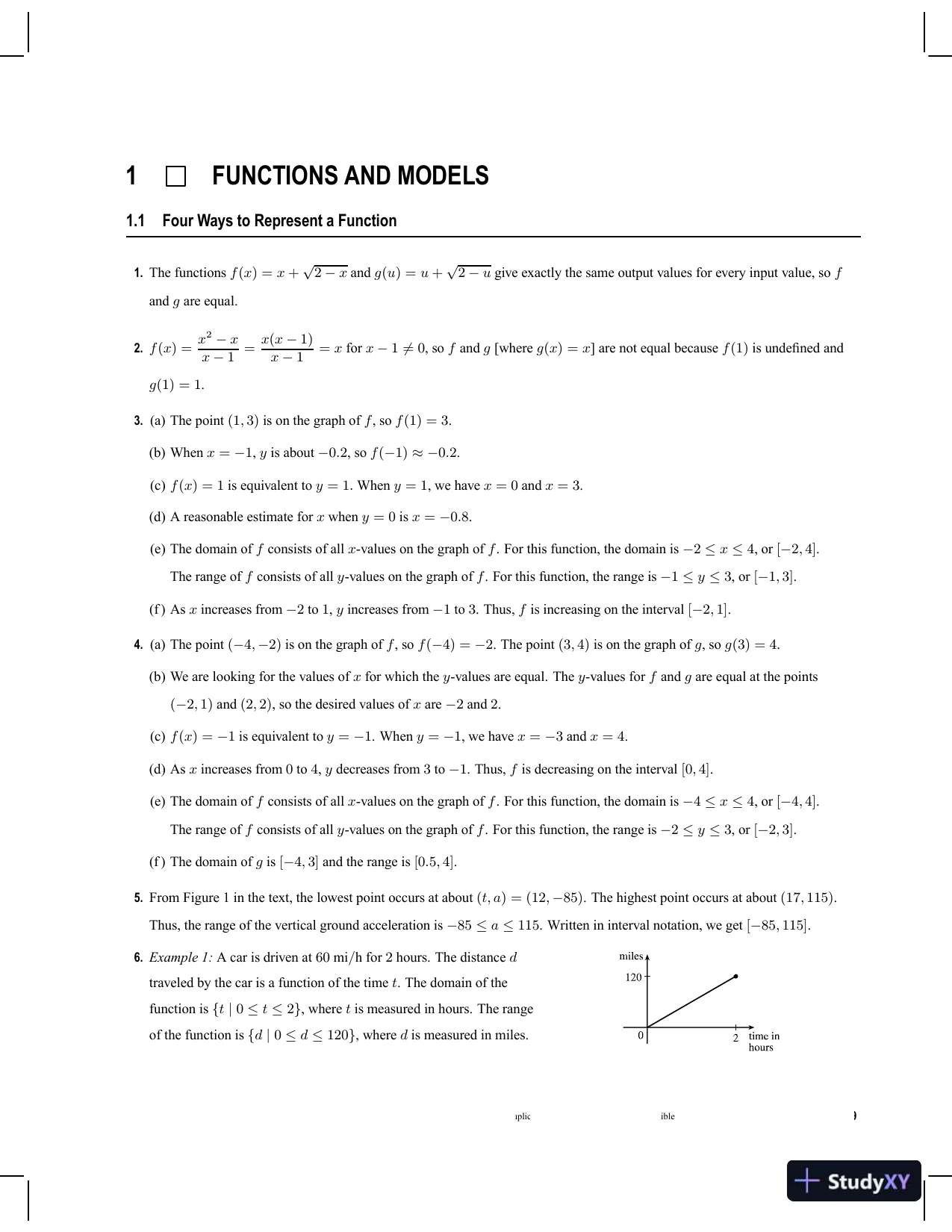
1FUNCTIONS AND MODELS1.1Four Ways to Represent a Function1.The functions() =+2and() =+2give exactly the same output values for every input value, soandare equal.2.() =21=(1)1=for16= 0, soand[where() =] are not equal because(1)is undefined and(1) = 1.3.(a) The point(13)is on the graph of, so(1) = 3.(b) When=1,is about02, so(1)≈ −02.(c)() = 1is equivalent to= 1When= 1, we have= 0and= 3.(d) A reasonable estimate forwhen= 0is=08.(e) The domain ofconsists of all-values on the graph of. For this function, the domain is24, or[24].The range ofconsists of all-values on the graph of. For this function, the range is13, or[13].(f ) Asincreases from2to1,increases from1to3. Thus,is increasing on the interval[21].4.(a) The point(42)is on the graph of, so(4) =2. The point(34)is on the graph of, so(3) = 4.(b) We are looking for the values offor which the-values are equal. The-values forandare equal at the points(21)and(22), so the desired values ofare2and2.(c)() =1is equivalent to=1. When=1, we have=3and= 4.(d) Asincreases from0to4,decreases from3to1. Thus,is decreasing on the interval[04].(e) The domain ofconsists of all-values on the graph of. For this function, the domain is44, or[44].The range ofconsists of all-values on the graph of. For this function, the range is23, or[23].(f ) The domain ofis[43]and the range is[054].5.From Figure 1 in the text, the lowest point occurs at about( ) = (1285). The highest point occurs at about(17115).Thus, the range of the vertical ground acceleration is85115. Written in interval notation, we get[85115].6.Example 1:A car is driven at60mih for2hours. The distancetraveled by the car is a function of the time. The domain of thefunction is{|02}, whereis measured in hours. The rangeof the function is{|0120}, whereis measured in miles.uplicible9

Page 2

Solution Manual For Calculus: Early Transcendentals, 8th Edition - Page 2 preview image

Loading page ...

Page 3

Solution Manual For Calculus: Early Transcendentals, 8th Edition - Page 3 preview image

Loading page ...

10¤CHAPTER 1FUNCTIONS AND MODELSExample 2:At a certain university, the number of studentsoncampus at any time on a particular day is a function of the timeaftermidnight. The domain of the function is{|024}, whereismeasured in hours. The range of the function is{|0},whereis an integer andis the largest number of students oncampus at once.Example 3:A certain employee is paid$800per hour and works amaximum of30hours per week. The number of hours worked isrounded down to the nearest quarter of an hour. This employee’sgross weekly payis a function of the number of hours worked.The domain of the function is[030]and the range of the function is{0200400    2380024000}.240payhours0.250.500.75029.50 29.7530242382367.No, the curve is not the graph of a function because a vertical line intersects the curve more than once. Hence, the curve failsthe Vertical Line Test.8.Yes, the curve is the graph of a function because it passes the Vertical Line Test. The domain is[22]and the rangeis[12].9.Yes, the curve is the graph of a function because it passes the Vertical Line Test. The domain is[32]and the rangeis[32)[13].10.No, the curve is not the graph of a function since for= 0,±1, and±2, there are infinitely many points on the curve.11.(a) When= 1950,138C, so the global average temperature in 1950 was about138C.(b) When= 142C,1990.(c) The global average temperature was smallest in 1910 (the year corresponding to the lowest point on the graph) and largestin 2005 (the year corresponding to the highest point on the graph).(d) When= 1910,135C, and when= 2005,145C. Thus, the range ofis about[135,145].12.(a) The ring width varies from near0 mmto about16 mm, so the range of the ring width function is approximately[016].(b) According to the graph, the earth gradually cooled from 1550 to 1700, warmed into the late 1700s, cooled again into thelate 1800s, and has been steadily warming since then. In the mid-19th century, there was variation that could have beenassociated with volcanic eruptions.13.The water will cool down almost to freezing as the ice melts. Then, whenthe ice has melted, the water will slowly warm up to room temperature.post, in

Page 4

Solution Manual For Calculus: Early Transcendentals, 8th Edition - Page 4 preview image

Loading page ...

SECTION 1.1FOUR WAYS TO REPRESENT A FUNCTION¤1114.Runner A won the race, reaching thefinish line at100meters in about15seconds, followed by runner B with a time of about19seconds, and then by runner C whofinished in around23seconds. B initially led the race, followed by C, and then A.C then passed B to lead for a while. Then A passedfirst B, and then passed C to take the lead andfinishfirst. Finally,B passed C tofinish in second place. All three runners completed the race.15.(a) The power consumption at 6AMis500 MWwhich is obtained by reading the value of powerwhen= 6from thegraph. At 6PMwe read the value ofwhen= 18obtaining approximately730 MW(b) The minimum power consumption is determined byfinding the time for the lowest point on the graph,= 4or4AM. Themaximum power consumption corresponds to the highest point on the graph, which occurs just before= 12or rightbefore noon. These times are reasonable, considering the power consumption schedules of most individuals andbusinesses.16.The summer solstice (the longest day of the year) isaround June 21, and the winter solstice (the shortest day)is around December 22. (Exchange the dates for thesouthern hemisphere.)17.Of course, this graph depends strongly on thegeographical location!18.The value of the car decreases fairly rapidly initially, thensomewhat less rapidly.19.As the price increases, the amount sold decreases.20.The temperature of the pie would increase rapidly, leveloff to oven temperature, decrease rapidly, and then leveloff to room temperature.21.orducessi

Page 5

Solution Manual For Calculus: Early Transcendentals, 8th Edition - Page 5 preview image

Loading page ...

12¤CHAPTER 1FUNCTIONS AND MODELS22.(a)(b)(c)(d)23.(a)(b) 9:00AMcorresponds to= 9. When= 9, thetemperatureis about74F.24.(a)(b) The blood alcohol concentration rises rapidly, then slowlydecreases to near zero. Note that the BAC in this exercise ismeasured inmgmL, not percent.25.() = 32+ 2(2) = 3(2)22 + 2 = 122 + 2 = 12(2) = 3(2)2(2) + 2 = 12 + 2 + 2 = 16() = 32+ 2() = 3()2() + 2 = 32++ 2(+ 1) = 3(+ 1)2(+ 1) + 2 = 3(2+ 2+ 1)1 + 2 = 32+ 6+ 3+ 1 = 32+ 5+ 42() = 2·() = 2(32+ 2) = 622+ 4post, in

Page 6

Solution Manual For Calculus: Early Transcendentals, 8th Edition - Page 6 preview image

Loading page ...

SECTION 1.1FOUR WAYS TO REPRESENT A FUNCTION¤13(2) = 3(2)2(2) + 2 = 3(42)2+ 2 = 1222+ 2(2) = 3(2)2(2) + 2 = 3(4)2+ 2 = 342+ 2[()]2=32+ 22=32+ 232+ 2= 9433+ 6233+22+ 622+ 4 = 9463+ 1324+ 4(+) = 3(+)2(+) + 2 = 3(2+ 2+2)+ 2 = 32+ 6+ 32+ 226.A spherical balloon with radius+ 1has volume(+ 1) =43(+ 1)3=43(3+ 32+ 3+ 1). We wish tofind theamount of air needed to inflate the balloon from a radius ofto+ 1. Hence, we need tofind the difference(+ 1)() =43(3+ 32+ 3+ 1)433=43(32+ 3+ 1).27.() = 4 + 32, so(3 +) = 4 + 3(3 +)(3 +)2= 4 + 9 + 3(9 + 6+2) = 432,and(3 +)(3)= (432)4=(3)=3.28.() =3, so(+) = (+)3=3+ 32+ 32+3,and(+)()= (3+ 32+ 32+3)3=(32+ 3+2)= 32+ 3+2.29.()()=11==() =1()() =130.()(1)1=+ 3+ 121=+ 32(+ 1)+ 11=+ 322(+ 1)(1)=+ 1(+ 1)(1) =(1)(+ 1)(1) =1+ 131.() = (+ 4)(29)is defined for allexcept when0 =290 = (+ 3)(3)=3or3, so thedomain is{R|6=33}= (−∞3)(33)(3).32.() = (235)(2+6)is defined for allexcept when0 =2+60 = (+ 3)(2)=3or2, so the domain is{R|6=32}= (−∞3)(32)(2).33.() =321is defined for all real numbers. In fact3(), where()is a polynomial, is defined for all real numbers.Thus, the domain isRor(−∞).34.() =32 +is defined when303and2 +0≥ −2. Thus, the domain is23, or[23].35.() = 1425is defined when25 0(5)0. Note that256= 0since that would result indivision by zero. The expression(5)is positive if 0or 5. (See Appendix A for methods for solvinginequalities.) Thus, the domain is(−∞0)(5).or ducessi

Page 7

Solution Manual For Calculus: Early Transcendentals, 8th Edition - Page 7 preview image

Loading page ...

14¤CHAPTER 1FUNCTIONS AND MODELS36.() =+ 11 +1+ 1is defined when+ 16= 0[6=1] and1 +1+ 16= 0. Since1 +1+ 1 = 01+ 1 =11 =1=2, the domain is{|6=2,6=1}= (−∞2)(21)(1).37.() =2is defined when0and20. Since202204, the domain is[04].38.() =42. Now=422= 422+2= 4, sothe graph is the top half of a circle of radius2with center at the origin. The domainis|420=|42={|2||}= [22]. From the graph,the range is02, or[02].39.The domain of() = 1624is the set of all real numbers, denoted byRor(−∞). The graph offis a line with slope16andy-intercept24.40.Note that() =21+ 1= (+ 1)(1)+ 1=1for+ 16= 0, i.e.,6=1.The domain ofis the set of all real numbers except1. In interval notation, wehave(−∞1)(1). The graph ofis a line with slope1,-intercept1,and a hole at=1.41.() =+ 2if 01if0(3) =3 + 2 =1,(0) = 10 = 1, and(2) = 12 =1.42.() =312if 225if2(3) = 312(3) =92,(0) = 312(0) = 3,and(2) = 2(2)5 =1.43.() =+ 1if≤ −12if 1(3) =3 + 1 =2,(0) = 02= 0, and(2) = 22= 4.post, in

Page 8

Solution Manual For Calculus: Early Transcendentals, 8th Edition - Page 8 preview image

Loading page ...

SECTION 1.1FOUR WAYS TO REPRESENT A FUNCTION¤1544.() =1if172if 1(3) =1,(0) =1, and(2) = 72(2) = 3.45.||=if0if 0so() =+||=2if00if 0Graph the line= 2for0and graph= 0(the-axis) for 046.() =|+ 2|=+ 2if+ 20(+ 2)if+ 20=+ 2if≥ −22if 247.() =|13|=13if130(13)if13 0=13if1331if 1348.||=if0if 0and|+ 1|=+ 1if+ 10(+ 1)if+ 10 =+ 1if≥ −11if 1so() =||+|+ 1|=+ (+ 1)if0+ (+ 1)if1 0+ (1)if 1=2+ 1if01if1 021if 1orducessi

Page 9

Solution Manual For Calculus: Early Transcendentals, 8th Edition - Page 9 preview image

Loading page ...

16¤CHAPTER 1FUNCTIONS AND MODELS49.To graph() =||if||11if||1, graph=||(Figure 16)for11and graph= 1for 1and for 1.We could rewritefas() =1if 1if1 0if011if 1.50.() =||1=||1if||10(||1)if||10=||1if||1||+ 1if||1=1if||1and01if||1and 0+ 1if||1and0() + 1if||1and 0=1if11if≤ −1+ 1if0 1+ 1if1  051.Recall that the slopeof a line between the two points(1 1)and(2 2)is=2121and an equation of the lineconnecting those two points is1=(1). The slope of the line segment joining the points(13)and(57)is7(3)51= 52, so an equation is(3) =52(1). The function is() =52112,15.52.The slope of the line segment joining the points(510)and(710)is10107(5) =53, so an equation is10 =53[(5)]. The function is() =53+53,57.53.We need to solve the given equation for.+ (1)2= 0(1)2=1 =±= 1±. The expression with the positive radical represents the top half of the parabola, and the one with the negativeradical represents the bottom half. Hence, we want() = 1. Note that the domain is0.54.2+ (2)2= 4(2)2= 422 =±42= 2±42. The top half is given bythe function() = 2 +42,22.55.For03, the graph is the line with slope1and-intercept3, that is,=+ 3. For3 5, the graph is the linewith slope2passing through(30); that is,0 = 2(3), or= 26. So the function is() =+ 3if0326if3 556.For4≤ −2, the graph is the line with slope32passing through(20); that is,0 =32[(2)], or=323. For2  2, the graph is the top half of the circle with center(00)and radius2. An equation of the circlepost, in

Page 10

Solution Manual For Calculus: Early Transcendentals, 8th Edition - Page 10 preview image

Loading page ...

SECTION 1.1FOUR WAYS TO REPRESENT A FUNCTION¤17is2+2= 4, so an equation of the top half is=42. For24, the graph is the line with slope32passingthrough(20); that is,0 =32(2), or=323. So the function is() =323if4≤ −242if2  2323if2457.Let the length and width of the rectangle beand. Then the perimeter is2+ 2= 20and the area is=.Solving thefirst equation forin terms ofgives= 2022= 10. Thus,() =(10) = 102. Sincelengths are positive, the domain ofis0  10. If we further restrictto be larger than, then5  10would bethe domain.58.Let the length and width of the rectangle beand. Then the area is= 16, so that= 16. The perimeter is= 2+ 2, so() = 2+ 2(16) = 2+ 32, and the domain ofis 0, since lengths must be positivequantities. If we further restrictto be larger than, then 4would be the domain.59.Let the length of a side of the equilateral triangle be. Then by the Pythagorean Theorem, the heightof the triangle satisfies2+122=2, so that2=2142=342and=32. Using the formula for the areaof a triangle,=12(base)(height), we obtain() =12()32=342, with domain 0.60.Let the length, width, and height of the closed rectangular box be denoted by,, and, respectively. The length is twicethe width, so= 2. The volumeof the box is given by=. Since= 8, we have8 = (2)8 = 22=822=42, and so=() =42.61.Let each side of the base of the box have length, and let the height of the box be. Since the volume is2, we know that2 =2, so that= 22, and the surface area is=2+ 4. Thus,() =2+ 4(22) =2+ (8), withdomain 0.62.The area of the window is=+12122=+28, whereis the height of the rectangular portion of the window.The perimeter is= 2++12= 302= 3012=14(602). Thus,() =6024+28= 1512242+82= 1548282= 152+ 48.Since the lengthsandmust be positive quantities, we have 0and 0. For 0, we have2 03012 0602+ 602 +. Hence, the domain ofis0  602 +.63.The height of the box isand the length and width are= 202,= 122. Then= and so() = (202)(122)() = 4(10)(6)() = 4(6016+2) = 43642+ 240.The sides,, andmust be positive. Thus, 0202 0 10; 0122 0 6; and 0. Combining these restrictions gives us the domain0  6.or ducessi

Page 11

Solution Manual For Calculus: Early Transcendentals, 8th Edition - Page 11 preview image

Loading page ...

18¤CHAPTER 1FUNCTIONS AND MODELS64.We can summarize the monthly cost with a piecewisedefined function.() =35if040035 + 010(400)if 40065.We can summarize the amount of thefine with apiecewise defined function.() =15(40)if0 400if406515(65)if 6566.For thefirst1200 kWh,() = 10 + 006.For usage over1200 kWh, the cost is() = 10 + 006(1200) + 007(1200) = 82 + 007(1200).Thus,() =10 + 006if0120082 + 007(1200)if 120067.(a)(b) On$14,000, tax is assessed on$4000, and10%($4000) = $400.On$26,000, tax is assessed on$16,000, and10%($10,000) + 15%($6000) = $1000 + $900 = $1900.(c) As in part (b), there is $1000 tax assessed on $20,000 of income, sothe graph ofis a line segment from(10,0000)to(20,0001000).The tax on $30,000 is $2500, so the graph offor 20,000isthe ray with initial point(20,0001000)that passes through(30,0002500).68.One example is the amount paid for cable or telephone system repair in the home, usually measured to the nearest quarter hour.Another example is the amount paid by a student in tuition fees, if the fees vary according to the number of credits for whichthe student has registered.69.is an odd function because its graph is symmetric about the origin.is an even function because its graph is symmetric withrespect to the-axis.post, in

Page 12

Solution Manual For Calculus: Early Transcendentals, 8th Edition - Page 12 preview image

Loading page ...

SECTION 1.1FOUR WAYS TO REPRESENT A FUNCTION¤1970.is not an even function since it is not symmetric with respect to the-axis.is not an odd function since it is not symmetricabout the origin. Hence,isneithereven nor odd.is an even function because its graph is symmetric with respect to the-axis.71.(a) Because an even function is symmetric with respect to the-axis, and the point(53)is on the graph of this even function,the point(53)must also be on its graph.(b) Because an odd function is symmetric with respect to the origin, and the point(53)is on the graph of this odd function,the point(53)must also be on its graph.72.(a) Ifis even, we get the rest of the graph by reflectingabout the-axis.(b) Ifis odd, we get the rest of the graph by rotating180about the origin.73.() =2+ 1.() =()2+ 1 =2+ 1 =2+ 1 =().Since() =(),is an odd function.74.() =24+ 1.() =()2()4+ 1 =24+ 1 =().Since() =(),is an even function.75.() =+ 1, so() =+ 1 =1.Since this is neither()nor(), the functionisneither even nor odd.76.() =||.() = ()||= ()||=(||)=()Since() =(),is an odd function.or ducessi

Page 13

Solution Manual For Calculus: Early Transcendentals, 8th Edition - Page 13 preview image

Loading page ...

20¤CHAPTER 1FUNCTIONS AND MODELS77.() = 1 + 324.() = 1+3()2()4= 1+324=().Since() =(),is an even function.78.() = 1 + 335, so() = 1 + 3()3()5= 1 + 3(3)(5)= 133+5Since this is neither()nor(), the functionisneither even nor odd.79.(i) Ifandare both even functions, then() =()and() =(). Now(+)() =() +() =() +() = (+)(), so+is anevenfunction.(ii) Ifandare both odd functions, then() =()and() =(). Now(+)() =() +() =() + [()] =[() +()] =(+)(), so+is anoddfunction.(iii) Ifis an even function andis an odd function, then(+)() =() +() =() + [()] =()(),which is not(+)()nor(+)(), s o+isneithereven nor odd. (Exception: ifis the zero function, then+will beodd. Ifis the zero function, then+will beeven.)80.(i) Ifandare both even functions, then() =()and() =(). Now( )() =()() =()() = ( )(), sois anevenfunction.(ii) Ifandare both odd functions, then() =()and() =(). Now( )() =()() = [()][()] =()() = ( )(), so is anevenfunction.(iii) Ifis an even function andis an odd function, then( )() =()() =()[()] =[()()] =( )(), so is anoddfunction.1.2Mathematical Models: A Catalog of Essential Functions1.(a)() = log2is a logarithmic function.(b)() =4is a root function with= 4.(c)() =2312is a rational function because it is a ratio of polynomials.(d)() = 111+ 2542is a polynomial of degree2(also called aquadratic function).(e)() = 5is an exponential function.(f )() = sincos2is a trigonometric function.post, in

Page 14

Solution Manual For Calculus: Early Transcendentals, 8th Edition - Page 14 preview image

Loading page ...

SECTION 1.2MATHEMATICAL MODELS: A CATALOG OF ESSENTIAL FUNCTIONS¤212.(a)=is an exponential function (notice thatis theexponent).(b)=is a power function (notice thatis thebase).(c)=2(23) = 225is a polynomial of degree5.(d)= tancosis a trigonometric function.(e)=(1 +)is a rational function because it is a ratio of polynomials.(f )=31(1 +3)is an algebraic function because it involves polynomials and roots of polynomials.3.We notice from thefigure thatandare even functions (symmetric with respect to the-axis) and thatis an odd function(symmetric with respect to the origin). So (b)=5must be. Sinceisflatter thannear the origin, we must have(c)=8matched withand (a)=2matched with.4.(a) The graph of= 3is a line (choice).(b)= 3is an exponential function (choice).(c)=3is an odd polynomial function or power function (choice).(d)=3=13is a root function (choice).5.The denominator cannot equal 0, so1sin6= 0sin6= 16=2+ 2. Thus, the domain of() =cos1sinis|6=2+ 2,an integer.6.The denominator cannot equal 0, so1tan6= 0tan6= 16=4+. The tangent function is not definedif6=2+. Thus, the domain of() =11tanis|6=4+,6=2+,an integer.7.(a) An equation for the family of linear functions with slope2is=() = 2+, whereis the-intercept.(b)(2) = 1means that the point(21)is on the graph of. We can use thepoint-slope form of a line to obtain an equation for the family of linearfunctions through the point(21).1 =(2), which is equivalentto=+ (12)in slope-intercept form.(c) To belong to both families, an equation must have slope= 2, so the equation in part (b),=+ (12),becomes= 23. It is theonlyfunction that belongs to both families.or ducessi

Page 15

Solution Manual For Calculus: Early Transcendentals, 8th Edition - Page 15 preview image

Loading page ...

22¤CHAPTER 1FUNCTIONS AND MODELS8.All members of the family of linear functions() = 1 +(+ 3)havegraphs that are lines passing through the point(31).9.All members of the family of linear functions() =have graphsthat are lines with slope1. The-intercept is.10.The vertex of the parabola on the left is(30), so an equation is=(3)2+ 0. Since the point(42)is on theparabola, we’ll substitute4forand2fortofind.2 =(43)2= 2, so an equation is() = 2(3)2.The-intercept of the parabola on the right is(01), so an equation is=2++ 1. Since the points(22)and(125)are on the parabola, we’ll substitute2forand2foras well as1forand25forto obtain two equationswith the unknownsand.(22):2 = 42+ 142= 1(1)(125):25 =++ 1+=35(2)2·(2)+(1)gives us6=6=1. F rom(2),1 +=35=25, so an equationis() =225+ 1.11.Since(1) =(0) =(2) = 0,has zeros of1,0, and2, so an equation foris() =[(1)](0)(2),or() =(+ 1)(2). Because(1) = 6, we’ll substitute1forand6for().6 =(1)(2)(1)2= 6=3, so an equation foris() =3(+ 1)(2).12.(a) For= 002+ 850, the slope is002, which means that the average surface temperature of the world is increasing at arate of002Cper year. The-intercept is850, which represents the average surface temperature inCin the year 1900.(b)= 21001900 = 200= 002(200) + 850 = 1250C13.(a)= 200, so= 00417(+ 1) = 00417(200)(+ 1) = 834+ 834. The slope is834, which represents thechange in mg of the dosage for a child for each change of 1 year in age.(b) For a newborn,= 0, so= 834mg.post, in

Page 16

Solution Manual For Calculus: Early Transcendentals, 8th Edition - Page 16 preview image

Loading page ...

SECTION 1.2MATHEMATICAL MODELS: A CATALOG OF ESSENTIAL FUNCTIONS¤2314.(a)(b) The slope of4means that for each increase of1dollar for arental space, the number of spaces renteddecreasesby4. The-intercept of200is the number of spaces that would be occupiedif there were no charge for each space. The-intercept of50is thesmallest rental fee that results in no spaces rented.15.(a)(b) The slope of95means thatincreases95degrees for each increaseof1C. (Equivalently,increases by9whenincreases by5anddecreases by9whendecreases by5.) The-intercept of32is the Fahrenheit temperature corresponding to a Celsiustemperature of0.16.(a) Let=distance traveled (in miles) and=time elapsed (in hours). At= 0,= 0and at= 50minutes= 50·160=56h,= 40. Thus wehave two points:(00)and5640, so= 400560 = 48and so= 48.(b)(c) The slope is48and represents the car’s speed in mih.17.(a) Usingin place ofandin place of, wefind the slope to be2121=8070173113 = 1060 = 16. So a linearequation is80 =16(173)80 =161736=16+30763076= 5116.(b) The slope of16means that the temperature in Fahrenheit degrees increases one-sixth as rapidly as the number of cricketchirps per minute. Said differently, each increase of6cricket chirps per minute corresponds to an increase of1F.(c) When= 150, the temperature is given approximately by=16(150) +3076= 7616F76F.18.(a) Letdenote the number of chairs produced in one day andthe associatedcost. Using the points(1002200)and(3004800), we get the slope48002200300100=2600200= 13. So2200 = 13(100)= 13+ 900.(b) The slope of the line in part (a) is13and it represents the cost (in dollars)of producing each additional chair.(c) The-intercept is900and it represents thefixed daily costs of operatingthe factory.19.(a) We are givenchange in pressure10feet change in depth= 43410= 0434. Usingfor pressure andfor depth with the point( ) = (015), we have the slope-intercept form of the line,= 0434+ 15.or ducessi
Preview Mode

This document has 1630 pages. Sign in to access the full document!