

Solution Manual for Introduction to Information Systems, 4th Edition
- Mathematics
- 217 pages
- Shared February 2025
- 97 downloads
Solution Manual for Introduction to Information Systems, 4th Edition makes solving textbook questions easier with expertly crafted solutions.
Preview 31 of 217 pages
See the first 31 pages exactly as they appear in the document.
Page 1 Read page 1 as text
Wallace, Introduction to Information Systems, 4th edition Instructor’s Manual Chapter 1, Information Systems and People 1 Chapter 1 Information Systems and People Learning Objectives 1. Describe the main roles that information systems play in organizations. 2. Compare the terms data , information , and knowledge , and describe three characteristics that make information valuable. 3. Describe the four main components of an information system and the role that each plays. 4. Identify several research areas that are studied in the discipline of management information systems (MIS). 5. Provide examples of how business, nonprofit, and government managers, as well as information technology departments, depend on information systems knowledge. 6. Explain how information systems present both promises and perils, and pose ethical questions. Solutions to Chapter Review Questions 1 - 1. What are the six primary roles that information systems play in o rganizations? How are information systems used in each context? What does digital transformation mean? Information systems play critical roles in (1) managing operations, (2) supporting customer interactions, (3) making decisions , (4) collaborat ing on teams , (5) gaining competitive advantage, and (6) improving individual productivity. In operations management, information systems are used to manage assets and inventories; track employee payroll, taxes, benefits , and timesheets; process transactions; track accounts payable and accounts receivable; procure goods and services ; and pay suppliers. Information systems that support customer interactions include customer relationship management systems, web - based front offices, online self - service applications, modern point - of - sale systems and self - service checkouts. Information systems support data - driven decision making by using both internal organizational data and external data from partners, suppliers
Page 2 Page 3 Read page 3 as text
Wallace, Introduction to Information Systems, 4th edition Instructor’s Manual Chapter 1, Information Systems and People 2 and public sources. Smart managers use aggregated data to identify trends and patterns rather than rely on gut instincts. Collaboration and teamwork have considerable support from information systems such as web applications that enable virtual meeting spaces and social networking sites. Microsoft’s SharePoint is an example of information technology that supports project teams with document management, shared calendars, and communication features. The innovative use of an information system can provide a competitive advantage until competitors jump on the bandwagon. Consider how Apple’s iPhone got the jump on smartphone com petitors with Siri, the intelli gent personal assistant. The selection of information systems and technology to improve personal productivity ranges from use of email and smartphones to word processing programs and contact databases. The challenge for most people is to pick easy - to - use software and devices that integrate with existing applications. Digital transformation is how organizations develop new business models by integrating digital technologies into all aspects of the business, including relationships with customers, suppliers, and partners. 1 - 2. How is data different from information? How is information different from knowledge? What are examples of each? Data refers to individual facts or pieces of information, and information refers to data or facts that are assembled and analyzed to add meaning and usefulness. A patient’s temperature reading is one piece of data; however, when combined with other pieces of data in a patient records information system, it becomes information that is useful for diagnostic purposes. Aggregated with data from other patients, it can be further refined and analyzed to become knowledge of a flu out break that is even more useful. 1 - 3. What are the three characteristics that make information valuable? Why is each a critical attribute of information? The three characteristics that make information valuable are timeliness, accuracy , and completeness. Timeliness is a critical attribute for certain kinds of information, such as stock prices. Accuracy is a critical attribute for some information, such as a patient’s temperature reading. On the other hand, extreme accuracy may not be necessary for certain kinds of information, such as a competitor’s price for a rival product. Completeness is a critical attribute for some information, such as a patient’s list of current medications. In the context of a marketing survey, complete information adds value as a means to avoid bias or spin. 1 - 4. What are the four components of an information system? Describe each component. What are the five functions that these components provide?
Page 4 Read page 4 as text
Wallace, Introduction to Information Systems, 4th edition Instructor’s Manual Chapter 1, Information Systems and People 3 The four components of an information system are (1) people, (2) technology, (3) processes , and (4) data. People interact with information systems in various roles such as systems analysis and developers, managers, users, customers, contributors , and sometimes roadblocks . Information technology includes hardware, software, and telecommunications equipment. Business processes are activities designed to achieve a task, such as automatically generating form letters to students. Data are individual facts or pieces of information . These four components are used to collect, process, manage, analyze, and distribute information. 1 - 5. How are information systems important to managers in a variety of functional business units? What are examples of ways that information systems are important to the success of a marketing department, a human resources department, and a small business owner? Information systems are important to business managers because they support the company’s business activities throughout every functional department. Information systems are used to streamline processes, reduce costs, increase revenue, or launch that “killer app . ” A marketing manager who knows how to analyze big data from multiple sources will make much smarter decisions about how to spend the marketing budget most effectively. A talent development professional who has experience launching effective e - learning modules will reach more employees for far less money compared with the trainer who hands out three - ring binders in face - to - face classes. The online learning programs can also be easily updated, while information in the binders grows stale quickly. Self - employed consultants with knowledge of information systems can launch websites, build social networks, and maximize profits from online ads — all for very little money. 1 - 6. What are the functional areas that are common to most information technology departments? Common functional areas in an information systems department include help desk, systems administration, data center operations, enterprise systems and applications , and telecommunications and network services. 1 - 7. What is the role of the chief information officer ? The chief information officer (CIO) heads the IT department, and is responsible for managing and maintaining information systems and ensuring they support the organization’s strategic goals . The CIO might report directly to the CEO or the vice president of finance and administration. 1 - 8. What are some of the perils of information systems? What are some of the ethical questions associated with the use of information systems?
Page 5 Read page 5 as text
Wallace, Introduction to Information Systems, 4th edition Instructor’s Manual Chapter 1, Information Systems and People 4 The perils of information systems include the increased risk of privacy breaches and amplification effects that result from interconnected systems. A number of ethical questions are associated with the use of information systems: Who is responsible for the damage caused by a privacy breach? Who is responsible when false, damaging, or illegal videos are shared on the i nternet ? Is it unethical to broadcast an email message received by mistake? Solutions to Projects and Discussion Questions 1 - 9. As customers, students, patients, taxpayers, and citizens, we are surrounded by information systems that support customer interactions. Identify and describe two such systems that you have used. Briefly describe the types of customer interactions you have experienced with these systems and compare what you found to be important features of each one. Are there features or function s that you would change or add to either system? Answers will vary, as the object of this question is to prompt the student to consider features of an information system. An example is a student registration system that allows students to browse class offerings, review course descriptions and required textbooks, and register for classes. 1 - 10. Web conferencing has been available for many years. In this market space, products from Adobe, Cisco, Citrix, IBM, and Microsoft compete with lower - cost or free web - conferencing applications from Zoom, AnyMeeting , and others. What are some of the advantages of using a virtual meeting space? Are there disadvantages? Search the web to learn more about online meeting rooms and prepare a five - minute presentation of your findings. The benefits of virtual meetings include saved time and money, increased productivity, increased meeting participation, and the ability to record meetings for presentation at a later date. On the other hand, virtual meeting participants may be less likely to build strong, personal relationships, and they may be more likely to experience distractions and engage in multitasking ( e.g ., checking email ) during the meeting. Acquiring the necessary technology and training in the use of that technology are additional drawbacks of virtual meetings. 1 - 11. Information systems play a very large role in decision making, and many would argue that you can always use more information to make better decisions. But sometimes digging deeply for more information leads to troubling ethical dilemmas. Visit 23andme.com, the website of a company that offers to read your DNA from saliva for a flat fee and provide reports about disease risk factors, ancestral lineage, and more. If you learn of a significant health risk, should you tell siblings who chose not to investigate their own DNA? Should you tell your significant other ? List factors you should take into account when making decisions about whether to obtain information like this and how to use it.
Page 6 Read page 6 as text
Wallace, Introduction to Information Systems, 4th edition Instructor’s Manual Chapter 1, Information Systems and People 5 Answers to this question will vary based on the student’s perspective and experience. Potential factors that students may identify are the physical and psychological health of their friends and family, their own physical and psychological health, and potential impact to past and future relationships. 1 - 12. One way to be more productive and manage time efficiently, is to use the calendar feature of fered by many email system s, such as Microsoft Outlook or Gmail . C reate a calendar for the semester that shows class times as well as test dates and project due dates. If you have a smartphone, you may be able to sync your calendar to an app so you always have it handy. Which reminder option did you select for class times? Which reminder option did you select for project due dates? Briefly describe several benefits of using the calendar feature. Answers will vary , as the object of this question is to require students to work with software that enhances productivity . At a minimum, students should be able to list several benefits of the Outlook or Gmail calendar feature s , which include the ability to mark items such as appointments, meetings, or all - day events, and to specify items as recurring or one - time events. The scheduling option is used to invite others to a meeting . Reminders can be set anywhere from 15 minutes up to five days prior to an appointment. 1 - 13. Netflix has grown to more than million s of customers who can stream movies and TV episodes to any i nternet - connected device or request DVDs by mail. Describe Netflix in terms of (1) the types of information technology it uses and (2) its customer - facing business processes. Answers supplied by students will vary, but generally should be drawn from chapter information contained in Section 1.3 : The Components of an Information System. Answers should include brief statements relating to people, technology, processes, and data.
Page 7 Read page 7 as text
Wallace, Introduction to Information Systems, 4th edition Instructor’s Manual Chapter 1, Information Systems and People 6 1 - 14. Consider the information that is maintained by a bank . I n addition to customer records, the bank maintains records on accounts and loans. Figure 1 - 20 and Figure 1 - 21 (below) are two examples of database tables for a regional bank. How might this data be aggregated and analyzed to create information and knowledge? Figure 1 - 20 Customers t able CustomerID Name Address City State Zip 100001 Don Baker 1215 E. New York Aurora IL 60504 100002 Yuxiang Jiang 1230 Douglas Road Oswego IL 60543 100003 Emily Brown 632 Fox Valley Road Aurora IL 60504 100004 Mario Sanchez 24 E. Ogden Naperville IL 60563 Figure 1 - 21 Accounts t able CustomerID AccountNumber AccountType DateOpened Balance 100001 4875940 Checking 10/19/1971 2500.00 100001 1660375 Savings 08/10/1973 1200.00 100002 1783032 Savings 05/15/1987 500.00 100002 4793289 Checking 05/15/1987 3200.00 100003 6213690 Checking 02/14/1996 6700.00 100004 1890571 Savings 10/16/2007 5300.00 100004 8390126 Checking 12/02/2008 2700.00 Answers will vary but the student should be able to provide several examples. For instance, the student may discuss how customer data may be aggregated with account data to create information such as a table showing customers in zip code 60504 having a savings account, and how customer data and account data may be aggregated and analyzed to create higher - level knowledge , such as which customers may be prospects for a CD savings account or a consumer loan. 1 - 15. Parking is a problem at many universities across the United States. Is it a problem on your campus? Describe the business process to acquire a parking pass at your school. Can you get a parking pass online? Can you get one in person? How does your process compare with that of a n organization that uses a paper form to apply for a parking permit? How can that organization use an information system to improve this business process? Can you think of a business process at your college or university that can be improved with an information system? Answers will vary depending on the business process evaluated. Students should be able to provide a comprehensive description of the process they use to acquire a parking pass and a comparison to the process used at a smaller school. They may identify a process they have experienced that can be improved or eliminated with the help of information systems.
Page 8 Read page 8 as text
Wallace, Introduction to Information Systems, 4th edition Instructor’s Manual Chapter 1, Information Systems and People 7 1 - 16. A typical information technology department is comp osed of common functional areas, and each requires skills and competencies unique to that area. Scan the web or visit an online job search site such as careerbuilder.com or monster.com to learn more about the IT functional areas described in Figure 1 - 15 . Select two functional areas and compare job postings for each. In a brief report, contrast the differences in education, experience, and technical certification that are required for each job. Answers will vary depending on the website s accessed. Job titles generally should be drawn from information contained in Figure 1 - 1 6 . Students may identify network and security certifications such as CCNA (Cisco Certified Network Associate), CCNP (Cisco Certified Network Professional), and CompTIA’s A+, Network+ , and Security+ certifications. 1 - 17. In June, 2010, a security breach in the AT&T network exposed the email addresses of 114,000 Apple iPad 3G owners, many of whom were well - known business executives. The list of subscribers whose data was released included TV journalist Diane Sawyer, former New York City Mayor Michael Bloomberg, and former White House Chief of Staff and Chicago Mayor Rahm Emanuel. Work in a small group with classmates to consider the severity of this leak of private information. In this case, is the severity of the breach measured by the number of affected individuals or by the high - profile status of some of the subscribers? What criteria are best for judging the severity of a data leak? Prepare a brief summary of your group discussion. Answers will vary but students should weigh the factors that they consider important in judging the scope of the damage, and defend their criteria. The extent of harm done directly and indirectly should be considered, whether or not high profile individuals are involved. 1 - 18. Information systems are fundamental to the success of every functional business unit within an organization, from marketing to manufacturing to finance. Work in a small group with classmates to share your career choice and discuss how information systems support processes within your field. Can you name types of software applications that are used in your chosen career? Answers will vary depending on students’ career choices. Students should discuss how information systems support processes within a given field in the context of the different roles information systems play in different organizations. Accounting majors may identify QuickBooks or NetSuite accounting programs. Marketing majors may identify email marketing or i nternet marketing software programs. Information technology majors may identify project management software programs.
Page 9 Read page 9 as text
Wallace, Introduction to Information Systems, 4th edition Instructor’s Manual Chapter 1, Information Systems and People 8 Solutions to Application Exercises 1 - 19 . Excel Application : Staff Planning Spreadsheet Precision Products specializes in custom - manufactured metal parts. The production manager has asked you to create an Excel spreadsheet to help m anage operations. The company needs a way to calculate staffing requirements (number of employees) based on different levels of production. The five manufacturing operations are fabrication, welding, machining, assembly, and packaging. One unit of production requires 1.5 hours for fabrication, 2.25 hours for welding, 0.7 hours for machining, 3.2 hours for assembly, and 0.5 hours for packaging. Download the Excel file Ch01Ex01 ( Figure 1 .22)and then calculate the weekly staffing required, at 40 hours per week, for production levels of 200, 300, 400 , and 500 units. How does the total required for each level of production change if Precision Products operates a 45 - hour production schedule? In the file Excel Ch01Ex01, students should go to the cell containing 40 (Weekly Requirement ) hours and change it to 45; the formula would then recalculate the Total Requirement amount. Refer to the Ch01Ex01_Solution file. Figure 1 .22 Managing operations at Precision Products using Excel.
Page 10 Read page 10 as text
Wallace, Introduction to Information Systems, 4th edition Instructor’s Manual Chapter 1, Information Systems and People 9 1 - 20 . Access Application : Information Systems in Business Seconds Later, a clothing consignment shop, is fast becoming a favorite place to shop. T he owner has asked you to create an Access database to help manage inventory. Download and import the information p rovided in the spreadsheet Ch01Ex02 to crea te a database with two tables (C on signors and I tems). The owner wants you to add a calculated field to the I tems table that shows the net selling price after he has paid the com mission to the consignors . S tart with two reports: an Inventory Report and a Consignor Report. The Inventory Report summarizes the inventory by item type. This report will include the number of items and the total selling price for each item type plus the total sales value of each inventory type. It will also include the total potential commission that the consignors will earn if the owner sells all items. The Consignor Report will list the total number of items and the total selling price and commission for each consignor. What other reports could you make with this d ata that would be useful to the owner ? Students should produce an Access database with two tables by importing data from the Excel file named Ch01Ex02. In Access, you can create table fields that calculate values. In the older Access 2007, calculated fields are created in a query. Students should create queries to produce the Inventory Report and the Consignor Report, using the Property sheet caption field to name the columns and the format function to show values as currency. Refer to the Ch01Ex02_Solution file.
Page 11 Read page 11 as text
Wallace, Introduction to Information Systems, 4th edition Instructor’s Manual Chapter 1, Information Systems and People 10 Solutions to Case Study Questions Case 1 — Trading at the Speed of Light: Nasdaq’s Information Challenges 1 - 21. How has Nasdaq’s business benefited from the use of information systems? The purpose of the first two questions for this case is to have students consider how information systems (IS) can transform an organization. Nasdaq is a technology company that would not be possible without IS. IS enabled Nasdaq to enter the trading market even after the NYSE was well established, to offer customers a full range of trading services even as a relatively new organization, and to achieve an advantage in speed compared with other exchanges. Further, IS are a source of revenue growth for Nasdaq, as Nasdaq has sold its technology to other countries and the IT department directly supports Nasdaq’s new business strategies. 1 - 22. What risks do information systems pose for Nasdaq’s business? The purpose of this question is to have students give a balanced consideration to the risks of IS as well as the benefits of IS. The benefits of IS were addressed in the previous question , and this question addresses risks. One risk is that IS lowers the cost of doing business for all firms in an industry, which is likely to lead to lower prices. Nasdaq must manage this risk by finding ways to remain profitable even in an environment of lower prices. A second risk is that IS can contribute to high market volatility, which could lead to a loss of investor confidence and cause instability for the entire industry. To manage this risk, Nasdaq would want to be involved in the creation of industry - wide technical and trading standards to achieve greater stability. 1 - 23. This chapter discusses the value of information. What types of information are handled through Nasdaq systems, what are the key characteristics of this information, and how do Nasdaq customers use this information to create value? The purpose of this question is to have students focus on the “information” aspect of IS. The most critical components of information handled through Nasdaq systems are the security name, price, seller, buyer, and time of the trade. One interesting characteristic is that this information is constantly changing. For example, from one moment to the next, the price of a security will change and the seller willing to sell the security at that price will change. Nasdaq customers create value based on access to timely information, as a customer may want to buy at a certain price, sell at a certain price, or transact on an exchange with a certain level of commission. 1 - 24. What does the example of Goldman Sachs paying to locate its server in the Nasdaq data center say about the relationship between information systems and physical operations?
Page 12 Read page 12 as text
Wallace, Introduction to Information Systems, 4th edition Instructor’s Manual Chapter 1, Information Systems and People 11 The purpose of this question is to help students understand the relationship between technical considerations and physical operations. This theme will surface in several cases throughout the textbook. Given the importance of timeliness to Nasdaq customers (see third question in this case study ), even with high - speed IS there is a small benefit in response time based on server location and the distance the information must travel to confirm trades . Trades are conducted within nanoseconds so any delays due to physical distance might be costly. Goldman Sachs is willing to pay a premium for server location, which represents yet another IS revenue source for Nasdaq. Even in automated operations, students will need to understand where physical location may still make a difference for firms, workers, and customers. Case 2 — Breaking News: Twitter’s Growing Role in Emergencies and Disaster Communications . 1 - 25. What are the potential benefits of Twitter and other social media for emergency and disaster communications? The purpose of the first two questions for this case is to have students consider how IS can transform a public service . Although emergency and disaster communications have developed through the years based on existing technologies (such as an air horn for a tornado watch, or the Federal Emergency Alert System [EAS] through television and radio), new technologies such as Twitter and social media offer potential benefits for these communications. For example, social media enable emergency and disaster communications to originate from multiple locations at the same time (while an air horn or a news reporter operates from only one location at a time). Social media also enable emergency and disaster communications to be constantly updated in real time. 1 - 26. What are the potential risks of using Twitter and other social media for emergency and disaster communications? T he purpose of this question is to have students give a balanced consideration to the risks of IS as well as the benefits of IS. The benefits of IS were addressed in the previous question for this case study above, and this question addresses risks. One risk is that the IT and telecommunications infrastructure on which social media operate s could be overloaded or cease to operate in a disaster. For example, on September 11, 2001 many mobile phone circuits in large cities were overloaded by excessive demand. To manage this risk, providers would need to look at the robustness of their infrastructure in the face of peak demand, and the flexibility of infrastructure to reroute traffic if some nodes are damaged. A second risk is that because various individual citizens are preparing updates, the updates may vary in depth and accuracy. Management of this risk will be discussed in the next question.
Page 13 Read page 13 as text
Wallace, Introduction to Information Systems, 4th edition Instructor’s Manual Chapter 1, Information Systems and People 12 1 - 27. What types of education would be necessary at the user level to make Twitter and other social media more effective for emergency and disaster communications? The purpose of this question is to have students consider the value chain in social media. As social media begins to play a role in functions (such as public safety) that were previously hand l ed by firms, students need to understand how the related value chains may be impacted. The key objectives of educating citizens on the use of social media in emergencies would be to reduce variability and increase quality and timeliness of communications. Accordingly, it would be useful to educate citizens on basic principles (such as syntax) of using social media for emergency communications. It is also important to remind citizens to issue genuine communications, and to prioritize urgent communications during an emergency or disaster. 1 - 28. What would need to happen on the part of aid organizations and traditional media for Twitter and other social media to be effective in emergency and disaster communications? The purpose of this question is for students to continue the discussion from the third question for this case study and consider the value chain implications of using social media for emergency and disaster communications. Although citizens may originate the communications, aid organizations and traditional media would still need to monitor the communications, integrate the communications, and prioritize the communications so that appropriate action can be taken. Aid organizations also need to coordinate directly with each other to ensure that they do not duplicate efforts in the response, and that they allocate resources efficiently to address all important areas in a timely manner. Solutions to E - Project Questions E - Project 1 — Analyzing the May 6 “Flash Crash” with Excel Charts 1 - 29. Download the Ch01_AAPL Excel file, which contains the high, low, and closing prices for Apple Computers between May 3 and May 14. (AAPL is the ticker symbol for Apple.) Open the file to see how the data are arranged in columns, with the first row showing the column headers. Refer to the Ch01_AAPL_Solution file. a) What was the closing price for Apple on May 6? On May 6, the closing price for Apple stock was $60.75 per share. b) What was the volume of trading for this stock on May 6? On May 6, there were 28,560,400 shares of Apple stock traded.
Page 14 Read page 14 as text
Wallace, Introduction to Information Systems, 4th edition Instructor’s Manual Chapter 1, Information Systems and People 13 1 - 30. Create a line graph from the AAPL data, in which the dates are on the x - axis (horizontal), and the stock prices are on the vertical y - axis. Include the opening price, high, low, and closing price on the graph. Add a title to the top of your chart. The line graph would appear as follows: 1 - 31. Download Expedia stock prices (ticker symbol EXPE) for the same time period (May 3 – May 14, 2010) from http://finance.yahoo.com. (Click on “ Historical Data” , under the current chart and prices .) a) Create a line graph to compare the l ow and c losing prices for Apple stock and Expedia stock. You do not need to include o pen and h igh prices on this graph. The line graph would appear as follows: b) How do you compare the activity on those two stocks? 35 40 45 50 55 60 65 05/03/10 05/04/10 05/05/10 05/06/10 05/07/10 05/08/10 05/09/10 05/10/10 05/11/10 05/12/10 05/13/10 05/14/10 Price Apple AAPL Open High Low Close 20 25 30 35 40 45 50 55 60 65 05/03/10 05/04/10 05/05/10 05/06/10 05/07/10 05/08/10 05/09/10 05/10/10 05/11/10 05/12/10 05/13/10 05/14/10 Price Apple AAPL and Expedia EXPE AAPL Low EXPE Low AAPL Close EXPE Close
Page 15 Read page 15 as text
Wallace, Introduction to Information Systems, 4th edition Instructor’s Manual Chapter 1, Information Systems and People 14 Apple experienced a significant intraday price decline (Low stock price) on May 6 during the “flash crash,” while Expedia did not experience a significant decline that day. E - Project 2 — Gathering, Visualizing, and Evaluating Reports from Twitter and Other Sources During a Disaster D ownload the Excel file called “Ch01_ OilSpill ,” which c ontain s sample reports , and answer the following questions (also refer to the Ch01_OilSpill_Solution file. : 1 - 32. First, select columns B through F and reformat them with word wrap so you can easily see the actual comments people sent in. Using word wrap the spreadsheet should now appear consistent with the sample of title and first two lines of data below: 1 - 33. Suppose you have a friend who lives in Bay Champagne. First sort the table by LOCATION, and scroll down to Bay Champagne. How many reports do you find using this strategy? Why would this approach be limited in terms of its ability to find all the events that may have affected your friend? Eight reports were found . This search strategy is limited for at least two reasons. First, a user may miscount the number of rows when data is sorted. Second, it is possible that Bay Champagne may be mistyped for other entries (for example, “Champagne Bay”) and may not show next to the other eight Bay Champagne entries in the spreadsheet.
Page 16 Read page 16 as text
Wallace, Introduction to Information Systems, 4th edition Instructor’s Manual Chapter 1, Information Systems and People 15 1 - 34. For crisis management, timeliness is important, but so is accuracy. How many reports in this sample were not verified (NO in the Verified column)? You can use Excel’s countif function to determine the number of NO s and YES es . What is the percentage of total reports that have not been verified? The verified column indicates that 791 out of 2464 reports (32.1 percent) have not been verified. 1 - 35. Sort the file by CATEGORY then by LOCATION. Take a look at the reports that are categorized as Health Effects in Grand Isle. Why do you think many of these reports are not verified? Many reports of Health Effects in Grand Isle involve internal symptoms (such as coughing or difficulty breathing) that may be more difficult to verify during a reporting visit. This may be partly because the symptom may not manifest during the reporting visit, and partly because the report data collection involved verbal interviews rather than medical examinations.
Page 17 Read page 17 as text
Wallace, Introduction to Information Systems, 4th edition Instructor’s Manual Chapter 2, Information Systems and Strategy 1 Chapter 2 Information Systems and Strategy Learning Objectives 1. Describe Porter’s five competitive forces that shape industry competition. 2. Explain how disruptive innovations, government policies, complementary products and services, and other factors affect how the competitive forces operate. 3. Identify the components of the value chain and explain its extended version. 4. Describe how information systems apply to competitive strategies for business. 5. Explain how information systems apply to strategy for nonprofit organizations and governments. 6. Explain why the role of information systems in organizations shift s depending on whether the systems are deployed to run, gr ow, or transform the business. Solutions to Chapter Review Questions 2 - 1. What are the five competitive forces that shape industry competition? How are these forces interrelated? The five forces that influence industry competition are (1) threat of new entrants, (2) power of buyers, (3) power of suppliers, (4) threat of substitutes, and (5) rivalry among existing competitors. The five forces determine industry structure and how profitable companies in the industry will be. The five interrelated forces are “internal” to the industry. 2 - 2. How do disruptive innovations, government policies, complementary products and services, and environmental events affect how the competitive forces operate? Disruptive innovations, government policies, compl e mentary products and services, and environmental are “external” forces that affect how the five forces operate. For example, certain innovations can flood through an industry like a tidal wave , changing everything in their path, forcing every company to either make changes or sink .
Page 18 Read page 18 as text
Wallace, Introduction to Information Systems, 4th edition Instructor’s Manual Chapter 2, Information Systems and Strategy 2 2 - 3. What are the components of the value chain? Which components comprise the primary activities? Which components comprise the support activities? What is the extended value chain? The primary activities of a value chain are: (1) bring in raw resources; (2) make the product or service; (3) market the product or service; (4) deliver the product or service; and (5) provide customer support. The support activities are: (1) administration and management; (2) human resources (3) technology support; and (4) procurement. The extended value chain links the company’s value chain with the value chains of its suppliers and its customers. 2 - 4. How do managers use benchmarks to analyze the value chain and IT spending? Organizations use the value chain model to compare their performance to industry benchmarks and identify areas that should be targeted for improvement. For example, an organization may compare its budget allocation to each value chain activity to industry benchmarks (i.e., average expenditures in its industry). IT benchmarks include average IT spending by industry and amount spent on IT per employee. 2 - 5. How do information systems apply to competitive strategies for business? All of the competitive strategies leverage information systems to achieve success. Low - cost leaders must automate as much as possible using information systems to reduce costs in many different ways depending on the industry. Organizations with a differentiated product or service often rely on innovations in IT to implement their strategy. 2 - 6. How are information systems used to run, grow, and transform a business? Information systems are used to run a business by supporting productivity throughout the organization, in every component of the value chain, helping to streamline processes in administration and management and improve customer loyalty. As a strategic enabler, IT can be used to grow and transform a business by facilitating a new business model or introducing disruptive innovations. 2 - 7. How do information systems apply to competitive strategies for nonprofit organizations? Nonprofit organizations can apply information systems to their competitive strategy in two critical areas: fund - raising and volunteer management. Specialized information systems assist nonprofits in managing donations and online fund - raising as well as building relationships with volunteers.
Page 19 Read page 19 as text
Wallace, Introduction to Information Systems, 4th edition Instructor’s Manual Chapter 2, Information Systems and Strategy 3 2 - 8. How do governments use information systems to improve services and fund research? Governments use information systems to improve services in varied ways depending on the specialized requirements and responsibilities of the agency providing the service. For example, the military uses real - time systems to support military personnel and material distribution; the Department of Natural Resources needs easy ways for people to report poachers who damage forests or hunt illegally, and the agency offers online tools for that; the US Internal Revenue Service must have information systems to support e - filing and to process millions of tax returns. Government funding is critical to certain kinds of research projects that private investors might avoid for various reasons including risk and uncertainty. For example, the internet was developed by the Defense Advanced Research Projects Agency. Currently, green sources of energy and the smart electricity grid are receiving significant funding from governments. Solutions to Projects and Discussion Questions 2 - 9. Although many people think electronic book readers are too expensive, there is a massive global demand for the devices , and the trend is likely to continue for some time. Search the web to learn more about how digital technology has disrupted the book publishing industry, and prepare a five - minute presentation of your findings. Answers will vary. At a minimum, students should be able to list several effects of digital technology on book publishing such as a decrease in sales of non - digital books and new options for self - publishing books and make them available on Kindle and iBooks and other websites. 2 - 10. The value that attracts million s of customers to McDonald’s every day comes from capabilities that are based in its value chain. Briefly describe McDonald’s value chain and discuss how information systems facilitate each component in the chain. Can you think of a way that information technology could improve your next trip to McDonald’s? Answers will vary but should include an example of at least one information system that is used in each component of the value chain and one improvement using information technology .
Page 20 Read page 20 as text
Wallace, Introduction to Information Systems, 4th edition Instructor’s Manual Chapter 2, Information Systems and Strategy 4 2 - 11. Information technology enables nonprofit organizations to reach out to constituents 24 hours a day, 7 days a week. Visit www.redcross.org and note the various ways this charity is using its website to communicate with volunteers, donors, and people who need assistance. Compare the Red Cross site to your university’s alumni association website . Prepare a brief summary of your findings that includes a list of specific services provided on each site. How does each website support the organization’s strategic goals? Answers will vary depending on the services made available by their local alumni association. Because the content of www.redcross.org may change, expected results will vary but should include services such as these: Get Assistance, Volunteer, Take a Class, and Give Blood. 2 - 12. Government agencies and corporations have similar information needs . Identify and briefly discuss specific examples of information systems typically used by a law enforcement agency such as a state or local police department. Whic h of these systems are used to “run” the business? Which are used t o fulfill the agency’s mission? Answers will vary , but should include an example of an information system used to manage operations such as human resource scheduling, payroll, or accounts payable. The mission of a state or local police department includes safeguarding the lives and property of the people it serves. Examples of systems to fulfill the agency’s mission may include systems to manage criminal history records, arrest warrants, stolen vehicles and property, fingerprint identification, sex - offender registration, and concealed handgun licenses. 2 - 13. What are the three basic strategies that companies adopt to compete ? Describe how information systems support each strategy. What is a “hybrid” strategy? Describe a company, product, or service that adopts each of these four competitive strategies. The three basic strategies are (1) low - cost leadership, (2) product differentiation, and (3) focused niche . The low - cost leadership strategy relies on information systems that automate and streamline processes and eliminate costly human labor. The product differentiation strategy requires systems that add special features or unique add - ons for which customers are willing to pay more. The focused niche strategy relies on special features for a particular market niche such as a business or government segment. A hybrid model incorporates aspects of several strategies . An example of a hybrid strategy is providing the best value for the lowest price . Answers will vary regarding names of companies, products, or services that adopt each of these competitive strategies. This question draws on the student’s ability to understand the four strategies and their knowledge of companies, products, and services.
Page 21 Read page 21 as text
Wallace, Introduction to Information Systems, 4th edition Instructor’s Manual Chapter 2, Information Systems and Strategy 5 2 - 14. T he U.S. federal government collect s trillion s in taxes each year, including individual income taxes, s ocial s ecurity/ s ocial i nsurance taxes, and corporate taxes. Visit www.ir s.gov and describe how this website enhances services to the public. What types of services are available to individuals? To businesses? To charities and non profit organizations? What kind of “tax information for students” does th is site provide? Prepare a five - minute presentation of your findings. The list of services provided at www.irs.gov could be extensive. For example, services provided to individuals include assistance with finding a “free file” provider, transmitting a tax return electronically, and checking on the status of a tax return. Services provided to businesses include electronic submission of tax returns, links to compliance and enforcement information, and taxpayer advocate services. Services provided to charities and nonprofit organizations are similar to those provided to businesses. Services provided to students include links to an interactive tax education program and information on education credits and student loan interest. Student lists will vary and should include specific services for each category of client.
Page 22 Read page 22 as text
Wallace, Introduction to Information Systems, 4th edition Instructor’s Manual Chapter 2, Information Systems and Strategy 6 2 - 15. Why are IT resources described as a commodity? How do IT resources “matter” in terms of the different roles they play in an organization? Which component of an information system is most critical to success in growing and transforming the business? Why? A commodity is a product for which quality is the same no matter who produces it. Examples are milk and paper. The price of a commodity fluctuates depending on supply and demand. Nicholas Carr suggests that IT resources have become so commonplace that their strategic importance has diminished, and they have become an infrastructure commodity, much like electricity. Information technology resources that are used to run the business generally fall into the commodity category where price competition is fierce. Consequently, organizations can avoid wasteful spending for these systems and get the best value for the lowest cost. On the other hand, information systems that are used to grow and transform an organization include the “people” component. Although many technologies are commodities, the ability to extract their value requires human imagination. Innovative business practices, new products and services, and changed processes come from talented people who know how to leverage information technology. 2 - 16. According to the Computer History Museum (www.computerhistory.org), the Kenbak Corporation sold the first personal computer in 1971. Since then, several billion PCs have been sold under various brand names. Work in a small group with classmates to analyze and describe the personal computer industry using the f ive c ompetitive forces model. Students should be able to provide a brief analysis that describes competitive rivalry as high due to little differentiation in PCs, supplier power that comes from the lack of substitutes for their input product and the cost associated with changing suppliers, and buyer power that comes from customer price sensitivity and the low cost of switching to another PC. The threat of substitutes is relatively high because it is easy for customers to switch to alternate products such as laptops, notebooks, and netbooks. The threat of a new entrant in this industry is relatively low due to barriers to entry such as acquiring necessary inputs from key suppliers.
Page 23 Read page 23 as text
Wallace, Introduction to Information Systems, 4th edition Instructor’s Manual Chapter 2, Information Systems and Strategy 7 2 - 17. Work in a small group with classmates to discuss how information technology plays a role in the competitive environment of your college or university. How do you describe the competition to attract and retain students? How do you describe the threat of substitutes in higher education? How does the threat of substitutes affect supplier power in education? Answers will vary. At a minimum, students should provide a list of ways that IT is used by their college or university to attract and retain students and discuss the competitive environment of their school. The threat of substitutes in higher education includes programs provided by community colleges and technical schools , as well as online degree programs offered by traditional and virtual universities. As students have more choices, supplier power for institutions of higher education is reduced. Solutions to Application Exercises 2 - 19. Excel Application: IT Benchmarks Jay’s Bikes is a family - owned and - operated business that stocks a wide range of bikes designed to fit the needs of professional riders, your child’s first bike, and everything in between. The business has 12 full - time employees. Download the Excel file Ch02Ex01 (Figure 2.21) to calculate average IT spending so that it can be compared with the retail industry average. Recall that average IT spending in the retail industry is about 2 percent of revenue. How do Jay’s IT expenditures compare with the industry average? How much would Jay need to change spending in order to match the retail industry average? Students should use formulas to calculate Jay’s average IT spending as a percent of revenue and his average IT spending per employee, then use Goal Seek to determine how much he needs to change IT expenditures to match the industry benchmark of 2 percent of revenue . To answer the question, “How much would Jay need to change spending in order to match the retail industry average?,” students should use a formulas to calculate (a) the difference between Jay’s current IT spending as a percent of revenue and the target spending as a percent of revenue and (b) the difference between Jay’s current IT spending per employee and the target spending per employee. Refer to Ch02Ex01_Solution file.
Page 24 Read page 24 as text
Wallace, Introduction to Information Systems, 4th edition Instructor’s Manual Chapter 2, Information Systems and Strategy 8 2 - 2 0. Access Application : Telethon Call Reports The volunteer coordinator of the Downtown Emergency Shelter has asked you to use the information provided in Figure 2 - 2 2 to create an Access database. (You can download the Excel file called Ch02Ex02 and import the data into your database.) The coordinator will use the database to manage donor records and help the shelter prepare for an upcoming Phonathon fundraising event. During the Phonathon, volunteers will call previous donors to ask for donations to this year’s fund. Your instructions are to create two tables (donors and volunteers) and prepare a Phonathon Call Report for each volunteer. The shelter manager wants you to add three fields to the donor table: this year’s contribution, a calculated field that shows the average contribution per employee, and a calculated field that shows a target contribution that is 5 percent higher than last year’s contribution. The report should list the volunteer’s name and number, as well as the following donor information: donor number, donor name, company name, phone number, contribution amount from the prior year, number of employees, average contribution per employee, and target contribution for this year. Although address information will not be included on the report, that information will be used to send receipts to the donors at the conclusion of this year’s fund - raising event. Students should produce an Access database with two tables by importing data from the Excel file named Ch02Ex02. Students should create a query to produce the Phonathon Call Report. The query includes two calculated fields: average contribution per employee
Page 25 Read page 25 as text
Wallace, Introduction to Information Systems, 4th edition Instructor’s Manual Chapter 2, Information Systems and Strategy 9 and target contribution per employee for the current year. Set the format for both fields to currency in the Property sheet. Refer to Ch02Ex01_Solution file. Solutions to Case Study Questions Case 1 — Can GameStop Survive with Its Brick - and - Mortar Stores? 2 - 21. Perform a five forces analysis of the online gaming industry. What are the implications of th e five forces analysis for GameS top? The purpose of this question is to have students apply a framework from the chapter to the case. A five forces analysis provides an idea of whether or not an industry would be attractive to enter. In the online gaming industry, entry barriers are reasonably low (implies that industry is not attractive), because all that is required to enter the industry are developers to program a game and a website to publish the game. There are numerous available substitutes (implies that industry is not attractive), as online gaming is only one of many forms of entertainment. Internal rivalry is increasing (implies that industry is not attractive) with multiple providers of online gaming. Buyer power is low (implies that industry is attractive), because buyers are individual consumers and no consumer wields undue market power. There is some supplier power (implies that industry is moderately attractive), because there may be a limit to the number of talented developers available for hire. This five forces analysis suggests that the online
Page 26 Read page 26 as text
Wallace, Introduction to Information Systems, 4th edition Instructor’s Manual Chapter 2, Information Systems and Strategy 10 gaming industry has low to moderate attractiveness. It is not necessary for students to arrive at this suggested answer, instead it is more important for students to get experience in performing and drawing implications from a five forces analysis. 2 - 22. What role have information systems played in the fiv e forces you identified ? Building from the five forces analysis in the previous question, IS plays a key role in at least three of the five forces. For example, one reason that barriers to entry are low is because online distribution reduces the barriers to entry. A game publisher does not require physical logistics to distribute games to retail locations ; the publisher can simply distribute directly to consumers via the internet . One reason that substitutes for online gaming are high is that the target demographic can use online social media (another form of entertainment) at no cost. One reason that internal rivalry is increasing is because existing retailers (such as GameStop) are adding online channels. It is not necessary for students to develop this precise analysis, instead it is more important for students to understand the relationship between IS and strategy. 2 - 23. How has GameS top used information systems to compete more effectively? The five forces analysis performed in questions 1 and 2 relate with GameStop’s evaluation of the industry and GameStop’s response to the industry. The purpose of this question is to have students understand how firms can incorporate IS as part of their strategy. GameStop acquired an online gaming company to embrace online gaming as a substitute for offline gaming and to enter that segment of the industry. Firms can use IS as a tool to implement their strategies. 2 - 24. What ot her strategic actions will GameS top need to take to protect its business? The purpose of this question is to have students understand that IS are only one component of strategy, and that organizations need to integrate IS together with other components to successfully execute a strategy. For this case, in addition to acquiring the online gaming company, GameStop will need to integrate operations of the online gaming company with its brick and mortar operations, to take advantage of GameStop’s physical footprint. Offering opportunities to earn PowerUP reward points is an example of how the company can attract more in - store customers. The company might also conduct gaming tournaments that further integrate its online presence with in - store events . GameStop management will need to think through whether the firm will compete more based on low price (in which case it might increase its focus on online gaming) or quality service (in which case it might maintain focus on the brick and mortar stores and personnel).
Page 27 Read page 27 as text
Wallace, Introduction to Information Systems, 4th edition Instructor’s Manual Chapter 2, Information Systems and Strategy 11 Case 2 — The Battle over Net Neutrality 2 - 25. What are the strategic interests of carriers? What are the strategic interests of website s? The purpose of this case is to give students the opportunity to think through strategic considerations at the industry level, as opposed to the firm level as in the GameStop case. In this case, the strategic interests of carriers such as Verizon and AT&T are not necessarily aligned with the strategic interests of website s such as YouTube and Facebook. Carriers argue that they have invested substantial financial resources to build internet capacity, and want to protect their ability to generate additional revenues from their investments. On the other hand, website s argue that their success depends on a direct connection to the customer and the ability to offer the customer an exceptional user experience. 2 - 26. How do the interests of carriers differ from the interests of website s? What are the implications for websites from a value chain perspective? The purpose of this question is to help students further understand the relationship between IS and strategy at the industry level. Building from t he first question for this case , one way for carriers to protect their investments and generate additional revenues would be to have users pay for enhanced internet connectivity. Another way for carriers to generate additional revenues would be to have websites pay for higher priority. On the other hand, website s would view less robust internet access for some users or website s (implied if not all users or websites pay for enhanced access) as interference to their user experience and business models . From a five forces perspective, the decision on net neutrality could dramatically impact the proportion of online revenues that accrue to carriers versus website s (carriers are one supplier for website s), and the relative attractiveness of each industry. 2 - 27. What is the basis for Verizon’s lawsuit against the Federal Communications Commission? Why did it claim a violation of free speech? This question helps students understand how companies can use the legal system to fight government regulations. As a carrier, Verizon is hindered by the FCC’s ruling in favor of net neutrality . Verizon is claiming a “violation of free speech” because the FCC’s rulings are taking away control over the carrier’s property, which in some contexts might be considered speech. Students might also answer this question more fully by researching the outcome of the case and the court’s response. 2 - 28. What are relevant considerations on the role government could play to resolve differences between carriers and websites? As in questions the first two questions for this case , the carriers have different interests than the websites. This situation is likely to require some resolution
Page 28 Read page 28 as text
Wallace, Introduction to Information Systems, 4th edition Instructor’s Manual Chapter 2, Information Systems and Strategy 12 between these differences. Governments also have conflicting considerations. On one hand, governments have a responsibility to protect the rights of citizens. On the other hand, governments have a responsibility to regulate commerce. Governments will need to balance these conflicting considerations as they make decisions related to net neutrality. Solutions to E - Project Questions E - Project 1 — Identifying Company Strategy with Online Financial Chart Tools One useful way to catch up on a company’s strategy is to check out trends in its stock price, and the net offers many free tools. Go to Google’s finance website (www.google.com/finance) and type the stock ticker symbol for GameStop (GME) into the search bar to pull up current news about the company, including a graph of its share prices. 2 - 29. Change the graph to zoom to different periods of time . Do you see any large changes in share price? Check out the news section to see if something happened that might have triggered a change in investors’ sentiments about the company. The answer to this question will vary based on the date the student performs the search. A screenshot of the search as of January 20 20 is below. This screenshot shows a
Page 29 Read page 29 as text
Wallace, Introduction to Information Systems, 4th edition Instructor’s Manual Chapter 2, Information Systems and Strategy 13 change in the stock’s prices in January of 20 202 , tied to the upsurge in digital games. 2 - 30. One way to get an idea of how well the company is doing is to compare the trend in its share prices to a competitor . Click on Compare at the top of the graph to view Best Buy and Game S top performance on the same graph . How does GameStop’s performance compare in recent years ? The answer to this question will vary based on the date the student performs the search. A screenshot of the search as of January 15, 2020 , is below . This screenshot shows that stock price for GameStop decreased faster than the stock price for Best Buy during the period shown in the graph.
Page 30 Read page 30 as text
Wallace, Introduction to Information Systems, 4th edition Instructor’s Manual Chapter 2, Information Systems and Strategy 14 E - Project 2 — Analyzing Media Download Times with Excel
Page 31 Read page 31 as text
Wallace, Introduction to Information Systems, 4th edition Instructor’s Manual Chapter 2, Information Systems and Strategy 15 In this e - project, you will obtain and analyze information about download times to assess internet connectivity. 2 - 31. Download the file called CH02_MediaDownloads. This file shows the approximate file sizes for different kinds of media, along with estimated download times. 2 - 3 2 . Add a column called Speed Advantage and enter the formula that shows how many times faster the download will be if one uses fast broadband (d2/c2). Copy the formula to the remaining rows, and then add a row at the bottom called “AVERAGE”. On average, how much faster is it to download media files using fast broadband compared to regular broadband? On average, it is 4.85 times faster to download media files using fast broadband compared to regular broadband. See screenshot of completed Excel spreadsheet below . 2 - 3 3 . Add two more columns called Download Time per MB (Fast Broadband) and Download Time per MB (Regular Broadband). Compute these values by dividing the appropriate download time by the file size in MB, and add the average at the bottom. a. What is the average download time per MB for fast broadband? The average download time is 1.12 seconds per MB for fast broadband. See screenshot of completed Excel spreadsheet above.
186 more pages in the full document
Unlock it once and it stays in your library, ready to chat with or turn into flashcards.
Unlock the full documentMore Mathematics study materials
See all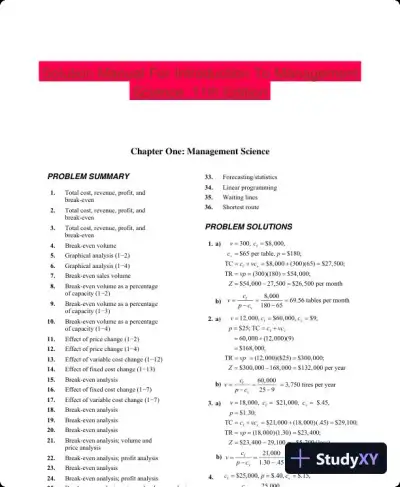 Textbook Guides
Solution Manual For Introduction To Management Science, 11th Edition
Mathematics
437 pages167downloadsFeb 2025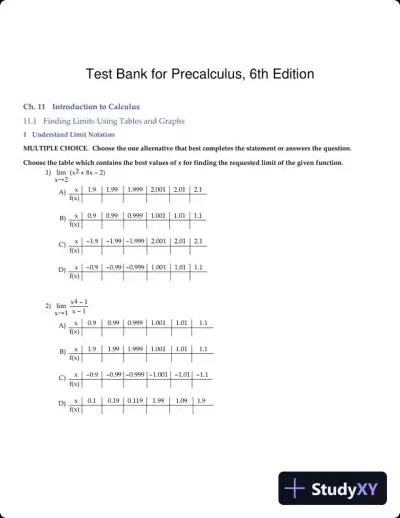 Exam Guides
Test Bank for Precalculus, 6th Edition
Mathematics
1051 pages175downloadsFeb 2025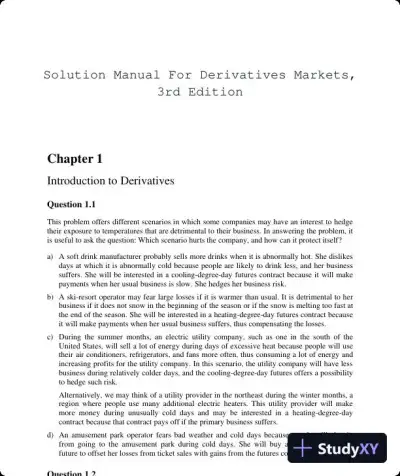 Textbook Guides
Solution Manual For Derivatives Markets, 3rd Edition
Mathematics
358 pages143downloadsFeb 2025 Textbook Guides
Solution Manual for Geometry, 1st Edition
Mathematics
446 pages141downloadsFeb 2025 Textbook Guides
Solution Manual for Beginning Algebra, 7th Edition
Mathematics
479 pages139downloadsFeb 2025 Textbook Guides
Solution Manual for Developmental Mathematics, 1st Edition
Mathematics
1623 pages137downloadsFeb 2025 Textbook Guides
Solution Manual for Elementary and Intermediate Algebra: Graphs and Models, 5th Edition
Mathematics
1278 pages126downloadsFeb 2025 Exam Guides
Test Bank for Calculus: Concepts and Contexts, Enhanced 4th Edition
Mathematics
687 pages122downloadsFeb 2025
Study this document with CramX
Once it is in your library, every tool can work from it.