
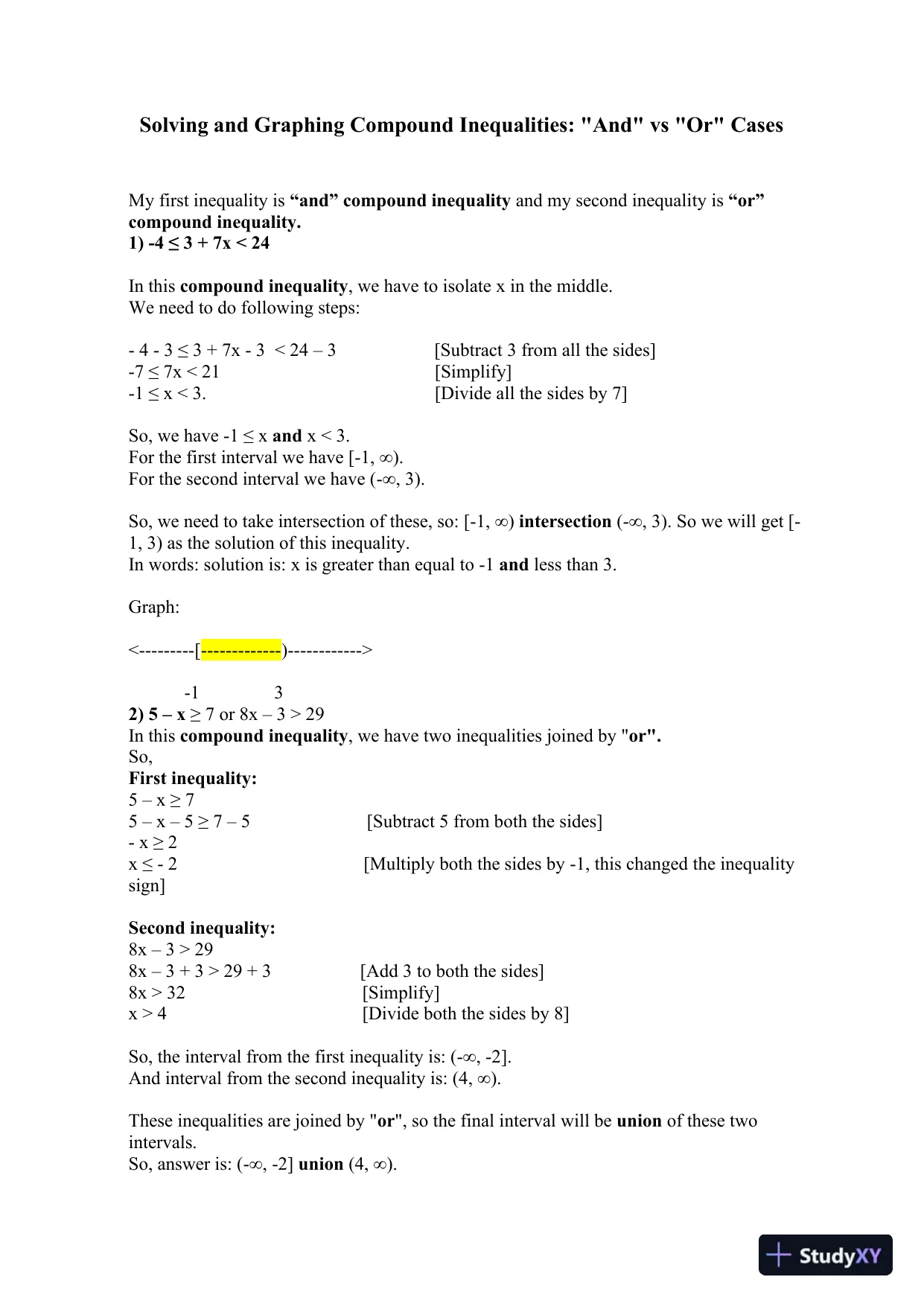
 Solving and Graphing Compound Inequalities: "And" vs "Or" CasesMy first inequality is“and” compound inequalityand my second inequality is“or”compound inequality.1)-4 ≤ 3 + 7x < 24In thiscompound inequality, we have to isolate x in themiddle.We need to do following steps:-4-3 ≤ 3+7x-3< 24–3[Subtract 3 from all the sides]-7≤7x < 21[Simplify]-1 ≤ x < 3.[Divide all the sides by 7]So, we have-1 ≤ xandx < 3.For the first interval we have [-1, ∞).For the second interval we have (-∞, 3).So, we need to take intersection of these, so: [-1, ∞)intersection(-∞, 3). So we will get [-1, 3) as the solution of this inequality.In words: solution is:x is greater than equal to-1andless than 3.Graph:<---------[-------------)------------>-132)5–x≥7 or 8x–3 > 29In thiscompound inequality, we have twoinequalities joined by "or".So,First inequality:5–x≥75–x–5≥7–5[Subtract 5 from both the sides]-x≥2x≤-2[Multiply both the sides by-1, this changed the inequalitysign]Second inequality:8x–3 > 298x–3 + 3 > 29 + 3[Add 3 to both the sides]8x > 32[Simplify]x > 4[Divide both the sides by 8]So, the interval fromthe first inequality is: (-∞,-2].And interval from the second inequality is: (4, ∞).These inequalities are joined by "or", so the final interval will beunionof these twointervals.So, answer is: (-∞,-2]union(4,∞).
Solving And Graphing Compound Inequalities: "And" Vs "Or" Cases
Download this Solved Assignment for a clear understanding of compound inequalities.
William Chen
Contributor
4.1
0
over 1 year ago
Preview (2 of 2 Pages)
100%
Log in to unlock
Study Now!
X-Copilot AI
Unlimited Access
Secure Payment
Instant Access
24/7 Support
Document Chat
Document Details
Subject
Mathematics