

Test Bank for Calculus: Early Transcendentals, 3rd Edition
- Mathematics
- 756 pages
- Shared May 2025
Want to ace your exam? Test Bank for Calculus: Early Transcendentals, 3rd Edition is your solution, with solved MCQs and questions tailored to your syllabus.
Preview 16 of 756 pages
See the first 16 pages exactly as they appear in the document.
Page 1 Read page 1 as text
Exam Name___________________________________ MULTIPLE CHOICE. Choose the one alternative that best completes the statement or answers the question. Determine whether or not the graph is a graph of a function of x. 1) 1) A) Function B) Not a function 2) 2) A) Function B) Not a function 3) 3) A) Function B) Not a function 1
Page 2 Page 3 Read page 3 as text
4) 4) A) Function B) Not a function 5) 5) A) Function B) Not a function 6) 6) A) Function B) Not a function Find the domain and graph the function. 2
Page 4 Read page 4 as text
7) f(x) = 3 x - 6 7) A) D: [0 , Q ) B) D: ( - Q , Q ) C) D: ( - Q , Q ) D) D: ( - Q , Q ) 3
Page 5 Read page 5 as text
8) g(x) = 2 + 2 x - x 2 8) A) D: ( - Q , Q ) B) D: ( - Q , Q ) C) D: ( - Q , 3 ] D) D: ( - Q , Q ) 4
Page 6 Read page 6 as text
9) F(x) = - x 9) A) D: ( - Q , 0) B) D: [0, Q ) C) D: ( - Q , 0] D) D: ( - Q , Q ) 5
Page 7 Read page 7 as text
10) G(x) = x 10) A) D: [0, Q ) B) D: ( - Q , 0] C) D: ( - Q , 0) D) D: ( - Q , Q ) 6
Page 8 Read page 8 as text
11) F(t) = t - 1 t - 1 11) A) D: ( - Q , Q ) B) D: ( - Q , 1 ) 1 ( 1 > , Q ) C) D: ( - Q , 1 ) 1 ( 1 , Q ) D) D: ( - Q , 0) 1 (0, Q ) 7
Page 9 Read page 9 as text
12) G(t) = 1 t + 3 12) A) D: ( - Q , - 3 ) 1 ( - 3 , Q ) B) D: ( - Q , 0) 1 (0, Q ) C) D: ( - Q , - 3 ) 1 ( - 3 , Q ) D) D: ( - Q , Q ) Find the domain and range of the function. 13) f(x) = 4 - x 2 13) A) D: ( - Q , Q ), R: [ 4 , Q ) B) D: ( - Q , Q ), R: ( - Q , Q ) C) D: ( - Q , 4 ], R: ( - Q , Q ) D) D: ( - Q , Q ), R: ( - Q , 4 ] 8
Page 10 Read page 10 as text
14) F(t) = t 2 + 5 14) A) D: ( - Q , Q ), R: ( - Q , Q ) B) D: ( - Q , Q ), R: [ 5 , Q ) C) D: [0, Q ), R: ( - Q , 5 ] D) D: [ - 25 , Q ) , R: [ 5 , Q ) 15) g(z) = - 5 - z 15) A) D: ( - Q , Q ), R: ( - Q , - 5 ] B) D: ( - Q ,0], R: [ - 5 , Q ) C) D: ( - Q , - 5 ] , R: ( - Q , Q ) D) D: [0, Q ), R: ( - Q , - 5 ] 16) f(x) = 7 + x 16) A) D: [0, Q ), R: [ 7 , Q ) B) D: [0, Q ), R: ( - Q , Q ) C) D: ( - Q , Q ), R: [ 7 , Q ) D) D: ( - Q ,0], R: ( - Q , 7 ] 17) F(t) = 1 t 17) A) D: ( - Q ,0) , R: ( - Q ,0) B) D: [0, Q ) , R: ( - Q , Q ) C) D: (0, Q ) , R: (0, Q ) D) D: ( - Q , Q ) , R: ( - Q , Q ) 18) g(z) = - 10 z + 1 18) A) D: [1 , Q ) , R: ( - Q , Q ) B) D: ( - 1, Q ) , R: ( - Q ,0) C) D: [0, Q ), R: ( - Q , Q ) D) D: ( - Q , - 1) , R: (0, Q ) 19) f(x) = 10 2 + x 19) A) D: ( - Q , Q ) , R: 0, 5 B) D: [0, Q ) , R: 0, 5 C) D: [0, Q ) , R: ( - Q , Q ) D) D: ( - Q ,0] , R:( - Q ,0] 20) F(t) = 3 4 t 20) A) D: ( - Q ,0) , R: ( - Q ,0) B) D: (0, Q ) , R: (0, Q ) C) D: [0, Q ) , R: [0, Q ) D) D: ( - Q , Q ) , R: ( - Q , Q ) 21) g(z) = 25 - z 2 21) A) D: [ - 5 , 5 ], R: [0, 5 ] B) D: ( - Q , Q ) , R: (0, 5 ) C) D: ( - 5 , 5 ), R: ( - 5 , 5 ) D) D: [0, Q ), R: ( - Q , Q ) Determine an appropriate domain of the function. Identify the independent and dependent variables. 22) A cylindrical water tank with a radius of 9 feet and a height of 65 feet is filled to a height of h. The volume V of water (in cubic feet) is given by the function g(h) = 81 Δ h. 22) A) D = [0, 5265 Δ ] The independent variable is V. The dependent variable is h. B) D = [0, 65 ] The independent variable is V. The dependent variable is h. C) D = [0, 81 ] The independent variable is h. The dependent variable is V. D) D = [0, 65 ] The independent variable is h. The dependent variable is V. 9
Page 11 Read page 11 as text
23) A weather balloon of radius r (in meters) is filled with air. The volume V of the balloon is given by the function f(r) = 4 3 Δ r 3 . Assume the balloon can hold up to 4 m 3 of air. 23) A) D = [0, 4 ] The independent variable is r. The dependent variable is V. B) D = 3 3 Δ , 4 The independent variable is r. The dependent variable is V. C) D = 0, 3 Δ 3 The independent variable is V. The dependent variable is r. D) D = 0, 3 3 Δ The independent variable is r. The dependent variable is V. Solve the problem. 24) If f(x) = 5 x + 7 and g(x) = 2 x - 1, find f(g(x)). 24) A) 10 x + 13 B) 10 x + 2 C) 10 x + 6 D) 10 x + 12 25) If f(x) = - 5 x + 9 and g(x) = 4 x + 8 , find g(f(x)). 25) A) - 20 x + 44 B) - 20 x - 28 C) - 20 x + 49 D) 20 x + 44 26) If f(x) = x - 4 7 and g(x) = 7 x + 4 , find g(f(x)). 26) A) 7 x + 24 B) x + 8 C) x D) - 4 7 27) If f(x) = x + 8 and g(x) = 8x - 12 , find f(g(x)). 27) A) 2 2 x + 1 B) 2 2 x - 1 C) 8 x - 4 D) 8 x + 8 - 12 28) If f(x) = 4x 2 + 2 x + 7 and g(x) = 2 x - 8 , find g(f(x)). 28) A) 4x 2 + 4 x + 6 B) 4x 2 + 2 x - 1 C) 8 x 2 + 4 x + 22 D) 8 x 2 + 4 x + 6 29) If f(x) = 1 x and g(x) = 3 x 5 , find g(f(x)). 29) A) 1 3 x 5 B) 1 x 5 C) 3 x D) 3 x 5 30) If f(x) = - 3 x + 8 and g(x) = - 5 x 2 + 3 x - 8 , find g( f ( - 5 )). 30) A) - 54 B) - 2584 C) 2 D) 452 31) If f(x) = - 5 x + 8 and g(x) = 6 x 2 - 5 x + 5 , find g( f( 8 )). 31) A) - 1737 B) - 57 C) - 27 D) 6309 32) If f(x) = x , g(x) = x 3 , and h(x) = 3 x + 9 , find f(g(h(x))). 32) A) x + 9 B) 3 x + 9 C) x + 3 D) x + 3 10
Page 12 Read page 12 as text
33) If f(x) = x , g(x) = x 5 , and h(x) = 5 x + 20 , find h(g(f(x))). 33) A) 5 x + 20 B) x + 4 C) x + 4 D) x + 20 Express the given function as a composite of functions f and g such that y = f(g(x)). 34) y = 1 x 2 - 8 34) A) f(x) = 1 x 2 , g(x) = x - 8 B) f(x) = 1 8 , g(x) = x 2 - 8 C) f(x) = 1 x , g(x) = x 2 - 8 D) f(x) = 1 x 2 , g(x) = - 1 8 35) y = 9 x + 4 35) A) f(x) = x, g(x) = 9 x + 4 B) f(x) = - x , g(x) = 9 x + 4 C) f(x) = - x , g(x) = 9 x - 4 D) f(x) = x , g(x) = 9 x + 4 36) y = 5 x 2 + 6 36) A) f(x) = 1 x , g(x) = 5 x + 6 B) f(x) = x + 6 , g(x) = 5 x 2 C) f(x) = 5 x 2 , g(x) = 6 D) f(x) = x, g(x) = 5 x + 6 37) y = 5 5 x + 1 37) A) f(x) = 5 x + 1 , g(x) = 5 B) f(x) = 5 x , g(x) = 5 x + 1 C) f(x) = 5 , g(x) = 5 + 1 D) f(x) = 5 x , g(x) = 5 x + 1 38) y = ( 3 x + 13 ) 7 38) A) f(x) = 3 x 7 , g(x) = x + 13 B) f(x) = ( 3 x) 7 , g(x) = 13 C) f(x) = x 7 , g(x) = 3 x + 13 D) f(x) = 3 x + 13 , g(x) = x 7 Solve the problem. 39) Let f(x) = x x - 6 . Find a function y = g(x) so that (f H g)(x) = x. 39) A) g(x) = 6 x x - 1 B) g(x) = 1 x - 6 C) g(x) = x - 6 6 D) g(x) = x(x - 6 ) 40) Let f(x) = x - 4 . Find a function y = g(x) so that (f H g)(x) = x 2 - 4 . 40) A) g(x) = x 2 B) g(x) = x 2 - 4 C) g(x) = x 2 + 4 D) g(x) = 2x 11
Page 13 Read page 13 as text
41) Let g(x) = x . Find a function y = f(x) so that (f H g)(x) = x . 41) A) f(x) = x 2 B) f(x) = 1 x C) f(x) = x D) f(x) = 1 x 2 42) Let g(x) = x + 2 . Find a function y = f(x) so that (f H g)(x) = 4 x + 8 42) A) f(x) = 4 (x + 1) B) f(x) = 4 x C) f(x) = 4 x - 2 D) f(x) = 4 x + 2 Simplify the difference quotients f(x + h) - f(x) h and f(x) - f(a) x - a for the following function. Rationalize the numerator when necessary. 43) f(x) = 7 x + 1 43) A) 7 x - 7 h; 7 x - 7 a B) 7 h; 7 a C) 7 ; 7 D) 7 ; 7 x - 7 a 44) f(x) = 3 x 44) A) 6 x + h ; 6 x - a B) - 3 x + h ; - 3 x - a C) 6 x(x + h) ; 6 ax D) - 3 x(x + h) ; - 3 ax 45) f(x) = 6 x 3 45) A) 18 x 2 - 18 x - 6 h; 6 x 2 - 6 ax - 6 a 2 B) 18 x 2 + 18 xh + 6 h 2 ; 6 x 2 + 6 ax + 6 a 2 C) 6 x 2 + 6 xh + 6 h 2 ; 18 x 2 + 18 ax + 18 a 2 D) 6 x 2 + 6 xh + 6 h 2 ; 6 x 2 + 18 ax + 18 a 2 46) f(x) = 2 x 2 + 7 x - 5 46) A) 4 x + 2 h + 7 ; 2 x + 2 a + 7 B) 4 x + 7 h - 5 ; 4 x + 4 a + 7 C) 4 x + 4 h + 7 ; 2 x - 2 a - 7 D) 4 x 2 + h; 4 x + 4 a + 7 47) f(x) = x x + 3 47) A) 1 ( 3 - x)( 3 - x - h) ; 1 ( 3 - x)( 3 - a) B) 3 (x + 3 )(x + h + 3 ) ; 3 (x + 3 )(a + 3 ) C) - 3 ( 3 - x)( 3 - x - h) ; - 3 ( 3 - x)( 3 - a) D) - h + 3 (x + 3 )(x + h + 3 ) ; - a + 3 (x + 3 )(a + 3 ) 48) f(x) = 1 - 2 x 48) A) 1 2 x + 2 h + 1 - 2 x + 1 ; 1 2 x + 1 - 2 a + 1 B) 2 1 - 2 x - 2 h + 1 - 2 x ; 2 2 x - 1 + 2 a - 1 C) - 2 1 - 2 x - 2 h + 1 - 2 x ; - 2 1 - 2 x + 1 - 2 a D) - 1 1 - 2 x - 2 h - 1 - 2 x ; - 1 1 - 2 x - 1 - 2 a 12
Page 14 Read page 14 as text
49) f(x) = - 8 x 49) A) 8 x (x + h) - x x + h ; 8 x a - a x B) 8 x (x + h) + x x + h ; 8 x a + a x C) 8 x x + h - x (x + h) ; 8 a x - x a D) - 8 x (x + h) + x x + h ; - 8 x a + a x Graph the function. Determine the symmetry, if any, of the function. 50) y = 1 x 3 50) A) Symmetric about the origin B) No symmetry 13
Page 15 Read page 15 as text
C) Symmetric about the y - axis D) Symmetric about the origin 51) y = - 1 x 2 51) A) Symmetric about the y - axis B) Symmetric about the y - axis 14
Page 16 Read page 16 as text
C) No symmetry D) Symmetric about the y - axis 52) y = 1 x 52) A) Symmetric about the origin B) Symmetric about the origin 15
740 more pages in the full document
Unlock it once and it stays in your library, ready to chat with or turn into flashcards.
Unlock the full documentMore Mathematics study materials
See all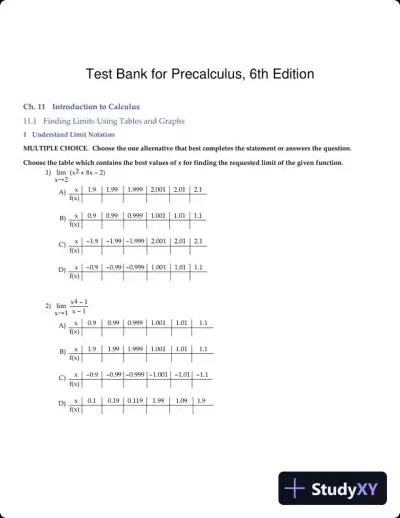 Exam Guides
Test Bank for Precalculus, 6th Edition
Mathematics
1051 pages175downloadsFeb 2025 Textbook Guides
Solution Manual For Introduction To Management Science, 11th Edition
Mathematics
437 pages167downloadsFeb 2025 Textbook Guides
Solution Manual For Derivatives Markets, 3rd Edition
Mathematics
358 pages143downloadsFeb 2025 Textbook Guides
Solution Manual for Geometry, 1st Edition
Mathematics
446 pages141downloadsFeb 2025 Textbook Guides
Solution Manual for Beginning Algebra, 7th Edition
Mathematics
479 pages139downloadsFeb 2025 Textbook Guides
Solution Manual for Developmental Mathematics, 1st Edition
Mathematics
1623 pages137downloadsFeb 2025 Textbook Guides
Solution Manual for Elementary and Intermediate Algebra: Graphs and Models, 5th Edition
Mathematics
1278 pages126downloadsFeb 2025 Exam Guides
Test Bank for Calculus: Concepts and Contexts, Enhanced 4th Edition
Mathematics
687 pages122downloadsFeb 2025
Study this document with CramX
Once it is in your library, every tool can work from it.