

Solution Manual for An Introduction to Mechanical Engineering, 3rd Edition
- Mechanical Engineering
- 272 pages
- Shared May 2025
Prepare better with Solution Manual for An Introduction to Mechanical Engineering, 3rd Edition, a solutions manual that breaks down complex textbook problems.
Preview 16 of 272 pages
See the first 16 pages exactly as they appear in the document.
Page 1 Read page 1 as text
An ’s Solutions Manual to Accompany AN INTRODUCTION TO MECHANICAL ENGINEERING, 3 RD EDITION JONATHAN WICKERT KEMPER LEWIS
Page 2 Page 3 Read page 3 as text
Table of Contents Preface………………………………………………………………………………………………………..vi Chapter 2 ......................................................................................................... 1 Chapter 3 ....................................................................................................... 15 Chapter 4 ....................................................................................................... 55 Chapter 5 ....................................................................................................... 97 Chapter 6 ..................................................................................................... 139 Chapter 7 ..................................................................................................... 191 Chapter 8 ..................................................................................................... 227
Page 4 Read page 4 as text
Chapter 2: Mechanical Design 1 Chapter 2 Solutions
Page 5 Read page 5 as text
Chapter 2: Mechanical Design 2 Problem P2.1: Give three examples of engineered products that must be circular in shape and explain why. Any ball is not allowed as an answer! Examples include: ⋅ DVD’s ⋅ CD’s ⋅ manhole covers ⋅ railroad advance warning signs ⋅ wheel (for flat roads) ⋅ axles ⋅ bullet cross-section (balanced for stable flight) ⋅ European speed limit sign ⋅ any shape with minimized arc length/surface area for given area/volume ⋅ optimized pressure vessel cross sections ⋅ US coin ⋅ lens (part of circle) ⋅ optimal nozzle/diffuser (no edge effects) ⋅ optimal capillary tube ⋅ optimal suction cup ⋅ traffic circle ⋅ thrown pot (on potting wheel)
Page 6 Read page 6 as text
Chapter 2: Mechanical Design 3 Problem P2.2: Give three examples of engineered products that must be triangular in shape and explain why. Examples include: ⋅ yield signs ⋅ the triangle instrument ⋅ billiards rack ⋅ knife blade (cross-section) ⋅ supports for finishing wood (pyramids or cones, must come to a point) ⋅ splitting wedge ⋅ handicap ramp viewed from side (to meet code) ⋅ three equally spaced instances per rotation cam ⋅ 30°-60°-90° or 45°-45°-90° drafting triangle ⋅ one of six identical pieces that can be assembled into a hexagon ⋅ chisel point
Page 7 Read page 7 as text
Chapter 2: Mechanical Design 4 Problem P2.3: Give three examples of engineered products that must be rectangular in shape and explain why. Examples include: ⋅ A size (or any other standard size) sheet of paper ⋅ four equally spaced instances per rotation cam ⋅ football/soccer field (civil engineered) ⋅ US speed limit sign ⋅ US dollar bill
Page 8 Read page 8 as text
Chapter 2: Mechanical Design 5 Problem P2.4: Give three examples of engineered products that must be green in color. Examples include ⋅ fake plant/turf (imitate actual plant) ⋅ John Deer product (branding) ⋅ Cameron Compressor (branding) ⋅ Green (traffic) light ⋅ European recycling bin ⋅ Kermit the frog paraphernalia (branding)
Page 9 Read page 9 as text
Chapter 2: Mechanical Design 6 Problem P2.5: Give three examples of engineered products that must be black in color. Examples include ⋅ Background for one way signs and night speed limit signs ⋅ theater bins/supports (disappears in dark) ⋅ stealth fighter (better “bounce” characteristics) ⋅ ninja suit (stealth at night) ⋅ black paint ⋅ black ink ⋅ backing for solar water heating ⋅ negative electric cables
Page 10 Read page 10 as text
Chapter 2: Mechanical Design 7 Problem P2.6: Give three examples of engineered products that must be transparent. Examples include ⋅ Contact lenses (over pupil portion) ⋅ glasses (spectacles) ⋅ (camera) lens (any tint causes loss of quality/information) ⋅ Microscope slide and slide cover
Page 11 Read page 11 as text
Chapter 2: Mechanical Design 8 Problem P2.7: Give three examples of engineered products that have a specific minimum weight, but no specified maximum weight and specify the approximate minimum weight. Examples include: ⋅ Helium balloon holder (minimum weight will depend upon how many helium balloons are being held) ⋅ non-wedge based door stop (minimum weight based on friction coefficient) ⋅ racecar (minimum weight based on racing regulations) ⋅ competition bike (minimum weight based on racing regulations)
Page 12 Read page 12 as text
Chapter 2: Mechanical Design 9 Problem P2.8: Give three examples of engineered products that have to be precisely a certain weight, and provide the weight. Examples include: ⋅ balancing weight for car wheel ⋅ coins (weight used to count coins in some automated machines) ⋅ precious metal coins (weight dictates worth) ⋅ exercise weights (15 lb weight must be 15 lb)
Page 13 Read page 13 as text
Chapter 2: Mechanical Design 10 Problem P2.9: Give three examples of engineered products that fulfill their designed purpose by failing or breaking. Examples include: ⋅ saw stop mechanism (http://www.sawstop.com/) ⋅ crumple zone in car ⋅ bumper (foam insert) in car ⋅ bike helmet ⋅ frangible bullets (split up when they hit anything other than flesh) to protect bystanders ⋅ stress indicating paint has fluorescent dyes capsules that split under known deflections (http://www.newscientist.com/blog/invention/2007/10/stress-sensitive-paint.html) ⋅ Some meds are packaged in glass bottles that you break to open ⋅ Cover on a “pit trap” breaks when weight is applied ⋅ Fire suppression sprinkler detection device (solder connect melts or glass connection shatters)
Page 14 Read page 14 as text
Chapter 2: Mechanical Design 11 Problem P2.10: Give three examples of engineered products that are designed to work well over a million times. Examples include: ⋅ Roads ⋅ Bridges ⋅ Engine components (if each Otto cycle is a “use”) ⋅ Fuses ⋅ Door hinges ⋅ 3-D shutter glasses (the shutters)
Page 15 Read page 15 as text
Chapter 2: Mechanical Design 12 Problem P2.11: List three products that can be used equally well by people with and without visual impairments and explain why. Examples include: ⋅ Silverware ⋅ Chairs ⋅ Drinking Cups ⋅ Headphones ⋅ Bed ⋅ Drawers ⋅ Emergency response necklace (one button, worn around neck to locate) http://inventorspot.com/articles/one_touch_911_dialer_calls_help_you_30719 ⋅ Sight and sound cross walk guides ⋅ Fire alarm (day to day use, not installation and maintenance) ⋅ Automatic doors (and other motion detectors)
Page 16 Read page 16 as text
Chapter 2: Mechanical Design 13 Problem P2.27: For the magnesium camera body shown, provide an explanation for which processes you think were used in its manufacture and why. This was most likely manufactured using a die cast procedure because of the material and geometric detail in the pieces including a number of inclusions. Certain features could have been machined, and some polishing/grinding operations may have been used.
256 more pages in the full document
Unlock it once and it stays in your library, ready to chat with or turn into flashcards.
Unlock the full documentMore Mechanical Engineering study materials
See all Textbook Guides
Solution Manual for Engineering Mechanics Dynamics, 13th Edition
Mechanical Engineering
1360 pages123downloadsFeb 2025 Textbook Guides
Solution Manual For Introduction To Engineering Experimentation, 3rd Edition
Mechanical Engineering
298 pages99downloadsFeb 2025 Textbook Guides
Solution Manual for Mechanics of Materials SI, 9th Edition
Mechanical Engineering
1598 pages91downloadsFeb 2025 Textbook Guides
Solution Manual for Engineering Mechanics: Dynamics, 2nd Edition
Mechanical Engineering
41 pages82downloadsFeb 2025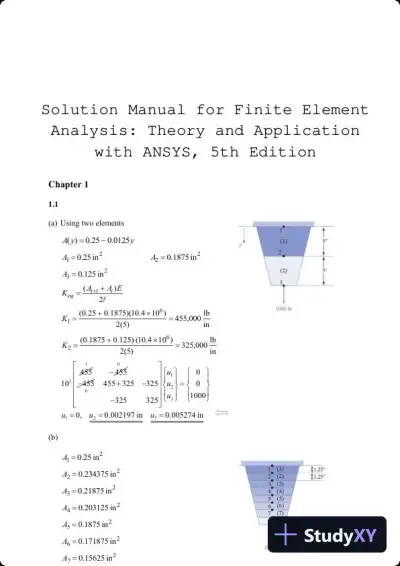 Textbook Guides
Solution Manual for Finite Element Analysis: Theory and Application with ANSYS, 5th Edition
Mechanical Engineering
426 pages53downloadsFeb 2025 Textbook Guides
Solution Manual For Modern Compressible Flow: With Historical Perspective, 3rd Edition
Mechanical Engineering
362 pages52downloadsFeb 2025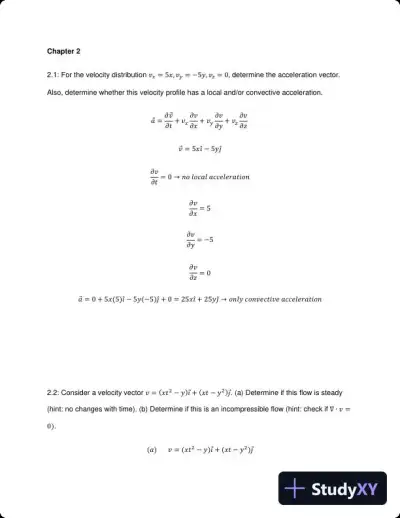 Certification Guides
Biofluid Mechanics: An Introduction to Fluid Mechanics, Macrocirculation, and Microcirculation, 3rd Edition (2021)
Mechanical Engineering
172 pages48downloadsFeb 2025 Textbook Guides
Solution Manual for Introduction to Finite Elements in Engineering, 4th Edition
Mechanical Engineering
308 pages47downloadsFeb 2025
Study this document with CramX
Once it is in your library, every tool can work from it.