

Solution Manual For Basics Of Engineering Economy, 2nd Edition
- Mechanical Engineering
- 276 pages
- Shared May 2025
Boost your textbook learning with Solution Manual For Basics Of Engineering Economy, 2nd Edition, providing the answers and solutions you need to succeed.
Preview 16 of 276 pages
See the first 16 pages exactly as they appear in the document.
Page 1 Read page 1 as text
1 Solutions to end - of - chapter problems Basics of Engineering Economy , 2 nd edition Leland Blank and Anthony Tarquin Chapter 1 Foundations of Engineering Economy 1. 1 If the alternative that is actually the best one is not even recognized as an alternative , it obviously will not be able to be selected by using any economic analysis tools. 1.2 Non - economic factors are (b), (c), (e) and (f): moral e, goodwill, public acceptance and ae st h etics, respectively. 1.3 Revenues and costs are examples of cash flows. 1.4 The analysis techniques that are used in engineering economic analysis are only as good as the accuracy of the cash flow estimates. 1.5 The do - nothing alternative represents the as - is or status quo condition. 1.6 Evaluation criterion refers to the measurement standard or procedure that is used to determine which alternative is “best”. 1.7 In engineering economy, the evaluation criterion is financial units (dollars, pesos, etc). 1.8 Intangible factors are non - economic considerations that may have to be taken into account in identifying the best alternative. 1.9 Examples of intangible factors are goodwill, morale, convenience, friendship, implementation know - how, aesthetics, public acceptance 1.10 Time value of money means that there is a certain worth in having money and that worth changes as a function of time. 1.11 Interest is a manifestation of the time value of money. 1.12 The most important fundamental dimension in economic analysis is time because of time value of money. 1.13 The term that describes compensation for “renting” of money is time value of money, which manifests itself as interest. 1.14 When an interest rate does not include the time period, the time period is assumed to be one year.
Page 2 Page 3 Read page 3 as text
2 1.15 The original amount of money in a loan transaction is known as the principal. 1.16 Minimum attractive rate of return is the lowest rate of return (interest rate) on a project that companies or individuals consider t o be high enough to induce them to invest their money . 1.17 When the yield on a U.S. Government Bond is 3% per year, investors are expecting the inflation rate to be near zero. 1.18 (a) Payment = 1,600,000(1.10)(1.10) = $1,936,000 (b) Interest = total amt paid – principal = 1,936,000 - 1,600,000 = $336,000 1.19 (a) Equivalent cost in 1 year = 38,000 + 38,000(0.10) = $41,800 (b) Since $41,600 is less than $41,800, the firm should remodel 1ater (i.e. 1 year from now). 1.20 P = 50,000/1.08 = $46,296.30 1.21 Rate of return = (1,450,000/10,000,000)( 100 %) = 14.5% per year 1.22 Rate of return = (45/966)( 100 %) = 4.7% 1.23 Ra te of increase = [(29 – 22)/22]( 100 %) = 31.8% 1.24 Inte rest rate = (275,000/2,000,000)( 100 %) = 13.75% 1.25 Rate of return = (2.3/6)( 100 %) = 38.3% 1.26 F = P(1 + i) 2,360,000 = 2,000,000(1 + i) i = 0.18 ( 18% ) 1.27 F = P(1 + i) 53,000,000 = P (1 + 0.10) P = $48,181,818
Page 4 Read page 4 as text
3 1.28 Amount of earnings in year one = 400,000,000(0.25) = $100,000,000 1.29 Amt at end of year 1 = 280,000(1.15) = $322,000 < $425,000 Amt at end of year 2 = 322,000(1.15) = $370,300 < $425,000 Amt at end of year 3 = 370,300(1.15) = $425,845 > $425,000 Time = 3 years 1.30 MARR is set relative to t he cost of capital . 1 .31 The engineer is wrong, unless the MARR is exactly equal to the cost of capital. Usually, the inequality ROR ≥ MARR > cost of capital is used, and the MARR is established higher than the cost of capital so that profit, risk and other factors are considered. 1.32 (a) Amt owed ; compoun d interest = 150,000(1.05)(1.05)(1.05) = $173,644 Amt owed ; simple interest = P + Pni = 150,000 + 150,000(3)(0.055) = 150,000 + 24,750 = $174,750 Company should accept 5% compound interest rate (b) Difference = 174,750 – 173,644 = $1106 1.33 F = P + Pni 850,000 = P + P(4)(0.10) 1.4P = 850,000 P = $607,143 1.34 F = P + Pni 100,000 = 1000 + 1000(n)(0.1) 99 ,000 = 1000(n)(0.10) n = 990 years 1.35 Follow plan 4, Figure 1.3 as a model. A is 9900 – 2000 = $79 00 B is 7900(0.10) = $79 0 C is 7900 + 790 = $869 0 D is 8690 – 2000 = $669 0
Page 5 Read page 5 as text
4 1.36 F = P + Pni 35,000 = P + P(3)(0.07) 1.21P = 35,000 P = $28,925.60 1.37 P(1.20)(1.20) = 20,000 P = $13,888.89 1.38 (a) Interest rate = 900,000/6,000,000 = 0.15 = 15% per year (b) Total due after 1 year = 6,000,000 + 900,000 = $6,900,000 Interest charged for 2 nd year = 6,900,000(0.15) = $1,035,000 1.39 (a) F = P + Pni 2,800,000 = 2,000,000 + 2,000,000(4)(i) Interest = 10% per year (b) F = P(1 + i) (1 + i) (1 + i) (1 + i) 2,800,000 = 2,000,000(1 + i) 4 (1 + i) 4 = 1.4000 log(1 + i) 4 = log1.400 4log(1 + i) = 0.146 log(1 + i) = 0.0365 (1 + i) = 10 0.0365 (1 + i) = 1.0877 i = 8.77% 1.40 F = P + P(n)(i) 3P = P + P(n)(0.20) n = 10 years 1.41 (a) F = P + P(n)(i) 2P = P + P(4)(i) i = 25% (b) F = P(1 + i) (1 + i) (1 + i) (1 + i) 2P = P(1 + i) 4 2 = (1 + i) 4 log 2 = log(1 + i) 4 0.301 = 4 log(1 + i) log(1 + i) = 0.0753 (1 + i) = 10 0.0753 i = 18.93%
Page 6 Read page 6 as text
5 1.42 (a) Loan A: interest/year = 500,000(0.10) = $50,000 Loan B: interest/year = 500,000(0.10) = $50,000 The same amount of interest was be paid on each loan (b) There was no difference paid between the two loans 1.43 All engineering economy problems will involve i and n 1.44 P = $1 3,000; F = $26,000; i = 6.8% per year; n = ? 1.45 P = $1000; F = $1270; n = 3 ; i = ? 1. 46 P = $50,000; F = ?; i = 15%; n = 3 1.47 F= $200,000,000; n = 5; i = 12 % per year; A = ? 1.48 A = $225,000; n = 3; i = 15% per year; F = ? 1.49 F = $400,000; n = 2; i = 20% per year; P = ? 1.50 P = $225,00 0; n = 4; i = 15% per year; A = ? 1.51 P = $1,800,000; n = 6; i = 12% per year; A = ? 1.52 P = $16,000,000; A = $3,800,000; i = 18% per year; n = ? 1.53 End - of - period - convention means end - of - interest period. It does not mean end of the calendar year. 1.54 Period refers to interest period. 1.55 The difference between cash inflows and cas h outflows is known as net cash flow. 1.56 Office supplies = outflow; GPS surveying equipment = outflow; Auctioning of used earth - moving equipment = inflow; Staff salaries = outflow; Fees for services rendered = inflow; Interest from bank deposits = inflow 1.57 The following items are inflows : salvage value, sales revenues, cost reductions by subcontractors. The following items are outflows : income taxes, loan interest, rebates to dealers, accounting services .
Page 7 Read page 7 as text
6 1.58 Assuming down is negative: down arrow of $40,000 in year 5; up arrow in year 0 identi fied as P =?; i = 15% per year. 1.5 9 Assuming down is negative: down arrow of $10,000 in year 0; up arrows in the amount of $3000 in years 1 through 5; i = 10% per year; arrow in year 5 i dentified as F = ? . 1.60 Assuming down is negative: down arrow in year 0 identified as P=?; i = 15% per year; up arrows in years 1 thru 5 in the amount of $75,000 - $30,000 = $45,000 1.6 1 (a) FV is F (b) PMT is A (c) NPER is n (d) IRR is i (e) PV is P 1.62 (a) F = ?; i = 8%; n = 10; A = $2000; P = $ - 10,000 (b) A = ?; i = 12%; n = 30; P = $16,000; F = 0 (c) P = ?; i = 9%; n = 15; A = $1000; F = $700 (d) n = ?; i = 8.5% ; A = $50 00; P = $ - 50000; F = $ 2 0000 (calculator function) 1.63 (a) FV(i%,n,A,P) finds the future value, F (b) IRR(first_cell:last_cell) finds the compound interest rate, i (c) PMT(i%,n,P,F) finds the equal periodic payment, A (d) PV(i%,n,A,F) finds the present value, P 1.64 For built - in spreadsheet functions, a parameter that d oes not apply can be left blank when it is not an interior one. For examp le, if no F is involved when using the PMT function, it can be left blank because it is an end parameter. When the parameter involved is an interior one (like P in the PMT function), a comma must be put in its position. 1.65 A common moral is a fundamental belief held by virtually all people . A personal moral is the translation of a common moral into that which an individual believes and uses as guidance for their own decisions and actions. 1.66 A code of ethics can be used as an evaluation measure for the decision and actions of an individual who works in the discipline that honors the code. 1.67 (a) Assuming that Carol’s supervisor is a trustworthy and ethical person himself, going to her supervisor and inform ing him of her suspicion is probably the best of these options. This puts Carol on record (verbally) as questioning something she heard at an informal gathering. (b) Another good option is to go to Joe one - on - one and inform him of her concern about what she heard him say at lunch. Joe may not be aware he is on the bid evaluation team and the potential ethical consequences if he accepts the free tickets from Dryer.
Page 8 Read page 8 as text
7 1.68 Explain your own situation and what you think an ethical action might be. 1.69 Amount now = 10,000 + 10,000(0.10) = $11,000 Answer is (c) 1.70 Answer is (a) 1.71 Move both cash flows to year 0 and solve for i 1000(1 + i) = 1345.60/(1 + i) (1 + i) 2 = 1345.60/1000 (1 + i) = 1.16 i = 16% Answer is (d) 1.72 F in year 2 at 20% compound interest = P(1.20)(1.20) = 1.44P For simple interest, F = P + Pni = P(1 + ni) P(1 + 2i) = 1.44P (1 + 2i) = 1.44P i = 22% Answer is (c) 1.73 F = P(1+i) n 16,000 = 8000(1 + i) 9 2 1/9 = 1 + i 1.08 = 1 + i i = 0.08 (8%) Answer is (b) 1.74 Answer is (c) 1.75 Let i = compound rate of increase: 268 = 200(1 + i) 5 (1 + i) 5 = 268/200 (1 + i) = (1.34) 0.2 (1 + i) = 1.0602 i = 6.02% Answer is (b)
Page 9 Read page 9 as text
8 1.76 2P = P + P(n)(0.05) 1 = 0.05n n = 20 Answer is (d) 1.77 Only a parameter at the end of the string can be omitted without an entry or comma. Answer is ( d).
Page 10 Read page 10 as text
1 Solutions to end - of - chapter problems Basics of Engineering Economy , 2 nd edition Leland Blank and Anthony Tarquin Chapter 2 Factors: How Time and Interest Affect Money 2.1 (a) (F/P,10%,20) = 6.7275 (b) (A/F,4%,8) = 0.10853 (c) (P/A,8%,20) = 9.8181 (d) (A/P,20%,28) = 0.20122 (e) (F/A,30%,15) = 167.2863 2.2 P = 30,000(P/F,10%,8) = 30,000(0.4665) = $13,995 2.3 F = 15,000(F/P,6%,25) = 15,000(4.2919) = 64,378.50 2.4 (a) F = 885,000 + 100,000(F/P,10%,3) = 885,000 + 100,000(1.3310) = $1,018,000 (b) Spreadsheet functio n is = - FV(10%,3,,100000) + 885000 Display is $1,018,000 2.5 (a) P = 19,000(P/F,10%,7) = 19,000(0.5132) = $9750.80 (b) If the calculator function is PV(10,7,0,19000), display is P = $ - 9750.00 (c) If the spreadsheet function is = - PV(10%,7,,19000), display is $9750.00 2.6 (a) Total for 7 lots is 7(120,000) = $840,000 P = 840,000 (P/F,10%,2) = 840,000(0.8264) = $694,176 (b) If the calc ulator function is PV(10,2,0,8400 00), dis play is P = $ - 694,214.88 (c) If the spreadsheet function is = - PV(10%,2,,840000), display is $694,214.88
Page 11 Read page 11 as text
2 2.7 (a) F = 3000(F/P,10%,12) + 5000(F/P,10%,8) = 3000(3.1384) + 5000(2.1436) = $20,133.20 (b) Sum two calculator functions FV(10,12,, - 3000) + FV(10,8 , - 5000) 9,415.29 + 10,717.94 = $20,133.23 (c) If the spreadsheet function is = – FV(10%,12,,3000) – FV(10%,8,,5000), the display is $ 20,133.23 2.8 (a) P = 30,000,000(P/F,10%, 5 ) – 15,000,000 = 30,000,000(0.6 209 ) – 15,000,000 = $ 3,627,000 (b) If the spreadsheet function is = - PV(10%,5,,30000000) – 15,000000, the display is $3,627,640 The increased decimal accuracy of a spreadsheet function indicates an increased the required amount of $640. 2.9 F = 2 80,000(F/P,1 2 %, 2 ) = 2 80,000(1. 2544 ) = $ 351,232 2.10 A = 12,700,000(A/P,20%,8) = 12,700,000 (0.26061) = $3,309,747 2.11 P = 6000(P/A,10%,10) = 6000(6.1446) = $36,867.60 2.12 (a) A = 60,000(A/P ,8%,5) = 60,000(0.25406 ) = $15,027.60 (b) If calculator function is PMT(8,5, - 60000,0), the answer is $15,027.39 (c) A spreadsheet function of = - PMT(8%,5,60000) displays $15,027.39 2.13 A = 20,000,000(A/P,10%,6) = 20,000,000(0.22961) = $4,592,200
Page 12 Read page 12 as text
3 2.14 A = 50,000(A/F,20%,3) = 50,000(0.27473) = $13,736.50 2.15 (a) 17,000,000(A/P,i,8) = 2,737,680 (A/P,i,8) = 0.16104 From interest tables at n = 8, i = 6% per year (b) Calculator function is i(8, - 2737680,17000000,0) to obtain i = 6.00% (c) If the spreadsheet function is = RATE(8, - 2737680,17000000 ), display is 6.00% 2.16 (a) A = 3,000,000(10)(A/P,8%,10) = 30,000,000(0.14903) = $4,470,900 (b) If calculator function is PMT(8,10, - 30000000,0), the answer is $4,470,884.66 (c) If the spreadsheet function is = - PMT(8%,10,30000000) , display is A = $4,470,884.66 2.17 P = 1 , 40 0 ,000(F/P,7%,4) =1 , 4 0 0,000(1.3108) = $1 ,83 5 , 12 0 2.18 P = 600,000(P/F,12%,4) = 600,000(0.6355) = $381,300 2.19 (a) A = 225,000(A/P,15%,4) = 225,000(0.35027) = $78,811 (b) Recall amount = 78,811/0.10 = $788,110 per year 2.20 P = 100,000((P/F,12%,2) = 100,000(0.7972) = $79,720 2.21 F = 65,000(F/P,4%,5) = 65,000(1.2167) = $79,086
Page 13 Read page 13 as text
4 2.22 P = (280,000 - 90,000)(P/A,10%,5) = 190,000(3.7908) = $720,252 2.23 F = 649 (F/P,8%,2) = 649 (1.1664) = $757 2.24 The value of the system is the interest saved on $20 million for 2 years. F = 20,000,000(F/P,8%,2) = 20,000,000(1.1664) = $23,328,000 Interest = 23,328,000 - 20,000,000 = $3,328,000 2.25 P = 2,100,000(P/F,1 0 %,2) = 2,100,000( 0.8264 ) = $1, 735,440 2.26 P = 40,000(P/F,12%,4) = 40,000(0.6355) = $25,420 2.27 (a) A = 85 0,000(A /F,18%,5) = 850,000(0.13978 ) = $118,813 (b) S preadsheet function = PMT(18%,5,,850000) results in a minus sign. 2.28 P = 95,000,000(P/F,12%,3) = 95,000,000(0.7118) = $67,621,000 2.29 F = 375,000(F/P,10%,6) = 375,000(1.7716) = $664,350 2.30 F = 150,000(F/P,8%,8) = 150,000(1.8509) = $277,635 2.31 (a) P = 7000(P/F,10%,2) + 9000(P/F,10%, 4 ) + 1 5 , 000(P/F,10%,5) = 7000(0.8264) + 9000( 0.6830 ) + 1 5 , 000(0.6209) = $ 21,245 .30
Page 14 Read page 14 as text
5 (b) Three calculator functions are added. - PV(10,2,0,7000) – PV(10,4,0,9000) – PV(10,5,0,15000) Total is 5785.12 + 6147.12 + 9313,82 = $21,246.06 2.32 P = 600,000(0.10)(P/F,10%,2) + 1,350,000(0.10)(P/F,10%,5) = 60,000(0.8264) + 135,000(0.6209) = $133,406 2.33 P = 8,000,000(P/A,10%,5) = 8,000,000(3.7908) = $30,326,400 2.34 A = 10,000,000(A/P,10%,10) = 10,000,000(0.16275) = $1,627,500 2.35 A = 140,000(4000)(A/P,10%,4) = 560,000,000(0.31547) = $176,663,200 2.36 P = 1,500,000(P/A,8%,4) = 1,500,000(3.3121) = $4,968,150 2.37 A = 3,2 50,000(A/P,1 5 %,6) = 3 , 2 50,000( 0.26424 ) = $ 858,780 2.38 P = 280,000(P/A,18%,8) = 280,000(4.0776) = $1,141,728 2.39 A = 3,500,000(A/P,2 5 %,5) = 3,500,000( 0.37185 ) = $1, 301,475 2.40 A = 5000(7)(A/P,10%,10) = 35,000(0.16275) = $5696.25 2.41 (a) F = 70,000(F/P,12%,6) + 90,000(F/P,12%,4) = 70,000(1.9738) + 90,000(1.5735) = $279,781
Page 15 Read page 15 as text
6 (b) Sprea dsheet function is = - FV(12%,6 ,0, 70000) – FV(12%,4,0,90000) to obtain $279,784.33 2.42 F = (458 - 360)(0.90)(20,000)(P /A,10%,5) = 1,764,000( 3.7908 ) = $ 6,686,971 2.43 (a) Let CF 4 be the amount in year 4 100,000( F/P,9%,3) + 75,000(F/P,9%,2) + CF 4 (F/P,9%,1) = 290,000 100, 000(1.2950) + 75,000(1.1881) + CF 4 (1.0900) = 290,000 (1.09)CF 4 = 71.392.50 CF 4 = $65,497.71 (b) F in year 5 for 2 known amounts = - FV(9%,3,0,100000) - FV(9%,2,0,75000) P in year 4 of $290,000 minus amount above (assume it’s in cell H9) = - PV(9%,1,0,290000 - H9) Answer is $65,495.05 2.44 P = 225,000(P/A,15%,3) = 225,000(2.2832) = $513,720 2.45 400,000 = 50,000(F/A,12%,n) (F/A,12 %,n) = 8.0000 From 12% interest table, n is between 5 and 6 years. Therefore, n = 6 2.46 F = P(F/P,1 0 %,n) 3 P = P(F/P,1 0 %,n) (F/P,1 0 %,n) = 3 .000 From 1 0 % interest tables, n is between 1 1 and 1 2 years. Therefore, n = 1 2 years 2.47 (a) 1,200,000 = 400,000(F/P,10%,n) + 50,000(F/A,10%,n) Solve for n by trial and error: Try n = 5: 400,000(F/P,10%,5) + 50,000(F/A,10%,5) 400,000(1.6105) + 50,000(6.1051) 949,455 < 1,200,000 n too low Try n = 8: 400,000(2.1436) + 50,000(11.4359) 1,429,235 > 1,200,000 n too high
Page 16 Read page 16 as text
7 By continued interpolation, n is between 6 and 7 . Therefore, n = 7 years (b) Spreadsheet function = NPER(10%, - 50000, - 400000,1200000 ) display s 6. 67 2.48 2,000,000 (F/P,7%,n) = 158,000(F/A,7%,n) Solve for n by trial and error (in $ thousands) : Try n = 30: 2,000,000(F/P,7%,30) = 158,000(F/A,7%,30) 2,000,000(7.6123) = 158,000(94.4608) 15,224,600 > 14, 924,806 n too low Try n = 32: 2,000,000(8.7153) = 158,000(110.2182) 17,430 ,60 0 > 17,414,476 n too low Try n = 33: 2,000,000(9.3253) = 158,000(118.9334) 18,650,600 < 18,791,447 n too high By interpolation, n is between 32 and 33 , and close to 32 years. Spreadsheet function is = NPER(7%, - 158 000 ,20 000 00 ) to display 32.1 years 2.49 (a) P = 26,000 (P/A,10%,5) + 2000(P/G,10%,5) = 26,000 (3.7908) + 2000(6.8618) = $112,284 (b) Spreadsheet: enter each annual cost in adjacent cells and use the NPV function to display P = $112,284 Calculators have no function for gradients; use the PV function on each cash flow and add the five P values to get $112,284 .55 2.50 A = 72,000 + 1000(A/G,8%,5) = 72,000 + 1000(1.8465) = $73,846 2.51 (a) 84,000 = 15,000 + G(A/G,10%,5) 84,000 = 15,000 + G(1.8101) G = $38,119 (b) The annual increase of over $38,000 is substantially larger than the first - year cost of $15,000 2.52 A = 9000 – 560(A/G,10%,5) = 9000 – 560(1.8101) = $7986
260 more pages in the full document
Unlock it once and it stays in your library, ready to chat with or turn into flashcards.
Unlock the full documentMore Mechanical Engineering study materials
See all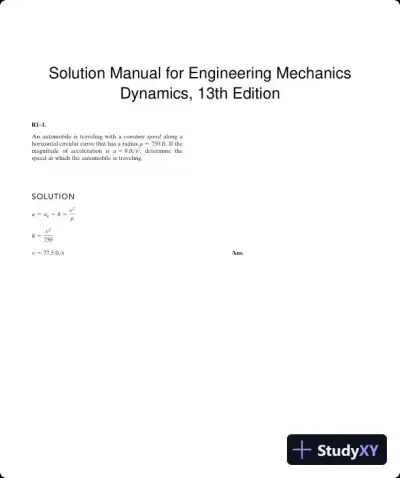 Textbook Guides
Solution Manual for Engineering Mechanics Dynamics, 13th Edition
Mechanical Engineering
1360 pages123downloadsFeb 2025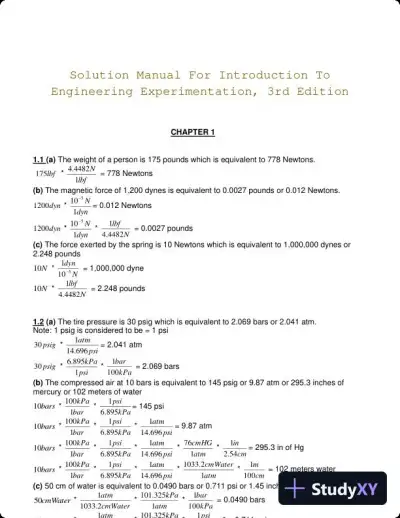 Textbook Guides
Solution Manual For Introduction To Engineering Experimentation, 3rd Edition
Mechanical Engineering
298 pages99downloadsFeb 2025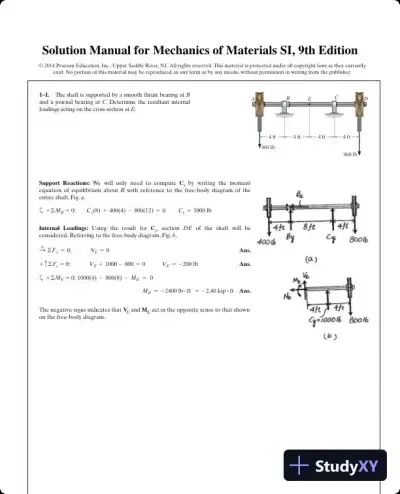 Textbook Guides
Solution Manual for Mechanics of Materials SI, 9th Edition
Mechanical Engineering
1598 pages91downloadsFeb 2025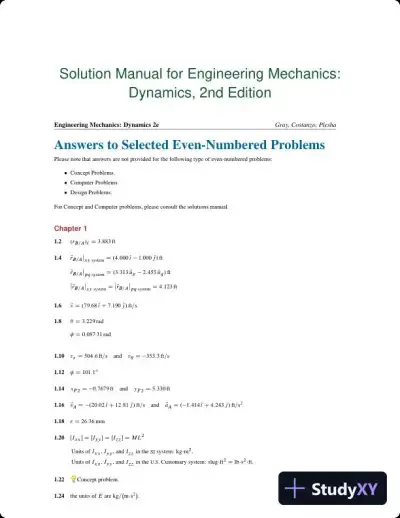 Textbook Guides
Solution Manual for Engineering Mechanics: Dynamics, 2nd Edition
Mechanical Engineering
41 pages82downloadsFeb 2025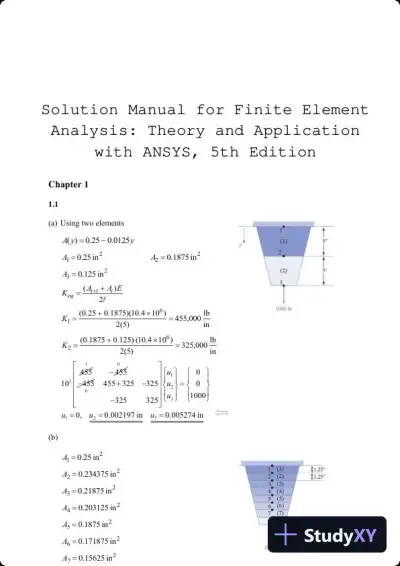 Textbook Guides
Solution Manual for Finite Element Analysis: Theory and Application with ANSYS, 5th Edition
Mechanical Engineering
426 pages53downloadsFeb 2025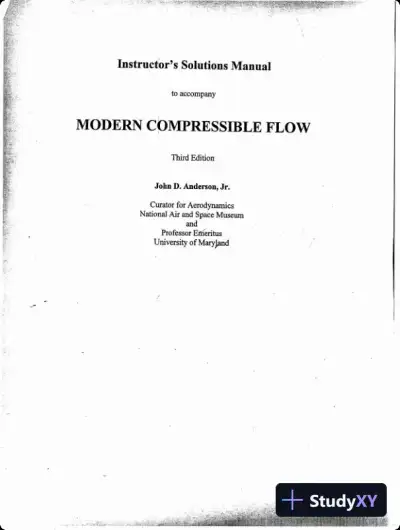 Textbook Guides
Solution Manual For Modern Compressible Flow: With Historical Perspective, 3rd Edition
Mechanical Engineering
362 pages52downloadsFeb 2025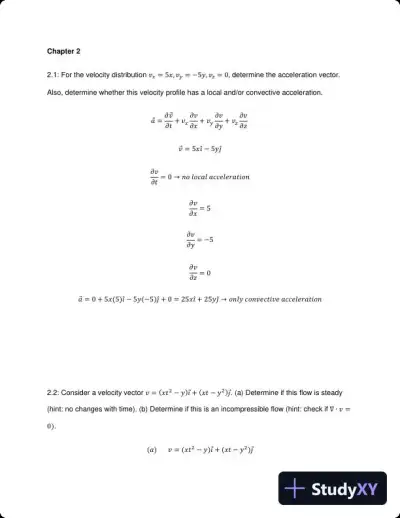 Certification Guides
Biofluid Mechanics: An Introduction to Fluid Mechanics, Macrocirculation, and Microcirculation, 3rd Edition (2021)
Mechanical Engineering
172 pages48downloadsFeb 2025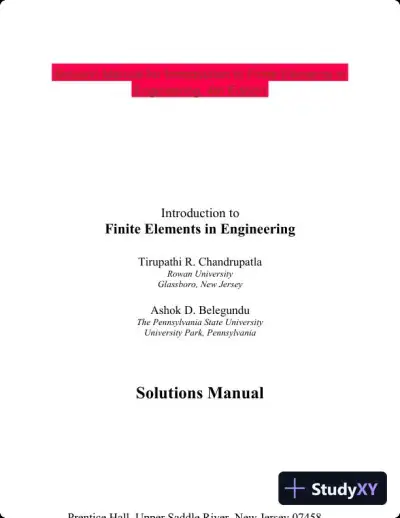 Textbook Guides
Solution Manual for Introduction to Finite Elements in Engineering, 4th Edition
Mechanical Engineering
308 pages47downloadsFeb 2025
Study this document with CramX
Once it is in your library, every tool can work from it.