

Solution Manual For Fundamentals of Thermal-Fluid Sciences, 5th Edition
- Mechanical Engineering
- 1792 pages
- Shared May 2025
Solve textbook problems with ease using Solution Manual For Fundamentals of Thermal-Fluid Sciences, 5th Edition, featuring detailed solutions and step-by-step guides.
Preview 16 of 1792 pages
See the first 16 pages exactly as they appear in the document.
Page 1 Read page 1 as text
1-1 Solutions Manual for Fundamentals of Thermal Fluid Sciences 5th Edition Yunus A. Ç engel, John M. Cimbala, Robert H. Turner Chapter 1 INTRODUCTION AND OVERVIEW
Page 2 Page 3 Read page 3 as text
1-2 Thermodynamics, Heat Transfer, and Fluid Mechanics 1-1C On a downhill road the potential energy of the bicyclist is being converted to kinetic energy, and thus the bicyclist picks up speed. There is no creation of energy, and thus no violation of the conservation of energy principle. 1-2C There is no truth to his claim. It violates the second law of thermodynamics. 1-3C A car going uphill without the engine running would increase the energy of the car, and thus it would be a violation of the first law of thermodynamics. Therefore, this cannot happen. Using a level meter (a device with an air bubble between two marks of a horizontal water tube) it can shown that the road that looks uphill to the eye is actually downhill. 1-4C Thermodynamics deals with the amount of heat transfer as a system undergoes a process from one equilibrium state to another. Heat transfer, on the other hand, deals with the rate of heat transfer as well as the temperature distribution within the system at a specified time. 1-5C (a) The driving force for heat transfer is the temperature difference. (b) The driving force for electric current flow is the electric potential difference (voltage). (a) The driving force for fluid flow is the pressure difference. 1-6C Heat transfer is a non-equilibrium phenomena since in a system that is in equilibrium there can be no temperature differences and thus no heat flow. 1-7C No, there cannot be any heat transfer between two bodies that are at the same temperature (regardless of pressure) since the driving force for heat transfer is temperature difference. 1-8C Stress is defined as force per unit area, and is determined by dividing the force by the area upon which it acts. The normal component of a force acting on a surface per unit area is called the normal stress , and the tangential component of a force acting on a surface per unit area is called shear stress . In a fluid, the normal stress is called pressure . Mass, Force, and Units 1-9C Kg-mass is the mass unit in the SI system whereas kg-force is a force unit. 1-kg-force is the force required to accelerate a 1-kg mass by 9.807 m/s 2 . In other words, the weight of 1-kg mass at sea level is 1 kg-force. 1-10C In this unit, the word light refers to the speed of light. The light-year unit is then the product of a velocity and time. Hence, this product forms a distance dimension and unit. 1-11C There is no acceleration, thus the net force is zero in both cases.
Page 4 Read page 4 as text
1-3 1-12 The variation of gravitational acceleration above the sea level is given as a function of altitude. The height at which the weight of a body will decrease by 0.3% is to be determined. Analysis The weight of a body at the elevation z can be expressed as W mg m z ( . . ) 9 807 3 32 10 6 In our case, ) 807 . 9 )( ( 997 . 0 997 . 0 997 . 0 ) 100 / 3 . 0 1 ( m mg W W W s s s Substituting, m 8862 z z ) 10 32 . 3 807 . 9 ( ) 807 . 9 ( 997 . 0 6 1-13 The mass of an object is given. Its weight is to be determined. Analysis Applying Newton's second law, the weight is determined to be N 1920 ) m/s 6 . 9 )( kg 200 ( 2 mg W 1-14 A plastic tank is filled with water. The weight of the combined system is to be determined. Assumptions The density of water is constant throughout. Properties The density of water is given to be = 1000 kg/m 3 . Analysis The mass of the water in the tank and the total mass are m w = V = (1000 kg/m 3 )(0.2 m 3 ) = 200 kg m total = m w + m tank = 200 + 3 = 203 kg Thus, N 1991 m/s kg 1 N 1 ) m/s kg)(9.81 (203 2 2 mg W 1-15E The constant-pressure specific heat of air given in a specified unit is to be expressed in various units. Analysis Using proper unit conversions, the constant-pressure specific heat is determined in various units to be F Btu/lbm 0.240 C kcal/kg 0.240 C J/g 1.005 K kJ/kg 1.005 C kJ/kg 4.1868 F Btu/lbm 1 C) kJ/kg (1.005 kJ 4.1868 kcal 1 C) kJ/kg (1.005 g 1000 kg 1 kJ 1 J 1000 C) kJ/kg (1.005 C kJ/kg 1 K kJ/kg 1 C) kJ/kg (1.005 p p p p c c c c Sea level z 0 m tank = 3 kg V =0.2 m 3 H 2 O
Page 5 Read page 5 as text
1-4 1-16 A rock is thrown upward with a specified force. The acceleration of the rock is to be determined. Analysis The weight of the rock is N .37 29 m/s kg 1 N 1 ) m/s kg)(9.79 (3 2 2 mg W Then the net force that acts on the rock is N 6 . 170 37 . 29 0 20 down up net F F F From the Newton's second law, the acceleration of the rock becomes 2 m/s 56.9 N 1 m/s kg 1 kg 3 N 170.6 2 m F a Stone
Page 6 Read page 6 as text
1-5 1-17 Problem 1-16 is reconsidered. The entire software solution is to be printed out, including the numerical results with proper units. Analysis The problem is solved using EES, and the solution is given below. "The weight of the rock is" W=m*g m=3 [kg] g=9.79 [m/s2] "The force balance on the rock yields the net force acting on the rock as" F_up=200 [N] F_net = F_up - F_down F_down=W "The acceleration of the rock is determined from Newton's second law." F_net=m*a "To Run the program, press F2 or select Solve from the Calculate menu." SOLUTION a=56.88 [m/s^2] F_down=29.37 [N] F_net=170.6 [N] F_up=200 [N] g=9.79 [m/s2] m=3 [kg] W=29.37 [N] m [kg] a [m/s 2 ] 1 2 3 4 5 6 7 8 9 10 190.2 90.21 56.88 40.21 30.21 23.54 18.78 15.21 12.43 10.21 1 2 3 4 5 6 7 8 9 10 0 40 80 120 160 200 m [kg] a [m/s 2 ]
Page 7 Read page 7 as text
1-6 1-18 A resistance heater is used to heat water to desired temperature. The amount of electric energy used in kWh and kJ are to be determined. Analysis The resistance heater consumes electric energy at a rate of 4 kW or 4 kJ/s. Then the total amount of electric energy used in 3 hours becomes Total energy = (Energy per unit time)(Time interval) = (4 kW)(3 h) = 12 kWh Noting that 1 kWh = (1 kJ/s)(3600 s) = 3600 kJ, Total energy = (12 kWh)(3600 kJ/kWh) = 43,200 kJ Discussion Note kW is a unit for power whereas kWh is a unit for energy. 1-19E An astronaut took his scales with him to space. It is to be determined how much he will weigh on the spring and beam scales in space. Analysis ( a ) A spring scale measures weight, which is the local gravitational force applied on a body: lbf 25.5 2 2 ft/s lbm 32.2 lbf 1 ) ft/s lbm)(5.48 (150 mg W ( b ) A beam scale compares masses and thus is not affected by the variations in gravitational acceleration. The beam scale will read what it reads on earth, W 150 lbf 1-20 A gas tank is being filled with gasoline at a specified flow rate. Based on unit considerations alone, a relation is to be obtained for the filling time. Assumptions Gasoline is an incompressible substance and the flow rate is constant. Analysis The filling time depends on the volume of the tank and the discharge rate of gasoline. Also, we know that the unit of time is „seconds‟. Therefore, the independent quantities should be arranged such that we end up with the unit of seconds. Putting the given information into perspective, we have t [s] V [L], and V [L/s} It is obvious that the only way to end up with the unit “s” for time is to divide the tank volume by the discharge rate. Therefore, the desired relation is V t V Discussion Note that this approach may not work for cases that involve dimensionless (and thus unitless) quantities.
Page 8 Read page 8 as text
1-7 1-21 A pool is to be filled with water using a hose. Based on unit considerations, a relation is to be obtained for the volume of the pool. Assumptions Water is an incompressible substance and the average flow velocity is constant. Analysis The pool volume depends on the filling time, the cross-sectional area which depends on hose diameter, and flow velocity. Also, we know that the unit of volume is m 3 . Therefore, the independent quantities should be arranged such that we end up with the unit of seconds. Putting the given information into perspective, we have V [m 3 ] is a function of t [s], D [m], and V [m/s} It is obvious that the only way to end up with the unit “m 3 ” for volume is to multiply the quantities t and V with the square of D . Therefore, the desired relation is V = CD 2 Vt where the constant of proportionality is obtained for a round hose, namely, C = π /4 so that V = ( D 2 /4) Vt . Discussion Note that the values of dimensionless constants of proportionality cannot be determined with this approach. Review Problems 1-22 The gravitational acceleration changes with altitude. Accounting for this variation, the weights of a body at different locations are to be determined. Analysis The weight of an 80-kg man at various locations is obtained by substituting the altitude z (values in m) into the relation 2 2 6 m/s kg 1 N 1 ) m/s 10 3.32 kg)(9.807 (80 z mg W Sea level: (z = 0 m): W = 80 (9.807-3.32x10 -6 0) = 80 9.807 = 784.6 N Denver: (z = 1610 m): W = 80 (9.807 - 3.32x10 - 6 1610) = 80 9.802 = 784.2 N Mt. Ev.: (z = 8848 m): W = 80 (9.807 - 3.32x10 - 6 8848) = 80 9.778 = 782.2 N 1 - 23 E A man is considering buying a 12 - oz steak for $3.15, or a 300 - g steak for $2.95. The steak that is a better buy is to be determined. Assumptions The steaks are of identical quality. Analysis To make a comparison possible, we need to express the cost of each steak on a common basis. Let us choose 1 kg as the basis for comparison. Using proper conversion factors, the unit cost of each steak is determined to be 12 ounce steak : $9.26/kg kg 0.45359 lbm 1 lbm 1 oz 16 oz 12 $3.15 = Cost Unit 300 gram steak : $9.83/kg kg 1 g 1000 g 300 $2.95 = Cost Unit Therefore, the steak at the traditional market is a better buy.
Page 9 Read page 9 as text
1-8 1-24E The mass of a substance is given. Its weight is to be determined in various units. Analysis Applying Newton's second law, the weight is determined in various units to be N 9.81 2 2 m/s kg 1 N 1 ) m/s kg)(9.81 (1 mg W kN 0.00981 2 2 m/s kg 1000 kN 1 ) m/s kg)(9.81 (1 mg W 2 m/s kg 1 ) m/s kg)(9.81 (1 2 mg W kgf 1 N 9.81 kgf 1 m/s kg 1 N 1 ) m/s kg)(9.81 (1 2 2 mg W 2 ft/s lbm 71 ) ft/s (32.2 kg 1 lbm 2.205 kg) (1 2 mg W lbf 2.21 2 2 ft/s lbm 32.2 lbf 1 ) ft/s (32.2 kg 1 lbm 2.205 kg) (1 mg W 1-25 The flow of air through a wind turbine is considered. Based on unit considerations, a proportionality relation is to be obtained for the mass flow rate of air through the blades. Assumptions Wind approaches the turbine blades with a uniform velocity. Analysis The mass flow rate depends on the air density, average wind velocity, and the cross-sectional area which depends on hose diameter. Also, the unit of mass flow rate m is kg/s. Therefore, the independent quantities should be arranged such that we end up with the proper unit. Putting the given information into perspective, we have m [kg/s] is a function of [kg/m 3 ], D [m], and V [m/s} It is obvious that the only way to end up with the unit “kg/s” for mass flow rate is to multiply the quantities and V with the square of D . Therefore, the desired proportionality relation is 2 is proportional to m D V or, V D C m 2 where the constant of proportionality is C = π /4 so that V D m ) 4 / ( 2 Discussion Note that the dimensionless constants of proportionality cannot be determined with this approach.
Page 10 Read page 10 as text
1-9 1-26 A relation for the air drag exerted on a car is to be obtained in terms of on the drag coefficient, the air density, the car velocity, and the frontal area of the car. Analysis The drag force depends on a dimensionless drag coefficient, the air density, the car velocity, and the frontal area. Also, the unit of force F is newton N, which is equivalent to kg m/s 2 . Therefore, the independent quantities should be arranged such that we end up with the unit kg m/s 2 for the drag force. Putting the given information into perspective, we have F D [ kg m/s 2 ] C Drag [], A front [m 2 ], [kg/m 3 ], and V [m/s] It is obvious that the only way to end up with the unit “kg m/s 2 ” for drag force is to multiply mass with the square of the velocity and the fontal area, with the drag coefficient serving as the constant of proportionality. Therefore, the desired relation is 2 front Drag V A C F D Discussion Note that this approach is not sensitive to dimensionless quantities, and thus a strong reasoning is required. 1-27C Despite the convenience and capability the engineering software packages offer, they are still just tools, and they will not replace the traditional engineering courses. They will simply cause a shift in emphasis in the course material from mathematics to physics. They are of great value in engineering practice, however, as engineers today rely on software packages for solving large and complex problems in a short time, and perform optimization studies efficiently. 1-28 Design and Essay Problems
Page 11 Read page 11 as text
2-1 Solutions Manual for Fundamentals of Thermal Fluid Sciences 5th Edition Yunus A. Ç engel, John M. Cimbala, Robert H. Turner Chapter 2 BASIC CONCEPTS OF THERMODYNAMICS
Page 12 Read page 12 as text
2-2 Systems, Properties, State, and Processes 2-1C The radiator should be analyzed as an open system since mass is crossing the boundaries of the system. 2-2C The system is taken as the air contained in the piston-cylinder device. This system is a closed or fixed mass system since no mass enters or leaves it. 2-3C A can of soft drink should be analyzed as a closed system since no mass is crossing the boundaries of the system. 2-4C Intensive properties do not depend on the size (extent) of the system but extensive properties do. 2-5C If we were to divide the system into smaller portions, the weight of each portion would also be smaller. Hence, the weight is an extensive property . 2-6C Yes, because temperature and pressure are two independent properties and the air in an isolated room is a simple compressible system. 2-7C If we were to divide this system in half, both the volume and the number of moles contained in each half would be one-half that of the original system. The molar specific volume of the original system is N V v and the molar specific volume of one of the smaller systems is N N / V V v 2 / 2 which is the same as that of the original system. The molar specific volume is then an intensive property . 2-8C A process during which a system remains almost in equilibrium at all times is called a quasi-equilibrium process. Many engineering processes can be approximated as being quasi-equilibrium. The work output of a device is maximum and the work input to a device is minimum when quasi-equilibrium processes are used instead of nonquasi-equilibrium processes. 2-9C A process during which the temperature remains constant is called isothermal; a process during which the pressure remains constant is called isobaric; and a process during which the volume remains constant is called isochoric. 2-10C The pressure and temperature of the water are normally used to describe the state. Chemical composition, surface tension coefficient, and other properties may be required in some cases. As the water cools, its pressure remains fixed. This cooling process is then an isobaric process.
Page 13 Read page 13 as text
2-3 2-11C When analyzing the acceleration of gases as they flow through a nozzle, the proper choice for the system is the volume within the nozzle, bounded by the entire inner surface of the nozzle and the inlet and outlet cross-sections. This is a control volume since mass crosses the boundary. 2-12C The specific gravity, or relative density, and is defined as the ratio of the density of a substance to the density of some standard substance at a specified temperature (usually water at 4°C , for which H2O = 1000 kg/m 3 ). That is, H2O / SG . When specific gravity is known, density is determined from H2O SG .
Page 14 Read page 14 as text
2-4 2-13 The variation of density of atmospheric air with elevation is given in tabular form. A relation for the variation of density with elevation is to be obtained, the density at 7 km elevation is to be calculated, and the mass of the atmosphere using the correlation is to be estimated. Assumptions 1 Atmospheric air behaves as an ideal gas. 2 The earth is perfectly sphere with a radius of 6377 km, and the thickness of the atmosphere is 25 km. Properties The density data are given in tabular form as r , km z , km , kg/m 3 6377 0 1.225 6378 1 1.112 6379 2 1.007 6380 3 0.9093 6381 4 0.8194 6382 5 0.7364 6383 6 0.6601 6385 8 0.5258 6387 10 0.4135 6392 15 0.1948 6397 20 0.08891 6402 25 0.04008 Analysis Using EES, (1) Define a trivial function rho= a+z in equation window, (2) select new parametric table from Tables, and type the data in a two- column table, (3) select Plot and plot the data, and (4) select plot and click on “curve fit” to get curve fit window. Then specify 2 nd order polynomial and enter/edit equation. The results are: ( z ) = a + bz + cz 2 = 1.20252 – 0.101674 z + 0.0022375 z 2 for the unit of kg/m 3 , (or, ( z ) = (1.20252 – 0.101674 z + 0.0022375 z 2 ) 10 9 for the unit of kg/km 3 ) where z is the vertical distance from the earth surface at sea level. At z = 7 km, the equation would give = 0.60 kg/m 3 . ( b ) The mass of atmosphere can be evaluated by integration to be 5 / 4 / ) 2 ( 3 / ) 2 ( 2 / ) 2 ( 4 ) 2 )( ( 4 ) ( 4 ) ( 5 4 0 3 2 0 0 2 0 0 2 0 2 0 2 0 2 0 2 0 2 0 ch h cr b h cr br a h br a r h ar dz z z r r cz bz a dz z r cz bz a dV m h z h z V where r 0 = 6377 km is the radius of the earth, h = 25 km is the thickness of the atmosphere, and a = 1.20252, b = - 0.101674, and c = 0.0022375 are the constants in the density function. Substituting and multiplying by the factor 10 9 for the density unity kg/km 3 , the mass of the atmosphere is determined to be m = 5.092 10 18 kg Discussion Performing the analysis with excel would yield exactly the same results. EES Solution for final result: a=1.2025166 ; b= - 0.10167 c=0.0022375 ; r=6377 ; h=25 m=4*pi*(a*r^2*h+r*(2*a+b*r)*h^2/2+(a+2*b*r+c*r^2)*h^3/3+(b+2*c*r)*h^4/4+c*h^5/5)*1E+9
Page 15 Read page 15 as text
2-5 Temperature 2-14C They are Celsius ( C) and kelvin (K) in the SI, and fahrenheit ( F) and rankine (R) in the English system. 2-15C Probably, but not necessarily. The operation of these two thermometers is based on the thermal expansion of a fluid. If the thermal expansion coefficients of both fluids vary linearly with temperature, then both fluids will expand at the same rate with temperature, and both thermometers will always give identical readings. Otherwise, the two readings may deviate. 2-16C Two systems having different temperatures and energy contents are brought in contact. The direction of heat transfer is to be determined. Analysis Heat transfer occurs from warmer to cooler objects. Therefore, heat will be transferred from system B to system A until both systems reach the same temperature. 2-17 A temperature is given in C. It is to be expressed in K. Analysis The Kelvin scale is related to Celsius scale by T (K] = T ( C) + 273 Thus, T (K] = 37 C + 273 = 310 K 2 - 18 E The temperature of air given in C unit is to be converted to F and R unit. Analysis Using the conversion relations between the various temperature scales, R 762 F 302 460 302 460 ) F ( ) R ( 32 ) 150 )( 8 . 1 ( 32 ) C ( 8 . 1 ) F ( T T T T 2 - 19 A temperature change is given in C. It is to be expressed in K. Analysis This problem deals with temperature changes, which are identical in Kelvin and Celsius scales. Thus, T (K] = T ( C) = 70 K 2 - 20 E The flash point temperature of engine oil given in F unit is to be converted to K and R units. Analysis Using the conversion relations between the various temperature scales, K 457 R 823 8 . 1 823 1.8 ) R ( ) K ( 460 363 460 ) F ( ) R ( T T T T
Page 16 Read page 16 as text
2-6 2-21E The temperature of ambient air given in C unit is to be converted to F, K and R units. Analysis Using the conversion relations between the various temperature scales, R 419.67 K 233.15 F 40 67 . 459 40 15 . 273 40 32 ) 8 . 1 )( 40 ( C 40 T T T 2-22E A temperature change is given in F. It is to be expressed in C, K, and R. Analysis This problem deals with temperature changes, which are identical in Rankine and Fahrenheit scales. Thus, T (R) = T ( ° F) = 45 R The temperature changes in Celsius and Kelvin scales are also identical, and are related to the changes in Fahrenheit and Rankine scales by T (K) = T (R)/1.8 = 45/1.8 = 25 K and T ( C) = T (K) = 25 C Pressure, Manometer, and Barometer 2 - 23 C The atmospheric pressure, which is the external pressure exerted on the skin, decreases with increasing elevation. Therefore, the pressure is lower at higher elevations. As a result, the difference between the blood pressure in the veins an d the air press ure outside increases. This pressure imbalance may cause some thin - walled veins such as the ones in the nose to burst, causing bleeding. The shortness of breath is caused by the lower air density at higher elevations, and thus lower amount of oxygen per un it volume. 2 - 24 C The blood vessels are more restricted when the arm is parallel to the body than when the arm is perpendicular to the body. For a constant volume of blood to be discharged by the heart, the blood pressure must increase to overcome the in creased resistance to flow. 2 - 25 C No, the absolute pressure in a liquid of constant density does not double when the depth is doubled. It is the gage pressure that doubles when the depth is doubled. 2 - 26 C Pascal’s principle states that the pressure applied to a confined fluid increases the pressure throughout by the same amount . This is a consequence of the pressure in a fluid remaining constant in the horizontal direction. An example of Pascal’s principle is the operation of the hydraulic car jack. 2 - 27 C The density of air at sea level is higher than the density of air on top of a high mountain. Therefore, the volume flow rates of the two fans running at identical speeds will be the same, but the mass flow rate of the fan at sea level will be hig her.
1776 more pages in the full document
Unlock it once and it stays in your library, ready to chat with or turn into flashcards.
Unlock the full documentMore Mechanical Engineering study materials
See all Textbook Guides
Solution Manual for Engineering Mechanics Dynamics, 13th Edition
Mechanical Engineering
1360 pages123downloadsFeb 2025 Textbook Guides
Solution Manual For Introduction To Engineering Experimentation, 3rd Edition
Mechanical Engineering
298 pages99downloadsFeb 2025 Textbook Guides
Solution Manual for Mechanics of Materials SI, 9th Edition
Mechanical Engineering
1598 pages91downloadsFeb 2025 Textbook Guides
Solution Manual for Engineering Mechanics: Dynamics, 2nd Edition
Mechanical Engineering
41 pages82downloadsFeb 2025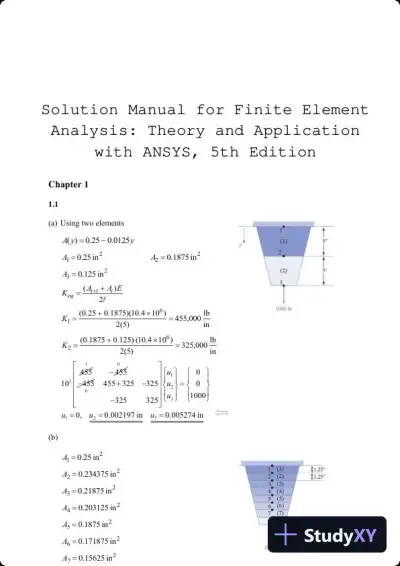 Textbook Guides
Solution Manual for Finite Element Analysis: Theory and Application with ANSYS, 5th Edition
Mechanical Engineering
426 pages53downloadsFeb 2025 Textbook Guides
Solution Manual For Modern Compressible Flow: With Historical Perspective, 3rd Edition
Mechanical Engineering
362 pages52downloadsFeb 2025 Certification Guides
Biofluid Mechanics: An Introduction to Fluid Mechanics, Macrocirculation, and Microcirculation, 3rd Edition (2021)
Mechanical Engineering
172 pages48downloadsFeb 2025 Textbook Guides
Solution Manual for Introduction to Finite Elements in Engineering, 4th Edition
Mechanical Engineering
308 pages47downloadsFeb 2025
Study this document with CramX
Once it is in your library, every tool can work from it.