

Solution Manual for Materials Science and Engineering: An Introduction, 10th Edition
- Mechanical Engineering
- 1360 pages
- Shared May 2025
Solution Manual for Materials Science and Engineering: An Introduction, 10th Edition ensures effective exam preparation with structured textbook notes.
Preview 16 of 1360 pages
See the first 16 pages exactly as they appear in the document.
Page 1 Read page 1 as text
CHAPTER 2 ATOMIC STRUCTURE AND INTERATOMIC BONDING PROBLEM SOLUTIONS Fundamental Concepts Electrons in Atoms 2.1 Cite the difference between atomic mass and atomic weight. Solution Atomic mass is the mass of an individual atom, whereas atomic weight is the average (weighted) of the atomic masses of an atom's naturally occurring isotopes.
Page 2 Page 3 Read page 3 as text
2.2 Chromium has four naturally - occurring isotopes: 4.34% of 50 Cr, with an atomic weight of 49.9460 amu, 83.79% of 52 Cr, with an atomic weight of 51.9405 amu, 9.50% of 53 Cr, with an atomic weight of 52.9407 amu, and 2.37% of 54 Cr, with an atomic weight of 53.9389 amu. On the basis of these data, confirm that the average atomic weight of Cr is 51.9963 amu. Solution The average atomic weight of chromium is computed by adding fraction - of - occurrence/atomic weight products for the three isotopes. Thus
Page 4 Read page 4 as text
2. 3 Hafnium has six naturally occurring isotopes: 0.16% of 174 Hf, with an atomic weight of 173.940 amu; 5.26% of 176 Hf, with an atomic weight of 175.941 amu; 18.60% of 177 Hf, with an atomic weight of 176.943 amu; 27.28% of 178 Hf, with an atomic weight of 177.944 amu; 13.62% of 179 Hf, with an atomic weight of 178.946 amu;. and 35.08% of 180 Hf, with an atomic weight of 179.947 amu. Calculate the average atomic weight of Hf. Solution The average atomic weight of halfnium is computed by adding fraction - of - occurrence — ato mic weight products for the six isotopes — i.e., using Equation 2.2. (Remember: fraction of occurrence is equal to the percent of occurrence divided by 100.) Thus Including data provided in the problem statement we solve for as = 178.485 amu
Page 5 Read page 5 as text
2.4 Bromium has two naturally occurring isotopes: 79 Br, with an atomic weight of 78.918 amu, and 81 Br, with an atomic weight of 80.916 amu. If the average atomic weight for Br is 79.903 amu, calculate the fraction - of - occurrences of these two isotopes. Solution The average atomic weight of indium is computed by adding fraction - of - occurrence — atomic weight products for the two isotopes — i.e., using Equation 2.2, or Because there are just two isotopes, the sum of the fracture - of - occurrences will be 1.000; or which means that Substituting into this expression the one noted above for , and incorporating the atomic weight values provided in the problem statement yields Solving this expression for yields . Furthermore, because
Page 6 Read page 6 as text
then
Page 7 Read page 7 as text
2.5 (a) How many grams are there in one amu of a material? (b) Mole, in the context of this book, is taken in units of gram - mole. On this basis, how many atoms are there in a pound - mole of a substance? Solution (a) In order to determine the number of grams in one amu of material, appropriate manipulation of the amu/atom, g/mol, and atom/mol relationships is all that is necessary, as = 1.66 10 - 24 g/amu (b) Since there are 453.6 g/lb m , = 2.73 10 26 atoms/lb - mol
Page 8 Read page 8 as text
2.6 (a) Cite two important quantum - mechanical concepts associated with the Bohr model of the atom. (b) Cite two important additional refinements that resulted from the wave - mechanical atomic model. Solution (a) Two important quantum - mechanical concepts associated with the Bohr model of the atom are (1) that electrons are particles moving in discrete orbitals, and (2) electron energy is quantized into shells. (b) Two important refinements resulting from the wave - mechanical atomic model are (1) that electron position is described in terms of a probability distribution, and (2) electron energy is quantized into both shells and subshells -- each electron is characterized by four quantum numbers.
Page 9 Read page 9 as text
2.7 Relative to electrons and electron states, what does each of the four quantum numbers specify? Solution The n quantum number designates the electron shell. The l quantum number designates the electron subshell. The m l quantum number designates the number of electron states in each electron subshell. The m s quantum number designates the spin moment on each electron.
Page 10 Read page 10 as text
2. 8 Allowed values for the quantum numbers of electrons are as follows: n = 1, 2, 3, . . . l = 0, 1, 2, 3, . . . , n – 1 m l = 0, ±1, ±2, ±3, . . . , ±l The relationships between n and the shell designations are noted in Table 2.1. Relative to the subshells, l = 0 corresponds to an s subshell l = 1 corresponds to a p subshell l = 2 corresponds to a d subshell l = 3 corresponds to an f subshell For the K shell, the four quantum numbers for each of the two electrons in the 1s state, in the order of nlm l m s , are 100( 1 2 ) and 100( - 1 2 ). Write the four quantum numbers for all of the electrons in the L and M shells, and note which correspond to the s, p, and d subshells. Solution For the L state, n = 2, and eight electron states are possible. Possible l values are 0 and 1, while possible m l values are 0 and ±1; and possible m s values are Therefore, for the s states, the quantum numbers are and . For the p states, the quantum numbers are , , , , , and . For the M state, n = 3, and 18 states are possible. Possible l values are 0, 1, and 2; possible m l values are 0, ±1, and ±2; and possible m s values are Therefore, for the s states, the quantum numbers are , , for the p states they are , , , , , and ; for the d states they are , , , , , , , , , and .
Page 11 Read page 11 as text
2.9 Give the electron configurations for the following ions: Fe 2+ , Al 3+ , Cu + , Ba 2+ , Br - , and O 2 - . Solution The electron configurations for the ions are determined using Table 2.2 (and Figure 2.8 ). Fe 2+ : From Table 2.2, the electron configuration for an atom of iron is 1 s 2 2 s 2 2 p 6 3 s 2 3 p 6 3 d 6 4 s 2 . In order to become an ion with a plus two charge, it must lose two electrons — in this case the two 4 s . Thus, the electron configuration for an Fe 2+ ion is 1 s 2 2 s 2 2 p 6 3 s 2 3 p 6 3 d 6 . Al 3+ : From Table 2.2, the electron configuration for an atom of aluminum is 1 s 2 2 s 2 2 p 6 3 s 2 3 p 1 . In order to become an ion with a plus three charge, it must lose three electrons — in this case two 3 s and the one 3 p . Thus, the electron configuration for an Al 3+ ion is 1 s 2 2 s 2 2 p 6 . Cu + : From Table 2.2, the electron configuration for an atom of copper is 1 s 2 2 s 2 2 p 6 3 s 2 3 p 6 3 d 10 4 s 1 . In order to become an ion with a plus one charge, it must lose one electron — in this case the 4 s . Thus, the electron configuration for a Cu + ion is 1 s 2 2 s 2 2 p 6 3 s 2 3 p 6 3 d 10 . Ba 2+ : The atomic num ber for barium is 56 (Figure 2.8 ), and inasmuch as it is not a transition element the electron configuration for one of its atoms is 1 s 2 2 s 2 2 p 6 3 s 2 3 p 6 3 d 10 4 s 2 4 p 6 4 d 10 5 s 2 5 p 6 6 s 2 . In order to become an ion with a plus two charge, it must lose two electrons — in this case two the 6 s . Thus, the electron configuration for a Ba 2+ ion is 1 s 2 2 s 2 2 p 6 3 s 2 3 p 6 3 d 10 4 s 2 4 p 6 4 d 10 5 s 2 5 p 6 . Br - : From Table 2.2, the electron configuration for an atom of bromine is 1 s 2 2 s 2 2 p 6 3 s 2 3 p 6 3 d 10 4 s 2 4 p 5 . In order to become an ion with a minus one charge, it must acquire one electron — in this case another 4 p . Thus, the electron configuration for a Br - ion is 1 s 2 2 s 2 2 p 6 3 s 2 3 p 6 3 d 10 4 s 2 4 p 6 . O 2 - : From Table 2.2, the electron configuration for an atom of oxygen is 1 s 2 2 s 2 2 p 4 . In order to become an ion with a minus two charge, it must acquire two electrons — in this case another two 2 p . Thus, the electron configuration for an O 2 - ion is 1 s 2 2 s 2 2 p 6 .
Page 12 Read page 12 as text
2.10 Sodium chloride (NaCl) exhibits predominantly ionic bonding. The Na + and Cl - ions have electron structures that are identical to which two inert gases? Solution The Na + ion is just a sodium atom that has lost one electron; therefore, it has an electron configurat ion the same as neon (Figure 2.8 ). The Cl - ion is a chlorine atom that h as acquired one extra electron; therefore, it has an electron configuration the same as argon.
Page 13 Read page 13 as text
The Periodic Table 2.11 With regard to electron configuration, what do all the elements in Group VIIA of the periodic table have in common? Solution Each of the elements in Group VIIA has five p electrons.
Page 14 Read page 14 as text
2.12 To what group in the periodic table would a n element with atomic number 119 belong? Solution Fro m the periodic table (Figure 2.8 ) the element having atomic number 119 would belong to group I A. According to Figure 2.8 , Uuo , having an atomic number of 118 belongs to Group 0 (or 18) of the periodic table. The next column to the right is actually the left - most column, Group IA (or 1).
Page 15 Read page 15 as text
2.13 Without consulting Figure 2.8 or Table 2.2, determine whether each of the electron configurations given below is an inert gas, a halogen, an alkali metal, an alkaline earth metal, or a transition metal. Justify your choices. (a ) 1s 2 2s 2 2p 6 3s 2 3p 6 3d 7 4s 2 (b ) 1s 2 2s 2 2p 6 3s 2 3p 6 (c) 1s 2 2s 2 2p 5 (d ) 1s 2 2s 2 2p 6 3s 2 (e) 1s 2 2s 2 2p 6 3s 2 3p 6 3d 2 4s 2 (f) 1s 2 2s 2 2p 6 3s 2 3p 6 4s 1 Solution (a) The 1 s 2 2 s 2 2 p 6 3 s 2 3 p 6 3 d 7 4 s 2 electron configuration is that of a transition metal because of an incomplete d subshell. (b) The 1 s 2 2 s 2 2 p 6 3 s 2 3 p 6 electron configuration is that of an inert gas because of filled 3 s and 3 p subshells. (c) The 1 s 2 2 s 2 2 p 5 electron configuration is that of a halogen because it is one electron deficient from having a filled L shell. (d) The 1 s 2 2 s 2 2 p 6 3 s 2 electron configuration is that of an alkaline earth metal because of two s electrons. (e) The 1 s 2 2 s 2 2 p 6 3 s 2 3 p 6 3 d 2 4 s 2 electron configuration is that of a transition metal because of an incomplete d subshell. (f) The 1 s 2 2 s 2 2 p 6 3 s 2 3 p 6 4 s 1 electron configuration is that of an alkali metal because of a single s electron.
Page 16 Read page 16 as text
2.14 (a) What electron subshell is being filled for the rare earth series of elements on the periodic table? (b) What electron subshell is being filled for the actinide series? Solution (a) The 4 f subshell is being filled for the rare earth series of elements. (b) The 5 f subshell is being filled for the actinide series of elements.
1344 more pages in the full document
Unlock it once and it stays in your library, ready to chat with or turn into flashcards.
Unlock the full documentMore Mechanical Engineering study materials
See all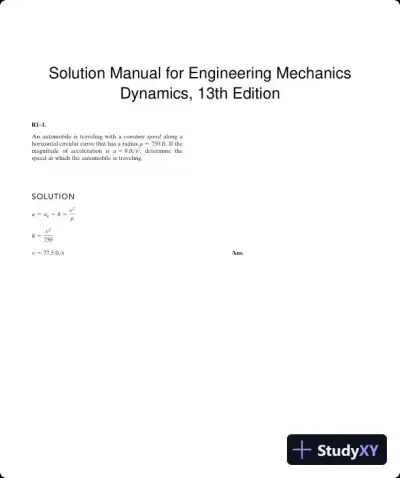 Textbook Guides
Solution Manual for Engineering Mechanics Dynamics, 13th Edition
Mechanical Engineering
1360 pages123downloadsFeb 2025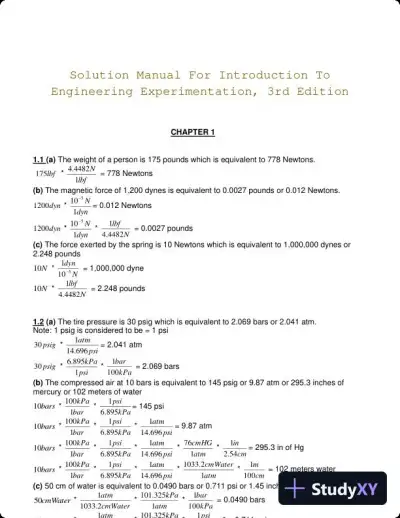 Textbook Guides
Solution Manual For Introduction To Engineering Experimentation, 3rd Edition
Mechanical Engineering
298 pages99downloadsFeb 2025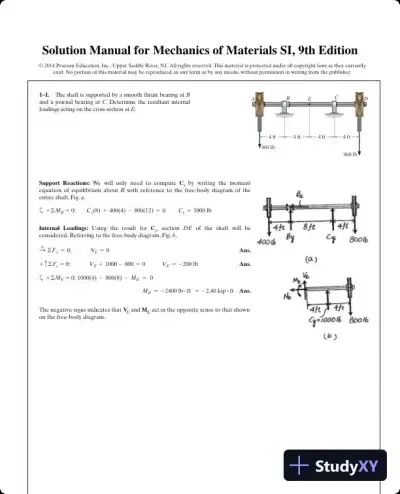 Textbook Guides
Solution Manual for Mechanics of Materials SI, 9th Edition
Mechanical Engineering
1598 pages91downloadsFeb 2025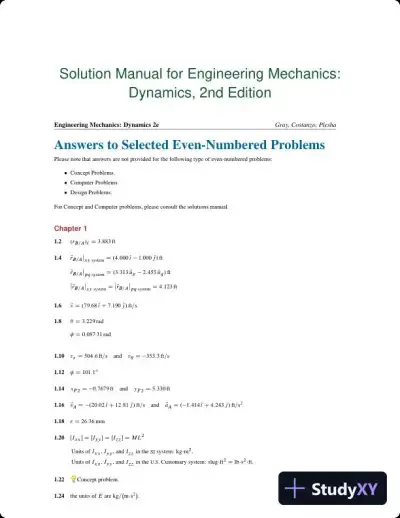 Textbook Guides
Solution Manual for Engineering Mechanics: Dynamics, 2nd Edition
Mechanical Engineering
41 pages82downloadsFeb 2025 Textbook Guides
Solution Manual for Finite Element Analysis: Theory and Application with ANSYS, 5th Edition
Mechanical Engineering
426 pages53downloadsFeb 2025 Textbook Guides
Solution Manual For Modern Compressible Flow: With Historical Perspective, 3rd Edition
Mechanical Engineering
362 pages52downloadsFeb 2025 Certification Guides
Biofluid Mechanics: An Introduction to Fluid Mechanics, Macrocirculation, and Microcirculation, 3rd Edition (2021)
Mechanical Engineering
172 pages48downloadsFeb 2025 Textbook Guides
Solution Manual for Introduction to Finite Elements in Engineering, 4th Edition
Mechanical Engineering
308 pages47downloadsFeb 2025
Study this document with CramX
Once it is in your library, every tool can work from it.