

Solution Manual For Mechanics Of Materials, 7th Edition
- Mechanical Engineering
- 1998 pages
- Shared May 2025
Get a deeper understanding of your textbook with Solution Manual For Mechanics Of Materials, 7th Edition, featuring expert solutions to every problem.
Preview 16 of 1998 pages
See the first 16 pages exactly as they appear in the document.
Page 1 Read page 1 as text
Solutions Manual to accompany Mechanics of Materials Seventh Edition Ferdinand P. Beer Late of Lehigh University E. Russell Johnston, Jr. Late of University of Connecticut John T. DeWolf University of Connecticut David F. Mazurek United States Coast Guard Academy Prepared by Amy Mazurek
Page 2 Page 3 Read page 3 as text
v DESCRIPTION OF THE MATERIAL CONTAINED IN MECHANICS OF MATERIALS, Seventh Edition Chapter 1 Introduction–Concept of Stress The main purpose of this chapter is to introduce the concept of stress. After a short review of Statics in Section 1.1 emphasizing the use of free-body diagrams, Sections 1.2 through 1.2 discuss normal stresses under an axial loading, shearing stresses —with applications to pins and bolts in single and double shear—and bearing stresses . This section also introduces the student to the concepts of analysis and design. Section 1.2A emphasizes the fact that stresses are inherently statically indeterminate and that, at this point, normal stresses under an axial loading can only be assumed to be uniformly distributed. Moreover, such an assumption requires that the axial loading be centric. Section 1.2D is devoted to the application of these concepts to the analysis of a simple structure. Section 1.2E describes how students should approach the solution of a problem in mechanics of materials using the SMART methodology: Strategy, Modeling, Analysis and Reflect & Think. Section 1.2E also discusses the numerical accuracy to be expected in such a solution. Problems included in the first lesson also serve as a review of the methods of analysis of trusses, frames, and mechanisms learned in statics. Section 1.3 discusses the determination of normal and shearing stresses on oblique planes under an axial loading, while Section 1.4 introduces the components of stress under general loading conditions. This section emphasizes the fact that the components of the shearing stresses exerted on perpendicular planes, such as τ xy and τ yx , must be equal. It also introduces the students to the concept of transformation of stress. However, the study of the computational techniques associated with the transformation of stress at a point is delayed until Chapter 7, after students have discovered for themselves the need for such techniques. Section 1.5 is devoted to design considerations. It introduces the concepts of ultimate load , ultimate stress , and factor of safety . It also discusses the reasons for the use of factors of safety in engineering practice. The section ends with an optional presentation of an alternative method of design, Load and Resistance Factor Design. Chapter 2 Stress and Strain–Axial Loading This chapter is devoted to the analysis and design of members under a centric axial loading. Section 2.1A introduces the concept of normal strain , while Section 2.1B describes the general properties of the stress-strain diagrams of ductile and brittle materials and defines the yield strength, ultimate strength, and breaking strength of a material. Section 21C, which is optional, defines true stress and true strain . Section 2.1D introduces Hooke’s law , the modulus of elasticity, and the proportional limit of a material. It defines as isotropic those materials whose mechanical properties are independent of the direction considered and as anisotropic those
Page 4 Read page 4 as text
vi whose mechanical properties depend upon that direction. Among the latter are fiber-reinforced composite materials, that are described in this section. Section 2.1E discusses the elastic and the plastic behavior of a material and defines its elastic limit , while Section 2.1F is devoted to fatigue and the behavior of materials under repeated loadings. The first lesson of Chapter 2 ends with Section 2.1G, which shows how Hooke’s law can be used to determine the deformation of a rod of uniform or variable cross section under one or several loads, and introduces the concept of relative displacement . Section 2.2 discusses statically indeterminate problems involving members under an axial load. As indicated in the preface of the text and in the introduction to this manual, the authors believe it is important to introduce the students at an early stage to the concept of statical indeterminacy and to show them how the analysis of deformations can be used in the solution of problems that cannot be solved by the methods of statics alone. It will also help them realize that stresses, being statically indeterminate, can be computed only by considering the corresponding distribution of strains. Section 2.3 discusses the thermal expansion of rods and shows how to determine stresses in statically indeterminate members subjected to temperature changes. Section 2.4 introduces the concept of lateral strain for an isotropic material and defines Poisson’s ratio . Section 2.5 discusses the multiaxial loading of a structural element and derives the generalized Hooke’s law for such a loading. Since this derivation is based on the application of the principle of superposition , this principle is also introduced in Section 2.5, and the conditions under which it can be used are clearly stated. Section 2.6 is optional. It discusses the change in volume of a material under a multiaxial loading and defines the dilatation and the bulk modulus or modulus of compression of a given material. Section 2.7 introduces the concept of shearing strain . It should be noted that the authors define the shearing strain as the change in the angle formed by the faces of the element of material considered, and not as the angle through which one of these faces rotates. Hooke’s law for shearing stress and strain and the modulus of rigidity are also introduced in this section, as well as the generalized Hooke’s law for a homogeneous, isotropic material under the most general stress conditions. Section 2.8 points out that strains, just as stresses, depend upon the orientation of the planes considered. It also establishes the fact that the constants E , v , and G are not independent from each other and derives Eq. (2.35), that expresses the relation among these three constants. Section 2.9, which is optional, extends the stress-strain relationships to fiber-reinforced composite materials. The relations obtained are expressed by Eqs. (2.37) and (2.39) and involve three different values of the modulus of elasticity and six different values of Poisson’s ratio. Section 2.10 discusses the distribution of the normal stresses under a centric axial loading and shows that this distribution depends upon the manner in which the loads are applied. However, except in the immediate vicinity of the points of application of the loads, the distribution of stresses can be assumed uniform. This result verifies Saint-Venant’s principle. Section 2.11 discusses stress concentrations near circular holes and fillets in flat bars under axial loading. Section 2.12 is devoted to the plastic deformation of members under centric axial loads and introduces the concept of an elastoplastic material . As stated in the preface of the text, the authors believe that students should be exposed to the concept of plastic deformation in the first
Page 5 Read page 5 as text
vii course in mechanics of materials, if only to let them realize the limitations of the assumption of a linear stress-strain relation in engineering applications. By introducing this concept early in the course in connection with axial loading, rather than later with torsion or bending, one makes it easier for the students to understand and accept it. For the same reason, residual stresses are discussed in Section 2.13 in connection with axial loading. However, since some instructors may not want to include the concept of residual stresses in an elementary course, this section is optional and can be omitted without any prejudice to the understanding of the rest of the text. Chapter 3 Torsion The Introduction introduces this type of loading, while Section 3.1 establishes the relation that must be satisfied, on the basis of statics, by the shearing stresses in a given section of a shaft subjected to a torque. This condition, however, does not suffice to determine the stresses, and one must analyze the deformations that occur in the shaft. This is done in Section 3.1A, where it is proved that the distribution of shearing strains in a circular shaft is linear. It should be noted that the discussion presented in See. 3.1B is based solely on the assumption of rigid end plates, rather than on arbitrary and gratuitous assumptions regarding the deformations of a shaft. The results obtained in this and the following sections clearly depend upon the validity of this assumption, but can be extended to other loading conditions through the application of Saint- Venant’s principle. Section 3.1C is devoted to the analysis of the shearing stresses in the elastic range and presents the derivation of the elastic torsion formulas for circular shafts. The section ends with remarks on the transformation of stresses in torsion and the comparison between the failures of ductile and brittle materials in torsion. The formula for the angle of twist of a shaft in the elastic range is derived in Section 3.2. This section also contains various applications involving the twisting of single and gear-connected shafts. Section 3.3 deals with the solution of problems involving statically indeterminate shafts. Section 3.4 is devoted to the design of transmission shafts and begins with the determination of the torque required to transmit a given power at a given speed, both in SI and U.S. customary units. Note that the effect of bending on the design of transmission shafts will be discussed in Section 8.2, which is optional. Section 3.5 discusses stress concentrations at fillets in circular shafts. Sections 3.6 through 3.7 deal with the plastic deformations and residual stresses in circular shafts and are optional. Since a similar presentation of the plastic deformations and residual stresses of members in pure bending is given in Chapter 4, the instructor may decide to include only one of these presentations in the course. Section 3.6 describes the general method for the determination of the torque corresponding to a given maximum shearing stress in a shaft made of a material with a nonlinear stress-strain diagram , while Sections 3.7 and 3.8 deal, respectively, with the deformations and the residual stresses in shafts made of an elastoplastic material . Sections 3.9 and 3.10 are also optional. They are devoted, respectively, to the torsion of solid members and thin-walled hollow shafts of noncircular section .
Page 6 Read page 6 as text
viii Chapter 4 Pure Bending The Introduction defines this type of loading and shows how the results obtained in the following sections can be applied to the analysis of other types of loadings as well, namely, eccentric axial loadings and transverse loadings. Sections 4.1 and 4.1A establish the relation that must be satisfied, on the basis of statics, by the normal stresses in a given section of a member subjected to pure bending. This condition, however, does not suffice to determine the stresses, and one must analyze the deformations that occur in the member. This is done in Section 4.1B, where it is proved that the distribution of normal stresses in a symmetric member in pure bending is linear. It should be noted that no assumption is made in this discussion regarding the deformations of the member, except that the couples should be applied in such a way that the ends of the member remain plane. Whether this can actually be accomplished is discussed at the end of Section 4.3. Section 4.2 is devoted to the analysis of the normal stresses in the elastic range and presents the derivation of the elastic flexure formulas . It also defines the elastic section modulus and ends with the derivation of the formula for the curvature of an elastic beam. Section 4.3 discusses the anticlastic curvature of members in pure bending and also states the loading conditions required for the ends of the member to remain plane. Section 4.4 discusses the determination of stresses in members made of several materials and defines the transformed section of such members. It also shows how the transformed section can be used to determine the radius of curvature of the member. The section ends with a discussion of the stresses in reinforced-concrete beams . Section 4.5 deals with the stress concentrations at fillets and grooves in flat bars under pure bending. Section 4.6 is optional. This section discusses the plastic deformations and residual stresses in members subjected to pure bending in much the same way that these were discussed in Sections 3.6 through 3.8 in the case of members in torsion. Section 4.6 describes the general method for the determination of the bending moment corresponding to a given maximum normal stress in a member possessing two planes of symmetry and made of a material with a nonlinear stress-strain diagram. Section 4.6A deals with members made of an elastoplastic material and derives formulas relating the thickness of the elastic core and the radius of curvature with the applied bending moment in the case of members with a rectangular cross section. It also defines the shape factor and the plastic section modulus of members with a nonrectangular section. Section 4.6B deals with the determination of the plastic moment of members made of an elastoplastic material and possessing a single plane of symmetry, while Section 4.6C discusses residual stresses . Section 4.7 shows how the stresses due to a two-dimensional eccentric axial loading can be obtained by replacing the given eccentric load by a centric load and a couple, and superposing the corresponding stresses. Attention is called to the fact that the neutral axis does not pass through the centroid of the section. Section 4.8 deals with the unsymmetric bending of elastic members. It is first shown that the neutral axis of a cross section will coincide with the axis of the bending couple if, and only if, the
Page 7 Read page 7 as text
ix axis of the couple is directed along one of the principal centroidal axes of the cross section. It is then shown that stresses due to unsymmetric bending can always be determined by resolving the given bending couple into two component couples directed along the principal axes of the section and superposing the corresponding stresses. Sample Problem 4.10 has been included in this section to provide an opportunity for students to use material on Mohr’s Circle to determine stresses in non-symmetrical sections. The material is based on what students will have learned in a study of Statics where the transformation of moments of inertia is covered for problems where it is necessary to look at the rotation of coordinate axes. Problems 4.141 through 4.143 are also asterisked and are best solved with the use of Mohr’s Circle. This method of analysis is extended in Section 4.9 to the determination of the stresses due to an eccentric axial loading in three-dimensional space . The eccentric load is replaced by an equivalent system consisting of a centric load and two bending couples, and the corresponding stresses are superposed. Section 4.10 is optional; it deals with the bending of curved members . Chapter 5 Analysis and Design of Beams for Bending In the Introduction beams are defined as slender prismatic members subjected to transverse loads and are classified according to the way in which they are supported. It is shown that the internal forces in any given cross section are equivalent to a shear force V and a bending couple M. The bending couple M creates normal stresses in the section, while the shear force V creates shearing stresses. The former is determined in this chapter, using the flexure formula (5.1), while the latter will be discussed in Chapter 6. Since the dominant criterion in the design of beams for strength is usually the bending stresses in the beam, the determination of the maximum value of the bending moment in the beam is the most important factor to be considered. To facilitate the determination of the bending moment in any given section of the beam, the concept of shear and bending-moment diagrams will be introduced in Section 5.1, using free-body diagrams of various portions of the beam. An alternative method for the determination of shear and bending-moment diagrams, based on relations among load, shear, and bending moment, is presented in Section 5.2. To maintain the interest of the students, most of the problems to be assigned are focused on the engineering applications of these methods and call for the determination, not only of the shear and bending moment, but also of the normal stresses in the beam. Section 5.3 is devoted to the design of prismatic beams based on the allowable normal stress for the material used. Sample Problems and problems to be assigned include wooden beams of rectangular cross section, as well as rolled-steel W and S beams. An optional paragraph on page 372 describes the application of Load and Resistance Factor Design to beams under transverse loading. Section 5.4 introduces the concept of singularity functions and shows how these functions can provide an alternative and effective method for the determination of the shear and bending
Page 8 Read page 8 as text
x moment at any point of a beam under the most general loading condition. While this section is optional, it should be included in the lesson schedule if singularity functions are to be used later for the determination of the slope and deflection of a beam (Section 9.3). It is pointed out on page 387 that singularity functions are particularly well suited to the use of computers , and several optional problems requiring the use of a computer (Probs. 5.118 through 5.125) have been included in this assignment. Section 5.5, which is optional, is devoted to nonprismatic beams , such as forged or cast beams designed to be of constant strength, and rolled-steel beams reinforced with cover plates. Chapter 6 Shearing Stresses in Beams and Thin-Walled Members It is shown in the Introduction that a transverse load creates shearing stresses as well as normal stresses in a beam. Considering first the horizontal face of a beam element, it is shown in Sections 61A that the horizontal shear per unit length q , or shear flow , is equal to VQ/I. This result is applied in Concept Application 6.1 to the determination of the shear force in the nails connecting three planks forming a wooden beam, as well as in Probs. 6.1 through 6.4. Probs. 6.5 through 6.8 apply the same concepts to steel beams made of sections bolted together In Section 6.1B the average shearing stress τ ave exerted on the horizontal face of the beam element is obtained by dividing the shear flow q by the width t of the beam: ave VQ It (6.6) Note that since the shearing stresses τ xy and τ yx exerted at a given point are equal, the expression obtained also represents the average shearing stress exerted at a given height on a vertical section of the beam. This formula is used to determine shearing stresses in a beam made of glued planks in Sample Prob. 6.1 and to design a timber beam in Sample Prob. 6.2. Problems 6.9 through 6.12 and 6.21 and 6.22 call for the determination of shearing stresses in various types of beams. Section 6.1C explores shearing stresses in common beam types In Concept Applications 6.2 and 6.3 the designs obtained on the basis of normal stresses, respectively, for a timber beam in Sample Prob. 5.7 and for a rolled-steel beam in Sample Prob. 5.8 are checked and found to be acceptable from the point of view of shearing stresses. Section 6.2 is optional and discusses the distribution of stresses in a narrow rectangular beam. In Section 6.3 the expression q = VQ / I obtained on Section 6.1A for the shear flow on the horizontal face of a beam element is shown to remain valid for the curved surface of a beam element of arbitrary shape. It is then applied in Concept Application 6.4 and in Probs. 6.29 through 6.33 to the determination of the shearing forces and shearing stresses in nailed and glued vertical surfaces.
Page 9 Read page 9 as text
xi Section 6.4 deals with the determination of shearing stresses in thin-walled members and shows that Eq. (6.6) can be applied to the determination of the average shearing stress in a section of arbitrary orientation. Section 6.5, which is optional, describes the formation of plastic zones in beams subjected to transverse loads. Section 6.6, which is also optional, deals with the unsymmetric loading of thin-walled members, the determination of the shear center , and the computation of the shearing stresses caused by a shearing force exerted at the shear center. Chapter 7 Transformations of Stress and Strain After a short introduction, formulas for the transformation of plane stress under a rotation of axes are derived in Section 7.1A, while the principal planes of stress, principal stresses, and maximum shearing stress are determined in Section 7.1B. Section 7.2 is devoted to the use of Mohr’s circle . It should be noted that the convention used in the text provides for a rotation on Mohr’s circle in the same sense as the corresponding rotation of the element; in other words, this convention is the same as that used in statics for the transformation of moments and products of inertia. Attention is called to the statement at the bottom of page 493 of the text and the accompanying Fig. 7.15. Section 7.3 discusses the general ( three-dimensional ) state of stress and establishes the fact that three principal axes of stress and three principal stresses exist. Section 7.4 shows how three different Mohr’s circles can be used to represent the transformations of stress associated with rotations of the element about the principal axes. The results obtained are used to show that in a state of plane stress, the maximum shearing stress does not necessarily occur in the plane of stress. Section 7.5 is optional. Section 7.5A presents the two criteria most commonly used to predict whether a ductile material will yield under a given state of plane stress, while Section 7.5B discusses the two criteria used to predict the fracture of brittle materials. Section 7.6 deals with stresses in thin-walled pressure vessels ; it is limited to the analysis of cylindrical and spherical pressure vessels. The second part of the chapter (Sections 7.7 through 7.9) deals with transformations of strain and is optional. Section 7.7A presents the derivation of the formulas for the transformation of strain under a rotation of axes. It should be noted that this derivation is based on the consideration of an oblique triangle (Fig. 7.51) and the use of the law of cosines, and that the determination of the shearing strain is facilitated by the use of Eq. (7.43), which relates it to the normal strain along the coordinate axes and their bisector.
Page 10 Read page 10 as text
xii Section 7.7B introduces Mohr’s circle for plane strain , and Section 7.8 discusses the three- dimensional analysis of strain and its application to the determination of the maximum shearing strain in states of plane strain and of plane stress. Section 7.9 deals with the use of strain rosettes for the determination of states of plane strain. Chapter 8 Principal Stresses under a Given Loading This chapter is devoted to the determination of the principal stresses and maximum shearing stress in beams, transmission shafts subjected to transverse loads as well as to torques, and bodies of arbitrary shape under combined loadings. In the Introduction it is shown that, while only normal stresses occur on a square element with horizontal and vertical faces located at the surface of a beam, shearing stresses will occur if the element is rotated through 45 o (Fig. 8.1). The reverse situation is observed for an element with horizontal and vertical faces subjected only to shearing stresses (Fig. 8.2). The analysis of beams, therefore, should include the determination of the principal stresses and maximum shearing stress at various points. This is done in Section 8.1 for cantilever beams of various rectangular sections subjected to a single concentrated load at their free end. It is found that the principal stress σ max does not exceed the maximum normal stress σ m determined by the method of Chapter 5 except very close to the load. While this result holds for most beams of nonrectangular section, it may not be valid for rolled-steel W and S beams, and the analysis and design of such beams should include the determination of the principal stress σ max at the junction of the web with the flanges of the beam . (See Sample Probs. 8.1 and 8.2, and Probs. 8.1 through 8.14). Section 8.2 is devoted to the analysis and design of transmission shafts using gears or sprocket wheels to transmit power to and from the shaft. These shafts are subjected to transverse loads as well as to torques. The design of such shafts is the subject of Sample Prob. 8.3 and Probs. 8.15 through 8.30. The determination of the stresses at a given point K of a body due to a combined loading is the subject of Section 8.3. First, the loading is reduced to an equivalent system of forces and couples in a section of the body containing K . Next, the normal and shearing stresses are determined at K . Finally, using one of the methods of transformation of stresses presented in Chapter 7, the principal planes, principal stresses, and maximum shearing stress may be determined at K . This procedure is illustrated in Concept Application 8.1 and Sample Probs. 8.4 and 8.5.
Page 11 Read page 11 as text
xiii Chapter 9 Deflection of Beams The relation derived in Chapter 4 between the curvature of a beam and the bending moment is recalled in Section 9.1 and used to predict the variation of the curvature along the beam. In Section 9.1A, the equation of the elastic curve for a beam is obtained through two successive integrations, after the bending moment has been expressed as a function of the coordinate x . Concept Applications 9.1 and 9.2 show how the boundary conditions can be used to determine the two constants of integration in the cases of a cantilever beam and of a simply supported beam. Concept Application 9.3 indicates how to proceed when the bending moment must be represented by two different functions of x . Section 9.1B is optional; it shows in the case of a beam supporting a distributed load, how the equation of the elastic curve can be obtained directly from the function representing the load distribution through the use of four successive integrations. Section 9.2 is devoted to the analysis of statically indeterminate beams and to the determination of the reactions at their supports. It is suggested that a minimum of two lessons be spent on Sections 9.1 through 9.2 if neither the use of singularity functions (Section 9.3) nor the moment-area method (Sections 9.5 through 9.6) are to be covered in the course. Section 9.3 is devoted to the use of singularity functions for the determination of beam deflections and slopes. It is optional and assumes that Section 5.4 has been covered previously. It is recommended that both Sections 5.4 and 9.3 be included in the course, since singularity functions provide the students with an effective and versatile method for the determination of deflections and slopes under the most diverse loading conditions. In addition, and as indicated earlier, singularity functions are well suited to the use of computers. Section 9.4A discusses the method of superposition for the determination of beam deflections and slopes. It shows how the expressions given in Appendix D for various simple loadings can be used to obtain the deflection and slope of a beam supporting a more complex loading. In Section 9.4B, the method of superposition is applied to the determination of the reactions at the supports of statically indeterminate beams . Sections 9.5 through 9.6 are optional. They deal with the application of the moment-area methods to the determination of the deflection of beams and may be omitted in courses that place a greater emphasis on analytical methods and make use of singularity functions. It should be noted, however, that these methods provide a very practical means for the determination of the deflection and slope of beams of variable cross section . The two moment-area theorems are derived in Section 9.5A and are immediately applied in Section 9.5B to the computation of the slope and deflection of cantilever beams and beams with symmetric loadings (simply supported or overhanging beams). Section 9.5C shows how to draw a bending-moment diagram by parts . This approach greatly facilitates the determination of moment areas in all but the simplest loading situations.
Page 12 Read page 12 as text
xiv Section 9.6 deals with simply supported and overhanging beams with unsymmetric loadings . The analysis of such beams hinges on the use of a reference tangent drawn through one of the supports after the tangential deviation of the second support has been computed from the bending-moment diagram. Section 9.6B describes how to locate the point of maximum deflection and how to compute that deflection. Section 9.6C deals with the analysis of statically indeterminate beams and the determination of the reactions at their supports. Chapter 10 Columns Section 10.1 introduces the concept of stability of a structure . The example considered in this section consists of a block supported by two spring-connected rigid rods. It is shown that the position of equilibrium in which both rods are aligned is stable if this position is the only possible position of equilibrium of the system. The same criterion is applied to an elastic pin-ended column in Section 10.1A in order to derive Euler’s formula . Section 10.1B shows how Euler’s formula for pin-ended columns can be used to determine the critical load of columns with other end conditions. Section 10.2 is optional; it deals with the eccentric loading of a column and gives the derivation of the secant formula. Section 10.3 discusses the design of columns under a centric load . Empirical formulas developed by various engineering associations for the design of steel columns, aluminum columns, and wood columns are presented in Section 10.3A. Section 10.3B is devoted to an optional discussion of the application of Load and Resistance Factor Design to steel columns. As noted at the end of this section, the design formulas presented in this section are intended to provide introductory examples of different design approaches. These formulas do not provide all the requirements that are needed for more comprehensive designs often encountered in engineering practice. Section 10.4 discusses the design of columns under an eccentric load and presents two of the most frequently used methods: the allowable-stress method and the interaction method. Chapter 11 Energy Methods Section 11.1A introduces the concept of strain energy by considering the work required to stretch a rod of uniform cross section. This work, which is equal to the area under the load- deformation curve, represents the strain energy of the rod. The strain-energy density is defined in Section. 11.1B, as well as the modulus of toughness and the modulus of resilience of a given material. The formula for the elastic strain energy associated with normal stresses is derived in Section 11.2A, as well as the expressions for the strain energy corresponding to an axial loading and to pure bending. The formula for the strain energy associated with shearing stresses is derived in Section 11.2B, as well as the expressions corresponding to torsion and transverse loading.
Page 13 Read page 13 as text
xv Section 11.3, which is optional, covers the strain energy for a general state of stress and derives an expression for the distortion energy per unit volume , both in the general case of three- dimensional stress and in the particular case of plane stress. Section 11.4A discusses impact loadings and Section 11.4B the design of a structure for an impact load. To facilitate the solution of impact-loading problems, it is shown in Section 11.5A that the strain energy of a structure subjected to a single concentrated load P can be obtained by equating the strain energy to the work of P. (Appendix D is used to express the deflection in terms of P ). As shown in Section 11.5B, the reverse procedure can be used to determine the deflection of a structure at the point of application of a single load P or a single couple M ; the strain energy of the structure is computed from one of the formulas derived in Section 11.2, and the work of P or M is equated to the expression obtained for the strain energy. Sections 11.6 through 11.9 are optional. In Section 11.6 an expression for the strain energy of a structure subjected to several loads is obtained by computing the work of the loads as they are successively applied. Reversing the order in which the loads are applied, one proves Maxwell’s reciprocal theorem . The expression obtained for the strain energy of the structure is used in Section 11.7 to prove Castigliano’s theorem . Section 11.8 is devoted to the application of Castigliano’s theorem to the determination of the deflection and slope of a beam and to the deflection of a point in a truss. Finally, Section 11.9 deals with the application of Castigliano’s theorem to the determination of the reactions at the supports of statically indeterminate structures such as beams and trusses.
Page 14 Page 15 Read page 15 as text
TABLE I: LIST OF TOPICS COVERED IN MECHANICS OF MATERIALS , Seventh Edition Suggested Number of Periods Core Additional Advanced Sections Topics Topics Topics Topics Chapter 1: Introduction – Concept of Stress 1.1-2 Stress Under Axial Loading 1-2 1.3-5 Components of Stress; Factor of Safety 1 Chapter 2: Stress and Strain – Axial Loading 2.1 Stress-Strain Diagrams; Deformations Under 1-2 Axial Loading 2.2-3 Statically Indeterminate Problems 1 2.4-5 Poisson’s Ratio; Generalized Hooke’s Law 1 *2.6 Dilatation; Bulk Modulus 0.25-0.5 2.7-8 Shearing Strain 0.5 *2.9 Stress-Strain Relationships for Fiber-Reinforced 0.5-1 Composite Materials 2.10-12 Stress Concentrations; Plastic Deformations 0.5-1 *2.13 Residual Stresses 0.5 Chapter 3: Torsion 3.1 Stresses in Elastic Range 1 3.2-3 Angle of Twist; Statically Indeterminate Shafts 1-2 3.4-5 Design of Transmission Shafts; Stress 1 Concentrations *3.6-8 Plastic Deformations; Residual Stresses 1-2 *3.9-10 Noncircular Members; Thin-Walled Hollow Shafts 1-2 Chapter 4: Pure Bending 4.1-3 Stresses in Elastic Range 1-2 4.4-5 Members Made of Several Materials; Stress 1-2 Concentrations *4.6 Plastic Deformations; Residual Stresses 1-2 4.7 Eccentric Axial Loading 1-2 4.8-9 Unsymmetric Bending; General Eccentric 1-2 Axial Loading *4.10 Bending of Curved Members 1-2 Chapter 5: Analysis and Design of Beams for Bending 5.1 Shear and Bending-Moment Diagrams 1-1.5 5.2 Using Relations Between w, V, and M 1-1.5 5.3 Design of Prismatic Beams in Bending 1-2 *5.4 Use of Singularity Functions to Determine V and M 1-2 *5.5 Nonprismatic Beams 1-2 Chapter 6: Shearing Stresses in Beams and Thin-Walled Members 6.1 Shearing Stresses in Beams 1-2 *6.2 Shearing Stresses in Narrow Rectangular Beam 0.25 6.3-4 Shearing Stresses in Thin-Walled Members 1-2 *6.5 Plastic Deformations 0.25 *6.6 Unsymmetric Loading; Shear Center 1-2
Page 16 Read page 16 as text
TABLE I: LIST OF TOPICS COVERED IN MECHANICS OF MATERIALS , Seventh Edition (CONTINUED) Suggested Number of Periods Core Additional Advanced Sections Topics Topics Topics Topics Chapter 7: Transformation of Stress and Strain 7.1 Transformation of Plane Stress 1-2 7.2 Mohr’s Circle for Plane Stress 1-2 7.3-4 Three-Dimensional Analysis of Stress 0.5-1 *7.5 Yield and Fracture Criteria 0.5-1 7.6 Thin-Walled Pressure Vessels 0.5-1 *7.7-8 Analysis of Strain; Mohr’s Circle 1-1.5 *7.9 Strain Rosette 0.5 Chapter 8: Principal Stresses under a Given Loading 8.1 Principal Stresses in a Beam 0.5-1 8.2 Design of Transmission Shafts 0.5-1 8.3 Stresses under Combined Loadings 1-3 Chapter 9: Deflection of Beams 9.1-1A Equation of Elastic Curve 0.5-1 *9.1B Direct Determination of Elastic Curve from 0.5 Load Distribution 9.2 Statically Indeterminate Beams 0.5 - 1 *9.3 Use of Singularity Functions 1-2 9.4 Method of Superposition 1-2 Application of Moment-Area Theorems to: *9.5 Cantilever Beams and Beams with 1-2 Symmetric Loadings *9.6A-6B Beams with Unsymmetric Loadings; Maximum 1-1.5 Deflection *9.6C Statically Indeterminate Beams 0.5 Chapter 10: Columns 10.1 Euler’s Column Formula 1-2 *10.2 Eccentric Loading; Secant Formula 1 10.3 Design of Columns under a Centric Load 1-2 10.4 Design of Columns under an Eccentric Load 1-2 Chapter 11: Energy Methods 11.1-2 Strain Energy 1-2 11.3 Strain Energy for General State of Stress 0.5 11.4 Impact Loading 0.5-1 11.5 Deflections by Work-Energy Method 0.5-1 *11.6-8 Castigliano’s Theorem 1-2 *11.9 Statically Indeterminate Structures 1-2 _______ _______ _______ Total Number of Periods 24-41½ 21-38½ 3-6
1982 more pages in the full document
Unlock it once and it stays in your library, ready to chat with or turn into flashcards.
Unlock the full documentMore Mechanical Engineering study materials
See all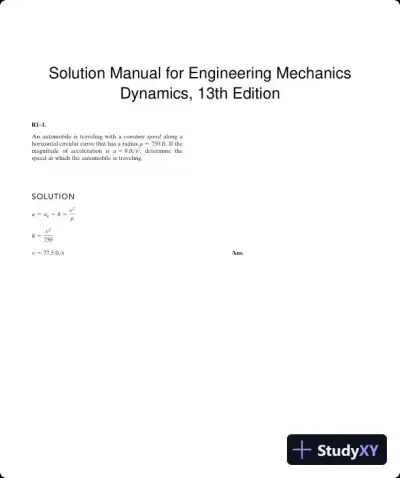 Textbook Guides
Solution Manual for Engineering Mechanics Dynamics, 13th Edition
Mechanical Engineering
1360 pages123downloadsFeb 2025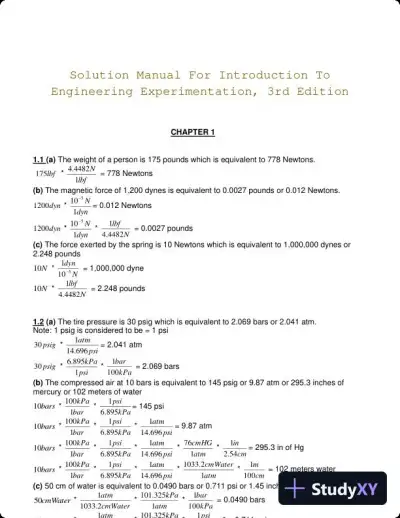 Textbook Guides
Solution Manual For Introduction To Engineering Experimentation, 3rd Edition
Mechanical Engineering
298 pages99downloadsFeb 2025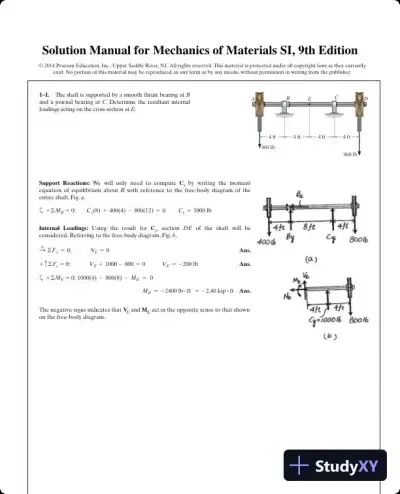 Textbook Guides
Solution Manual for Mechanics of Materials SI, 9th Edition
Mechanical Engineering
1598 pages91downloadsFeb 2025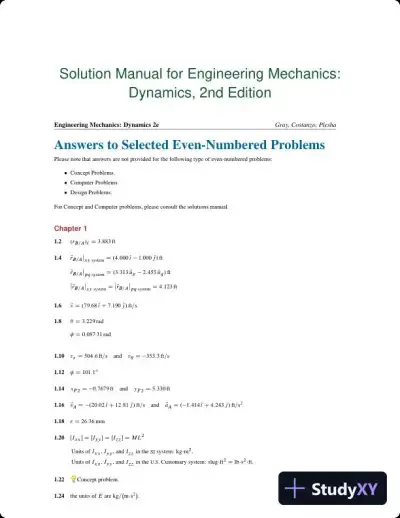 Textbook Guides
Solution Manual for Engineering Mechanics: Dynamics, 2nd Edition
Mechanical Engineering
41 pages82downloadsFeb 2025 Textbook Guides
Solution Manual for Finite Element Analysis: Theory and Application with ANSYS, 5th Edition
Mechanical Engineering
426 pages53downloadsFeb 2025 Textbook Guides
Solution Manual For Modern Compressible Flow: With Historical Perspective, 3rd Edition
Mechanical Engineering
362 pages52downloadsFeb 2025 Certification Guides
Biofluid Mechanics: An Introduction to Fluid Mechanics, Macrocirculation, and Microcirculation, 3rd Edition (2021)
Mechanical Engineering
172 pages48downloadsFeb 2025 Textbook Guides
Solution Manual for Introduction to Finite Elements in Engineering, 4th Edition
Mechanical Engineering
308 pages47downloadsFeb 2025
Study this document with CramX
Once it is in your library, every tool can work from it.