

2022 NR507 Pathophysiology Final Exam With Answers (75 Solved Questions)
- Medicine
- Chamberlain College of Nursing
- 36 pages
- Shared May 2025
Prepare strategically with 2022 NR507 Pathophysiology Final Exam With Answers, covering all essential past exam topics.
Preview 11 of 36 pages
See the first 11 pages exactly as they appear in the document.
Page 1 Read page 1 as text
Question 1 2 / 2 pts Tissue damage caused by the deposition of circulating immune complexes containing an antibody against the host DNA is the cause of which disease? Hemolytic anemia Pernicious anemia Systemic lupus erythematosus Myasthenia gravis Only the deposition of circulating immune complexes containing an antibody against the host DNA produce tissue damage in individuals with systemic lupus erythematosus (SLE). Question 2 2 / 2 pts How does chest wall compliance in an infant differ from that of an adult? An adult’s chest wall compliance is lower than an infant’s. An adult’s chest wall compliance is higher than an infant’s. An adult’s chest wall compliance is the same as an infant’s. An adult’s chest wall compliance is dissimilar to that of an infant’s. Chest wall compliance is higher in infants than it is in adults, particularly in premature infants. Question 3 2 / 2 pts
Page 2 Page 3 Read page 3 as text
What term is used to describe a hernial protrusion of a saclike cyst that contains meninges, spinal fluid, and a portion of the spinal cord through a defect in a posterior arch of a vertebra? Encephalocele Meningocele Spina bifida occulta Myelomeningocele Myelomeningocele is a hernial protrusion of a saclike cyst containing meninges, spinal fluid, and a portion of the spinal cord with its nerves through a defect in the posterior arch of a vertebra. The remaining options are not appropriate terms to identity the described condition. Question 4 2 / 2 pts Continued therapy of pernicious anemia (PA) generally lasts how long? 6 to 8 weeks 8 to 12 months Until the iron level is normal The rest of one’s life Because PA cannot be cured, maintenance therapy is a life-long endeavor. Question 5 2 / 2 pts Cytokines are thought to cause fevers by stimulating the synthesis of which chemical mediator?
Page 4 Read page 4 as text
Leukotriene Histamine Prostaglandin Bradykinin Cytokines seem to raise the thermoregulatory set point through stimulation of prostaglandin synthesis and turnover in thermoregulatory (brain) and nonthermoregulatory (peripheral) tissues. The other options do not accurately identify the appropriate chemical mediator. Question 6 2 / 2 pts The World Health Organization (WHO) defines grade 1 (overweight) as a BMI of: 18.5 to 24.9 25 to 29.9 30 to 39.9 40 to 50.9 A BMI of 25 to 29.9 kg/m 2 is considered a grade 1 (overweight) classification. A BMI of 18.5 to 24.9 kg/m 2 is considered normal range, whereas 30 to 39.9 kg/m 2 is a grade 2 (severe overweight) classification, and a BMI higher than 40 kg/m 2 is considered grade 3 (morbidly overweight). IncorrectQuestion 7 0 / 2 pts When diagnosed with hemolytic disease of the newborn (HDN), why does the newborn develop hyperbilirubinemia after birth but not in utero? Excretion of unconjugated bilirubin through the placenta into the mother’s circulation is no longer possible.
Page 5 Read page 5 as text
Hemoglobin does not break down into bilirubin in the intrauterine environment. The liver of the fetus is too immature to conjugate bilirubin from a lipid-soluble to water-soluble form. The destruction of erythrocytes producing bilirubin is greater after birth. Hyperbilirubinemia occurs in the neonate after birth because excretion of lipid- soluble unconjugated bilirubin through the placenta is no longer possible. This selection is the only option that accurately explains why HDN causes hyperbilirubinemia after birth but not in utero. Question 8 2 / 2 pts Which of the following describes how the body compensates for anemia? Increasing rate and depth of breathing Decreasing capillary vasoconstriction Hemoglobin holding more firmly onto oxygen Kidneys releasing more erythropoietin Tissue hypoxia creates additional demands and compensatory actions on the pulmonary and hematologic systems. The rate and depth of breathing increase in an attempt to increase the availability of oxygen. This selection is the only option that accurately describes the compensation mechanism in such anemias. Question 9 2 / 2 pts An infant has a continuous machine-type murmur best heard at the left upper sternal border throughout systole and diastole, as well as a bounding pulse and a thrill on palpation. These clinical findings are consistent with which congenital heart defect? Atrial septal defect (ASD)
Page 6 Read page 6 as text
Ventricular septal defect (VSD) Patent ductus arteriosus (PDA) Atrioventricular canal (AVC) defect If pulmonary vascular resistance has fallen, then infants with PDA will characteristically have a continuous machine-type murmur best heard at the left upper sternal border throughout systole and diastole. If the PDA is significant, then the infant also will have bounding pulses, an active precordium, a thrill on palpation, and signs and symptoms of pulmonary overcirculation. The presentations of the other congenital heart defects are not consistent with the described the symptoms. Question 10 2 / 2 pts Research has shown a link between cancer and which sexually transmitted disease? Syphilis Gonorrhea Human papillomavirus Pelvic inflammatory disease Human papillomavirus (HPV) is the most common sexually transmitted virus in the United States. High-risk, or oncogenic, HPVs can cause cancer. A persistence of infection with high-risk HPV is a prerequisite for the development of cervical intraepithelial neoplasia (CIN) lesions and invasive cervical cancers. No research supports such a link between the remaining options and cancer. Question 11 2 / 2 pts When renin is released, it is capable of which action? Inactivation of autoregulation
Page 7 Read page 7 as text
Direct activation of angiotensin II Direct release of antidiuretic hormone (ADH) Formation of angiotensin I When renin is released, it cleaves an α-globulin (angiotensinogen produced by liver hepatocytes) in the plasma to form angiotensin I. Question 12 2 / 2 pts What characteristic do atopic individuals have that make them genetically predisposed to develop allergies? Greater quantities of histamine More histamine receptors Greater quantities of IgE A deficiency in epinephrine Atopic individuals tend to produce higher quantities of IgE and to have more crystalline fragment (Fc) receptors for IgE on their mast cells. The other options do not cause this reaction. Question 13 2 / 2 pts What is the primary cause of the symptoms of polycythemia vera? Decreased erythrocyte count Destruction of erythrocytes
Page 8 Read page 8 as text
Increased blood viscosity Neurologic involvement As polycythemia vera progresses, many of the symptoms are related to the increased blood cellularity and viscosity. No other option is the primary cause of the symptoms of polycythemia vera. Question 14 2 / 2 pts Pressure in the left ventricle must exceed pressure in which structure before the left ventricle can eject blood? Superior vena cava Aorta Inferior vena cava Pulmonary veins Pressure in the ventricle must exceed aortic pressure before blood can be pumped out during systole. The aorta is the only structure in which pressure must be less than the amount of blood in the left ventricle for ejection to occur. Question 15 2 / 2 pts Children with phenylketonuria (PKU) are unable to synthesize: Essential amino acid, phenylalanine, to tyrosine Renin, erythropoietin, and antidiuretic hormone Aldosterone, cortisol, and androgens
Page 9 Read page 9 as text
Neurotransmitters gamma-aminobutyric acid (GABA) and acetylcholine PKU is an inborn error of metabolism characterized by the inability of the body to convert the essential amino acid, phenylalanine, to tyrosine. PKU does not affect synthesis of the other options. Question 16 2 / 2 pts What is the chance with each pregnancy that a child born to two parents with the sickle trait will have sickle cell disease (SCD)? 20% 25% 33% 50% A 25% chance exists with each pregnancy that a child born to two parents with sickle cell trait will have SCD. Genetic counseling enables people with SCD or with the sickle cell trait to make informed decisions about transmitting this genetic disorder to their offspring. Question 17 2 / 2 pts Carcinoma refers to abnormal cell proliferation originating from which tissue origin? Blood vessels Epithelial cells Connective tissue Glandular tissue
Page 10 Read page 10 as text
Only cancers arising from epithelial cells are called carcinomas . Question 18 2 / 2 pts Chvostek and Trousseau signs indicate which electrolyte imbalance? Hypokalemia Hyperkalemia Hypocalcemia Hypercalcemia Two clinical signs of hypocalcemia are the Chvostek sign and Trousseau sign. These clinical signs are not indicative of any of the other options. Question 19 2 / 2 pts The ability of the pathogen to invade and multiply in the host is referred to as: Infectivity Toxigenicity Pathogenicity Virulence Infectivity is the ability of the pathogen to invade and multiply in the host. The other options do not accurately denote the pathogen’s ability to invade and multiply in the host. Question 20 2 / 2 pts
Page 11 Read page 11 as text
An infant has a crescendo-decrescendo systolic ejection murmur located between the second and third intercostal spaces along the left sternal border. A wide fixed splitting of the second heart sound is also found. These clinical findings are consistent with which congenital heart defect? Atrial septal defect (ASD) Ventricular septal defect (VSD) Patent ductus arteriosus (PDA) Atrioventricular canal (AVC) defect Because most children with ASD are asymptomatic, diagnosis is usually made during a routine physical examination by the auscultation of a crescendo- decrescendo systolic ejection murmur that reflects increased blood flow through the pulmonary valve. The location of the murmur is between the second and third intercostal spaces along the left sternal border. A wide fixed splitting of the second heart sound is also characteristic of ASD, reflecting volume overload to the right ventricle and causing prolonged ejection time and a delay of pulmonic valve closure. The presentations of other congenital heart defects are not consistent with the described symptoms. Question 21 2 / 2 pts Which cancer originates from connective tissue? Osteogenic sarcoma Basal cell carcinoma Multiple myeloma Adenocarcinoma
25 more pages in the full document
Unlock it once and it stays in your library, ready to chat with or turn into flashcards.
Unlock the full documentMore Medicine study materials
See all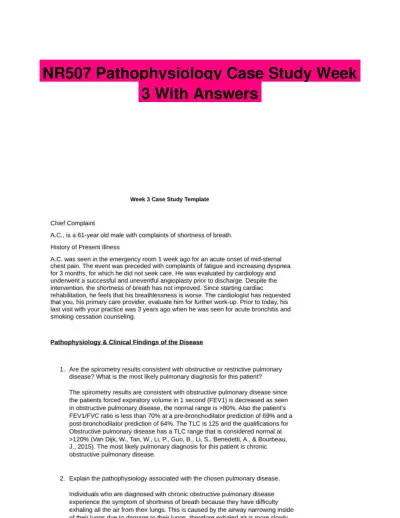 Past Exams
NR507 Pathophysiology Case Study Week 3 With Answers (8 Solved Questions)
Medicine
4 pagesMay 2025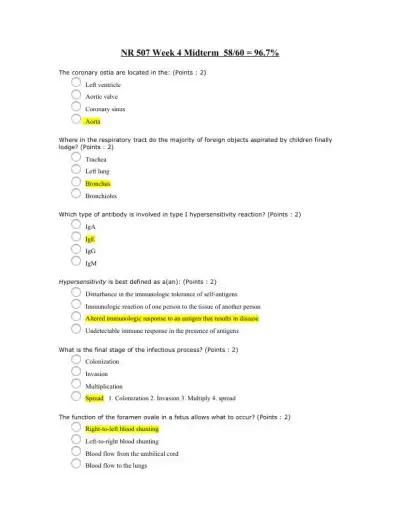 Past Exams
NR507 Pathophysiology Midterm Exam Week 4 With Answers (60 Solved Questions)
Medicine
11 pagesMay 2025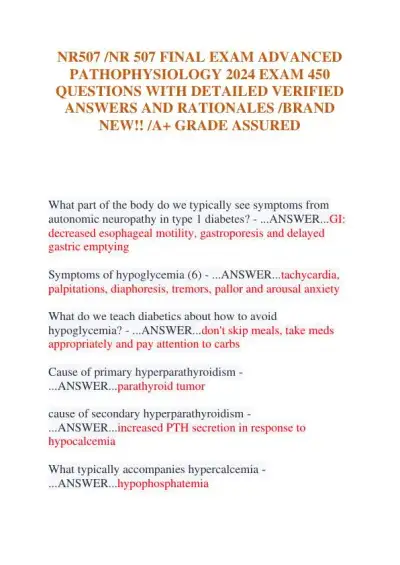 Past Exams
2024 NR507 Pathophysiology Final Exam With Answers (356 Solved Questions)
Medicine
83 pagesMay 2025 Exam Guides
Test Bank for The Human Body in Health and Illness, 7th Edition (Chapters 1-27)
Medicine
370 pages162downloadsFeb 2025 Textbook Guides
Solution Manual for Pearson's Comprehensive Medical Coding, 2nd Edition
Medicine
462 pages153downloadsFeb 2025 Certification Guides
Mosbys Exam Review for Computed Tomography 3rd Edition (2019)
Medicine
624 pages150downloadsFeb 2025 Exam Guides
Test Bank for CURRENT Medical Diagnosis and Treatment 2020, 59th Edition
Medicine
461 pages149downloadsFeb 2025 Exam Guides
Test Bank for Henke's Med-Math: Dosage Calculation, Preparation, and Administration, 9th Edition (Chapters 1-10)
Medicine
58 pages139downloadsFeb 2025
Study this document with CramX
Once it is in your library, every tool can work from it.