

2024 NR507 Pathophysiology Final Exam With Answers (356 Solved Questions)
- Medicine
- Chamberlain College of Nursing
- 83 pages
- Shared May 2025
2024 NR507 Pathophysiology Final Exam With Answers is a valuable resource for improving your exam approach and accuracy.
Preview 16 of 83 pages
See the first 16 pages exactly as they appear in the document.
Page 1 Read page 1 as text
NR507 /NR 507 FINAL EXAM ADVANCED PATHOPHYSIOLOGY 2024 EXAM 450 QUESTIONS WITH DETAILED VERIFIED ANSWERS AND RATIONALES /BRAND NEW!! /A+ GRADE ASSURED What part of the body do we typically see symptoms from autonomic neuropathy in type 1 diabetes? - ...ANSWER... GI: decreased esophageal motility, gastroporesis and delayed gastric emptying Symptoms of hypoglycemia (6) - ...ANSWER... tachycardia, palpitations, diaphoresis, tremors, pallor and arousal anxiety What do we teach diabetics about how to avoid hypoglycemia? - ...ANSWER... don't skip meals, take meds appropriately and pay attention to carbs Cause of primary hyperparathyroidism - ...ANSWER... parathyroid tumor cause of secondary hyperparathyroidism - . ..ANSWER... increased PTH secretion in response to hypocalcemia What typically accompanies hypercalcemia - ...ANSWER... hypophosphatemia
Page 2 Page 3 Read page 3 as text
Main symptom of hypercalcemia - ...ANSWER... osteoporosis in distal 1/3rd of the radius Risk factors of hypoparathyroid ism (4) - ...ANSWER... Alcoholics, malabsorption, increased renal clearance of mag, chemo drugs Symptoms of hypocalcemia (8) - ...ANSWER... dry skin, loss of body and scalp hair, hypoplasia of teeth, ridges on nails, cataracts, basal ganglia calcifications, bone deformities and bowing of long bones Another term for hypercortisolism - ...ANSWER... cushings syndrome Main characteristics of cushings syndrome - ...ANSWER... buffalo hump, moon face and truncal obesity What is the biggest signal of adrenal crisis ? - ...ANSWER... Hypotension What can cause adrenal crisis? - ...ANSWER... Improper weaning off glucocorticoid meds key symptoms associated with parkinson's disease (5) - ...ANSWER... shuffling gait, dysphagia, resting tremor, postural disturbance and dysar thia Risk factors for MS (3) - ...ANSWER... smoking, vit D deficiency and epstein - barr virus what kind of disease is MS - ...ANSWER... demyelinating
Page 4 Read page 4 as text
characteristics of cluster headache - ...ANSWER... unilateral trigeminal distribution of severe pain with i psilateral manefistations symptoms of cluster headache (3) - ...ANSWER... tearing on affected side, ptosis of ipsilateral eye and congestion of nasal mucosa Where does pain refer to in cluster headaches (2) - ...ANSWER... midface and teeth characteristics of a migraine - ...ANSWER... unilateral, throbbing pain that worsens with activity Symptoms of migraine headache (3) - ...ANSWER... N/V, photophobia and phonophobia What type of migraine is most common - ...ANSWER... migraine without an aura Characteristics of tension headache - ...ANSWER... bilateral headache that feels like a tight band around the head what type of headache is the most common - ...ANSWER... tension What cranial nerve is associated with bells palsy - ...ANSWER... cranial ner ve VII What cranial nerve is associated with trigeminal neuralgia - ...ANSWER... cranial nerve V
Page 5 Read page 5 as text
Symptoms of bells palsy - ...ANSWER... asymmetry and inability to close eye, smile or frown on affected side Symptoms of trigeminal neuralgia - ...ANSWER... se vere sharp stabbing pain that worsens with chewing symptoms of bacterial meningitis or meningial irritation - ...ANSWER ...severe throbbing headache, severe photophobia, nuchual rigidity and positive kernig/brudinski Result of infarct in the ACA - ...ANSW ER... motor contralateral paralysis or paresis that is greater in the foot and thigh result of basal artery infarct - ...ANSWER... loss of vibratory sense, sense of position with dysmetria, loss of two - point discrimination, impaired rapid alternating moveme nt causes of rosacea (5) - ...ANSWER... chronic sun exposure/damage, alcohol/hot beverage consumption, hormones, mites (demodex folliculorum) and mental stress/anxiety Most aggressive skin cancer - ...ANSWER... melanoma Which of the following is true regarding a complicated urinary tract infection? - ...ANSWER... Can be caused by a structural urinary tract disorder Which of the following is a risk factor for the development of a urinary tract infection (UTI)? - ...ANSWER. .. Pregnancy
Page 6 Read page 6 as text
A symptom of a lower urinary tract infection includes: - ...ANSWER... urgency Women are at a higher risk for the development of a UTI because of having a shorter urethra. - ...ANSWER... true Which of the following can help to prevent a UTI? - ...ANSWER ...Increase water consumption Uncomplicated UTI - ...ANSWER... Occurs in the normal urinary tract Responds well to short course of antibiotic therapy Simple cystitis in non - pregnant women without any urologic abnormalities Complicated UTI - ...AN SWER... UTI extends beyond the bladder Caused by structural or functional urinary tract abnormalities or untreated UTI Infants and older adults affected Associated with: indwelling catheters, renal calculi, diabetes, pregnancy A 25 year - old female presen ts to the primary care office with urinary burning and frequency for the last 3 days. She denies any fever, chills, back pain. Her gynecological history is negative and reports no vaginal discharge. The only new information reported is that she recently ha d sexual intercourse with a new male partner. The NP obtains a urinalysis and determines that the urine contains leukocytes, RBCs, nitrites, and WBCs. No casts are identified. Based on symptom presentation and UA results, the patient can be diagnosed with: - ...ANSWER... cystitis
Page 7 Read page 7 as text
J.S. is an 80 - year - old patient who resides in a local nursing home. He recently became confused and then fell while ambulating to the bathroom three days ago. Because of his confusion and fall, he was transferred to the acute care facility for evaluation and treatment. Lab work revealed that the patient was very dehydrated with hypernatremia identified and appropriate intravenous fluids started. Cystitis was also identified from the urinalysis. He was also noted to have red and exc oriated skin between the buttocks and inner thighs due to urinary frequency and dribbling. To help with skin healing and to prevent further urine leakage, an indwelling catheter was inserted. Two days after the catheter was placed, the patient spiked a fev er of 102 degrees Fahrenheit associated with shaking chills. An intense, foul odor was noted in the urine. On examination of the flank area, the patient yelled out when touched. A urine c - ...ANSWER... pyelonephritis Identify the major risk factor J.S. ha s that is associated with pyelonephritis: - ...ANSWER... indwelling foley catheter The urinalysis of a patient with a complicated UTI will show WBCs and casts - ...ANSWER... true Upon examination of a urinalysis, the NP can highly suspect that the causativ e bacteria are gram negative because of the presence of: - ...ANSWER... nitrites A 21 - year - old patient reports to the primary care clinic complaining of urinary urgency, frequency and burning. She also reports a small amount of vaginal discharge that conta ins an odor. It is likely that the NP will perform a vaginal exam at this visit. - ...ANSWER...true
Page 8 Read page 8 as text
The NP would know that the patient most likely has an uncomplicated UTI because: - ...ANSWER...The UTI responds well to a short course of antibiotic therap y. A common organism that causes a urinary tract infection include: - ...ANSWER...Staphylococcus saprophyticus. E coli The purpose of straining in BPH is to overcome the obstruction encountered during urination. - ...ANSWER...true The peripheral zone of the prostate is the largest zone. - ...ANSWER...true On a digital rectal exam to assess the quality of the prostate, the NP would be concerned with which of the following findings? - ...ANSWER...hard nodule There is a significant risk for men with benig n prostatic hyperplasia (BPH) to develop cellular mutations that lead to prostate cancer. - ...ANSWER...false The patient most often develops symptoms of BPH when: - ...ANSWER...The prostatic urethra becomes obstructed. Irritative symptoms - ...ANSWER... urinary frequency nocturia urgency that results from bladder hypertrophy and dysfunction obstructive symptoms - ...ANSWER...incomplete emptying post - void dribbling
Page 9 Read page 9 as text
The action of a 5 - Alpha - reductase inhibitor causes: - ...ANSWER...Shrinkage of the prosta te gland. Men who have BPH are prone to developing a UTI because: - ...ANSWER...Stagnated urine in the bladder promotes bacterial growth. The prostate specific antigen (PSA) helps to liquefy semen post - ejaculation. - ...ANSWER...true The underlying caus e of BPH is that normal prostate cells respond to increases in dihydrotestosterone that causes them to live longer and multiply. - ...ANSWER...true The location of the characteristic hyperplastic nodules of BPH is: - ...ANSWER...In the periurethral zone. The type of stone that forms due to a urinary tract infection is: - ...ANSWER...Struvite stone. Renal stones are formed when calcium and oxalate in the urine combine. - ...ANSWER...true Renal calculi are typically confined to the bladder. - ...ANSWER... false The most common type of stone is: - ...ANSWER...calcium stone The gold standard for diagnosing a renal stone is a urinalysis. - ...ANSWER...false (ct scan)
Page 10 Read page 10 as text
A 45 - year - old male presents to the primary care office with right flank pain that he descri bes as unremitting; he also reports nausea and vomiting. The NP performs an exam and observes him writhing in pain on the exam table with the inability to find a comfortable position. He is afebrile, BP 156/88 mmHg and HR 106/min. Right flank is mildly ten der on palpation. Abdominal exam is negative for any abnormality. A urinalysis was performed and revealed 1+ blood. Urine microscopy also revealed 10 - 20 RBCs per high - power field (hpf). A kidney stone is suspected. The patient reports no prior history of a kidney stone. After providing the patient an analgesic, where the patient reported mild relief, the NP had the patient transferred to the emergency room for intravenous fluids, pain management and further work - up for the kidney stone. Upon follow - up in th e office a week later, the patient reported that he was diagnosed with - ...ANSWER...adequate hydration balanced diet Lithotripsy is an invasive procedure used to break up the stone - ...ANSWER...false The most common stone found in the patient with gout is: - ...ANSWER...uric acid stone Hematuria can be seen with kidney stones because: - ...ANSWER...The stone injures the urinary structures as it passes through them. Renal colic is caused by the passing of the stone through the ureter. - ...ANSWER...tru e
Page 11 Read page 11 as text
At least half of individuals with renal stones will have a reoccurrence within 10 years of the prior stone. - ...ANSWER...true Which of the following actions will relax the detrusor muscle of the bladder? - ...ANSWER...Activation of Beta - 2 receptors by the sympathetic nervous system. The relay station in the brain that plays a major role in regulating micturition is: - ...ANSWER...Pontine micturition center. The location of the internal sphincter is under the urogenital diaphragm. - ...ANSWER...false (located in the bladder) When the bladder is empty, the detrusor muscle relaxes, and the internal and external sphincters constrict. - ...ANSWER...true The levator ani muscle plays a major role in constriction of the external sphincter. - ...ANSWER...tru e stress incontinence - ...ANSWER...leakage of urine with activity Increased intra - abdominal pressure causes leaking because there is no resistance to counteract the intra - abdominal pressure urge incontinence - ...ANSWER...leakage of urine with sensation of need to urinate Detrusor muscle hyperactivity leads to urine leakage
Page 12 Read page 12 as text
neurogenic incontinence - ...ANSWER...unimpeded urine leakage Neurological lesions alter nervous system impulses that innervate the detrusor muscle. The result is decreased bladder compliance and decreased sphincter tone overflow incontinence - ...ANSWER...leakage of urine is associated with urgency, frequency, dribbling, and hesitancy Leakage is due to retained urine in the bladder that leads to over - distention A 54 - year - old femal e reports to the primary care office with complaints of frequent urination. She reports that she is "leaking" urine several times a day, especially when she coughs, sneezes, or lifts a heavy object. She indicates that she has not experienced any dysuria or any urgency. The NP looked at the patient's previous urine culture obtained approximately 1 month ago and determined that it was negative. Other than her urinary complaints, she is in otherwise good health. BP 128/76; HR 78 bpm; T 98.6; Ht. 5'4"; Wt: 180l bs.; BMI 30.9. The NP performs a physical exam and all findings are normal. The urinalysis obtained was negative as well. Based on patient's symptoms and negative physical exam, she has a typical 1. blank. The leaking occurs when the abdominal pressure increases during coughing, sneezing, and lifting. We can rule out urge incontinence because the denied urgency with her urination. We could not - ...ANSWER...1. stress incontinence 2. stress incontinence
Page 13 Read page 13 as text
A sphincter malfunction that prevents urine from fl owing out of the bladder would most likely result in: - ...ANSWER...overflow incontinence The major cause of stress incontinence in women is hypermobility of the external sphincter. - ...ANSWER...true The pathophysiology of neurogenic bladder is: - ...AN SWER...Lesions alter nervous system impulses that innervate the detrusor muscle to decrease bladder compliance and decreased sphincter tone. Involuntary loss of urine caused by dementia or immobility is known as: - ...ANSWER...functional incontinence Whi ch of the following is considered be a transient cause of urinary incontinence? - ...ANSWER...UTI A pre - renal cause of acute renal failure is: - ...ANSWER...hypotension One of the first pathophysiological responses to the decreased GFR in acute renal fai lure is: - ...ANSWER...Activation of the renin - angiotensin - aldosterone system. One of the major markers for glomerular filtration rate is creatinine. - ...ANSWER...true Pre - renal is the most common cause of acute renal failure. The most common cause of a cute renal failure is due to a pre - renal failure. - ...ANSWER...true Acute renal failure - ...ANSWER...Oliguria (< 30ml/hr).
Page 14 Read page 14 as text
Increased blood urea nitrogen (BUN) and creatinine. Fluid and electrolyte abnormalities. Pre - renal - ...ANSWER...sudden and sever e drop in blood pressure or interruption of blood flow to the kidneys from severe injury or illness Intra - renal - ...ANSWER...direct damage to the kidneys by inflammation, toxins, drugs, infection, or reduced blood supply Post - renal - ...ANSWER...sudden obstruction of urine flow due to enlarged prostate, kidney stones, bladder tumor, or injury In post - renal failure, the damage occurs in the collecting duct. - ...ANSWER...truen In intrinsic renal failure, sodium and water excretion is increased which lea ds to a dilute urine. - ...ANSWER...true Which of the following is the best indicator of a good prognosis for recovery from acute renal failure? - ...ANSWER...The kidney responds to furosemide Which of the following is true regarding creatinine? - ...ANS WER...Creatinine gets freely filtered from the glomerulus. One of the issues that requires management of a patient with acute renal failure is hypokalemia - ...ANSWER...false (Hyperkalemia)
Page 15 Read page 15 as text
The result of vitamin D deficiency results in: - ...ANSWER...hyp ocalcemia The number one cause of end - stage renal disease is diabetes mellitus and hypertension combined. - ...ANSWER...true Stage III kidney disease is signified when the GFR drops below 60. - ...ANSWER...true Which of the following is a complication o f decreased GFR? - ...ANSWER...anemia The anemia seen in renal failure is due to the lack or iron. - ...ANSWER...false (Anemia occurs because there is a reduced production of erythropoietin which is responsible for triggering the production of RBCs rather than the lack of iron or a decrease in the RBCs) stage 1 - ...ANSWER...There is kidney damage with normal or elevated GFR (90 - 120) Stage 2 - ...ANSWER...There is kidney damage with mild decrease in GFR (60 - 89) stage 3 - ...ANSWER...There is a moderate decrease in GFR (30 - 59) stage 4 - ...ANSWER...There is a severe decrease in GFR (15 - 29) stage 5 - ...ANSWER...Kidney failure - End - stage renal disease (<15 dialysis)
Page 16 Read page 16 as text
Need dialysis with these symptoms - ...ANSWER...Metabolic acidosis. Hyperkalemia: Hyperk alemia in the presence of EKG changes (peaked T - waves) is an indication for dialysis. Hyperkalemia by itself is not an indication for dialysis. Drug toxicity: Drug toxicity due to the following drugs is an indication for dialysis and include salicylates, L ithium, Isopropanol, Methanol and Ethylene glycol). Fluid volume overload that is not responsive to diuretics. Uremic symptoms due to nitrogenous wastes in the blood stream. The decision to begin dialysis is guided by the patient's symptoms rather than GF R. - ...ANSWER...true Diuretic therapy is used in Stage IV kidney failures to stimulate kidney function. - ...ANSWER...false (diuretics used for stages 1 - 111 and dialysis for 4 and 5) The major acid/base disturbance in renal failure is: - ...ANSWER...met abolic acidosis Dietary management of a patient with CKD includes: - ...ANSWER...low potassium, low sodium, and low phosphate The Monoamine Deficiency Theory states that the underlying basis of depression is low levels of serotonin, norepinephrine and do pamine. - ...ANSWER...true Dysthymia is a persistent depressive disorder used to describe milder symptoms of depression that happen over longer periods of time. - ...ANSWER...true
67 more pages in the full document
Unlock it once and it stays in your library, ready to chat with or turn into flashcards.
Unlock the full documentMore Medicine study materials
See all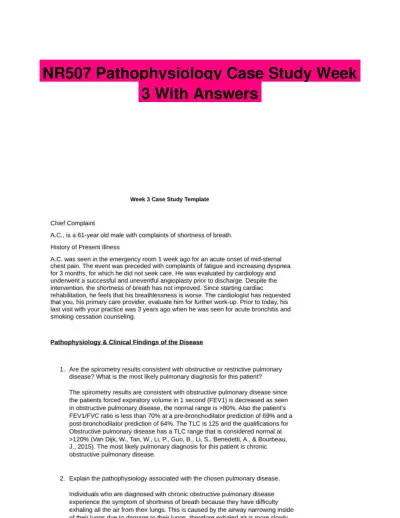 Past Exams
NR507 Pathophysiology Case Study Week 3 With Answers (8 Solved Questions)
Medicine
4 pagesMay 2025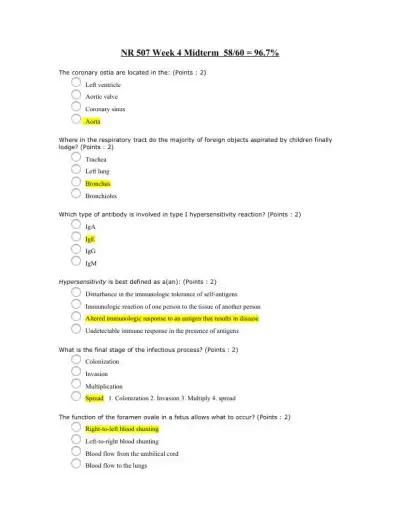 Past Exams
NR507 Pathophysiology Midterm Exam Week 4 With Answers (60 Solved Questions)
Medicine
11 pagesMay 2025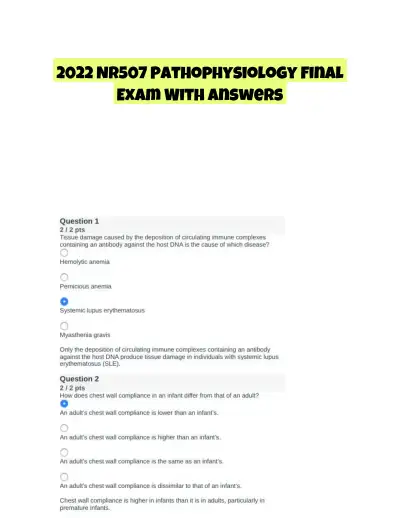 Past Exams
2022 NR507 Pathophysiology Final Exam With Answers (75 Solved Questions)
Medicine
36 pagesMay 2025 Exam Guides
Test Bank for The Human Body in Health and Illness, 7th Edition (Chapters 1-27)
Medicine
370 pages162downloadsFeb 2025 Textbook Guides
Solution Manual for Pearson's Comprehensive Medical Coding, 2nd Edition
Medicine
462 pages153downloadsFeb 2025 Certification Guides
Mosbys Exam Review for Computed Tomography 3rd Edition (2019)
Medicine
624 pages150downloadsFeb 2025 Exam Guides
Test Bank for CURRENT Medical Diagnosis and Treatment 2020, 59th Edition
Medicine
461 pages149downloadsFeb 2025 Exam Guides
Test Bank for Henke's Med-Math: Dosage Calculation, Preparation, and Administration, 9th Edition (Chapters 1-10)
Medicine
58 pages139downloadsFeb 2025
Study this document with CramX
Once it is in your library, every tool can work from it.