

NR507 Pathophysiology Case Study Week 3 With Answers (8 Solved Questions)
- Medicine
- Chamberlain College of Nursing
- 4 pages
- Shared May 2025
Learn faster with NR507 Pathophysiology Case Study Week 3 With Answers, featuring past exam questions with expert solutions.
Preview 2 of 4 pages
See the first 2 pages exactly as they appear in the document.
Page 1 Read page 1 as text
Week 3 Case Study Template Chief Complaint A.C., is a 61-year old male with complaints of shortness of breath. History of Present Illness A.C. was seen in the emergency room 1 week ago for an acute onset of mid-sternal chest pain. The event was preceded with complaints of fatigue and increasing dyspnea for 3 months, for which he did not seek care. He was evaluated by cardiology and underwent a successful and uneventful angioplasty prior to discharge. Despite the intervention, the shortness of breath has not improved. Since starting cardiac rehabilitation, he feels that his breathlessness is worse. The cardiologist has requested that you, his primary care provider, evaluate him for further work-up. Prior to today, his last visit with your practice was 3 years ago when he was seen for acute bronchitis and smoking cessation counseling. Pathophysiology & Clinical Findings of the Disease 1. Are the spirometry results consistent with obstructive or restrictive pulmonary disease? What is the most likely pulmonary diagnosis for this patient? The spirometry results are consistent with obstructive pulmonary disease since the patients forced expiratory volume in 1 second (FEV1) is decreased as seen in obstructive pulmonary disease, the normal range is >80%. Also the patient’s FEV1/FVC ratio is less than 70% at a pre-bronchodilator prediction of 69% and a post-bronchodilator prediction of 64%. The TLC is 125 and the qualifications for Obstructive pulmonary disease has a TLC range that is considered normal at >120% (Van Dijk, W., Tan, W., Li, P., Guo, B., Li, S., Benedetti, A., & Bourbeau, J., 2015). The most likely pulmonary diagnosis for this patient is chronic obstructive pulmonary disease. 2. Explain the pathophysiology associated with the chosen pulmonary disease. Individuals who are diagnosed with chronic obstructive pulmonary disease experience the symptom of shortness of breath because they have difficulty exhaling all the air from their lungs. This is caused by the airway narrowing inside of their lungs due to damage to their lungs, therefore exhaled air is more slowly expelled. After fully exhaling, the individual will still have an abnormally higher amount of air left lingering in their lungs (Asp, K. C., 2020). COPD is a mixture of small airway diseases like obstructive bronchiolitis and emphysema and may differ between patients depending on their history, risk factors and exposure to
Page 2
2 more pages in the full document
Unlock it once and it stays in your library, ready to chat with or turn into flashcards.
Unlock the full documentMore Medicine study materials
See all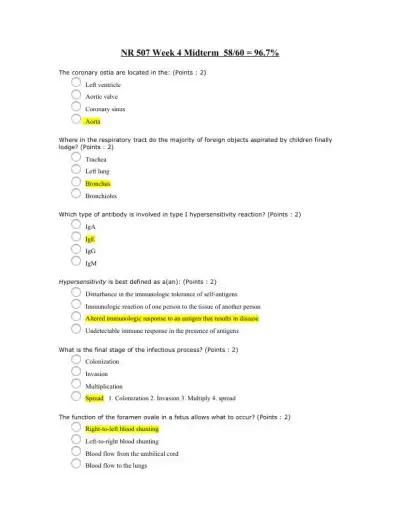 Past Exams
NR507 Pathophysiology Midterm Exam Week 4 With Answers (60 Solved Questions)
Medicine
11 pagesMay 2025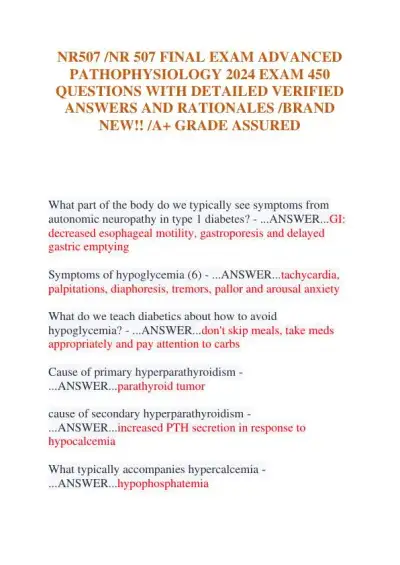 Past Exams
2024 NR507 Pathophysiology Final Exam With Answers (356 Solved Questions)
Medicine
83 pagesMay 2025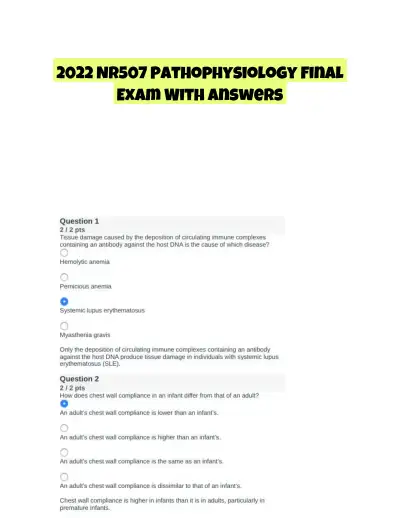 Past Exams
2022 NR507 Pathophysiology Final Exam With Answers (75 Solved Questions)
Medicine
36 pagesMay 2025 Exam Guides
Test Bank for The Human Body in Health and Illness, 7th Edition (Chapters 1-27)
Medicine
370 pages162downloadsFeb 2025 Textbook Guides
Solution Manual for Pearson's Comprehensive Medical Coding, 2nd Edition
Medicine
462 pages153downloadsFeb 2025 Certification Guides
Mosbys Exam Review for Computed Tomography 3rd Edition (2019)
Medicine
624 pages150downloadsFeb 2025 Exam Guides
Test Bank for CURRENT Medical Diagnosis and Treatment 2020, 59th Edition
Medicine
461 pages149downloadsFeb 2025 Exam Guides
Test Bank for Henke's Med-Math: Dosage Calculation, Preparation, and Administration, 9th Edition (Chapters 1-10)
Medicine
58 pages139downloadsFeb 2025
Study this document with CramX
Once it is in your library, every tool can work from it.