

Test Bank For Textbook of Physical Diagnosis: History and Examination, 7th Edition
- Medicine
- 324 pages
- Shared February 2025
- 83 downloads
Don't just study—practice smarter with Test Bank For Textbook of Physical Diagnosis: History and Examination, 7th Edition, the perfect test prep tool.
Preview 31 of 324 pages
See the first 31 pages exactly as they appear in the document.
Page 1 Read page 1 as text
TEXTBOOK OF PHYSICAL DIAGNOSIS HISTORY A ND EXAMINATION 7TH EDITION SWARTZ TEST BANK Chapter 1 The Interviewer’s Questions MULTIPLE CHOICE 1. The nurse is conducting an interview with a woman who has recently learned that she is pregnant and who has come to the clinic today to begin prenatal care. The woman states that she and her husband are excited about the pregnancy but have a few questions. She looks nervously at her hands during the interview and sighs loudly. Considering the concept of communication , which statement does the nurse know to be most accurate? The woman is: a. Excited about her pregnancy but nervous about the labor. b. Exhibiting verbal and nonverbal behaviors that do not match. c. Excited about her pregnancy, but her husband is not and this is upsetting to her. d. Not excited about her pregnancy but believes the nurse will negatively respond to her if she states this. ANS: B Communication is all behaviors, conscious and unconscious, verbal and nonverbal. All behaviors have meaning. Her behavior does not imply that she is nervous about labor, upset by her husband, or worried about the nurses response. DIF: Cognitive Level: Analyzing (Analysis) REF: dm . 28 MSC: Client Needs: Psychosocial Integrity 2. Receiving is a part of the communication process. Which receiver is most likely to misinterpret a message sent by a health care professional? a. Well-adjusted adolescent who came in for a sports physical b. Recovering alcoholic who came in for a basic physical examination c. Man whose wife has just been diagnosed with lung cancer d. Man with a hearing impairment who uses sign language to communicate and who has an interpreter with him ANS: C The receiver attaches meaning determined by his or her experiences, culture, self-concept, and current physical and emotional states. The man whose wife has just been diagnosed with lung cancer may be experiencing emotions that affect his receiving. DIF: Cognitive Level: Analyzing (Analysis) REF: dm . 28 MSC: Client Needs: Psychosocial Integrity 3. The nurse makes which adjustment in the physical environment to promote the success of an interview? a. Reduces noise by turning off televisions and radios b. Reduces the distance between the interviewer and the patient to 2 feet or less c. Provides a dim light that makes the room cozy and helps the patient relax d. Arranges seating across a desk or table to allow the patient some personal space
Page 2 Page 3 Read page 3 as text
ANS: A The nurse should reduce noise by turning off the television, radio, and other unnecessary equipment, because multiple stimuli are confusing. The interviewer and patient should be approximately 4 to 5 feet apart; the room should be well - lit, enabling the interviewer and patient to see each other clearly. Having a table or desk in between the tw o people creates the idea of a barrier; equal - status seating, at eye level, is better. DIF: Cognitive Level: Applying (Application) REF: dm . 29 MSC: Client Needs: Psychosocial Integrity 4. In an interview, the nurse may find it necessary to take notes to aid his or her memory later. Which statement is true regarding note-taking? a. Note-taking may impede the nurses observation of the patients nonverbal behaviors. b. Note-taking allows the patient to continue at his or her own pace as the nurse records what is said. c. Note-taking allows the nurse to shift attention away from the patient, resulting in an increased comfort level. d. Note-taking allows the nurse to break eye contact with the patient, which may increase his or her level of comfort. ANS: A The use of history forms and note-taking may be unavoidable. However, the nurse must be aware that note-taking during the interview has disadvantages. It breaks eye contact too often and shifts the attention away from the patient, which diminishes his or her sense of importance. Note- taking may also interrupt the patients narrative flow, and it impedes the observation of the patients nonverbal behavior. DIF: Cognitive Level: Understanding (Comprehension) REF: dm . 30 MSC: Client Needs: Psychosocial Integrity 5. The nurse asks, I would like to ask you some questions about your health and your usual daily activities so that we can better plan your stay here. This question is found at the __________ phase of the interview process. a. Summary b. Closing c. Body d. Opening or introduction ANS: D When gathering a complete history, the nurse should give the reason for the interview during the opening or introduction phase of the interview, not during or at the end of the interview. DIF: Cognitive Level: Understanding (Comprehension) REF: dm . 31 MSC: Client Needs: Psychosocial Integrity 6. A woman has just entered the emergency department after being battered by her husband. The nurse needs to get some information from her to begin treatment. What is the best choice for an opening phase of the interview with this patient? a. Hello, Nancy, my name is Mrs. C. b. Hello, Mrs. H., my name is Mrs. C. It sure is cold today!
Page 4 Read page 4 as text
c. Mrs. H., my name is Mrs. C. How are you? d. Mrs. H., my name is Mrs. C. Ill need to ask you a few questions about what happened. ANS: D Address the person by using his or her surname. The nurse should introduce him or herself and give the reason for the interview. Friendly small talk is not needed to build rapport. DIF: Cognitive Level: Applying (Application) REF: dm . 31 MSC: Client Needs: Psychosocial Integrity 7. During an interview, the nurse states, You mentioned having shortness of breath. Tell me more about that. Which verbal skill is used with this statement? a. Reflection b. Facilitation c. Direct question d. Open-ended question ANS: D The open-ended question asks for narrative information. It states the topic to be discussed but only in general terms. The nurse should use it to begin the interview, to introduce a new section of questions, and whenever the person introduces a new topic. DIF: Cognitive Level: Understanding (Comprehension) REF: dm . 31 MSC: Client Needs: Psychosocial Integrity 8. A patient has finished giving the nurse information about the reason he is seeking care. When reviewing the data, the nurse finds that some information about past hospitalizations is missing. At this point, which statement by the nurse would be most appropriate to gather these data? a. Mr. Y., at your age, surely you have been hospitalized before! b. Mr. Y., I just need permission to get your medical records from County Medical. c. Mr. Y., you mentioned that you have been hospitalized on several occasions. Would you tell me more about that? d. Mr. Y., I just need to get some additional information about your past hospitalizations. When was the last time you were admitted for chest pain? ANS: D The nurse should use direct questions after the persons opening narrative to fill in any details he or she left out. The nurse also should use direct questions when specific facts are needed, such as when asking about past health problems or during the review of systems. DIF: Cognitive Level: Applying (Application) REF: dm . 31 MSC: Client Needs: Psychosocial Integrity 9. In using verbal responses to assist the patients narrative, some responses focus on the patients frame of reference and some focus on the health care providers perspective. An example of a verbal response that focuses on the health care providers perspective would be: a. Empathy. b. Reflection. c. Facilitation. d. Confrontation.
Page 5 Read page 5 as text
ANS: D When the health care provider uses the response of confrontation, the frame of reference shifts from the patients perspective to the perspective of the health care provider, and the health care provider starts to express his or her own thoughts and feelings. Empathy, reflection, and facilitation responses focus on the patients frame of reference. DIF: Cognitive Level: Remembering (Knowledge) REF: dm . 32 MSC: Client Needs: Psychosocial Integrity 10. When taking a history from a newly admitted patient, the nurse notices that he often pauses and expectantly looks at the nurse. What would be the nurses best response to this behavior? a. Be silent, and allow him to continue when he is ready. b. Smile at him and say, Dont worry about all of this. Im sure we can find out why youre having these pains. c. Lean back in the chair and ask, You are looking at me kind of funny; there isnt anything wrong, is there? d. Stand up and say, I can see that this interview is uncomfortable for you. We can continue it another time. ANS: A Silent attentiveness communicates that the person has time to think and to organize what he or she wishes to say without an interruption from the nurse. Health professionals most often interrupt this thinking silence . The other responses are not conducive to ideal communication. DIF: Cognitive Level: Applying (Application) REF: dm . 33 MSC: Client Needs: Psychosocial Integrity 11. A woman is discussing the problems she is having with her 2-year-old son. She says, He wont go to sleep at night, and during the day he has several fits. I get so upset when that happens. The nurses best verbal response would be: a. Go on, Im listening. b. Fits? Tell me what you mean by this. c. Yes, it can be upsetting when a child has a fit. d. Dont be upset when he has a fit; every 2 year old has fits. ANS: B The nurse should use clarification when the persons word choice is ambiguous or confusing (e.g., Tell me what you mean by fits .). Clarification is also used to summarize the persons words or to simplify the words to make them clearer; the nurse should then ask if he or she is on the right track. DIF: Cognitive Level: Applying (Application) REF: dm . 33 MSC: Client Needs: Psychosocial Integrity 12. A 17-year-old single mother is describing how difficult it is to raise a 3-year-old child by herself. During the course of the interview she states, I cant believe my boyfriend left me to do this by myself! What a terrible thing to do to me! Which of these responses by the nurse uses empathy? a. You feel alone. b. You cant believe he left you alone?
Page 6 Read page 6 as text
c. It must be so hard to face this all alone. d. I would be angry, too; raising a child alone is no picnic. ANS: C An empathetic response recognizes the feeling and puts it into words. It names the feeling, allows its expression, and strengthens rapport. Other empathetic responses are, This must be very hard for you, I understand, or simply placing your hand on the persons arm. Simply reflecting the persons words or agreeing with the person is not an empathetic response. DIF: Cognitive Level: Applying (Application) REF: dm . 28 MSC: Client Needs: Psychosocial Integrity 13. A man has been admitted to the observation unit for observation after being treated for a large cut on his forehead. As the nurse works through the interview, one of the standard questions has to do with alcohol, tobacco, and drug use. When the nurse asks him about tobacco use, he states, I quit smoking after my wife died 7 years ago. However, the nurse notices an open pack of cigarettes in his shirt pocket. Using confrontation, the nurse could say: a. Mr. K., I know that you are lying. b. Mr. K., come on, tell me how much you smoke. c. Mr. K., I didnt realize your wife had died. It must be difficult for you at this time. Please tell me mo d. Mr. K., you have said that you dont smoke, but I see that you have an open pack of cigarettes in you ANS: D In the case of confrontation, a certain action, feeling, or statement has been observed, and the nurse now focuses the patients attention on it. The nurse should give honest feedback about what is seen or felt. Confrontation may focus on a discrepancy, or the nurse may confront the patient when parts of the story are inconsistent. The other statements are not appropriate. DIF: Cognitive Level: Applying (Application) REF: dm . 33 MSC: Client Needs: Psychosocial Integrity 14. The nurse has used interpretation regarding a patients statement or actions. After using this technique, it would be best for the nurse to: a. Apologize, because using interpretation can be demeaning for the patient. b. Allow time for the patient to confirm or correct the inference. c. Continue with the interview as though nothing has happened. d. Immediately restate the nurses conclusion on the basis of the patients nonverbal response. ANS: B Interpretation is not based on direct observation as is confrontation, but it is based on ones inference or conclusion. The nurse risks making the wrong inference. If this is the case, then the patient will correct it. However, even if the inference is correct, interpretation helps prompt further discussion of the topic. DIF: Cognitive Level: Analyzing (Analysis) REF: dm . 33 MSC: Client Needs: Psychosocial Integrity 15. During an interview, a woman says, I have decided that I can no longer allow my children to live with their fathers violence, but I just cant seem to leave him. Using interpretation, the nurses best response would be: a. You are going to leave him?
Page 7 Read page 7 as text
b. If you are afraid for your children, then why cant you leave? c. It sounds as if you might be afraid of how your husband will respond. d. It sounds as though you have made your decision. I think it is a good one. ANS: C This statement is not based on ones inference or conclusion. It links events, makes associations, or implies cause. Interpretation also ascribes feelings and helps the person understand his or her own feelings in relation to the verbal message. The other statements do not reflect interpreta tion. DIF: Cognitive Level: Applying (Application) REF: dm . 33 MSC: Client Needs: Psychosocial Integrity 16. A pregnant woman states, I just know labor will be so painful that I wont be able to stand it. I know it sounds awful, but I really dread going into labor. The nurse responds by stating, Oh, dont worry about labor so much. I have been through it, and although it is painful, many good medications are available to decrease the pain. Which statement is true regarding this response? The nurses reply was a: a. Therapeutic response. By sharing something personal, the nurse gives hope to this woman. b. Nontherapeutic response. By providing false reassurance, the nurse actually cut off further discussio fears. c. Therapeutic response. By providing information about the medications available, the nurse is giving woman. d. Nontherapeutic response. The nurse is essentially giving the message to the woman that labor canno without medication. ANS: B By providing false assurance or reassurance, this courage builder relieves the womans anxiety and gives the nurse the false sense of having provided comfort. However, for the woman, providing false assurance or reassurance actually closes off communication, trivializes her anxiety, and effectively denies any further talk of it. DIF: Cognitive Level: Analyzing (Analysis) REF: dm . 32 MSC: Client Needs: Psychosocial Integrity 17. During a visit to the clinic, a patient states, The doctor just told me he thought I ought to stop smoking. He doesnt understand how hard Ive tried. I just dont know the best way to do it. What should I do? The nurses most appropriate response in this case would be: a. Id quit if I were you. The doctor really knows what he is talking about. b. Would you like some information about the different ways a person can quit smoking? c. Stopping your dependence on cigarettes can be very difficult. I understand how you feel. d. Why are you confused? Didnt the doctor give you the information about the smoking cessation prog ANS: B Clarification should be used when the persons word choice is ambiguous or confusing. Clarification is also used to summarize the persons words or to simplify the words to make them clearer; the nurse should then ask if he or she is on the right track. The other responses give unwanted advice or do not offer a helpful response. DIF: Cognitive Level: Applying (Application) REF: dm . 33 MSC: Client Needs: Psychosocial Integrity
Page 8 Read page 8 as text
18. As the nurse enters a patients room, the nurse finds her crying. The patient states that she has just found out that the lump in her breast is cancer and says, Im so afraid of, um, you know. The nurses most therapeutic response would be to say in a gentle manner: a. Youre afraid you might lose your breast? b. No, Im not sure what you are talking about. c. Ill wait here until you get yourself under control, and then we can talk. d. I can see that you are very upset. Perhaps we should discuss this later. ANS: A Reflection echoes the patients words, repeating part of what the person has just said. Reflection can also help express the feelings behind a persons words. DIF: Cognitive Level: Applying (Application) REF: dm . 33 MSC: Client Needs: Psychosocial Integrity 19. A nurse is taking complete health histories on all of the patients attending a wellness workshop. On the history form, one of the written questions asks, You dont smoke, drink, or take drugs, do you? This question is an example of: a. Talking too much. b. Using confrontation. c. Using biased or leading questions. d. Using blunt language to deal with distasteful topics. ANS: C This question is an example of using leading or biased questions. Asking, You dont smoke, do you? implies that one answer is better than another. If the person wants to please someone, then he or she is either forced to answer in a way that corresponds to his or her implied values or is made to feel guilty when admitting the other answer. DIF: Cognitive Level: Understanding (Comprehension) REF: dm . 34 MSC: Client Needs: Psychosocial Integrity 20. When observing a patients verbal and nonverbal communication, the nurse notices a discrepancy. Which statement is true regarding this situation? The nurse should: a. Ask someone who knows the patient well to help interpret this discrepancy. b. Focus on the patients verbal message, and try to ignore the nonverbal behaviors. c. Try to integrate the verbal and nonverbal messages and then interpret them as an average. d. Focus on the patients nonverbal behaviors, because these are often more reflective of a patients true ANS: D When nonverbal and verbal messages are congruent, the verbal message is reinforced. When they are incongruent, the nonverbal message tends to be the true one because it is under less conscious control. Thus studying the nonverbal messages of the patients and examiners and understanding their meanings are important. The other statements are not true. DIF: Cognitive Level: Applying (Application) REF: dm . 28 MSC: Client Needs: Psychosocial Integrity 21. During an interview, a parent of a hospitalized child is sitting in an open position. As the interviewer begins to discuss his sons treatment, however, he suddenly crosses his arms against his chest and crosses his legs. This changed posture would suggest that the parent is:
Page 9 Read page 9 as text
a. Simply changing positions. b. More comfortable in this position. c. Tired and needs a break from the interview. d. Uncomfortable talking about his sons treatment. ANS: D The persons position is noted. An open position with the extension of large muscle groups shows relaxation, physical comfort, and a willingness to share information. A closed position with the arms and legs crossed tends to look defensive and anxious. Any change in posture should be noted. If a person in a relaxed position suddenly tenses, then this change in posture suggests possible discomfort with the new topic. DIF: Cognitive Level: Analyzing (Analysis) REF: dm . 35 MSC: Client Needs: Psychosocial Integrity 22. A mother brings her 28-month-old daughter into the clinic for a well-child visit. At the beginning of the visit, the nurse focuses attention away from the toddler, but as the interview progresses, the toddler begins to warm up and is smiling shyly at the nurse. The nurse will be most successful in interacting with the toddler if which is done next? a. Tickle the toddler, and get her to laugh. b. Stoop down to her level, and ask her about the toy she is holding. c. Continue to ignore her until it is time for the physical examination. d. Ask the mother to leave during the examination of the toddler, because toddlers often fuss less if the view. ANS: B Although most of the communication is with the parent, the nurse should not completely ignore the child. Making contact will help ease the toddler later during the physical examination. The nurse should begin by asking about the toys the child is playing with or about a special doll or teddy bear brought from home. Does your doll have a name? or What can your truck do? Stoop down to meet the child at his or her eye level. DIF: Cognitive Level: Applying (Application) REF: dm . 37 MSC: Client Needs: Psychosocial Integrity 23. During an examination of a 3-year-old child, the nurse will need to take her blood pressure. What might the nurse do to try to gain the childs full cooperation? a. Tell the child that the blood pressure cuff is going to give her arm a big hug. b. Tell the child that the blood pressure cuff is asleep and cannot wake up. c. Give the blood pressure cuff a name and refer to it by this name during the assessment. d. Tell the child that by using the blood pressure cuff, we can see how strong her muscles are. ANS: D Take the time to give a short, simple explanation with a concrete explanation for any unfamiliar equipment that will be used on the child. Preschoolers are animistic; they imagine inanimate objects can come alive and have human characteristics. Thus a blood pressure cuff can wake up and bite or pinch. DIF: Cognitive Level: Applying (Application) REF: pp. 38-39 MSC: Client Needs: Psychosocial Integrity
Page 10 Read page 10 as text
24. A 16 - year - old boy has just been admitted to the unit for overnight observation after being in an automobile accident. What is the nurses best approach to communicating with him? a. Use periods of silence to communicate respect for him. b. Be totally honest with him, even if the information is unpleasant. c. Tell him that everything that is discussed will be kept totally confidential. d. Use slang language when possible to help him open up. ANS: B Successful communication with an adolescent is possible and can be rewarding. The guidelines are simple. The first consideration is ones attitude, which must be one of respect. Second, communication must be totally honest. An adolescents intuition is highly tuned and can detect phoniness or the withholding of information. Always tell him or her the truth. DIF: Cognitive Level: Applying (Application) REF: dm . 39 MSC: Client Needs: Psychosocial Integrity 25. A 75-year-old woman is at the office for a preoperative interview. The nurse is aware that the interview may take longer than interviews with younger persons. What is the reason for this? a. An aged person has a longer story to tell. b. An aged person is usually lonely and likes to have someone with whom to talk. c. Aged persons lose much of their mental abilities and require longer time to complete an interview. d. As a person ages, he or she is unable to hear; thus the interviewer usually needs to repeat much of w ANS: A The interview usually takes longer with older adults because they have a longer story to tell. It is not necessarily true that all older adults are lonely, have lost mental abilities, or are hard of hearing. DIF: Cognitive Level: Understanding (Comprehension) REF: dm . 40 MSC: Client Needs: Psychosocial Integrity 26. The nurse is interviewing a male patient who has a hearing impairment. What techniques would be most beneficial in communicating with this patient? a. Determine the communication method he prefers. b. Avoid using facial and hand gestures because most hearing-impaired people find this degrading. c. Request a sign language interpreter before meeting with him to help facilitate the communication. d. Speak loudly and with exaggerated facial movement when talking with him because doing so will h ANS: A The nurse should ask the deaf person the preferred way to communicateby signing, lip reading, or writing. If the person prefers lip reading, then the nurse should be sure to face him squarely and have good lighting on the nurses face. The nurse should not exaggerate lip movements because this distorts words. Similarly, shouting distorts the reception of a hearing aid the person may wear. The nurse should speak slowly and supplement his or her voice with appropriate hand gestures or pantomime. DIF: Cognitive Level: Understanding (Comprehension) REF: dm . 41 MSC: Client Needs: Psychosocial Integrity
Page 11 Read page 11 as text
27. During a prenatal check, a patient begins to cry as the nurse asks her about previous pregnancies. She states that she is remembering her last pregnancy, which ended in miscarriage. The nurses best response to her crying would be: a. Im so sorry for making you cry! b. I can see that you are sad remembering this. It is all right to cry. c. Why dont I step out for a few minutes until youre feeling better? d. I can see that you feel sad about this; why dont we talk about something else? ANS: B A beginning examiner usually feels horrified when the patient starts crying. When the nurse says something that makes the person cry, the nurse should not think he or she has hurt the person. The nurse has simply hit on an important topic; therefore, moving on to a new topic is essential. The nurse should allow the person to cry and to express his or her feelings fully. The nurse can offer a tissue and wait until the crying subsides to talk. DIF: Cognitive Level: Applying (Application) REF: dm . 42 MSC: Client Needs: Psychosocial Integrity 28. A female nurse is interviewing a man who has recently immigrated. During the course of the interview, he leans forward and then finally moves his chair close enough that his knees are nearly touching the nurses knees. The nurse begins to feel uncomfortable with his proximity. Which statement most closely reflects what the nurse should do next? a. The nurse should try to relax; these behaviors are culturally appropriate for this person. b. The nurse should discreetly move his or her chair back until the distance is more comfortable, and th the interview. c. These behaviors are indicative of sexual aggression, and the nurse should confront this person about d. The nurse should laugh but tell him that he or she is uncomfortable with his proximity and ask him t ANS: A Both the patients and the nurses sense of spatial distance are significant throughout the interview and physical examination, with culturally appropriate distance zones varying widely. Some cultural groups value close physical proximity and may perceive a health care provider who is distancing him or herself as being aloof and unfriendly. DIF: Cognitive Level: Analyzing (Analysis) REF: dm . 29 MSC: Client Needs: Psychosocial Integrity 29. A female American Indian has come to the clinic for follow-up diabetic teaching. During the interview, the nurse notices that she never makes eye contact and speaks mostly to the floor. Which statement is true regarding this situation? a. The woman is nervous and embarrassed. b. She has something to hide and is ashamed. c. The woman is showing inconsistent verbal and nonverbal behaviors. d. She is showing that she is carefully listening to what the nurse is saying. ANS: D Eye contact is perhaps among the most culturally variable nonverbal behaviors. Asian, American Indian, Indochinese, Arabian, and Appalachian people may consider direct eye contact impolite or aggressive, and they may avert their eyes during the interview. American Indians often stare at
Page 12 Read page 12 as text
the floor during the interview, which is a culturally appropriate behavior, indicating that the listener is paying close attention to the speaker. DIF: Cognitive Level: Analyzing (Analysis) REF: dm . 36 MSC: Client Needs: Psychosocial Integrity 30. The nurse is performing a health interview on a patient who has a language barrier, and no interpreter is available. Which is the best example of an appropriate question for the nurse to ask in this situation? a. Do you take medicine? b. Do you sterilize the bottles? c. Do you have nausea and vomiting? d. You have been taking your medicine, havent you? ANS: A In a situation during which a language barrier exists and no interpreter is available, simple words should be used, avoiding medical jargon. The use of contractions and pronouns should also be avoided. Nouns should be repeatedly used, and one topic at a time should be discussed. DIF: Cognitive Level: Analyzing (Analysis) REF: dm . 46 MSC: Client Needs: Psychosocial Integrity 31. A man arrives at the clinic for his annual wellness physical. He is experiencing no acute health problems. Which question or statement by the nurse is most appropriate when beginning the interview? a. How is your family? b. How is your job? c. Tell me about your hypertension. d. How has your health been since your last visit? ANS: D Open-ended questions are used for gathering narrative information. This type of questioning should be used to begin the interview, to introduce a new section of questions, and whenever the person introduces a new topic. DIF: Cognitive Level: Applying (Application) REF: dm . 31 MSC: Client Needs: Psychosocial Integrity 32. The nurse makes this comment to a patient, I know it may be hard, but you should do what the doctor ordered because she is the expert in this field. Which statement is correct about the nurses comment? a. This comment is inappropriate because it shows the nurses bias. b. This comment is appropriate because members of the health care team are experts in their area of pa c. This type of comment promotes dependency and inferiority on the part of the patient and is best avo situation. d. Using authority statements when dealing with patients, especially when they are undecided about an at times. ANS: C
Page 13 Read page 13 as text
Using authority responses promotes dependency and inferiority. Avoiding the use of authority is best. Although the health care provider and patient do not have equal professional knowledge, both have equally worthy roles in the health process. The other statements are not correct. DIF: Cognitive Level: Applying (Application) REF: dm . 34 MSC: Client Needs: Psychosocial Integrity 33. A female patient does not speak English well, and the nurse needs to choose an interpreter. Which of the following would be the most appropriate choice? a. Trained interpreter b. Male family member c. Female family member d. Volunteer college student from the foreign language studies department ANS: A Whenever possible, the nurse should use a trained interpreter, preferably one who knows medical terminology. In general, an older, more mature interpreter is preferred to a younger, less experienced one, and the same gender is preferred when possible. DIF: Cognitive Level: Understanding (Comprehension) REF: dm . 44 MSC: Client Needs: Psychosocial Integrity 34. During a follow-up visit, the nurse discovers that a patient has not been taking his insulin on a regular basis. The nurse asks, Why havent you taken your insulin? Which statement is an appropriate evaluation of this question? a. This question may place the patient on the defensive. b. This question is an innocent search for information. c. Discussing his behavior with his wife would have been better. d. A direct question is the best way to discover the reasons for his behavior. ANS: A The adults use of why questions usually implies blame and condemnation and places the person on the defensive. The other statements are not correct. DIF: Cognitive Level: Analyzing (Analysis) REF: dm . 34 MSC: Client Needs: Psychosocial Integrity 35. The nurse is nearing the end of an interview. Which statement is appropriate at this time? a. Did we forget something? b. Is there anything else you would like to mention? c. I need to go on to the next patient. Ill be back. d. While Im here, lets talk about your upcoming surgery. ANS: B This question offers the person a final opportunity for self-expression. No new topic should be introduced. The other questions are not appropriate. DIF: Cognitive Level: Understanding (Comprehension) REF: dm . 36 MSC: Client Needs: Psychosocial Integrity 36. During the interview portion of data collection, the nurse collects __________ data. a. Physical
Page 14 Read page 14 as text
b. Historical c. Objective d. Subjective ANS: D The interview is the first, and really the most important, part of data collection. During the interview, the nurse collects subjective data; that is, what the person says about him or herself. DIF: Cognitive Level: Remembering (Knowledge) REF: dm . 27 MSC: Client Needs: Psychosocial Integrity 37. During an interview, the nurse would expect that most of the interview will take place at what distance? a. Intimate zone b. Personal distance c. Social distance d. Public distance ANS: C Social distance, 4 to 12 feet, is usually the distance category for most of the interview. Public distance, over 12 feet, is too much distance; the intimate zone is inappropriate, and the personal distance will be used for the physical assessment. DIF: Cognitive Level: Understanding (Comprehension) REF: dm . 29 MSC: Client Needs: Psychosocial Integrity 38. A female nurse is interviewing a male patient who is near the same age as the nurse. During the interview, the patient makes an overtly sexual comment. The nurses best reaction would be: a. Stop that immediately! b. Oh, you are too funny. Lets keep going with the interview. c. Do you really think I would be interested? d. It makes me uncomfortable when you talk that way. Please stop. ANS: D The nurses response must make it clear that she is a health professional who can best care for the person by maintaining a professional relationship. At the same time, the nurse should communicate that he or she accepts the person and understands the persons need to be self- assertive but that sexual advances cannot be tolerated. Chapter 2 The Patient’s Responses MULTIPLE CHOICE 1. After completing an initial assessment of a patient, the nurse has charted that his respirations are eupneic and his pulse is 58 beats per minute. These types of data would be: a. Objective. b. Reflective. c. Subjective.
Page 15 Read page 15 as text
d. Introspective. ANS: A Objective data are what the health professional observes by inspecting, percussing, palpating, and auscultating during the physical examination. Subjective data is what the person says about him or herself during history taking. The terms reflective and introspective are not used to describe data. DIF: Cognitive Level: Understanding (Comprehension) REF: dm . 2 MSC: Client Needs: Safe and Effective Care Environment: Management of Care 2. A patient tells the nurse that he is very nervous, is nauseated, and feels hot. These types of data would be: a. Objective. b. Reflective. c. Subjective. d. Introspective. ANS: C Subjective data are what the person says about him or herself during history taking. Objective data are what the health professional observes by inspecting, percussing, palpating, and auscultating during the physical examination. The terms reflective and introspective are not used to describe data. DIF: Cognitive Level: Understanding (Comprehension) REF: dm . 2 MSC: Client Needs: Safe and Effective Care Environment: Management of Care 3. The patients record, laboratory studies, objective data, and subjective data combine to form the: a. Data base. b. Admitting data. c. Financial statement. d. Discharge summary. ANS: A Together with the patients record and laboratory studies, the objective and subjective data form the data base. The other items are not part of the patients record, laboratory studies, or data. DIF: Cognitive Level: Remembering (Knowledge) REF: dm . 2 MSC: Client Needs: Safe and Effective Care Environment: Management of Care 4. When listening to a patients breath sounds, the nurse is unsure of a sound that is heard. The nurses next action should be to: a. Immediately notify the patients physician. b. Document the sound exactly as it was heard. c. Validate the data by asking a coworker to listen to the breath sounds. d. Assess again in 20 minutes to note whether the sound is still present. ANS: C
Page 16 Read page 16 as text
When unsure of a sound heard while listening to a patients breath sounds, the nurse validates the data to ensure accuracy. If the nurse has less experience in an area, then he or she asks an expert to listen. DIF: Cognitive Level: Analyzing (Analysis) REF: dm . 2 MSC: Client Needs: Safe and Effective Care Environment: Management of Care 5. The nurse is conducting a class for new graduate nurses. During the teaching session, the nurse should keep in mind that novice nurses, without a background of skills and experience from which to draw, are more likely to make their decisions using: a. Intuition. b. A set of rules. c. Articles in journals. d. Advice from supervisors. ANS: B Novice nurses operate from a set of defined, structured rules. The expert practitioner uses intuitive links. DIF: Cognitive Level: Understanding (Comprehension) REF: dm . 3 MSC: Client Needs: General 6. Expert nurses learn to attend to a pattern of assessment data and act without consciously labeling it. These responses are referred to as: a. Intuition. b. The nursing process. c. Clinical knowledge. d. Diagnostic reasoning. ANS: A Intuition is characterized by pattern recognitionexpert nurses learn to attend to a pattern of assessment data and act without consciously labeling it. The other options are not correct. DIF: Cognitive Level: Understanding (Comprehension) REF: dm . 4 MSC: Client Needs: General 7. The nurse is reviewing information about evidence-based practice (EBP). Which statement best reflects EBP? a. EBP relies on tradition for support of best practices. b. EBP is simply the use of best practice techniques for the treatment of patients. c. EBP emphasizes the use of best evidence with the clinicians experience. d. The patients own preferences are not important with EBP. ANS: C EBP is a systematic approach to practice that emphasizes the use of best evidence in combination with the clinicians experience, as well as patient preferences and values, when making decisions about care and treatment. EBP is more than simply using the best practice techniques to treat patients, and questioning tradition is important when no compelling and supportive research evidence exists. DIF: Cognitive Level: Applying (Application) REF: dm . 5 MSC: Client Needs: Safe and Effective Care Environment: Management of Care
Page 17 Read page 17 as text
8. The nurse is conducting a class on priority setting for a group of new graduate nurses. Which is an example of a first - level pri ority problem? a. Patient with postoperative pain b. Newly diagnosed patient with diabetes who needs diabetic teaching c. Individual with a small laceration on the sole of the foot d. Individual with shortness of breath and respiratory distress ANS: D First - level priority problems are those that are emergent, life threatening, and immediate (e.g., establishing an airway, supporting breathing, maintaining circulation, monitoring abnormal vital signs) (see Table 1 - 1). DIF: Cognitive Level: Understanding (Comprehension) REF: dm . 4 MSC: Client Needs: Safe and Effective Care Environment: Management of Care 9. When considering priority setting of problems, the nurse keeps in mind that second-level priority problems include which of these aspects? a. Low self-esteem b. Lack of knowledge c. Abnormal laboratory values d. Severely abnormal vital signs ANS: C Second-level priority problems are those that require prompt intervention to forestall further deterioration (e.g., mental status change, acute pain, abnormal laboratory values, risks to safety or security) (see Table 1-1). DIF: Cognitive Level: Understanding (Comprehension) REF: dm . 4 MSC: Client Needs: Safe and Effective Care Environment: Management of Care 10. Which critical thinking skill helps the nurse see relationships among the data? a. Validation b. Clustering related cues c. Identifying gaps in data d. Distinguishing relevant from irrelevant ANS: B Clustering related cues helps the nurse see relationships among the data. DIF: Cognitive Level: Understanding (Comprehension) REF: dm . 2 MSC: Client Needs: Safe and Effective Care Environment: Management of Care 11. The nurse knows that developing appropriate nursing interventions for a patient relies on the appropriateness of the __________ diagnosis. a. Nursing b. Medical c. Admission d. Collaborative ANS: A
Page 18 Read page 18 as text
An accurate nursing diagnosis provides the basis for the selection of nursing interventions to achieve outcomes for which the nurse is accountable. The other items do not contribute to the development of appropriate nursing interventions. DIF: Cognitive Level: Understanding (Comprehension) REF: dm . 6 MSC: Client Needs: Safe and Effective Care Environment: Management of Care 12. The nursing process is a sequential method of problem solving that nurses use and includes which steps? a. Assessment, treatment, planning, evaluation, discharge, and follow-up b. Admission, assessment, diagnosis, treatment, and discharge planning c. Admission, diagnosis, treatment, evaluation, and discharge planning d. Assessment, diagnosis, outcome identification, planning, implementation, and evaluation ANS: D The nursing process is a method of problem solving that includes assessment, diagnosis, outcome identification, planning, implementation, and evaluation. DIF: Cognitive Level: Understanding (Comprehension) REF: dm . 3 MSC: Client Needs: Safe and Effective Care Environment: Management of Care 13. A newly admitted patient is in acute pain, has not been sleeping well lately, and is having difficulty breathing. How should the nurse prioritize these problems? a. Breathing, pain, and sleep b. Breathing, sleep, and pain c. Sleep, breathing, and pain d. Sleep, pain, and breathing ANS: A First-level priority problems are immediate priorities, remembering the ABCs (airway, breathing, and circulation), followed by second-level problems, and then third-level problems. DIF: Cognitive Level: Analyzing (Analysis) REF: dm . 4 MSC: Client Needs: Safe and Effective Care Environment: Management of Care 14. Which of these would be formulated by a nurse using diagnostic reasoning? a. Nursing diagnosis b. Medical diagnosis c. Diagnostic hypothesis d. Diagnostic assessment ANS: C Diagnostic reasoning calls for the nurse to formulate a diagnostic hypothesis; the nursing process calls for a nursing diagnosis. DIF: Cognitive Level: Understanding (Comprehension) REF: dm . 2 MSC: Client Needs: General 15. Barriers to incorporating EBP include: a. Nurses lack of research skills in evaluating the quality of research studies. b. Lack of significant research studies.
Page 19 Read page 19 as text
c. Insufficient clinical skills of nurses. d. Inadequate physical assessment skills. ANS: A As individuals, nurses lack research skills in evaluating the quality of research studies, are isolated from other colleagues who are knowledgeable in research, and often lack the time to visit the library to read research. The other responses are not considered barriers. DIF: Cognitive Level: Understanding (Comprehension) REF: dm . 6 MSC: Client Needs: General 16. What step of the nursing process includes data collection by health history, physical examination, and interview? a. Planning b. Diagnosis c. Evaluation d. Assessment ANS: D Data collection, including performing the health history, physical examination, and interview, is the assessment step of the nursing process (see Figure 1-2). DIF: Cognitive Level: Remembering (Knowledge) REF: dm . 2 MSC: Client Needs: General 17. During a staff meeting, nurses discuss the problems with accessing research studies to incorporate evidence-based clinical decision making into their practice. Which suggestion by the nurse manager would best help these problems? a. Form a committee to conduct research studies. b. Post published research studies on the units bulletin boards. c. Encourage the nurses to visit the library to review studies. d. Teach the nurses how to conduct electronic searches for research studies. ANS: D Facilitating support for EBP would include teaching the nurses how to conduct electronic searches; time to visit the library may not be available for many nurses. Actually conducting research studies may be helpful in the long-run but not an immediate solution to reviewing existing research. DIF: Cognitive Level: Applying (Application) REF: dm . 6 MSC: Client Needs: Safe and Effective Care Environment: Management of Care 18. When reviewing the concepts of health, the nurse recalls that the components of holistic health include which of these? a. Disease originates from the external environment. b. The individual human is a closed system. c. Nurses are responsible for a patients health state. d. Holistic health views the mind, body, and spirit as interdependent. ANS: D
Page 20 Read page 20 as text
Consideration of the whole person is the essence of holistic health, which views the mind, body, and spirit as interdependent. The basis of disease originates from both the external environment and from within the person. Both the individual human and the external environment are open systems, continually changing and adapting, a nd each person is responsible for his or her own personal health state. DIF: Cognitive Level: Understanding (Comprehension) REF: dm . 7 MSC: Client Needs: Safe and Effective Care Environment: Management of Care 19. The nurse recognizes that the concept of prevention in describing health is essential because: a. Disease can be prevented by treating the external environment. b. The majority of deaths among Americans under age 65 years are not preventable. c. Prevention places the emphasis on the link between health and personal behavior. d. The means to prevention is through treatment provided by primary health care practitioners. ANS: C A natural progression to prevention rounds out the present concept of health. Guidelines to prevention place the emphasis on the link between health and personal behavior. DIF: Cognitive Level: Understanding (Comprehension) REF: dm . 7 MSC: Client Needs: General 20. The nurse is performing a physical assessment on a newly admitted patient. An example of objective information obtained during the physical assessment includes the: a. Patients history of allergies. b. Patients use of medications at home. c. Last menstrual period 1 month ago. d. 2 5 cm scar on the right lower forearm. ANS: D Objective data are the patients record, laboratory studies, and condition that the health professional observes by inspecting, percussing, palpating, and auscultating during the physical examination. The other responses reflect subjective data. DIF: Cognitive Level: Applying (Application) REF: dm . 2 MSC: Client Needs: Safe and Effective Care Environment: Management of Care 21. A visiting nurse is making an initial home visit for a patient who has many chronic medical problems. Which type of data base is most appropriate to collect in this setting? a. A follow-up data base to evaluate changes at appropriate intervals b. An episodic data base because of the continuing, complex medical problems of this patient c. A complete health data base because of the nurses primary responsibility for monitoring the patients d. An emergency data base because of the need to collect information and make accurate diagnoses rap ANS: C The complete data base is collected in a primary care setting, such as a pediatric or family practice clinic, independent or group private practice, college health service, womens health care agency, visiting nurse agency, or community health agency. In these settings, the nurse is the first health professional to see the patient and has the primary responsibility for monitoring the persons health care. DIF: Cognitive Level: Applying (Application) REF: dm . 6
Page 21 Read page 21 as text
MSC: Client Needs: Safe and Effective Care Environment: Management of Care 22. Which situation is most appropriate during which the nurse performs a focused or problem - centered history? a. Patient is admitted to a long - term care facility. b. Patient has a sudden and severe shortness of breath. c. Patient is admitted to the hospital for surgery the following day. d. Patient in an outpatient clinic has cold and influenza - like symptoms. ANS: D In a focused or problem - centered data base, the nurse collects a mini data base, which is smaller in scope than the completed data base. This mini data base primarily concerns one problem, one cue complex, or one body system. DIF: Cognitive Level: Applying (Application) REF: dm . 7 MSC: Client Needs: Safe and Effective Care Environment: Management of Care 23. A patient is at the clinic to have her blood pressure checked. She has been coming to the clinic weekly since she changed medications 2 months ago. The nurse should: a. Collect a follow-up data base and then check her blood pressure. b. Ask her to read her health record and indicate any changes since her last visit. c. Check only her blood pressure because her complete health history was documented 2 months ago. d. Obtain a complete health history before checking her blood pressure because much of her history in changed. ANS: A A follow-up data base is used in all settings to follow up short-term or chronic health problems. The other responses are not appropriate for the situation. DIF: Cognitive Level: Applying (Application) REF: dm . 7 MSC: Client Needs: Safe and Effective Care Environment: Management of Care 24. A patient is brought by ambulance to the emergency department with multiple traumas received in an automobile accident. He is alert and cooperative, but his injuries are quite severe. How would the nurse proceed with data collection? a. Collect history information first, then perform the physical examination and institute life-saving me b. Simultaneously ask history questions while performing the examination and initiating life-saving m c. Collect all information on the history form, including social support patterns, strengths, and coping d. Perform life-saving measures and delay asking any history questions until the patient is transferred t unit. ANS: B The emergency data base calls for a rapid collection of the data base, often concurrently compiled with life-saving measures. The other responses are not appropriate for the situation. DIF: Cognitive Level: Analyzing (Analysis) REF: dm . 7 MSC: Client Needs: Safe and Effective Care Environment: Management of Care 25. A 42-year-old patient of Asian descent is being seen at the clinic for an initial examination. The nurse knows that including cultural information in his health assessment is important to: a. Identify the cause of his illness.
Page 22 Read page 22 as text
b. Make accurate disease diagnoses. c. Provide cultural health rights for the individual. d. Provide culturally sensitive and appropriate care. ANS: D The inclusion of cultural considerations in the health assessment is of paramount importance to gathering data that are accurate and meaningful and to intervening with culturally sensitive and appropriate care. DIF: Cognitive Level: Understanding (Comprehension) REF: dm . 8 MSC: Client Needs: Psychosocial Integrity 26. In the health promotion model, the focus of the health professional includes: a. Changing the patients perceptions of disease. b. Identifying biomedical model interventions. c. Identifying negative health acts of the consumer. d. Helping the consumer choose a healthier lifestyle. ANS: D In the health promotion model, the focus of the health professional is on helping the consumer choose a healthier lifestyle. DIF: Cognitive Level: Remembering (Knowledge) REF: dm . 8 MSC: Client Needs: Health Promotion and Maintenance 27. The nurse has implemented several planned interventions to address the nursing diagnosis of acute pain. Which would be the next appropriate action? a. Establish priorities. b. Identify expected outcomes. c. Evaluate the individuals condition, and compare actual outcomes with expected outcomes. d. Interpret data, and then identify clusters of cues and make inferences. ANS: C Evaluation is the next step after the implementation phase of the nursing process. During this step, the nurse evaluates the individuals condition and compares the actual outcomes with expected outcomes (See Figure 1-2). DIF: Cognitive Level: Applying (Application) REF: dm . 3 MSC: Client Needs: Safe and Effective Care Environment: Management of Care 28. Which statement best describes a proficient nurse? A proficient nurse is one who: a. Has little experience with a specified population and uses rules to guide performance. b. Has an intuitive grasp of a clinical situation and quickly identifies the accurate solution. c. Sees actions in the context of daily plans for patients. d. Understands a patient situation as a whole rather than a list of tasks and recognizes the long-term go ANS: D The proficient nurse, with more time and experience than the novice nurse, is able to understand a patient situation as a whole rather than as a list of tasks. The proficient nurse is able to see how todays nursing actions can apply to the point the nurse wants the patient to reach at a future time.
Page 23 Read page 23 as text
Chapter 3 Caring for Patients in a Culturally Diverse Society MULTIPLE CHOICE 1. The nurse is reviewing the development of culture. Which statement is correct regarding the development of ones culture? Culture is: a. Genetically determined on the basis of racial background. b. Learned through language acquisition and socialization. c. A nonspecific phenomenon and is adaptive but unnecessary. d. Biologically determined on the basis of physical characteristics. ANS: B Culture is learned from birth through language acquisitio n and socialization. It is not biologically or genetically determined and is learned by the individual. DIF: Cognitive Level: Understanding (Comprehension) REF: dm . 14 MSC: Client Needs: Psychosocial Integrity 2. During a class on the aspects of culture, the nurse shares that culture has four basic characteristics. Which statement correctly reflects one of these characteristics? a. Cultures are static and unchanging, despite changes around them. b. Cultures are never specific, which makes them hard to identify. c. Culture is most clearly reflected in a persons language and behavior. d. Culture adapts to specific environmental factors and available natural resources. ANS: D Culture has four basic characteristics. Culture adapts to specific conditions related to environmental and technical factors and to the availability of natural resources, and it is dynamic and ever changing. Culture is learned from birth through the process of language acquisition and socialization, but it is not most clearly reflected in ones language and behavior. DIF: Cognitive Level: Analyzing (Analysis) REF: dm . 14 MSC: Client Needs: Psychosocial Integrity 3. During a seminar on cultural aspects of nursing, the nurse recognizes that the definition stating the specific and distinct knowledge, beliefs, skills, and customs acquired by members of a society reflects which term? a. Mores b. Norms c. Culture d. Social learning ANS: C The culture that develops in any given society is always specific and distinctive, encompassing all of the knowledge, beliefs, customs, and skills acquired by members of the society. The other terms do not fit the given definition. DIF: Cognitive Level: Remembering (Knowledge) REF: dm . 14
Page 24 Read page 24 as text
MSC: Client Needs: Psychosocial Integrity 4. When discussing the use of the term subculture , the nurse recognizes that it is best described as: a. Fitting as many people into the majority culture as possible. b. Defining small groups of people who do not want to be identified with the larger culture. c. Singling out groups of people who suffer differential and unequal treatment as a result of cultural va d. Identifying fairly large groups of people with shared characteristics that are not common to all mem ANS: D Within cultures, groups of people share different beliefs, values, and attitudes. Differences occur because of ethnicity, religion, education, occupation, age, and gender. When such groups function w ithin a large culture, they are referred to as subcultural groups . DIF: Cognitive Level: Understanding (Comprehension) REF: dm . 14 MSC: Client Needs: Psychosocial Integrity 5. When reviewing the demographics of ethnic groups in the United States, the nurse recalls that the largest and fastest growing population is: a. Hispanic. b. Black. c. Asian. d. American Indian. ANS: A Hispanics are the largest and fastest growing population in the United States, followed by Asians, Blacks, American Indians and Alaska natives, and other groups. DIF: Cognitive Level: Remembering (Knowledge) REF: dm . 11 MSC: Client Needs: General 6. During an assessment, the nurse notices that a patient is handling a small charm that is tied to a leather strip around his neck. Which action by the nurse is appropriate? a. Ask the patient about the item and its significance. b. Ask the patient to lock the item with other valuables in the hospitals safe. c. Tell the patient that a family member should take valuables home. d. No action is necessary. ANS: A The nurse should inquire about the amulets meaning. Amulets, such as charms, are often considered an important means of protection from evil spirits by some cultures. DIF: Cognitive Level: Applying (Application) REF: dm . 19 MSC: Client Needs: Psychosocial Integrity 7. The nurse manager is explaining culturally competent care during a staff meeting. Which statement accurately describes the concept of culturally competent care? The caregiver: a. Is able to speak the patients native language. b. Possesses some basic knowledge of the patients cultural background. c. Applies the proper background knowledge of a patients cultural background to provide the best poss
Page 25 Read page 25 as text
d. Understands and attends to the total context of t he patients situation. ANS: D Culturally competent implies that the caregiver understands and attends to the total context of the individuals situation. This competency includes awareness of immigration status, stress factors, other social factors, and cultural similarities and differences. It does not require the caregiver to speak the patients native language. DIF: Cognitive Level: Analyzing (Analysis) REF: dm . 24 MSC: Client Needs: Psychosocial Integrity 8. The nurse recognizes that an example of a person who is heritage consistent would be a: a. Woman who has adapted her clothing to the clothing style of her new country. b. Woman who follows the traditions that her mother followed regarding meals. c. Man who is not sure of his ancestors country of origin. d. Child who is not able to speak his parents native language. ANS: B Someone who is heritage consistent lives a lifestyle that reflects his or her traditional heritage, not the norms and customs of the new country. DIF: Cognitive Level: Understanding (Comprehension) REF: dm . 24 MSC: Client Needs: Psychosocial Integrity 9. After a class on culture and ethnicity, the new graduate nurse reflects a correct understanding of the concept of ethnicity with which statement? a. Ethnicity is dynamic and ever changing. b. Ethnicity is the belief in a higher power. c. Ethnicity pertains to a social group within the social system that claims shared values and traditions d. Ethnicity is learned from birth through the processes of language acquisition and socialization. ANS: C Ethnicity pertains to a social group within the social system that claims to have variable traits, such as a common geographic origin, migratory status, religion, race, language, values, traditions, symbols, or food preferences. Culture is dynamic, ever changing, and learned from birth through the processes of language acquisition and socialization. Religion is the belief in a higher power. DIF: Cognitive Level: Applying (Application) REF: dm . 14 MSC: Client Needs: Psychosocial Integrity 10. The nurse is comparing the concepts of religion and spirituality. Which of the following is an appropriate component of ones spirituality? a. Belief in and the worship of God or gods b. Attendance at a specific church or place of worship c. Personal effort made to find purpose and meaning in life d. Being closely tied to ones ethnic background ANS: C Spirituality refers to each persons unique life experiences and his or her personal effort to find purpose and meaning in life. The other responses apply to religion.
Page 26 Read page 26 as text
DIF: Cognitive Level: Applying (Application) REF: dm . 15 MSC: Client Needs: Psychosocial Integrity 11. A woman who has lived in the United States for a year after moving from Europe has learned to speak English and is almost finished with her college studies. She now dresses like her peers and says that her family in Europe would hardly recognize her. This nurse recognizes that this situation illustrates which concept? a. Assimilation b. Heritage consistency c. Biculturalism d. Acculturation ANS: A Assimilation is the process by which a person develops a new cultural identity and becomes like members of the dominant culture. This concept does not reflect heritage consistency. Biculturalism is a dual pattern of identification; acculturation is the process of adapting to and acquiring another culture. DIF: Cognitive Level: Understanding (Comprehension) REF: dm . 15 MSC: Client Needs: Psychosocial Integrity 12. The nurse is conducting a heritage assessment. Which question is most appropriate for this assessment? a. What is your religion? b. Do you mostly participate in the religious traditions of your family? c. Do you smoke? d. Do you have a history of heart disease? ANS: B Asking questions about participation in the religious traditions of family enables the nurse to assess a persons heritage. Simply asking about ones religion, smoking history, or health history does not reflect heritage. DIF: Cognitive Level: Applying (Application) REF: dm . 24 MSC: Client Needs: Psychosocial Integrity 13. In the majority culture of America, coughing, sweating, and diarrhea are symptoms of an illness. For some individuals of Mexican-American origin, however, these symptoms are a normal part of living. The nurse recognizes that this difference is true, probably because Mexican-Americans: a. Have less efficient immune systems and are often ill. b. Consider these symptoms part of normal living, not symptoms of ill health. c. Come from Mexico, and coughing is normal and healthy there. d. Are usually in a lower socioeconomic group and are more likely to be sick. ANS: B The nurse needs to identify the meaning of health to the patient, remembering that concepts are derived, in part, from the way in which members of the cultural group define health. DIF: Cognitive Level: Understanding (Comprehension) REF: dm . 17 MSC: Client Needs: Psychosocial Integrity
Page 27 Read page 27 as text
14. The nurse is reviewing theories of illness. The germ theory, which states that micros copic organisms such as bacteria and viruses are responsible for specific disease conditions, is a basic belief of which theory of illness? a. Holistic b. Biomedical c. Naturalistic d. Magicoreligious ANS: B Among the biomedical explanations for disease is the germ theory, which states that microscopic organisms such as bacteria and viruses are responsible for specific disease conditions. The naturalistic, or holistic, perspective holds that the forces of natu re must be kept in natural balance. The magicoreligious perspective holds that supernatural forces dominate and cause illness or health. DIF: Cognitive Level: Understanding (Comprehension) REF: dm . 18 MSC: Client Needs: Psychosocial Integrity 15. An Asian-American woman is experiencing diarrhea, which is believed to be cold or yin. The nurse expects that the woman is likely to try to treat it with: a. Foods that are hot or yang. b. Readings and Eastern medicine meditations. c. High doses of medicines believed to be cold. d. No treatment is tried because diarrhea is an expected part of life. ANS: A Yin foods are cold and yang foods are hot. Cold foods are eaten with a hot illness, and hot foods are eaten with a cold illness. The other explanations do not reflect the yin/yang theory. DIF: Cognitive Level: Applying (Application) REF: dm . 18 MSC: Client Needs: Psychosocial Integrity 16. Many Asians believe in the yin/yang theory, which is rooted in the ancient Chinese philosophy of Tao. Which statement most accurately reflects health in an Asian with this belief? a. A person is able to work and produce. b. A person is happy, stable, and feels good. c. All aspects of the person are in perfect balance. d. A person is able to care for others and function socially. ANS: C Many Asians believe in the yin/yang theory, in which health is believed to exist when all aspects of the person are in perfect balance. The other statements do not describe this theory. DIF: Cognitive Level: Analyzing (Analysis) REF: dm . 18 MSC: Client Needs: Psychosocial Integrity 17. Illness is considered part of lifes rhythmic course and is an outward sign of disharmony within. This statement most accurately reflects the views about illness from which theory? a. Naturalistic b. Biomedical
Page 28 Read page 28 as text
c. Reductionist d. Magicoreligious ANS: A The naturalistic perspective states that the laws of nature create imbalances, chaos, and disease. From the perspective of the Chinese, for example, illness is not considered an introducing agent; rather, illness is considered a part of lifes rhythmic cour se and an outward sign of disharmony within. The other options are not correct. DIF: Cognitive Level: Understanding (Comprehension) REF: dm . 18 MSC: Client Needs: Psychosocial Integrity 18. An individual who takes the magicoreligious perspective of illness and disease is likely to believe that his or her illness was caused by: a. Germs and viruses. b. Supernatural forces. c. Eating imbalanced foods. d. An imbalance within his or her spiritual nature. ANS: B The basic premise of the magicoreligious perspective is that the world is seen as an arena in which supernatural forces dominate. The fate of the world and those in it depends on the actions of supernatural forces for good or evil. The other answers do not reflect the magicoreligious perspective. DIF: Cognitive Level: Understanding (Comprehension) REF: dm . 18 MSC: Client Needs: Psychosocial Integrity 19. If an American Indian woman has come to the clinic to seek help with regulating her diabetes, then the nurse can expect that she: a. Will comply with the treatment prescribed. b. Has obviously given up her belief in naturalistic causes of disease. c. May also be seeking the assistance of a shaman or medicine man. d. Will need extra help in dealing with her illness and may be experiencing a crisis of faith. ANS: C When self-treatment is unsuccessful, the individual may turn to the lay or folk healing systems, to spiritual or religious healing, or to scientific biomedicine. In addition to seeking help from a biomedical or scientific health care provider, patients may also seek help from folk or religious healers. DIF: Cognitive Level: Analyzing (Analysis) REF: dm . 19 MSC: Client Needs: Psychosocial Integrity 20. An older Mexican-American woman with traditional beliefs has been admitted to an inpatient care unit. A culturally sensitive nurse would: a. Contact the hospital administrator about the best course of action. b. Automatically get a curandero for her, because requesting one herself is not culturally appropriate. c. Further assess the patients cultural beliefs and offer the patient assistance in contacting a curandero desires.
Page 29 Read page 29 as text
d. Ask the family what they would like to do because Mexican - Americans traditionally give control of their families. ANS: C In addition to seeking help from the biomedical or scientific health care provider, patients may also seek help from folk or religious healers. Some people, such as those of Mexican - American or American - Indian origins, may believe that the cure is incomple te unless the body, mind, and spirit are also healed (although the division of the person into parts is a Western concept). DIF: Cognitive Level: Analyzing (Analysis) REF: dm . 19 MSC: Client Needs: Psychosocial Integrity 21. A 63-year-old Chinese-American man enters the hospital with complaints of chest pain, shortness of breath, and palpitations. Which statement most accurately reflects the nurses best course of action? a. The nurse should focus on performing a full cardiac assessment. b. The nurse should focus on psychosomatic complaints because the patient has just learned that his w c. This patient is not in any danger at present; therefore, the nurse should send him home with instruct physician. d. It is unclear what is happening with this patient; consequently, the nurse should perform an assessm physical and the psychosocial realms. ANS: D Wide cultural variations exist in the manner in which certain symptoms and disease conditions are perceived, diagnosed, labeled, and treated. Chinese-Americans sometimes convert mental experiences or states into bodily symptoms (e.g., complaining of cardiac symptoms because the center of emotion in the Chinese culture is the heart). DIF: Cognitive Level: Analyzing (Analysis) REF: pp. 17-18 MSC: Client Needs: Psychosocial Integrity 22. Symptoms, such as pain, are often influenced by a persons cultural heritage. Which of the following is a true statement regarding pain? a. Nurses attitudes toward their patients pain are unrelated to their own experiences with pain. b. Nurses need to recognize that many cultures practice silent suffering as a response to pain. c. A nurses area of clinical practice will most likely determine his or her assessment of a patients pain. d. A nurses years of clinical experience and current position are strong indicators of his or her respons ANS: B Silent suffering is a potential response to pain in many cultures. The nurses assessment of pain needs to be embedded in a cultural context. The other responses are not correct. DIF: Cognitive Level: Understanding (Comprehension) REF: dm . 22 MSC: Client Needs: Psychosocial Integrity 23. The nurse is reviewing concepts of cultural aspects of pain. Which statement is true regarding pain? a. All patients will behave the same way when in pain. b. Just as patients vary in their perceptions of pain, so will they vary in their expressions of pain. c. Cultural norms have very little to do with pain tolerance, because pain tolerance is always biologica
Page 30 Read page 30 as text
d. A patients expression of pain is largely dependent on the amount of tissue injury associated with the ANS: B In addition to expecting variations in pain perception and tolerance, the nurse should expect variations in the expression of pain. It is well known that individuals turn to their social environment for validation and comparison. The other statements are incorrect. DIF: Cognitive Level: Understanding (Comprehension) REF: dm . 22 MSC: Client Needs: Psychosocial Integrity 24. During a class on religion and spirituality, the nurse is asked to define spirituality. Which answer is correct? Spirituality: a. Is a personal search to discover a supreme being. b. Is an organized system of beliefs concerning the cause, nature, and purpose of the universe. c. Is a belief that each person exists forever in some form, such as a belief in reincarnation or the afterl d. Arises out of each persons unique life experience and his or her personal effort to find purpose in lif ANS: D Spirituality arises out of each persons unique life experience and his or her personal effort to find purpose and meaning in life. The other definitions reflect the concept of religion. DIF: Cognitive Level: Understanding (Comprehension) REF: dm . 15 MSC: Client Needs: Psychosocial Integrity 25. The nurse recognizes that working with children with a different cultural perspective may be especially difficult because: a. Children have spiritual needs that are influenced by their stages of development. b. Children have spiritual needs that are direct reflections of what is occurring in their homes. c. Religious beliefs rarely affect the parents perceptions of the illness. d. Parents are often the decision makers, and they have no knowledge of their childrens spiritual needs ANS: A Illness during childhood may be an especially difficult clinical situation. Children, as well as adults, have spiritual needs that vary according to the childs developmental level and the religious climate that exists in the family. The other statements are not correct. DIF: Cognitive Level: Applying (Application) REF: dm . 21 MSC: Client Needs: Psychosocial Integrity 26. A 30-year-old woman has recently moved to the United States with her husband. They are living with the womans sister until they can get a home of their own. When company arrives to visit with the womans sister, the woman feels suddenly shy and retreats to the back bedroom to hide until the company leaves. She explains that her reaction to guests is simply because she does not know how to speak perfect English. This woman could be experiencing: a. Culture shock. b. Cultural taboos. c. Cultural unfamiliarity. d. Culture disorientation. ANS: A
Page 31 Read page 31 as text
Culture shock is a term used to describe the state of disorientation or inability to respond to the behavior of a different cultural group because of its sudden strangeness, unfamiliarity, and incompatibility with the individuals perceptions and expectations. The other terms are not correct. DIF: Cognitive Level: Analyzing (Analysis) REF: pp. 21 - 22 MSC: Client Needs: Psychosocial Integrity 27. After a symptom is recognized, the first effort at treatment is often self - care. Which of the following statements about self - care is true ? Self - care is: a. Not recognized as valuable by most health care providers. b. Usually ineffective and may delay more effective treatment. c. Always less expensive than biomedical alternatives. d. Influenced by the accessibility of over - the - counter medicines. ANS: D After a symptom is identified, the first effort at treatment is often self - care. The availability of over - the - counter medications, the relatively high literacy level of Americans, and the influence of the mass media in communicating health - related information to the general population have contributed to the high pe rcentage of cases of self - treatment. DIF: Cognitive Level: Understanding (Comprehension) REF: dm . 19 MSC: Client Needs: Psychosocial Integrity 28. The nurse is reviewing the hot/cold theory of health and illness. Which statement best describes the basic tenets of this theory? a. The causation of illness is based on supernatural forces that influence the humors of the body. b. Herbs and medicines are classified on their physical characteristics of hot and cold and the humors o c. The four humors of the body consist of blood, yellow bile, spiritual connectedness, and social aspec d. The treatment of disease consists of adding or subtracting cold, heat, dryness, or wetness to restore t humors of the body. ANS: D The hot/cold theory of health and illness is based on the four humors of the body: blood, phlegm, black bile, and yellow bile. These humors regulate the basic bodily functions, described in terms of temperature, dryness, and moisture. The treatment of disease consists of adding or subtracting cold, heat, dryness, or wetness to restore the balance of the humors. The other statements are not correct. DIF: Cognitive Level: Understanding (Comprehension) REF: dm . 18 MSC: Client Needs: Psychosocial Integrity 29. In the hot/cold theory, illnesses are believed to be caused by hot or cold entering the body. Which of these patient conditions is most consistent with a cold condition? a. Patient with diabetes and renal failure b. Teenager with an abscessed tooth c. Child with symptoms of itching and a rash d. Older man with gastrointestinal discomfort ANS: D
293 more pages in the full document
Unlock it once and it stays in your library, ready to chat with or turn into flashcards.
Unlock the full documentMore Medicine study materials
See all Exam Guides
Test Bank for The Human Body in Health and Illness, 7th Edition (Chapters 1-27)
Medicine
370 pages162downloadsFeb 2025 Textbook Guides
Solution Manual for Pearson's Comprehensive Medical Coding, 2nd Edition
Medicine
462 pages153downloadsFeb 2025 Certification Guides
Mosbys Exam Review for Computed Tomography 3rd Edition (2019)
Medicine
624 pages150downloadsFeb 2025 Exam Guides
Test Bank for CURRENT Medical Diagnosis and Treatment 2020, 59th Edition
Medicine
461 pages149downloadsFeb 2025 Exam Guides
Test Bank for Henke's Med-Math: Dosage Calculation, Preparation, and Administration, 9th Edition (Chapters 1-10)
Medicine
58 pages139downloadsFeb 2025 Exam Guides
Pathophysiology of Disease: An Introduction to Clinical Medicine 8th Edition Test Bank
Medicine
284 pages138downloadsFeb 2025 Past Exams
PDW Test Practice Exam with Answers (95 Solved Questions)
Medicine
19 pages136downloadsFeb 2025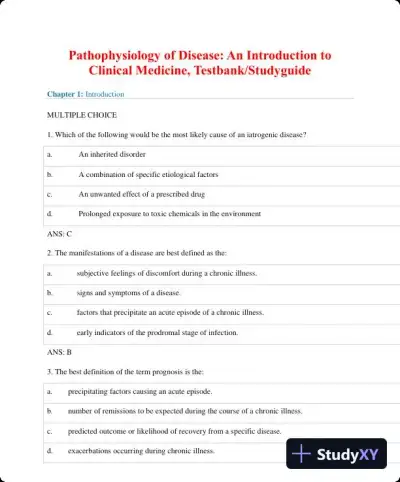 Exam Guides
Test Bank For Pathophysiology of Disease: An Introduction to Clinical Medicine, 8th Edition
Medicine
284 pages135downloadsFeb 2025
Study this document with CramX
Once it is in your library, every tool can work from it.